Britain’s Conservatives Back The Freedom To Marry

In the Sunday Telegraph yesterday, a group of Tory leaders in Britain reiterated their strong support for marriage for all:

The group, which unites under the slogan “Freedom to Marry”, contains some of the party’s biggest beasts, including Boris Johnson, the London Mayor, and Michael Gove, the Education Secretary. Patrick McLoughlin, the Transport Secretary, who is a Catholic, has also signed up.

Signatories share David Cameron’s view that churches should be allowed to conduct same-sex marriage ceremonies but should not be forced to do so if they do not wish to. In a letter to The Sunday Telegraph, announcing the formation of the group, 19 senior Tories declare: “Marriage should be open to all, regardless of sexuality. We recognise that civil partnerships were an important step forward in giving legal recognition to same sex couples. But civil partnerships are not marriages, which express a particular and universally understood commitment.”

Boris' backing, along with Cameron's clear and passionate commitment, is critical, it seems to me. There is some backlash on the Tory right, and the big danger is that the House of Lords – filled with what George Will called old people – could try and throw its weight around. But the arguments are clear. Even on the American right. And conservatism in its best incarnation is winning.

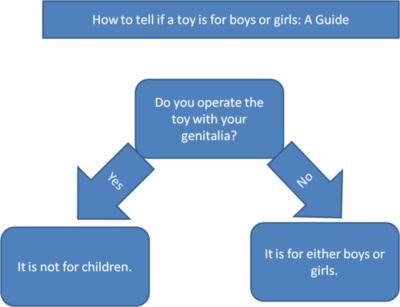
Toying Around With Gender, Ctd

20121206-171221

A reader writes:

The Swedish toy catalog is a silly example, I agree, and Sommers mentions it as an example of a certain attitude than anything else. But how do you respond to schools banning certain forms of play altogether, or banning toy trucks from classrooms because boys acribe them a higher status?  The point of the article isn't that these efforts will stop boys from being boys, but rather that their stereotypical "boy" behavior will be stigmatized – which is unfair and weird.  Much better to focus on removing the stigma from non-conforming children as opposed to placing a new stigma on conforming children.

Another:

The thought of your grandmother saying to your mom, "Well at least you have one normal son" just about broke my heart.  My son likes to wear his sisters' pink hand-me-down shirts and he's quiet and smart and sweet.  He is not what most people accept as a stereotypical boy.  He is who he is and he is wonderful.

(Illustration by Peter Harrison)

The Letter Of The Law

Kleiman objects to my characterization of marijuana law in Colorado and Washington:

Sullivan refers to people making money by growing and selling pot in violation of federal law as "law-abiding citizens." Many of them are in fact otherwise law-abiding. But the Controlled Substances Act law is still the law, even if you disagree with it.  And Sullivan certainly isn’t outraged that the federal government enforces, e.g., environmental laws or truth-in-lending laws, even in states whose own rules are looser; is someone who fills in a protected wetland without a federal permit in a state that requires no such permit "law-abiding"?  Only if each of us gets to pick his own laws.

Perhaps it is better stated that they are law-abiding in terms of their own state. Right now, I am a law-abiding married person in the state of New York. But the federal government regards my civil marriage as illegal. Should the feds actively arrest and enforce the federal law, i.e. DOMA, or let us be? You have to use discretion in prosecuting. Why not enforce those laws that apply both to states and the feds before pitting the two against each other in a shifting cultural climate? That's my point. Kleiman adds:

You can also read both essays through without ever learning that pot dependency is a real problem or that a large share of the current market involves sales to people with drug problems and to minors. Sullivan comes closest when he says that cannabis “is no more potentially damaging to a human being than alcohol,” which is a pretty low bar to have to clear.

Pot dependency is real but it is not a chemical addiction as with other Class I substances. And you can become dependent on a lot of things we do not find that problematic. Angry Birds dependency is real (tell me about it). Facebook dependency is real. Blog dependency is real (ditto). It doesn't mean, as Mark obviously agrees, that these dependencies should be illegal.

As to the "low bar" of alcohol – well, I didn't set that bar. The law does. And it is the bar, isn't it? It's the most common drug we market, consume and sell. If another substance does less harm to the individual and society than alcohol, it makes no sense to treat it differently. As for minors, I've long worried that the under-aged could hurt their mental development by using cannabis. We aired the arguments against pot use in The Cannabis Closet. The Dish hasn't shied away from these issues. There are trade-offs, to be sure. But I also believe that Prohibition makes pot more accessible to kids than a legal, regulated market would.

Will Readers Finally Pay For Content?

Newspaper ad revenue

Ryan Chittum makes the case for online subscriptions:

Digital subscriptions are an incremental source of revenue at a time when newspapers are bleeding to death and digital ads are bringing in four bucks a CPM. They won’t succeed everywhere, particularly at newspapers that have gutted their newsrooms, and they’re not enough on their own to assure we have robust news coverage. But it’s money on the table that newspapers can’t reject hoping for some nebulous future "free" innovation, which not one of 1,500 American newspapers has yet to find in some 17 years of the Web era.

He also makes a key distinction between a paywall and a meter, which allows a substantial amount of content to remain free and determined by individual readers: "a meter model preserves almost all traffic—and thus, ad revenue— by allowing casual readers to visit 10 or 20 times a month while charging core readers for access." Steve Buttry has more:

The alternative to paywalls is not reliance on CPM ads. As I replied to an anonymous CJR commenter claiming to be a Times staffer, I have blogged about plentiful new ideas for revenue that newspapers have not sufficiently tried yet. And others, such as Jeff Jarvis and Steve Outing have suggested plans such as a reverse meter or membership that I think have notably greater potential than paywalls.

News came out Friday that the WaPo is leaning toward a meter, to be begin some time next year. WaPo blogger Ezra Klein is a buzzkill:

I wish I was half as confident about the potential of paywalls as the evangelists over at the Columbia Journalism Review, but I’m not. I think paywalls might well prove a disaster for The Washington Post, and for many others. I don’t envy my bosses their jobs.

The Beast is also flirting with the meter idea. The Economist's take:

[I]t has also become clear that digital advertising dollars will never offset what newspapers are losing in print advertising—which is why papers want to be less dependent on ad revenue. Advertising, which is high-margin, has historically contributed around 80% of American newspapers’ revenues, far more than in most other countries. This is changing, mostly because advertising has slid so far. In the third quarter the New York Times earned more than 55% of its revenues from circulation, compared with only 29% in 2001. Newspaper bosses say they are moving their papers to a model where they get half their revenues from advertising and half from circulation.

Some parallels from history:

Gordon Borrell of Borrell Associates, a consultancy, thinks that newspapers are in a similar situation to radio in the 1950s. When television became popular, many advertisers fled, much as they did from print after the internet arrived. But within several years some returned to radio and ad revenues stabilised at a lower level [chart].

Hamilton Nolan offers a reality check, noting that "paywalls will work for content that is worth paying for" but also "the fact that readers like you is not enough to support an online paywall; readers must need you." And he believes many will never be able to adapt:

Examples of media outlets than cannot support paywalls: mediocre or shitty newspapers that have decimated their newsrooms, shitty magazines with little quality content, sites full of mostly opinions and listicles and other entertaining but easily reproduced things of that nature, most blogs.

But Nolan adds that new media are better positioned than legacy media:

For media outlets that grew up online, this dynamic should not be a huge problem. Those outlets have always supported themselves with online ad revenue; they grow in response to the money they make. The problem comes for media outlets that either A) matured in print form, and swelled to huge and bloated proportions, and then, when print collapsed, found themselves trying to somehow stuff that huge, bloated operation into a sleek online casing; or B) media outlets that were founded with a big pile of money from investors, and grew bloated on that, rather than on revenue they actually earned; and when that money dried up, they found that they had all these people they needed to pay, but no real revenue.

My take on Newsweek's tablet future here. Your takes here.

(Chart from Mark Perry)
Poseur Alert

Marxist pseud Slavoj Žižek and Fox News bloviator Bill O’Reilly have something in common – they really can’t stand that Gangnam Style:

For a glossary of the Dish’s award nominations – including the “Poseur Alert” – can be found here. We’re approaching the season when we nominate the finalists and you pick the winners.

DADT And DOMA Were Necessary For Progress?

A reader thinks so:

Let me begin by saying that I agree with you entirely in satisfaction over the repeal of DADT and in the hope that the Supreme Court finds DOMA unconstitutional.  But there's been a lot of talk recently about how these were both inherently terrible pieces of legislation and shouldn't have been passed in the first place, and I don't think that's an entirely fair assessment.

For example, DADT: before its passage, being gay in the military was illegal. Any gay Gradual-changemen or women serving in the military had committed a crime just by enlisting and faced court-martial and prison time (if not worse) upon coming out of the closet.  The passage of DADT didn't let those gay servicemembers out of the closet, but it greatly reduced the risks of falling out. This let gays and lesbians join the service in much larger numbers and made it safer for them to integrate into military society. If we'd gone directly from a state of total ban of homosexuals in the military to no restriction at all, there would have been massive disruptions – the kind of scare stories the Republicans were bandying about during this recent repeal – only real.  DADT, although imperfect, allowed the gradual development of a military culture that could accept full recognition of out gay and lesbian service members.

Similarly, DOMA played this role as mediator of the gay marriage issue. 

DOMA was originally passed in response to the supposition that Hawaii was going to legalize gay marriage, and with the law the way it stood at that time, this would have resulted in de facto federal gay marriage.  At the time, this turn of events would absolutely not have been acceptable to most Americans.  Not only would people have been upset over the reality of gay marriage, but they also would have resented having such a decision pushed upon them by just one state's voters.

DOMA did not disallow individual states from recognizing same-sex marriages; it just stopped those decisions from bleeding out into other states whose voters might not agree.  By doing this, it allowed those states to function as "laboratories of democracy" with regards to this issue. 

Today, federal recognition won't be the result of one small state forcing an unpopular policy on the rest of the country; it will result from at least 10 widely different states sharing a proven-as-good and generally accepted policy. Essentially what I'm saying is that both DOMA and DADT need to be repealed, but they are each a major factor in their own repeal.

There are two unproven points here. The first is that DADT greatly increased the number of gay people joining the military. I have seen absolutely no evidence for that.What I did see first hand at the time was that the rate at which gay people discharged from the military under DADT soared under president Clinton, whose record on gay equality was uniformly awful, although obviously pioneered by the Christianist right. DADT was the brutal backlash my reader argues it avoided.

The second matter of fact that is wrong here is that witout DOMA, civil marriage in one state automatically would require every other state in the country to recognize it. That was never true. It wasn't true during the long century of varying miscegenation laws. It was a phantasm cooked up by the right (and unfortunately propagated by some of the marriage equality pioneers) that was designed to provide an election wedge issue for the GOP in 1996. Neither DOMA nor DADT were necessary for full equality.

But what they unwittingly did, in the wake of the AIDS catastrophe, was re-focus the American mind on the question of homosexuality in a new way. By framing the issue as we did – against the full force of the gay rights establishment – we were able to create a dialogue that helped change how people saw homosexuals. From seeking protection and sexual freedom (both legitimate goals), we had painted ourselves into a corner. By instead demanding responsibility along with rights, we moved dramatically to the center. By embracing the conservative goals of responsibility, mutual care, and service to others which defined the marriage and military battles, we redefined the issue on terms that were both true (that is who we gays are, by and large) and much more politically persuasive. Yes this took time. And backlashes are inevitable. But I wouldn't go so far as to claim that DADT and DOMA were positive developments. Both were a function of cultural panic. Now we know just how misplaced that panic was.

(Illustration by Mike Rosulek)

A Super PAC Scam?

Ben Dimiero and Eric Hananoki put Dick Morris's Super PAC under the microscope. After reading their findings, Paul Waldman calls Morris – surprise – a "con artist":

Perhaps there's a more innocent explanation for all this, but the way it looks is that 1) People (should we call them "marks"?) donate money to Morris' super PAC; 2) he pays that money to Newsmax for "fundraising"; then 3) Newsmax turns around and pays the money back to Morris, for access to his list of donors. Perhaps Newsmax takes a cut, or perhaps the list is their cut, because these people can then become marks for all kinds of future scams.

He goes on:

Morris' super PAC is an organization whose entire purpose is to raise money, and its expenditures involve raising money and finding new donors. And not, say, getting Mitt Romney elected.

Kathryn Bigelow, Torture Apologist?

When the director of the magnificent movie, The Hurt Locker, decided to make a movie about the raid on Abottabad, the Republican right got twitchy. Would this be an Obama hagiography just before the election? Isn't that what Hollywood's about?

It turns out the opposite is the case. Bigelow constructs a movie upon a grotesque lie:

The film includes wrenching scenes of a terrorist suspect being waterboarded and subjected to other forms of torture by C.I.A. operatives; the suspect eventually surrenders information that helps lead to bin Laden. Bigelow maintains that everything in the film is based on first-hand accounts, but the waterboarding scene, which is likely to stir up controversy, appears to have strayed from real life. According to several official sources, including Dianne Feinstein, the head of the Senate Intelligence Committee, the identity of bin Laden’s courier, whose trail led the C.I.A. to the hideout in Pakistan, was not discovered through waterboarding. "It’s a movie, not a documentary," Boal said. "We’re trying to make the point that waterboarding and other harsh tactics were part of the C.I.A. program." Still, Bigelow said, "the film doesn’t have an agenda, and it doesn’t judge. I wanted a boots-on-the-ground experience."

I have not seen the movie yet, so I have to rely on descriptions of its plot. But if it portrays torture as integral to the killing of Osama bin Laden, it is a lie. If Bigelow is calling torture "harsh tactics" she is complicit in its defense. And lies do have an agenda, whatever Bigelow says. They pretend that the law allows torture, they violate the historical record, and they make war crimes more likely in the future. Yes, it makes for a more thrilling ride if we start with a torture scene in a movie drama. But actual torture, authorized illegally by war criminals, is not fiction and is far too grave a matter to be exploited as a plot device. It is illegal because it is evil and because it provides unreliable and often false leads, not real ones. Bigelow cannot argue that her movie has no agenda, or duck behind the excuse that this is a "movie" and not a "documentary". If it lies to promote the efficacy of torture, it has a very real agenda. And that is a defense of barbarism as entertainment, and as the law of the land.

Ask Moynihan Anything: Biggest Misconception Of Libertarianism?

From his Wiki page:

Michael C. Moynihan is an American journalist and managing editor of Vice magazine. Before that he was a senior editor of the libertarian magazine Reason. Moynihan founded the English language magazine based in Stockholm, Sweden, the Stockholm Spectator. After censorship by Comedy Central of an episode of South Park in 2010 that featured a depiction of the Prophet of Islam, Muhammad, Moynihan announced his support for the protest movement, “Everybody Draw Mohammed Day”. On July 30, 2012, a Moynihan article appeared in Tablet Magazine showing evidence that New Yorker writer Jonah Lehrer had fabricated Bob Dylan quotations, led to Lehrer’s resignation.

Read Michael’s writing for the Beast here. This past summer he wrote about libertarians at Right Turn:

Most of us libertarian types aren’t “money mad” or “greedy,” but believe that the private sector performs most functions better than government can, that lower taxes benefit not just our personal bottom lines, but the overall health of the economy and that free trade has helped more poor people than foreign aid ever did or ever will.

Will Obama Let Israel Hang Itself?

Beinart explains the White House’s thinking:

[I]nstead of confronting Netanyahu directly, Team Obama has hit upon a different strategy: stand back and let the rest of the world do the confronting. Once America stops trying to save Israel from the consequences of its actions, the logic goes, and once Israel feels the full brunt of its mounting international isolation, its leaders will be scared into changing course. “The tide of global opinion is moving [against Israel],” notes one senior administration official. And in that environment, America’s “standing back” is actually “doing something.”

America will still aid Israel militarily though, and continue to push back on the new Palestinian UN designation. However:

[U]nless events on the ground dramatically change, [America will not] appoint a big-name envoy (some have suggested Bill Clinton) to relaunch direct negotiations between Israel and the Palestinians. The reason: such negotiations would let Netanyahu off the hook. Senior administration officials believe the Israeli leader has no interest in the wrenching compromises necessary to birth a viable Palestinian state. Instead, they believe, he wants the façade of a peace process because it insulates him from international pressure. By refusing to make that charade possible, Obama officials believe, they are forcing Netanyahu to own his rejectionism, and letting an angry world take it from there.

I don’t blame the president. I do worry about Israel’s future if it cannot stop, reverse and destroy the settlements.