DeMint Exits, Stage Right, Ctd

89267337

A reader writes:

Why does it seem that there is rarely, if ever, any backlash against politicians who quit? Just recently Jesse Jackson Jr. and now Jim DeMint have called it quits, with Mr. Jackson running for reelection almost certainly knowing that, due to his health, he would resign once reelected. These individuals were elected by their constituents to serve a term of two or six years, in an election that costs taxpayers. Then they quit mid-term, forcing taxpayers to pay for special elections while they move on to cushier positions. And then an individual who wasn’t voted into office by his or her constituents is appointed by the governor. Something seems inherently wrong with all of this.

Yes, it does. Another:

Republican officials don’t believe in government. Influencing the direction of the country is best done via Fox News, K Street, or think tanks. Is there a precedent for this? Is it just the response of a minority party? Is it a response to Congress’ ineffectiveness, or is it a cause of it? I hope the DeMint retirement brings up these questions.

The GOP has long preferred politics to government, and they like their politics as entertainment. That’s why they’re the minority party – and wouldn’t control even the House without blatant gerrymandering. Maybe the exposure of cynics like Palin and DeMint may prod some reform. But the rot is so deep … and begins at Limbaugh and Fox News. The first Republican who takes them on will be the forger of the future.

(Photo: Alaska Governor Sarah Palin waves to the crowd while taking the stage before officially resigning during the annual Governor’s Picnic on July 26, 2009 at Pioneer Park in Fairbanks, Alaska. Sean Parnell was sworn in as the new Governor and Craig E. Campbell the new Lieutenant Governor. By Eric Engman/Getty Images)

America’s Fiscal Headwinds Are Getting Stronger

Suderman wants to go back to '90s-era spending levels:

[W]hy should we limit ourselves to just replicating one tiny fragment of Clinton-era governance—higher tax rates on a fairly small number of earners? Why not replicate other aspects of Clinton’s policy mix as well? Probably because that would entail mentioning something that Obama’s frequent invocations of the Clinton years always ignore: that Clinton’s spending levels were far, far lower than they have been for the last four years—or than President Obama has called for them to be in the years to come.

Ezra's answer to this kind of complaint:

Projected deficits are driven by two factors: health-care costs and old people.

The coming years will bring more of both. Today, the elderly make up 13 percent of the U.S. population. By 2050, they’re expected to be 20 percent. There’s no way that the tax receipts of the 1980s will support the demographics of the 2020s or 2030s. Anyone who says otherwise isn’t taking the numbers seriously, or is planning cuts to Social Security and Medicare that dwarf anything that has been openly discussed in Washington.

A “Knock On The Door” War

Gaza_Rubble

Eyal Weizman critiques Israel's use of low-explosive "teaser" bombs, which, during the Gaza conflict, were fired "onto houses designated for destruction, with the intention of making an impact serious enough to scare the inhabitants into fleeing their homes before they are destroyed completely":

The new procedure is a twist on the established ‘knock on the door’ method, which involved telephoning a house – with a recorded message, or using an Arabic-speaking air-force operator – to inform the inhabitants that in a few minutes the building would be destroyed. Sometimes phones that had been disconnected for months because the bill hadn’t been paid were suddenly reactivated in order to relay these warnings. According to the Israeli military, during the last 24 hours of Pillar of Defence, thousands of such calls were made to residents of Gaza, warning them of incoming strikes. 

The purposes of these warnings:

To communicate a warning can indeed save a life. But the strategy is also aimed at changing the legal designation of anyone who is killed. According to this interpretation of the law, if a warning has been issued, and not heeded, the victim is no longer a ‘non-combatant’ but a voluntary ‘human shield’.

(The sun sets over the rubble of a destroyed Palestinian police station in Gaza City on November 27, 2012. By Patrick Baz/AFP/Getty Images)

When Heroism Beckons

Below are our posts discussing subway heroism, including advice on how to survive such an incident as well several reader’s thoughts and experiences on both committing and benefiting from acts of sudden heroism in the subway and elsewhere.


Wed Dec 5, 2012 – 3.48pm:

When Heroism Beckons

“About ten years ago, I did jump down onto the tracks at the Penn Station IND to help lift a woman who had tripped, and was lying on her back looking shocked. Two other guys who did the same and I lifted her back onto the platform, and people reached out and pulled me and them up. I am surprised that no one helped this time. I am still disbelieving that I did that. Proud, but scared by the impulsiveness. When I watch how fast the trains come around the curve I can only shake my head in wonder that I, and they survived,” – PdM, Long Island.  (Hat tip: David Carr)


Thu Dec 6, 2012 – 2.22pm:

Jen Doll considers why “falling or being pushed into the subway tracks is one of the commonly held great fears of city living”:

Like a plane crash, when it does happen it is not a small event. It is often tragic and both physically and emotionally disruptive to not only the victim but also to the witnesses of the event and to the city at large. And when it ends as well as we could hope—no one dies—there are extreme reactions as well: We laud the subway heroes who thought, or didn’t think, but simply jumped, and succeeded. We wonder: Would we have done the same? What would we do if we were victim; what would we do, almost as horribly, if we were witness? Would we be a subway hero, or would we take the other course—run away, hide, shield our eyes, switch quickly to another train and get out of there as fast as we could? Would we stand and document; would we freeze? Would we try to help, and fail? And if we didn’t try, could we live with ourselves afterward?

In another post, Doll relays an MTA subway conductor’s advice on what to do if stranded on the tracks:

The best thing you can do is run as far down the platform as you can (in the opposite direction from where the train enters the station) and wave your arms frantically to get the train operator and passenger’s attention. Believe me, the passengers WILL be doing the exact same thing, as nobody wants to see you get run over and their train get delayed. If you can get to the far end of the platform, it gives the train more room to stop, and there is a ladder at the end of each platform where you can climb back up — do NOT try to climb up from where you are. So many people have been killed trying to jump back up rather than getting away from the entrance end of the station.

Brian Palmer’s advice:

After assessing your surroundings, you should consider four options. Obviously, the optimal choice is to get back onto the platform, often with the help of bystanders. Dramatic subway rescues are somewhat common. In 2009, for example, an off-Broadway actor rescued a stranded man by hoisting him back to safety. (The good Samaritan said his stage role at the time required him to lift and carry other actors.) If you can’t boost yourself up in time, look for a space beneath the platform edge. In some stations, particularly in Manhattan, there is enough room between the train and the platform to accommodate a person. If the platform appears flush with the approaching train, you could take shelter in the space between the two sets of train tracks. This is a dangerous choice, though, because you’d have to traverse the third rail, which carries 660 volts of electricity, more than enough to kill a person. A final option is to simply lie flat—there may be enough clearance for the train to pass over you. In 2007, when a seizure caused a man to fall onto the tracks, a Vietnam veteran saved his life by pinning him to the ground between the rails until the train passed. Both men sustained minor injuries.

A reader sends the above footage:

A couple years back a drunk woman fell on to the subway tracks in Boston, and the whole incident was caught on tape. With a train coming at full speed, the only thing bystanders could do was to wave and point in the path of the train, which stopped inches – inches! – short of the woman. The stumbling woman kicked – but was somehow not electrocuted – by the third rail, and was finally helped back on to the platform. No wonder no one jumped in front of a moving train.


Fri Dec 7, 2012 – 9.02am:

A reader shares his story:

I once jumped off the platform to help someone. It was about 15 years ago, give or take. Lower Manhattan 2 and 3 train; probably the Park Place station. An older woman lost her footing and fell down onto the tracks. There was the headlight of a train in the tunnel but it was quite far away and not at all an imminent threat. The platform was crowded with people. I jumped down immediately and so did one other guy. People on the platform closest to the train entrance waived their arms to signal the train driver, who very easily stopped before entering the station.

Half of the woman’s scalp was hanging off of her head; I flipped it back over so it was in place and covering the wound. She couldn’t get up, so the other guy and I told her just to lay there still and wait for more help. We waited with her; no one was very near the third rail. The police arrived fairly quickly and joined us on the tracks. I told a police officer about the woman’s scalp wound, since it was no longer clearly visible. The cop yelled, screamed, and swore at me, telling me essentially that he knew what he was doing and he didn’t any of need my help. He put his face right up to mine as he screamed and snarled in anger. That’s the part I remember the most – the thanks I got from the NYPD. (I’m happily living on the West Coast now.)

I certainly didn’t feel heroic; I just automatically tried to help. I don’t know what I would have done had the train been closer, but I’m sure that if it had been very close I couldn’t and wouldn’t have done much.


Fri Dec 7, 2012 – 3.20pm:

A reader writes:

Your subway “hero” thread is very interesting to me. Ten years ago or so I got a phone call from a very smart honorable friend. He was currently in graduate studies in political theory at Harvard with plans to enter government and politics. He told me that he was walking down the street and saw two or three men bullying/harassing a smaller man. He crossed the street to avoid the incident, worried that maybe one of the harassers had a weapon.

The reason for his call was shame. He thought how could he possibly have a role in government if he couldn’t put himself at risk to help an endangered citizen. He dropped out of Harvard that week and joined the Marines. He is now a firefighter.

That call and decision were powerful to me and the timing was fateful. That same week I was working as a waiter in NYC. I was on my way home at 2:30 am waiting on the subway. A man about 100 feet away passed out and fell onto the tracks.

There were maybe seven people on the platform. I started running down the platform passing people just standing worried and confused. I jumped down onto the tracks and found I couldn’t lift the unconscious man alone. The people on the platform saw this but nobody moved. Finally, I pointed to one man and said, “Get down here and help me lift him,” and then to another man, “stand closer and help us get him on the platform.” They both immediately reacted and did what I asked. We lifted the unconscious man onto the platform. I then ran upstairs to the booth to get the MTA attendant to call for police and ambulance (which today, there probably wouldn’t be an actual person there) .When I came back down, the train had arrived and had a group gathered around the man. I didn’t know what to do at that point and didn’t want to make a fuss, so I just got on the train. 

If I just hadn’t had a philosophical discussion on responsibility and citizenship (not heroism), would I have done anything? Would I have also told another citizen to jump down and endanger himself to help the unconscious man? I don’t know. Was I disappointed there was nothing in the newspaper the next day about a mysterious hero who saved a man and disappeared without taking credit, yes.


Mon Dec 10, 2012:

A reader writes:

Regarding the reader who had to order a person down into the subway tracks, I have found that the vast majority of people do absolutely nothing in situations like these and it is only a very few that will react to save or help someone. My story:

My partner and I were frolicking in the waves at Santa Cruz beach just off the Boardwalk. We are both good swimmers, but seriously out of shape. There is a river that empties out into the ocean at the beach, and there were some people in it, but we were the only people in the ocean itself.

All of a sudden there was a young boy’s head past us in the surf. While my brain was trying to figure out the logistics of how exactly he got there, it also registered the look of panic on his face. Simultaneously without saying a word, both my partner and I dove and swam out to him as fast as we could. My partner reached the boy first and held him up out of the water, but he could not swim to shore with him. I reached them and held my partner’s hand, but could not swim and pull them to shore either, as the receding current was too strong. So I swam around behind them and repeatedly pushed them towards shore.

During this long process of pushing, swimming back up to them and pushing again, I was facing the beach and saw the boy’s mother on the shore screaming in absolute hysterics. She was utterly alone in a beach full of people – none of them were doing anything about the situation.

We all managed to get on dry land safely and my partner and I went to rest. After a bit, we went over to the mother, who thanked us. They were from the interior of the state and the boy did not know how to swim, and the current in that river was abnormally strong that day.

About five minutes later the lifeguard drove up.

My partner was furious that nobody else did anything and it scared him that if we weren’t there when and where we were, that boy would probably have drowned. This incident affected him so much that he still refuses to go swimming in the ocean, lest something like this happens again.


Mon Dec 17, 2012 – 2.00pm:

A reader writes:

I had mostly been ignoring this thread, but the previous post got me. I am in the unfortunately position of having survived a drowning incident while one of the people who came to rescue me didn’t make it. In this case it wasn’t a stranger, but a friend of mine. I was 14 and leading a group of friends across a river in Northern California. I got stuck in a current draining a pool and reached out my hand to my friends for help. I really don’t think they understood the danger at all, but did the natural thing trying to help their friend. Three of them got pulled in also. One got pulled under and emerged in the next pool okay. One’s head I was able to hold above water until a stranger did come and help us and pulled her out. And a third got stuck up against a log under the water.

Luckily I have never felt guilt for the death of my friend. Because I know it was just something that happened and I would have done the same for her. I have no idea if I would feel differently had it been a stranger who died trying to help me.

The stranger in this case was unable to help me out. My head was above water, but I was stuck. After the second friend was saved (at this point I didn’t know about the others), I just gave up fighting. I didn’t know what was going to happen, but I just let go of caring. And then I had this amazing experience. From somewhere I got this burst of energy and determination and I was able to climb up the side of a rock face. To this day I don’t know if it was internal, some other power, or if it came from my friend dying beside me – whether in fact her last act was to save me. 

After I was out, I saw the first friend crying hysterically downstream and learned that the third friend was stuck under the water. Both the stranger and I went around to try to get her out. I could see her and put my hands on her body, but could not dislodge her. The (slightly drunk) stranger at this point started praying for God’s help. To which my 14-year-old self responded by cussing at him that God wasn’t going to help us; he had better do something. But there was nothing to be done. It took the fire department to get her body out.

It has been 18 years, and sometimes I wonder about that stranger and feel bad that I never did thank him. I doubt he reads your blog, but for the first time publicly, “You did the best you could in the situation and we were lucky that you were there. Sorry I unloaded on you. Thanks.”


When Liberal Policies Keep Women From The Top

Kay Hymowitz points to Sweden:

[T]he very family policies that make it easier for women to combine work and family discourage them from pursuing career Olympus. In a paper called "Is There a Glass Ceiling in Sweden?," James Albrecht and colleagues speculate that the country’s maternal benefits are so generous that they "may discourage strong career commitment" by women.

The paper also points out that Sweden’s liberal wage policies, elevating incomes at the bottom of society, make it prohibitively expensive for many ambitious mothers—and mothers still do most of the child care, even in Sweden—to hire outside help during hours when day-care centers are closed. In many countries, including the United States, professional-class dual-income families have become dependent on cheap immigrant labor to mind the kids and clean the house; researchers Patricia Cortés and José Tessada trace the increase in the work hours of highly educated American women to the 1990s, when immigration pushed down the cost of household services. The Swedish welfare state may reduce income inequality, but one consequence may be fewer women at the top.

SCOTUS Takes On Marriage Equality: Reax

Washington_Marriage_GT

Richard Socarides puts into context SCOTUS’s decision to hear both the DOMA and Prop 8 cases:

Those who follow these matters closely had almost uniformly predicted that the Court would take on the DOMA issue. That it seems to have embraced the Proposition 8 case as well is surprising. That suit was brought by the super-lawyers Ted Olson and David Boies, who argue that the federal Constitution guarantees a right to same-sex marriage, which would be applicable in all fifty states were the Court to adopt the broadest of their arguments.

Under Chief Justice John Roberts, the Court has often tried to avoid cases and decisions with these kinds of broad impacts, and in this instance, there were procedural grounds that presented the Court with easy outs, should the Justices have wanted to take them. Had they done so, and let the latest decision regarding the suit stand, they would have made same-sex marriage legal in California, but nowhere else—and, considering that it is already permitted in nine states and the District of Columbia, this might not have been such an unacceptable outcome even for the staunchest of gay marriage’s opponents. Instead, there seems to be support for a decision on the merits of the big issue of the day.

Rod Dreher, an opponent of marriage equality, bets that his side will lose:

I predict that gay marriage will be a constitutional right by this time next year.

What Ambinder is hearing:

Court watchers I’ve corresponded with believe that the likeliest outcome, given the justices’ individual histories on similar questions, would be a decision that strikes down the federal recognition prong of DOMA while also ruling there is no constitutional right to get married. This result would mean that married gay couples would be eligible for federal benefits but that gays could only get married in states where such unions were legal.

But Jason Mazzone thinks that the federalist argument against DOMA has its weaknesses:

One approach would say that section 3 actually has no impact on state power. States are perfectly free to recognize marriages between two men and two women and states are free to give out state marriage benefits in accordance with state definitions. Section 3 is merely about federal law and federal governmental benefits. It is understandable why New York, Massachusetts and other states where same-sex marriage is lawful would want all of their married couples to receive the same federal benefits. But state power to define marriage is not undermined just because the federal government follows a standard, for federal purposes, that does not track that of particular states.

Scott Lemieux’s read on the justices:

Tentatively, I would guess that the most likely outcome of the California case is that Prop. 8 will be struck down with a narrow opinion very similar to Kennedy’s opinion in Romer v. Evans. I would not be surprised, however, by either a blockbuster opinion making same-sex marriage legal in all 50 states, and I would also not be surprised if Prop. 8 is upheld. The oral argument will be fascinating and the outcome as suspenseful as this year’s ruling upholding the Affordable Care Act. If DOMA were to upheld, conversely, this would be a major surprise and a bitter defeat for social justice.

Some marriage equality supporters are unhappy that SCOTUS took both cases:

“I’m not thrilled,” said Katherine Franke, a professor of law at Columbia Law School, where she directs the center for Gender and Sexuality. “I would have preferred they took the Windsor case alone.” Windsor’s case, Franke explained, asks the court a relatively narrow question: whether the federal government can override states’ decisions about same-sex marriage laws. The argument against Prop 8, on the other hand, centers around whether people have a fundamental, constitutional right to marriage. Franke, like many other activists, has worried that it is too soon for the Supreme Court to deal with such a broad reaching question when the public opposition to same-sex marriage in the South and parts of the Midwest is still strong.

Stephen Miller has similar concerns:

[W]hile the court might now uphold Prop 8 and deny Californians marriage equality, there is at least the possibility that the court, through its Prop 8 decision, could declare that all states must allow same-sex marriage as a matter of equal protection under the law. Would that provoke a backlash that could strengthen the anti-gay contingent of the GOP? Probably. There is a sound argument that it would be better in the long run to let marriage equality advance through the states. There is also an argument that equal means equal.

Linda Hirshman also considers the risks:

Justice Kennedy has delivered an almost unbroken series of conservative votes in the last several years, swinging almost not at all between the factions. It pays to remember that even after a series of cautious moves led to victory, when the women’s movement asked for inclusion of pregnancy in disability benefits – they lost decisively. The closest case to the Boies-Olson litigation in the women’s movement – Roe v. Wade — triggered a four decade backlash. Once before the gay movement overplayed its hand ever so slightly with the Court and got a terrible decision upholding the criminal sodomy laws. Gays almost won the first sodomy case; the decision in Bowers v. Hardwick was only 5-4, so it was hardly a foolhardy risk. And yet, it does make you shiver.

And Jonathan Bernstein looks beyond the current court cases:

If the court strikes down DOMA, but narrowly, Republicans could try to pass a new version. If it doesn’t strike down DOMA, Dems will likely try to repeal it. And if the decision winds up promising future court fights, then gay and lesbian issues may move to higher importance in battles over the next set of judicial nominations. At the very least the Court will probably determine the nature of this ongoing battle going forward.

Earlier Dish on SCOTUS’s decision here, here and here.

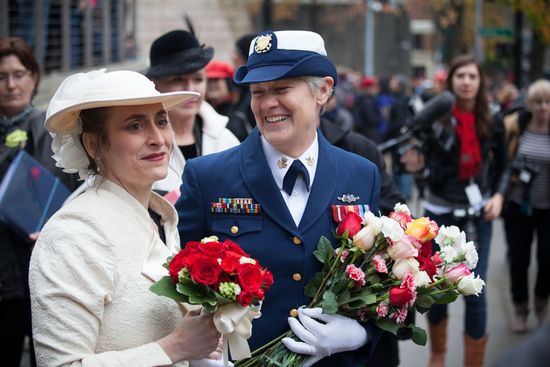
(Photo: Nancy Monahan, right, a retired Coast Guard petty officer, shares a laugh with her wife, Deb Needham, after their wedding at City Hall on December 9, 2012 in Seattle, Washington. By David Ryder/Getty Images)

The Six-Year Itch

Using history as a guide, Charlie Cook argues that the 2014 election will be bad for Democrats:

The 2014 vote is what’s known as a "six-year itch" election, with the party holding the White House usually losing a substantial number of House and Senate seats in the sixth year of its tenure. There are a variety of reasons, but at that midway point in a party’s second four years in the White House, the "in" party tends to lose energy and focus. Party leaders run out of ideas, and the "first team" in terms of personnel—the people who were there when the president took office—have often bailed out, and the second or third team is sometimes not as good. Voters tend to grow weary and to look for something different.

In the six "six-year itch" elections since World War II, the party in the White House has averaged a 29-seat loss in the House and a six-seat (actually 5.6) loss in the Senate. 

The Weekend Wrap

6a00d83451c45669e2017ee6196135970d-800wi

This weekend on the Dish, Andrew riffed on SCOTUS and gay marriage while nominating George Will for an Yglesias Award, meditated on Christianity and death, told the GOP to read John Stuart Mill, and noted a charming anecdote about jazz legend Dave Brubeck.

In matters of faith, doubt, and philosophy, Nick Olson deciphered the religious meaning of The Life of Pi, Morgan Meis learned from St. Francis of Assisi, Patrick Jarenwattananon covered the religious side of Dave Brubeck, Mary Karr told us how she prays, the LDS launched a new website about being gay and Mormon, and Nick Cave turned to the Bible for great love songs. Costica Bradatan argued that philosophy is a way of life, Susan Jacoby profiled the 19th century secularist Robert Green Ingersoll, Thomas Beller considered photography and memory, Edward Shorter highlighted the difficulty in diagnosing personality disorders, and Robin Hemley asked about the persistence of curses.

In literary coverage, Zoë Heller eviscerated Salmon Rushdie's new memoir, Lydia Kiesling reviewed Kurk Vonnegut's letters, Ben Zimmer detailed how the Oxford English Dictionary helped Tony Kushnerwrite Lincoln, and Tina Rosenberg recounted the true story of British spy novelist Dennis Wheatley. Helen Vendler worried that Ive League admissions systematically exclude artists and writers, Henri Cole pondered the relationship between selfishness and writing, Silas House revealed his writing habits, and Faith Barrett described poetry's role in the Civil War. Read Saturday's poem here and Sunday's here

In assorted news and views, Ricardo Cortés discussed the secret history off coffee and coca, Rachel White reported on the rise of red state surrogate mothers who carry children for gay couples, Emma Marris explained the uptick in liberal urban hunters, Debbie Nathan explored the nudist origins of the ACLU's defense of sex acts, and John Davis taught pot entrepreneur's about banking. Alyssa Rosenberg found the truth in a viral video about gender roles, Maria Popova praised John Homans' new book about dogs, G. Murphy Donovan held that proper meals hold civilization together, and James Flynn dissected how retirement might impact IQ. Check out another Bill McKibben "Ask Anything" video here, MHBs here and here, FOTDs here and here, VFYWs here and here, and the latest window contest here.

– M.S.

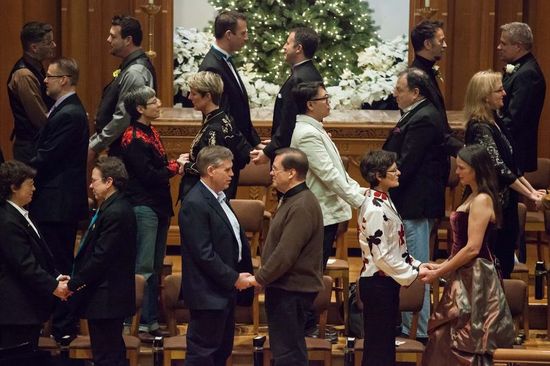
(Photo: Couples exchange vows during a mass wedding for 25 same-sex partners at Seattle First Baptist Church on December 9, 2012 in Seattle, Washington. Today is the first day that same-sex couples can legally wed in Washington state. By David Ryder/Getty Images.)

Letters From Millennial Voters

A reader writes:

A previous reader said, “So keep fighting for those issues, but just remember, Millennials: you aren’t that special.”  Oh really? That’s not what our boomer parents told us growing up.

Another:

I am shocked at the hatred towards millennial voters that I see in this thread and everyday life. To be brief, we have quietly fought two wars, inherited the greatest national debt in history, a climate on the verge of collapse, and a federal government concerned with programs that benefit boomers but no one else.  So to all the readers mad that millennials are talking about ourselves, sorry for once that we are not talking about the problems you created and so selflessly left to us.

Another:

Proud millennial here – 1983. You wanna know why millennials rule? Because while being self-congratulatory we are also incredibly self-aware as to how much we suck as a generation and how lucky we are. But you know what? I don’t see other generations calling out themselves on the stupid shit they did. The “Greatest Generation” fought for freedom abroad and then got home and quickly told Jews and black people that they didn’t want them in their new suburban town or their golf clubs. The boomers fought for free love, drug use and a peaceful world and then forgot their whole worldview as soon as the 1980s came around. I guess tax cuts and “Just Say No!” can change the world? Give me a break.

More generational antagonism after the jump:

I’m a female Millennial, born in 1984, and was a senior in highschool on 9/11.  Today I’m a married professional in one of America’s most liberal cities.  I’m a Democrat, a social liberal, but consider myself to be a fiscal conservative in the “don’t pay for shit you can’t afford” sense.

Assuming the Republican party becomes more libertarian in its social platform, I think there’s a chance it can recover if it gets serious about being the party of “fiscal responsibility.”  You know why? Because right now the Boomers and older generations of both parties have no problem royally screwing America’s younger generations.  We’re being simultaneously saddled with the irresponsible debt of our parents and grandparents (thanks Iraq/Afghanistan wars, Medicare Part D, and Bush tax cuts! – all President Bush, but had bi-partisan support) and bearing the brunt of the boomer-created financial melt-down (trying to buy your first home? Good luck affording or qualifying for a mortgage!) and cuts to social services, education, and investment in the future.

Some people might say this is a Republican problem only because, well, they caused the deficits and meltdown! But the Democrats’ reluctance to cut social programs and preserve its own interest groups also hurts Millennials. Who’s going to suggest that we get rid of Medicare D? No one. Democrats are the ones too cozy with teachers and other unions that reward tenure (and therefore benefit older workers) rather than merit, which would result in higher salaries for younger workers who deserved them. 

In short, both parties seem just fine spending boat loads of money on the old at the expense of the young.  Not only is it bad for my generation because, duh, government spending being a zero-sum game we’d prefer the money was spent on us.  It’s also bad for the future progress of the nation if we don’t invest in the future.  We are the future, we know it, and we get pissed when we see our selfish Boomer parents clinging to their mortgage-interest deduction for their vacation home while crippling our chances for future success.  

I think there would be a real appetite among Millennials for substantial tax and entitlement reform.  I can’t be the only one who thinks it’s grossly unfair to make my generation pay for the unpaid-for excesses our parents and grandparents.  Yes, entitlement and tax reform means that some people will be worse off.  But unless we do something to raise revenues and make cuts to programs my generation – and future generations – will be in an even worse position.

To your Boomers readers I say: Stop thinking about yourselves for a change. It’s about time you paid your bills and made an attempt to leave this country in at least as good of shape as you enjoyed it.

To read all the millennial letters, go here.

Capturing The Clothes We Consume

Screen shot 2012-12-05 at 11.39.08 AM

For his series "Baled," Wesley Law photographed bundled items at Goodwill liquidation centers:

It took him nine months. And when he finally got access, he found an awesome panorama — thousands of items leftover from Goodwill stores around the country, crammed together in bales as large as 5 feet tall by 7 feet wide, awaiting transport to new destinations. Initially, Law thought he'd shoot the scene as a landscape, to capture the size and scope of the facility and its contents. But on a second visit, he started considering the bales individually. "I realized when I got close to these things that they each have their own personality. They have their own identity," he says.

From Law's artist statement:

We are not forced to live among our refuse, knowing the immediacy of its decline, unaware of the process it undergoes. Our waste is conveniently carted off by mainly unseen forces. The average American discards 4.34 pounds of garbage each day. The majority of which ends up in a landfill or gets shipped overseas. Almost 200 million pounds of donated clothing was sold in 2011 by one non-profit in particular. The vast unknown quantities not sold were baled and sent away.

(Image by Wesley Law. Check out his Kickstarter here.)