A Fourth-Dimensional To-Do List

Scott Adams wants one for his smart phone:

The biggest problem with a list, especially once it gets to a dozen items or more, is that a list is one-dimensional. Ideally, I want my list sometimes organized by priority, but other times by location. For example, my to-do list app should sense my speed and motion and sort to the top of the list any tasks that involve phone calls, under the theory that I'm probably driving my car and I can make some calls on the way.

Other times I want my to-do list sorted by location. If I'm driving past the store, the items I need from the store should sort to the top of the list automatically. That function already exists in at least one "notes" app I've seen. At other times I want my list to have the simplest and quickest items on top because I might have a spare five minutes and want to knock off a few items.

Yglesias Award Nominee

158035124

“There is something like an emerging consensus. Quite literally, the opposition to gay marriage is dying. It’s old people,” – George F. Will.

I am worried about two things. I'm worried that we will fail, and I'm worried that we will succeed. It may be that SCOTUS will decide not to decide on the Big Issue, but will decide that California's marriages can continue and that the federal government should simply recognize the legal marriages states provide for the married couples who live in that state. To my mind, that smaller decision would be a relief. Why? Because I do not want a gay Roe vs Wade, a decision that appears to foist a premature answer on a still-not-entirely-convinced public.

And then I listen to the arguments I have long made coming back at me. And my prudence and federalism take a back-seat to the moral clarity of our cause. As human beings and citizens, as Hannah Arendt once put it,

"The right to marry whoever one wishes is an elementary human right compared to which ‘the right to attend an integrated school, the right to sit where one pleases on a bus, the right to go into any hotel or recreation area or place of amusement, regardless of one’s skin or color or race’ are minor indeed. Even political rights, like the right to vote, and nearly all other rights enumerated in the Constitution, are secondary to the inalienable human rights to 'life, liberty and the pursuit of happiness' proclaimed in the Declaration of Independence; and to this category the right to home and marriage unquestionably belongs."

Are we not human? Do we not need love and commitment and intimacy and family as much as any other human does? Are we citizens equal to our siblings and parents? Of course we are. And the reason to believe this would not be like Roe vs Wade is that the issue is of less moral gravity (it does not involve life and death), and, unlike abortion, where public opinion has remained pretty stable over the years and the generations, this reform has gained support very quickly and becomes more entrenched with every generation that arrives. So George Will is right.

And the arc of history may be getting shorter.

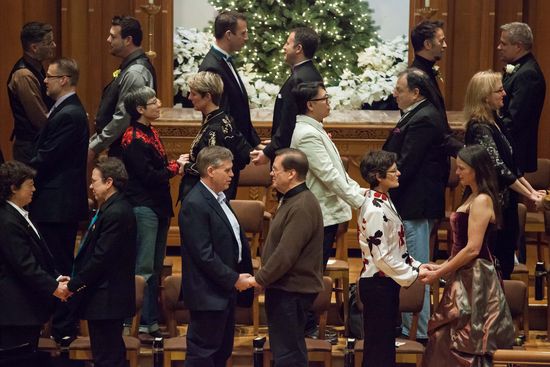
(Photo: Couples exchange vows during a mass wedding for 25 same-sex partners at Seattle First Baptist Church on December 9, 2012 in Seattle, Washington. Today is the first day that same-sex couples can legally wed in Washington state. By David Ryder/Getty Images.)


The Trouble With Legends

You sometimes have to live up to them:

Local pianist Chris Grasso said Brubeck was the first jazz pianist he ever saw perform live, at the Newport Jazz Festival in the late ’70s. A couple of years ago, Grasso said he actually had the daunting task of following Brubeck’s performance at the Litchfield Jazz Festival in 2010. “We were supposed to open for Mr. Brubeck, but he decided he didn’t want to stay up so late, so he went on first and then we closed the show,” Grasso said in an email. “So I had to go on right after him, playing piano — terrifying.”

Now, after that essay from Mr Orwell, over to you, Mr Blogger.

Quote For The Day (For The GOP)

Lostelephant

"It is hardly possible to overstate the value, in the present low state of human improvement, of placing human beings in contact with persons dissimilar to themselves, and with modes of thought and action dissimilar to themselves, and with modes of thought and action unlike those with which they are familiar … Such communication has always been, and is particularly in the present age, one of the primary sources of progress," – John Stuart Mill, The Principles of Political Economy (1848).

(Photo: Getty Images.)

Re-Enchanting The World


Nick Olson deciphers the religious meaning of The Life of Pi:

Interestingly, in an interview with PBS,  [author Yann] Martel says that he wrote his novel during a time when he felt lost: “I was sort of looking for a story, not only with a small ‘s’ but sort of with a capital ‘S’ — something that would direct my life.” Martel’s existential plight seems to have been Pi’s shipwrecked plight: lonely and directionless. Having “faith” in this particular context has a less specific range; its content is the simple belief that our lives — suffering included — are filled with meaning, purpose, and wonder. Which is to say, in Life of Pi, the religious and literary imaginations merely function as signals of the truth of significance itself, a “better Story” compared to a disenchanted, cold rationalism because there is more to humanity and existence than meets the eye.

A Student And Instructor Of Nature

Little Flowers of St. Francis, compiled in the 14th century, tells the tale of Gubbio, a small town being terrorized by a wolf. They ask Saint Francis of Assisi for help and he cuts a deal with the wolf, promising food from the town in exchange for an end to the attacks. Morgan Meis draws a larger lesson:

The story is a trite bit of saintly hagiography at first glance. But there is something more. Human beings were trying to work out a problem through this tale of Saint Francis and the wolf. It is Saint Francis, after all, who proposed that we all live as birds. Mirroring something that Christ is supposed to have said to his disciples, Francis told his little friars to trust in providence, as do the birds. The birds don't worry about where they will get their next meal, Francis said. They don't fret and stress and cause strife, they neither sow nor reap. And yet, nature provides for the birds, God provides for the birds. All of us, Francis suggests, can live more like the birds.

That's all well enough, the more skeptically inclined among us might say, but what about the wolves? If providence really provides, then what do we do about the wolves? At the heart of this worry is the deepest question of all. Are we being cared for?

There is no unambiguous answer to this question. But the story of Saint Francis and the wolf makes an interesting proposal. It proposes that man cannot have a simple relationship with nature. Sometimes we must learn, sometimes we must teach. There is something to be learned from the birds. From the birds we learn to trust in powers that are beyond us. We don't make things grow. The bounty of nature is given to us. This is something the birds know and that they can pass on to us. And we can pass it on as well. Human beings can have an influence on wolves. This is factually true. It is possible to tame wolves. It is also possible to kill wolves. But in Francis' vision the taming makes more sense.

A Poem For Sunday

Snow

“Karma” by Edwin Arlington Robinson:

Christmas was in the air and all was well
With him, but for a few confusing flaws
In divers of God’s images. Because
A friend of his would neither buy nor sell,
Was he to answer for the axe that fell?
He pondered; and the reason for it was,
Partly, a slowly freezing Santa Claus
Upon the corner, with his beard and bell.

Acknowledging an improvident surprise,
He magnified a fancy that he wished
The friend whom he had wrecked were here again.
Not sure of that, he found a compromise;
And from the fullness of  his heart he fished
A dime for Jesus who had died for men.

(From Dionysus in Doubt: Poems by Edwin Arlington Robinson. New York, Macmillan, 1925. Photo by Flickr user JoshSemans)

The Bright Tax

James Flynn explains how retirement might impact IQ:

The wisdom always was that the brighter you were, the less your mental abilities declined in old age. I found that was an oversimplification. It is true of verbal intelligence. The brighter you are, the more you get a bonus for verbal skills. I call that a “bright bonus.” Your vocabulary declines at a much less steep rate in old age than an ordinary or below average person. But to my amazement I found that for analytic abilities it was just the reverse. There is a “bright tax.” The brighter you are, the quicker after the age of 65 you have a downward curve for your analytic abilities. For a bright person, you go downhill faster than an average person.

This raises an interesting question. Is it something to do with the aging brain, or does it have to do with environment? It could be that a good analytic brain is like a high performance sports car; it just requires more maintenance, and in old age, the body can’t give it. That would be a physiological explanation; the bright brain requires sustenance from the body, which as the body ages is no longer forthcoming. The environmental explanation would be that we use our analytic abilities mainly at work. That means that if a bright person is in a cognitively demanding profession, they are like an athlete; they build up a big exercise advantage over the average person, who has a humdrum job. Then, retirement would be a leveler. That is, if you give up work at 65, you are like an athlete who is retired from competition. You no longer have that exercise advantage of your analytic abilities that work affords. We don’t really know which of these things is true. It could be that they are both true to some degree.

Life, Death, And Christianity

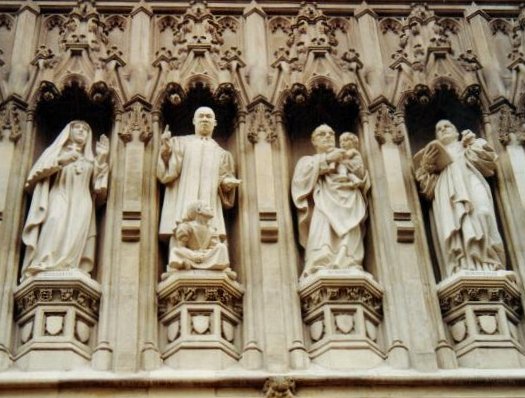
Westminster_Abbey_C20th_martyrs

"The cross is laid on every Christian. The first Christ-suffering which every man must experience is the call to abandon the attachments of this world. It is that dying of the old man which is the result of his encounter with Christ. As we embark upon discipleship we surrender ourselves to Christ in union with His death—we give over our lives to death.

Thus it begins; the cross is not the terrible end to an otherwise god-fearing and happy life, but it meets us at the beginning of our communion with Christ. When Christ calls a man, He bids him come and die. It may be a death like that of the first disciples who had to leave home and work to follow Him, or it may be a death like Luther’s, who had to leave the monastery and go out into the world. But it is the same death every time—death in Jesus Christ, the death of the old man at his call," – Dietrich Bonhoeffer. For more on this remarkable martyr, see here.

I sometimes think of this actual Christian perspective – "we give our lives over to death" – when confronted with the Vatican's new fanaticism for physical life, perpetuated by Popes John Paul II and Benedict XVI. How is keeping someone in a persistent vegetative state for years compatible with Bonhoeffer's worldview?

How is clinging by extraordinary means to life at all costs not actually anti-Christian?

(Photo: Westminster Abbey, West Door, Four of the ten 20th Century- Mother Elizabeth of Russia, Rev. Martin Luther King, Jr., Archbishop Oscar Romero, and Pastor Dietrich Bonhoeffer. By T Taylor, via Wiki.)

Sounding Like 1865

Ben Zimmer details how the Oxford English Dictionary helped Tony Kushner, who wrote the screenplay for Lincoln, master the language of 19th century America:

One key to making the language historically suitable, he told me, was having the 20-volume print edition of the Oxford English Dictionary close at hand. A complete set of the OED—which includes deep histories of all its entry words, with examples—was one of his first purchases when he started earning money from his 1993 Pulitzer Prize-winning Broadway play, “Angels in America,” Kushner said. Through the many drafts of “Lincoln,” he checked every word that he thought might not have been appropriate for 1865.

Occasionally, browsing through the volumes led to serendipitous discoveries. Looking for a word for a White House party occurring early in the film, Kushner initially thought of shivaree, an American take on the French charivari. He was disappointed to learn that shivaree specifically referred to a wedding celebration. But then his eye landed on a nearby entry: shindy, just after the similar shindig. That word for a merry gathering fit the bill nicely.

The blog Languagehat, however, caught some linguistic mistakes in the film:

Lincoln pronounced the last word in the phrase "forever and aye" as /ay/ (as in "Aye aye, sir!") rather than the correct /ey/ (as in "A, B, C"). This is not a matter of dialect or idiolect; in the nineteenth century anyone who used the word would have said it in the only available way (which they would have heard in speeches and sermons, not learned from books). To quote the OED (in an unrevised entry from 1885): "The word rhymes, in the literary speech, and in all the dialects, with the group bay, day, gay, hay, may, way." The second was when Lincoln is telling his (truly hilarious) story about Ethan Allen going to England after the Revolution and being insulted; when he asks where the privy is located, Lincoln talks about his being directed "thence" when the appropriate word is "thither." Again, these are words to which dwellers of the twenty-first century are unaccustomed but that no one of Lincoln's day would have confused.