“He Really Means It”

McConnellProvision

There are two red lines for the president, it appears, on the fiscal cliff. The first is that the top tax rate has to go up. The second is that the debt ceiling be taken off the table as a political weapon:

During a Wednesday morning meeting with business leaders, Obama was blunt: “I want to send a very clear message to people here. We are not going to play that game next year. If Congress in any way suggests that they’re going to tie negotiations to debt ceiling votes and take us to the brink of default once again as part of a budget negotiation, which, by the way, we have never done in our history until we did it last year, I will not play that game.”

And Obama and Geithner are citing what they have called “The McConnell Provision” after it was proposed by the Republican Senate Minority Leader in 2011. See the chart above and the Treasury post here. Obama and Geithner are acting as if they were Republicans who had just gotten re-elected. They are acting as if they have a mandate to roll back the extremism of the GOP, and prevent it from threatening another self-induced credit crisis. Imagine that.

Obama’s Empathy

Criticizing how conservatives have made judicial "empathy" a code word for "activist judges," Thomas B. Colby rehabilitates (pdf) Obama's praise of the concept:

Empathy is not compassion for the oppressed, or for anyone else, for that matter. Nor is it the capacity to feel the emotions of only the downtrodden. It is, rather, the capacity to understand the perspective and feel the emotions of others—all others. President Obama has reiterated many times that he understands the "basic idea of empathy" to be exactly that: the ability to "imagine standing in [others’] shoes, imagine looking through their eyes." A judge who exercises the ability to empathize will surely do so with the poor, the weak, and the little guy. But she will also empathize with the rich, the powerful, and the big guy…. 

President Obama’s point is not that judges should ignore law in favor of sympathy, but rather that the ability to render justice necessitates not only an ability to grapple with complex legal theories and dense technical footnotes, but also an ability to "understand and identify with people’s"—all people’s— "hopes and struggles."

Marriage Equality Update

A key case in Mexico where a state sued to be able not to recognize a same-sex marriage conducted in Mexico City (where such marriages are legal) has reached its conclusion:

The Supreme Court of Mexico issued a unanimous ruling Wednesday afternoon that paves the way to universal marriage rights in the country. … The court ruled on behalf of three same-sex couple seeking to marry in the southern state of Oaxaca. The court had already ruled in 2010 that gay marriages performed under a Mexico City ordinance had to be recognized nationwide. With this precedent, the remaining bans on gay marriage in most Mexican states could quickly fall. …

Rex Wockner emails:

Uruguay's Chamber of Deputies will vote on a same-sex marriage bill Dec. 11. Leading activists say the bill will pass with lots of votes to spare. Fifty yes votes are needed; more than 60 are expected. The bill will then move to the Senate for a vote early next year. Senators are believed to be even more enthusiastic about the bill, and it is expected to pass by even a larger margin.

Uruguay is great – but Mexico's shift is even greater. Both of America's geographic neighbors now have full, national marriage equality, which seems to change the global context a mite, don't you think? Especially if this issue comes to the Supreme Court. Ten years ago, it was seen as an exception to a widely accepted rule. Increasingly, America's federal refusal even to recognize all legal marriages conducted in several states makes Washington the exception to the rule.

Fox News vs MSNBC, Ctd

Readers continue to draw distinctions:

While I don’t think "Morning Joe" is very good, it’s notable that the networks morning show is anchored and named for a Newt Gingrich Republican congressman.  Think of Fox News giving their morning show over to Barney Frank or someone similar.  You can’t; it’s unthinkable.

Another points out:

Apparently Murdoch offered to bankroll a Petraeus run for president and Ailes would manage his campaign. Even if Murdock and Ailes were "joking," the conversation is still damning for all parties involved or mentioned.

Another:

The major distinction in my mind is the enormous power and influence wielded by Fox News.  Fox is often said to be driven by or controlled by the GOP but it's really the other way around;  Fox is doing the driving and controlling of the both party and of its base.  MSNBC hasn't got a fraction of that kind of influence.

The Republican primaries illustrated this quite well.

We recall that nearly all of the candidates (declared and otherwise) had been or were then employed by Fox, which is pretty extraordinary, but there's more to it than that.  The network had much if not everything to do with the rise of Cain's political viability and resurrection of Gingrich's, and with the general feeling going into the whole thing that Romney wasn't "one of us".  How big a star would Bachman have become without Fox?  Is it a coincidence that Palin's rapid loss of influence followed her falling out of favor with some of the network's house pundits (and that they all seemed to decide they'd had enough of her at precisely the same moment)?

Which isn't to say MSNBC doesn't suck.  It totally sucks, don't get me wrong.  Like Fox news, it's infotainment for those who enjoy "following" politics in the same manner that rabid sports fans follow their team.  Come to think of it, asinine sports radio is a pretty good analogy. 

But if MSNBC magically ceased to exist, politics would go on as usual.  I'm pretty sure quite a bit would change if Fox went away, though.

Another:

To those that argue an equivalence between Fox News and MSNBC, here's a thought experiment. Think about the first debate between Romney and Obama.  Afterwards, Chris Matthews and just about every MSNBC personality within ten feet of a microphone berated Obama for his woeful performance.  If Romney had tanked like that, do you think you would have seen Hannity and O'Reilly pummeling him on their shows?  Of course not. And we know this because after Romeny's 47% incident, Fox News was simply a mouthpiece for the Romney campaign, using up its air-time  to either downplay the comments or defend them. 

The Island That Wasn’t There

8228878398_6f643719fa_b

Last month, marine biologists discovered that Sandy Island, an island presumed to lie off the eastern coast of Australia in the Coral Sea, doesn't exist and never has, despite appearing on Google Maps up until recently (see above). Frank Jacobs explains why phantom islands still pepper our cartography:

The Coral Sea in particular is rich in treacherous reefs that lurk just beneath, or barely
above the ocean’s surface. … In such a tricky environment, it’s understandable that the precautionary principle is maximally applied. This explains why a cluster of potential dangers to shipping to the east of New Zealand, consisting of Wachusett Reef, Ernest Legouvé Rock, the Jupiter Breakers, and Maria Theresia Reef, is still a fixture on most nautical maps, even though they appear not to exist. Absence of evidence is not evidence of absence. Until an obstacle’s existence is positively disproved, it stays on the map. 

Failure Doesn’t Breed Success

Lydia DePillis resists the urge to glamorize failed start-ups:

Google’s venture capital arm ran the numbers, and found that entrepreneurs whose first business did well had a 29 percent chance of success on their second, compared to a 16 percent success rate for people who’d failed their the first time around (essentially the same as first timers, who succeed 15 percent of the time). A Harvard study from 2008 produced almost identical results. That makes sense: There are a zillion ways to fail, and resolving to avoid the mistake that did you in the first time doesn’t shield you from making another one. 

Sure, it’s possible to extract value from failure. But most of it is just wasted energy, and a high failure rate indicates that bad ideas are getting started when they shouldn’t.

From Beats To Board Meetings

104139052

Though he hasn't released an album in 13 years, Dr Dre tops the Forbes list of the highest-paid musicians, earning $110 million between May 2011 and 2012. The overwhelming source of his wealth? A line of headphones. Examining how entrepreneurialism came to be one of hip-hop's defining traits, Christine Flamsholt Jensen summarizes a recent talk by David Hajdu:

While "white rock in the ‘60s and ‘70s is absorbed with a certain narrow definition of authenticity," Hajdu posits "hip hop rejected white rock, including its cynicism of everything to do with business." Hip hop's aesthetic is "centred on prowess."

In an era where performing artists are "laying claim to narrower and narrower categories, because there is a collapse of traditional musical infrastructure," Hajdu’s argument is that the hip hop milieu is way ahead of the game…. "The mastery with which the moguls have branded and diversified themselves has made them models of equity as opposed to production." Hajdu cites how Diddy has leveraged his income from music with shares in Ciroc Vodka, which now constitute 12% of his net worth.

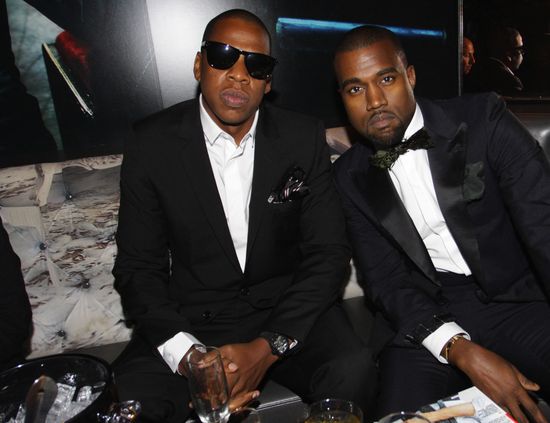
(Photo: Jay-Z and Kanye West attend the GQ & Rocawear celebration of their fall campaign at Provacateur on September 15, 2010 in New York City. By Johnny Nunez via Getty. Created in 1999 by Roc-A-Fella Records co-founders Jay-Z and Damon Dash, Rocawear has annual sales of $700 million. Rocawear expanded its brand through licensing pacts to develop lines for children and juniors; socks and sandals; leather, suede, and fur outerwear; handbags and belts; lounge wear; big and tall; headwear; jewelry; and sunglasses; as well as co-branded product with Pro-Keds, State Property, and Team Roc.)

An Economy On Fast-Forward

Fallows takes a close look at China:

Ten years ago, Chinese factory life stood comparison to the "dark Satanic Mills" of William Blake’s England in the early 1800s. Five years ago, I was struck by the parallels with accounts of Chicago packinghouse life in the 1890s. Now I see a counterpart to the American 1920s, with the first sizable generation of moderne post-rural life. In September, after turnover surged at many Chinese factories, PCH commissioned a nongovernmental organization to do a survey of worker attitudes. I sat in on a focus group from the factory discussing the findings. It’s not the long hours we mind, most of the workers said; according to the survey, fully 80 percent welcomed an average of two or three hours of overtime a day, because of the extra pay that meant. But we still want to "have a life," they told the survey takers. The No. 1 item on their wish list was more organized social activities on the weekends, and singles nights and mixers for all the unaccompanied young men.

China’s economic and social maturing, tumultuous or smooth as it may turn out to be, will certainly affect the world division of labor. Some very low-skill jobs may move to very low-wage economies, such as Burma, India, and parts of Africa; some will move to inland China; some will be automated or done by robots; some will stay in China, but at higher costs. But some of the next round of jobs that might have moved to China will be more attractive for producers to keep in the United States.