Two Billion Leaves Strong

6345361946_0502149256_b

David Quammen visits the sequoia known as The President, the second-largest tree in the world:

Its dead spire, blasted by lightning, rises to 247 feet. Its four great limbs, each as big as a sizable tree, elbow outward from the trunk around halfway up, billowing into a thick crown like a mushroom cloud flattening against the sky. Although its trunk isn’t quite so bulky as that of the largest giant, the General Sherman, its crown is fuller than the Sherman’s. The President holds nearly two billion leaves.

How do sequoias get so damn big?

They’re too strong to be knocked over by wind. Their heartwood and bark are infused with tannic acids and other chemicals that protect against fungal rot. Wood-boring beetles hardly faze them. Their thick bark is flame resistant. Ground fires, in fact, are good for sequoia populations, burning away competitors, opening sequoia cones, allowing sequoia seedlings to get started amid the sunlight and nurturing ash. Lightning hurts the big adults but usually doesn’t kill them. So they grow older and bigger across the millennia.

Another factor that can end the lives of big trees, of course, is logging. Many giant sequoias fell to the ax during the late 19th and early 20th centuries. But the wood of the old giants was so brittle that trunks often shattered when they hit the ground, and what remained had little value as lumber. It went into shingles, fence posts, grape stakes, and other scrappy products. Given the difficulties of dealing with logs 20 feet thick, broken or unbroken, the trees were hardly worth cutting. Sequoia National Park was established in 1890, and automobile tourism soon showed that giant sequoias were worth more alive.

(Photo of The President by Dennis Kleine)
Suspension Isn’t A Solution

Building off research in the Journal of School Violence, Christopher Ferguson makes the case against school suspensions:

Reasons why out-of-school suspensions don’t work are fairly obvious. Giving students what amounts to a free day or two off doesn’t actually feel like punishment for most kids, especially those who may already be hostile towards school to begin with. But if the student then misses school work, his or her grades will decline, further increasing the student’s detachment from the academic environment. Out-of-school suspensions leave kids at home unsupervised and able to cause more problems. And they also do nothing to teach appropriate alternative behavior nor address underlying issues that may be causing the bad behavior.

The Daily Wrap

Cliff_Blame

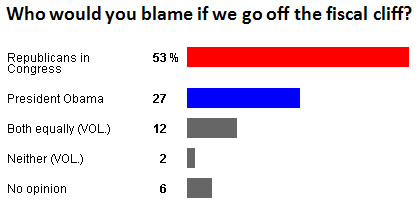
Today on the Dish, Andrew reacted to new polling regarding the GOP’s durable-yet-delusional minority, weighed in on the fiscal cliff blame-game, noted the demographic tipping-point regarding weed prohibition, and though Douthat worried about our “retreat from child rearing”, Andrew wondered if the dropping birthrate was an environmental blessing-in-disguise, while others pushed back against Douthat’s claim that our decadence was at fault.

In political coverage, Roger Ailes told his Fox News puppets to start avoiding Karl Rove and Dick Morris, Tom Coburn earned an Yglesias nod for agreeing to raise tax rates, Neil Irwin anticipated market reaction to the fiscal cliff, and Hertzberg advocated for powering entitlements with a carbon tax. We also published yet more letters from our millennial readers, while Alec MacGillis checked in on simply-a-citizen Romney, Will Wilkinson took Obama to task over the less-than-clear rules for drone use, Waldman spoke out against mortgage interest deductions, and Paul Krugman favored broad thrusts over wonkiness. Looking overseas, Marc Lynch saw through Kim Kardashian’s trip to Bahrain and Massie shared his thoughts on Scottish independence.

In assorted coverage, Virginia Postrel broke down the idiocy of current copyright policy, Keegan Hamilton considered the cartel-impact of Colorado and Washington’s legal weed, Farhad Manjoo guessed at Walmart’s web chances, and James Surowiecki explained the popularity of Warren Buffett, though Felix Salmon wasn’t as impressed. Jen Doll ranted about excessive hyphen abuse, Matt Mendelsohn lamented the photographer-contrived staging of modern wedding photos, Sonny Bunch differentiated cult classics from “cable classics”, a 2010 Metafilter commenter summed up the web-user marketplace, and Ethel Merman helped us forget our troubles for three whole minutes. Also, Gary Marcus outlined how we’re still in the shallow end when it comes to understanding the brain, a Long Islander remembered a moment of impulsive heroism, James Polchin imagined the influence that Paris may have had on Edward Hopper, Cristina Nehring appreciated the differences between her and her daughter with Down Syndrome, and we again philosophized about the moral implications of The Walking Dead, while Alyssa started looking for a little less violence in her TV shows. Anne Helen Petersen brought us to a WWII-era nightclub where troops were waited on by celebrities, neither Nickelback nor Instagram survived today’s brilliant MHB, the durian fruit stunk almost as bad as Nickleback, California leaves were turning in the VFYW, and we mourned one of Britain’s war dead with our FOTD.

Help us decide what to ask Michael Moynihan here.

-C.D.

Alone In Public

2194214077_83160fa5c0_o

James Polchin wonders what makes Edward Hopper such an iconic American artist. He finds one answer in a Paris retrospective of the painter's work:

To encounter Hopper’s paintings beyond their iconic aura, beyond the American geographies of hotel rooms, and apartment windows, of street facades and roadside gas stations, we can see how obsessed they are with turning privacy into a public spectacle, and public spectacle into mystery. As the poet Mark Strand has recently noted, standing in front of a Hopper painting "is as if we were spectators at an event we were unable to name; we feel the presence of what is hidden, of what surely exists but is not revealed."

I wonder if this too was something he learned in Paris, not from the paintings in the Louvre, but rather his wanderings along the streets and cafes of the city.

If anything Hopper in Paris gives us a different insight into our idea of expatriate Paris in the early 20th century. Not everyone was having a party, or talking about modernism. Some wandered the city alone. In Paris, he explored an aesthetic of voyeurism and spectatorship that would become central to his paintings for the rest of his life. Hopper’s canvases present dramas without scripts, actions without stories, and scenes that are hauntingly more mental than material, turning these American scenes of solitude into alluring and enigmatic uncertainties.

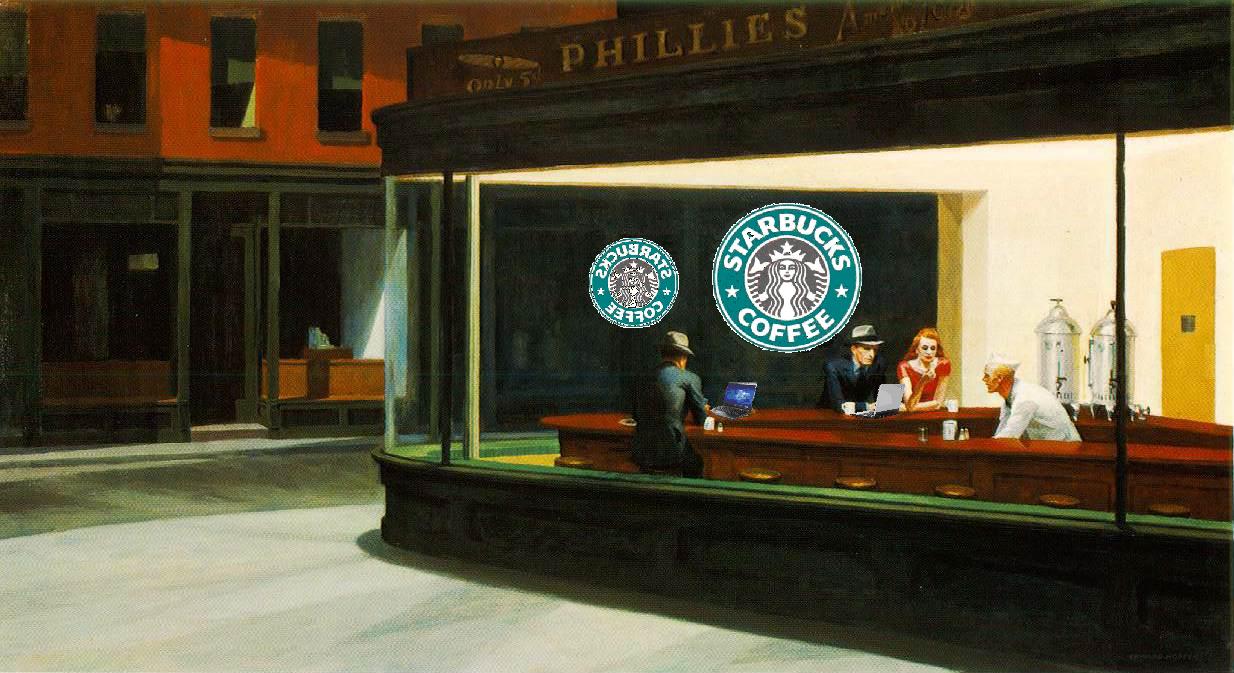
("Neo-Nighthawks, after Edward Hopper" by Mike Licht)

An Old-School Investor, Ctd

In response to Surowiecki and Andrew Ross Sorkin, Felix Salmon takes Warren Buffett down a notch:

Buffett famously avers a distaste for being judged on Berkshire Hathaway’s stock-market returns, preferring to use its book value as a measure, but the fact is that Berkshire has underperformed the S&P 500 for the past 1 year, 2 years, 3 years, and 5 years. At some point, Berkshire still outperforms, but I’m not sure where that point is: I’m having difficulty finding a suitable total-return index so that I can be sure that I’m including the effect of reinvesting the dividends which the S&P 500 pays out but Berkshire does not.

Dancing With The Stars: WWII Edition

Anne Helen Petersen reminisces about the Hollywood Canteen, the troops' own personal nightclub staffed by celebrities:

Every night of the week (save Sunday), 2000 GIs would pour into the Canteen. These troops were days, if not hours, away from embarking to the Pacific. They would get all the free food and "refreshments" they desired. And by "refreshments" I mean coffee, tea, water, and soda—no alcohol allowed. And they spent the night…dancing. With the stars. Some of the stars were B-List, "starlettes" as they were often called, on contract to studios, with just a few credits to their names. Pretty faces, questionable talent. Today’s analog = reality stars.

But there were always big stars as well—Bette Davis cutting cake, archrival Joan Crawford washing coffee cups, Betty Grable setting the record for jitterbugging, amassing three hundred cut-ins in a single hour. Bing Crosby brought his two young sons along to sing Christmas Carols on Christmas Eve; Dorothy Lamour dressed up as Santa Claus. Years later, Johnny Carson would later recall his night at the Canteen as a naval air cadet, dancing with Marlene Dietrich.

The Canteen was democratic in the most essential sense of the word. The stars did the dishes while the soldiers, for one, fleeting night, lived the life of the movie star, surrounded by beautiful, bountiful women.

Why Karl Rove could never rally Hollywood in the same way:

In 2001, Karl Rove met with Hollywood executives to go about arranging a latter-day Hollywood unit, hoping to arrange public service spots, documentaries, and other forms of "war on terror" collaboration—even, potentially, a revival of the Hollywood Canteen. But Rove’s efforts never came to pass. It wasn’t because today’s stars are too selfish, or studio heads were too concerned with the bottom line. There were few troops on the ground, fewer still "shipping out" in the traditional way, and there was little to no access to the independent information about the war. It was, as many have pointed out, a wholly different war, with dramatically different discourses of nationhood, sacrifice, and citizen collaboration.

(Video from Hollywood Canteen, featuring Joan Crawford, who called the film "a very pleasant pile of shit for wartime audiences.")

High Stakes TV

Alyssa is getting tired of sitting at the edge of her seat:

[A]lmost all television now, particularly in drama, seems to be operating in a sphere so intense that it’s impossible to relax—and sometimes impossible to watch, or even to follow what’s happening on-screen. Every show has a conspiracy. Shocking violence has become the norm, and seems to be escalating quickly. The stakes are constantly so high in every episode of television that plot is often swamping strong character dynamics. It made me wonder if our television needs to take a chill pill for a while, if only so we can start thinking more carefully about what kinds of storytelling tools are most effective.

Face Of The Day

157652294

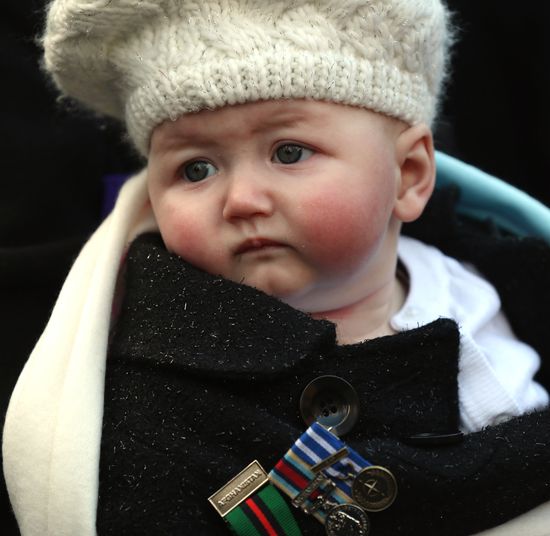
Five-month-old Lexie May Wade proudly wears the medals of her father Private Daniel Wade, who was killed in Afghanistan, as she watches the homecoming parade of 3 Yorks on December 5, 2012 in York, England. Soldiers from the 3rd Battalion Yorkshire Regiment marched through the City of York before attending a thanksgiving and remembrance service at York Minster. The soldiers have recently completed a six-month tour of duty in Afghanistan where they lost seven comrades, including six in one Taliban attack. By Christopher Furlong/Getty Images.

Can The World’s Biggest Company Conquer The Web?

Farhad Manjoo sizes up Walmart's digital footprint:

Walmart can succeed online without becoming the Amazon of the web. The phrase I hear most often from Walmart people is that the only way the company will win online is "by being Walmart." And they're right. Walmart doesn't need to be something radically different. The company that mastered IT in the service of unbeatable prices must now master web technology. It doesn't need to chase Amazon so much as it needs to identify how a digital Walmart can be as much a part of its customers' lives as the stores are today.

And it has to think long term. It may take a decade or more for Walmart to be a successful digital retailer. "Somebody at one of the board meetings asked me, 'Neil, how long is this going to take, and how much is it going to cost?'" [Neil Ashe, the company's top-ranking e-commerce executive] recalls. "And I said, 'It's going to take the rest of our careers, and it's going to cost whatever it costs. Because this isn't a project, this is the company.'"

Recent Dish on the subject here.

The Walking Dead Philosophers, Ctd

Zack Beauchamp feels that it's the reversion to "tribalism that makes The Walking Dead‘s apocalypse so chillingly real":

Modern moral progress, as Peter Singer argues, has proceeded by expanding the sphere of moral concern to an ever-larger group of people. People may have once only cared about those who share their nationality, race, or gender, but as Enlightenment ideals about universal human rights took root, humans have moved inexorably towards treating everyone as equally worthy of moral concern. The Walking Dead‘s third season has suggested that, when you demolish a stable society, this purported moral progress will have proved a smokescreen, and that our enlightened selves are just as brutally tribal as our ancestors.

The moral drama in the struggle between the two groups of survivors, then, isn’t over the appropriateness of groupism in the shadow of the End. Instead, it’s about how we rebuild our moral code from the ashes.

Scott Meslow notes the emergence of a theme in the show's latest episode:

I'm not willing to call The Walking Dead some kind of pointed allegory for the war on terror, but there are some parallels being drawn here that shouldn't be ignored.

The Governor has earned the unwavering loyalty of the Woodbury residents by offering them the security and the semblance of the lives they used to have. They live in actual houses, have an ample supply of food and alcohol, and walk down zombie-free streets. In return, they agree to give up certain freedoms, and don't ask too many questions about how the Governor ensures their security. And notice how easily the Governor convinces his followers that the others–including their erstwhile protector Merle–are an enemy to be vilified and destroyed.

One of the biggest themes of The Walking Dead has been dehumanization, which we've seen in a few forms. There's the literal dehumanization when a person becoming a zombie. There's the survivors' need to accept that their loved ones are no longer human after they've turned–a process abetted by calling them "walkers" or "biters." And most subtly–but also most importantly–there's the othering of fellow human beings with labels like "terrorist," which can turn a group of people into a bloodthirsty mob within moments.

Recent Dish on the series here and here.