“Politics isn’t about policy details, it’s about broad thrusts and whether people think you’re on their side,” – economics professor, Paul Krugman.
Month: December 2012
Reality Check
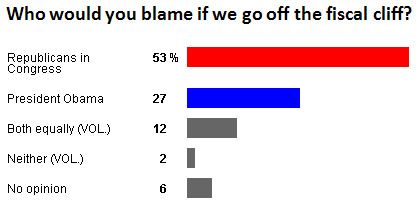
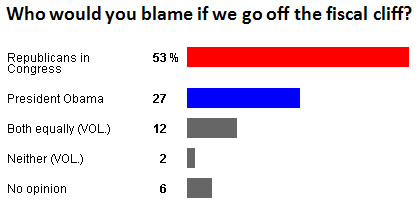
Americans say that they will blame the GOP if America tumbles over the fiscal cliff. Drum’s read on the situation:
Politically speaking, President Obama’s main job is to keep things this way. Republicans pay a price for their anti-tax jihad only if the public blames them for the ensuing catastrophe. But if Obama sticks to reasonable asks—modest tax increases, modest spending cuts, and a debt ceiling increase—and pounds away at Republican intransigence, these numbers aren’t likely to shift much.
McArdle thinks Democrats will also take a hit:
Of course, Democrats can go on the stump and explain that it is all the GOP’s fault for forcing us over the fiscal cliff. I, for one, would certainly pay cash money to watch Democrats spending much of their valuable campaign time and ad money explaining to voters that tax increases destroy the economy. Whatever effect this might have on voters, it would certainly be entertaining for the pundit class …
I’m sure that Republicans will take a lot of heat if they let us go over the fiscal cliff, especially from their donors and their base. Which is why I assume it won’t happen. But if it does, I suspect that Republican chances in 2016 get better, not worse.
I guess I find the entertainment of pundits less worthwhile than actually doing some sane trivial things, like a return to the top Clinton tax rates, and entitlement and tax reform. Right now, the GOP is not acting like a national party seeking the best for the public interest. They are acting still as purists in gerry-mandered safe districts, focusing entirely on their faction’s ideology, and playing chicken – they’re laughing at a re-elected president’s proposals, backed by a majority in polling – as if they were in a sandbox, instead of holding the entire global economy to ransom. The idea that we should be thinking about which party can make the most hay out of this, rather than fixing the fucking problem, is part of the fucking problem. Can’t we just get this over with? Or is the GOP’s fever actually rising after this election?
Contemporary Cult Classics
Sonny Bunch considers various candidates:
In many ways, the cult classic has been replaced by what I like to call the cable classic: There is a certain class of film that was lightly attended in theaters and derided by critics only to find a huge audience on cable and DVD. Zoolander is probably my favorite example of this phenomenon: Zoolander has gone on to find a huge audience in home viewings, is highly quotable (a key component to any "cable classic"), and is constantly the subject of sequel rumors.
But even Zoolander made $45M at the box office—not a huge sum, but not an embarrassing flop, either. The same goes for Cabin the Woods, suggested by Peter Suderman as a potential modern "cult classic." It grossed $42M. Can they really be considered "cult" after debuting on thousands of screens all over the nation?
Scratching The Brain’s Surface
Gary Marcus believes that neurology is still in its infancy:
The smallest element of a brain image that an fMRI can pick out is something called a voxel. But voxels are much larger than neurons, and, in the long run, the best way to understand the brain is probably not by asking which particular voxels are most active in a given process. It will instead come from asking how the many neurons work together within those voxels. And for that, fMRI may turn not out not to be the best technique, despite its current convenience. It may ultimately serve instead as the magnifying glass that leads us to the microscope we really need.
If most of the action in the brain lies at the level of neurons rather than voxels or brain regions (which themselves often contain hundreds or thousands of voxels), we may need new methods, like optogenetics or automated, robotically guided tools for studying individual neurons; my own best guess is that we will need many more insights from animal brains before we can fully grasp what happens in human brains. Scientists are also still struggling to construct theories about how arrays of individual neurons relate complex behaviors, even in principle. Neuroscience has yet find its Newton, let alone its Einstein.
Standing Out On Your Wedding Day

Wedding photographer Matt Mendelsohn vents:
Jesus, as wedding photographers are reminded each week, performed his first miracle at a wedding in Cana. Of course, there’s no photographic evidence. Probably for the best. Had there been a photographer that day in Galilee, the world might today be looking at a picture of a bride and groom posed sexily in some ox cart, lit from behind by a strobe hidden in the hay, holding balloons while drinking wine out of Mason jars and gazing adoringly at each other.
That’s the current state of the art. It’s no longer enough to take wedding pictures that show a bride and groom in love—dancing, whispering during dinner, playing with a nephew or niece. These days, wedding pictures are elaborate, photographer-contrived setups that show the newlyweds kissing in a wheat field (as if it were a natural act to go wheat-harvesting on one’s wedding day) or aboard an old-time fire engine.
Mendelsohn goes on to document his many followups with couples years after their weddings, discovering joy and sadness and a range of surprises, including a husband who comes out of the closet, vilifies the wife and then remarries another woman.
(Photo via TackyWeddings.com)
An Old-School Investor
James Surowiecki profiles Warren Buffett:
Buffett’s disdain for the trappings of wealth can be exaggerated—“When I get rid of the plane, you’ll know I’m broke,” he told me—but it’s obviously a big part of his appeal to ordinary Americans. How can you not like a billionaire who still lives in a house that he bought in 1958? But Buffett’s popularity doesn’t stem from his life style alone. More important, his success evokes an economy very different from today’s risky, unstable one. These days, workers are told that they need to adapt to a world of perpetual change, constantly reinventing themselves. The investing world is dominated by a manic-depressive style, in which the average mutual fund turns over nearly its entire portfolio every year. Yet Buffett has prospered by ignoring all this. As an investor, he’s known for his patience—he says that he likes holding stocks “forever”—and he prefers a few big bets to an endless number of small ones. “If you go from flower to flower, you have to find a lot of flowers to make a lot of money,” he told me. “There aren’t that many great ideas out there.”
Tastes Like Heaven, Smells Like Hell

That's one description of the durian fruit:
Even with the husk intact, the notorious Asian fruit has such a potent stench that it’s banned on the Singapore Rapid Mass Transit. Food writer Richard Sterling has written "its odor is best described as…turpentine and onions, garnished with a gym sock. It can be smelled from yards away."
A small minority, though, love the smell and taste of the fruit. Anthony Bourdain calls it "indescribable, something you will either love or despise…Your breath will smell as if you’d been French-kissing your dead grandmother." The fruit’s flesh is sometimes eaten raw, or is cooked and used to flavor a number of traditional Southeast Asian dishes and candies. It’s also used in traditional Asian medicine, as both an anti-fever treatment and a aphrodisiac.
(Photo by Kelantan Jottings)
Reconsidering Copyright
Highlighting a now-withdrawn Republican Study Committee memo (pdf) that blasted the current intellectual property system, Virginia Postrel argues that instead of "balancing the interests of consumers and future producers," copyright policy has become "an expanding monopoly privilege for well-connected industries." She looks at Robert Frost's 1923 poem "Stopping by Woods on a Snowy Evening" as an example:
Back then you only got copyright privileges for works officially registered with the copyright office, and only for a term of 28 years, which could be renewed if you filed again, as Frost did in 1951. Requiring such simple procedures reserved copyright privileges for creators with strong commercial or sentimental interests in limiting the publication of their works. Today, by contrast, copyright automatically applies to every eligible work, including your vacation snapshots and your 4-year-old’s handmade Mother’s Day card.
After a series of congressional reforms to copyright term length, the poem will not enter the public domain until 2018. Postrel adds:
Fifty-six years of copyright was clearly enough to encourage Frost to write the poem. Anything further is just a windfall for his estate and his publisher. The Constitution, reformers are quick to note, gave Congress the right to grant copyrights "to promote the Progress of Science and useful Arts," not to benefit producers.
Several weeks ago, Yglesias applauded the RSC memo's debunking of the myth "that our copyright system promotes the most innovation and productivity":
Longer-duration copyrights theoretically create larger financial incentives for creators to innovate and develop great characters and great stories. On the other hand, shorter-duration copyrights reduce the cost of artistic production and innovation.
Because the basic stories of Hamlet, Snow White, and Robin Rood are in the public domain, they can be easily and cheaply treated and retreated by artists in a variety of media. Spider-Man, by contrast, is enmeshed in a web of legal obligations that stifle creativity. Sony Pictures and Sony Pictures alone may make Spider-Man films, and unless they release them very frequently, they’ll lose this lucrative monopoly and the rights will revert back to Marvel. Decisions about which stories get told are driven by intellectual property considerations rather than dramatic ones. Peter Parker can’t appear in an Avengers film, and Iron Man can’t appear in a Spider-Man movie because the rights belong to different studios.
A Loophole With Strong Ties
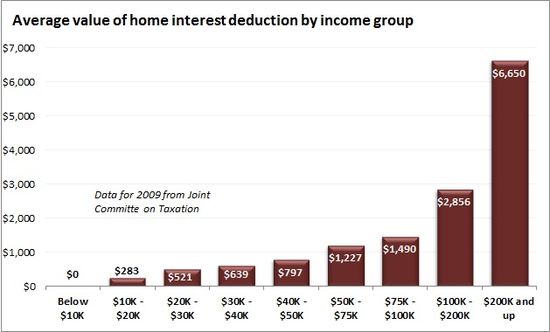
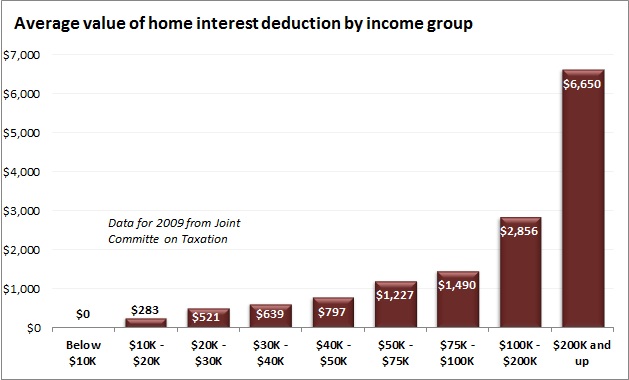
Waldman writes that the "mortgage interest deduction came about essentially by accident," because when "the Constitution was amended in 1913 to allow for an income tax, Congress made all interest payments deductible." He points out that it makes little economic sense and that it mostly benefits the wealthy:
As a homeowner, I love the mortgage interest deduction. Every year when I'm doing my taxes and I get to the step in the software where you enter in your mortgage interest, a wave of relief just washes over me, just as it surely does to millions of others. But I can't come up with any good argument to defend it. And there's the dilemma for lawmakers. They can make the case that eliminating (or scaling back) the deduction is good for the country's finances, but it's going to be hard for that case to be heard when taxpayers are screaming, "You're going to increase my taxes by how much?!?!" at them.
So I'd wager that if the deduction gets touched at all in these debates, it will be by putting some kind of cap on the amount of interest one can deduct. But that cap will be placed high enough—$20,000 of interest, say, or what you'd pay on a $400,000 loan at 5 percent—that very few homeowners would actually feel it.
The Scourge Of Hyphens
Jen Doll divulges her grammatical pet peeve:
While we bow to the elegance of the em-dash (hats off to you, lovely madam) and admire the skillful writer who knows how to employ the unicorn that is the en-dash (a very special mark, learn more about his charms here), the commonplace hyphen is everywhere and nowhere, a generic entity oft subbed for the real thing (i.e., the em- or en-dash), used willy-nilly, thrown in when one feels like it, as if it's salt or pepper being added to a stew. It is not! It is a hyphen. It should not just be added — added — added – and the reader then tasked with making heads or tails of it, too-salty, not-enough-seasoning, simply-wrong. And when it is used as a hyphen, for the express purpose of hyphenating something, it's often wrong, too. This-is-so-very-jarring.
She turns to the Purdue Online Writing Lab, which summarizes the basics of the punctuation mark's proper deployment.
 The Dish