Big Air Travel Touches Down

Responding to Delta's possible takeover of Virgin Atlantic, Kevin Roose laments the ostensible departure of "the best international airline [he's] ever flown":

A primary reason why flying is so terrible is that, over the past several decades, the airline industry has been undergoing a massive consolidation that has left only a few carriers standing. Less competition generally means higher fares and weaker performance, and the combination of separate airlines into a unified whole introduces a whole host of issues (labor integration, loyalty programs) that can jeopardize the flying experience.

Clive Irving sees a brand mismatch:

Virgin has something that just isn’t in the DNA of Delta. In terms of branding, Delta is analog and Virgin is digital. Virgin has an eye tuned to the tastes of a valuable market, the regular high-end pond-crossers in the media, fashion, and tech businesses. This has always reflected Branson’s own brilliance in playing the role of a business insurgent who offers an alternative to the soul-less service of the big carriers—sassy flight attendants and sexy business-class cabins loaded with gizmos and executive lounges to match.

Virgin loyalists, a clubbish bunch, are already quaking at the prospect of Delta having an influence on this niche market.

Clubbing Moderate Republicans

John Judis points to another reason why moderates are an endangered species:

[The Club For Growth] and its network have yet to unveil their overall strategy for 2014, but some of its members groups have already threatened to back primary challenges to Chambliss and South Carolinian Lindsay Graham. And the threats have had some effect. Chambliss incurred the network’s wrath last summer for attempting to work out a bipartisan compromise on the debt ceiling. After the election, he annoyed them by downplaying his commitment to the pledge, circulated by Grover Norquist, not to raise taxes. "I care more about my country than I do about a 20-year-old pledge." But by this week, he had tweeted that he is "not in favor of tax increases." Chambliss’s decision was not the result of pressure from Norquist, but of the looming threat of a primary challenge from the right.

If the Club and its network remain active for 2014 and 2016 elections, they will almost certainly make it more difficult for the Republicans to retake the Senate and to win back the Presidency.

Trial By Tundra

5054411072_d270a3d9ca_b

Julia Phillips tagged along for the Beringia, a dog sled race across Russia’s easternmost tundra:

Imagine the desert. White dunes, white peaks, white sun, white sky. Imagine a frozen ocean. This was the tundra. I’d never seen such emptiness in my life. I couldn’t stop staring around. It was far below freezing, and in my thermal underwear, fleece layer, double snow suit, double face masks, fur hat, and shearling mittens, my skin prickled as gently as it once did when I sat on summer afternoons in air-conditioned movie theaters.

Let’s be clear—I had no qualifications for such a trip, which took nearly three weeks and covered a mostly unpopulated wilderness. My talents extended only as far as selecting the finest pens at any given drugstore and analyzing the works of 20th-century American fiction writers. I’d never gone camping in the cold. I don’t go to the gym. People in Petropavlovsk, when hearing about my plans to travel with the Beringia, had pursed their lips and come at me with soft voices. "Do you know it’s very difficult?" they asked. "Do you understand?" It seemed to me that I did. I’d never gutted a fish, peeled potatoes with a knife, or ridden on a snowmobile, but soon I’d learn.

(Photo by IloveGreenland)

The Daily Is Dead, Ctd

Freddie DeBoer sees the e-newspaper's demise as part of a bigger problem:

Why would people think that you could have a viable media business model while catering only to people who own iPads? Because our media world is made up of people from a particular social and cultural class. … As such, they'll be lacking an important perspective, which is what the world looks like outside of the narrow slice of educated digitally-connected strivers who write the Internet. It's the most consistent and determinative aspect of our media: it's a homogenous group that fancies itself diverse and thus cannot see how incredibly out of touch it is with how most people live. I invite reporters to come here to Lafayette Indiana and ask around at the Village Pantry about the demise of The Daily.

Felix Salmon is in the same ballpark:

As far as news and journalism are concerned, the verdict is in: tablets aren’t a new medium which will support a whole new class of publications — there’s almost nothing you can do well on a tablet that you can’t just put on a website and ask people to read in a browser. Publications of the future will put their content online, and will go to great lengths to ensure that it looks fantastic when viewed on a tablet. But the tablet is basically just one of many ways to see material which exists on the internet; it’s not a place to put stuff which can’t be found anywhere else.

I'm not so sure for a simple reason.

I think long-form journalism works best on a tablet, while shorter forms perform better on desktops or laptops – often at work. The tablet is, for me, at least, about reading in a different way at a different time – in the evening or weekend, when you do not want to know the latest ripples on the news pond, but when you feel like a deep dive into a long essay or a book or a sustained piece of long-form reporting. It's a device for the long-attention span. Joshua Gans pushes back as well:

[D]oes this mean that news on tablets isn’t the way of the future? Felix Salmon seems to believe so but I think he is wrong. Tablets are great for reading in the way webpages are not. You just have to get the interface right as Macro Arment among others have learned. Readers want text and there is a place for that. The hard thing is to mix text with a good browsing experience to find what you want to read. The Daily presumed you wanted to read something or flip. For the rest of us, how to find what to read is still the challenge. Someone will solve it for me and others will solve it for other people. But solutions will be found.

Jack Shafer's bottom line:

The Daily demonstrates for the umpteenth million time that big media isn’t very good at creating new publications, be they new magazines, new newspapers, or new Web sites. Most big media operations have come to accept this, and instead of creating new properties they acquire them. So today, let’s both toast and damn Rupert Murdoch for trying but not trying hard enough to make something new, valuable, and profitable on the Web.

Letters From Millennial Voters

Read all of them here. Another:

I was born in 1986, and graduated from college in the winter of 2008 – right at the moment of the financial collapse. But I see, and many of my friends see, that our workforce woes were created by the policies of George W. Bush. Because that is the fact of the matter.

Facts, more than political orientations, are what I see as defining my generation. Our species has never had such unprecedented access to them. I can't think of a time that a bar debate didn't end with my friends pulling out their smartphones to find out the actual truth. We don't need to fight over who directed it; IMDB is a click away. I see this as distinct from my parents generation: the ubiquitous and sophisticated hoaxes on the Internet have given us finely-tuned bullshit radars, and I'm actually much less likely to believe something I've read than the boomers in my life (until I've checked snopes).

Pundits on both ends of the political spectrum have been crowing about how much the youth loves Obama. That may be so. But I think just as many were absolutely repulsed by Romney. Most of my friends were reading the news more for the fact-checking than for the analysis, and for anyone paying attention Romney was clearly more apt to lie. We saw a man who seemed totally incapable of speaking the truth.

Another reader:

Confession: The first time I saw a man kiss another man was on an episode of the Real World: San Francisco.  I can't explain my reaction to it, except to say my stomach turned a little bit.  I don't know why it happened either and I'm not proud of it.  But it happened and I think it was because I'd never imagined such a thing.  Having been raised in Tennessee, such a thing was wrong.

Pedro Zamora was the first gay man I ever met.  By the end of that season, I found myself crying over his death.  Today I have a number of gay and lesbian friends – some number as some of my closest friends.  So … confession number 2: Last night as I watched Glee, I got a little misty eyed when Kurt said "I love you" to Blaine. I must be a softie.

Love is love.  Love is powerful.  And it is increasingly winning my generation over.

Another illustrates that perfectly:

As a millennial who was able to vote in the last two elections, my vote was split between the two parties. In '08, I was comfortable with a McCain presidency (not so much a Palin VP, but I was willing to put faith in McCain's health keeping her from ever sitting in the oval office). But over the last four years, equal marriage rights became an increasingly important issue to me (not that it wasn't before 2008), and my disillusionment with the Republican party came to a head. My initial support of the party was rooted in economic issues, but the debt ceiling fiasco showed me that the Republicans in office were willing to act like insufferable toddlers if it meant making Obama look bad, our nation's credit rating be damned. 

When I renewed my driver's license after moving to a new state, the clerk also updated my voter registration and asked my political party. I had finally reached a point where I couldn't associate with the Republican party, but the fiscal conservative in me stopped short of telling the clerk to put me down as a Democrat.

It boils down to this: I refuse to consider myself part of a political party that doesn't support equal rights for all Americans, regardless of sexuality. This was why I supported Jon Huntsman in the primaries and Obama on Election Day. Until the Republican presidential candidate supports equal marriage rights, the party will never earn my vote. I can't trust someone to fix the economy that doesn't view all citizens as equal; it's a prerequisite in my eyes.

Will Assad Use Chemical Weapons?

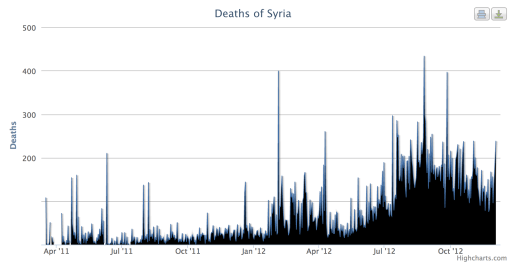
Syrian death toll graph

The regime has readied part of its arsenal:

Engineers working for the Assad regime in Syria have begun combining the two chemical precursors needed to weaponize sarin gas, an American official with knowledge of the situation tells Danger Room. International observers are now more worried than they’ve even been that the Damascus government could use its nerve agent stockpile to slaughter its own people.

Hillary Clinton, NATO and Obama have all warned the regime that there would be consequences if they use chemical weapons. David Blair tries to imagine an endgame for Assad:

[He] faces an impossible dilemma. From his point of view, the only rationale for using these weapons would be if his downfall would otherwise be absolutely inevitable. On the other hand, if he did choose to gas his enemies, that would be certain to trigger a US-led intervention that would seal his fate anyway. So rationality dictates that he should not use these weapons under any circumstances. But even if Assad is a still a rational actor, is he fully in control? And does there come a point in the inexorable collapse of a dictatorship when rationality itself goes out of the window and the bunker syndrome takes over?

Former UN advisor George Lopez fears the worst:

[F]or those who believe the rebel control of regions near the Turkish border should lend itself to international agencies providing direct humanitarian relief as winter comes to desperate refugees – recall that in their last disclaimer about chemical weapons, the regime said they would only use them if the nation faced foreign intervention. So Assad’s sick logic would excuse and explain his use of chemical weapons against rebel forces entering Damascus or along the Turkish border almost any time now. In short, we should be worried – very, very worried.

Goldblog reports that Israel has tried to get Jordan's permission to bomb Syria's chemical weapons:

Of course, Israel can attack these sites without Jordanian approval (in 2007, the Israeli Air Force destroyed a Syrian nuclear reactor), but one official told me that the Israelis are concerned about the possible repercussions of such an attack on Jordan. "A number of sites are not far from the border," he said, further explaining: "The Jordanians have to be very careful about provoking the regime and they assume the Syrians would suspect Jordanian complicity in an Israeli attack." Intelligence sources told me that Israeli drones are patrolling the skies over the Jordan-Syria border, and that both American and Israeli drones are keeping watch over suspected Syrian chemical weapons sites.

Aaron Stein says preemptive strikes may indeed happen, should any further preparation of the weapons occur:

[T]he U.S. and Israel are also using the media to tell Bashar that they will not wait for the use of chemical weapons, but will take action if intelligence indicates that their use is imminent. It is not hard to imagine a scenario where U.S. intelligence assets (drones, satellites, human) begin to witness the preparations for the launch of Syrian Scuds. If the threat is deemed credible, one can imagine a U.S. air strike on the missiles while they are being fueled and still on the ground.

It's worth pointing out that Syria is the first country with WMDs to go through a civil war. But at least Syria's Internet is back on. Per usual, Al Jazeera and The Guardian are live-blogging. 

(Image from the Deaths of Syria project)

Quote For The Day

You know how the web is – you're looking for something and find another that leads down another road. But my first thought when stumbling onto the following quote today was Israel's alleged commitment to a two-state solution even as it does everything it can to make sure it doesn't happen by pursuing settlements:

It's no good running a pig farm badly for 30 years while saying, 'Really, I was meant to be a ballet dancer.' By then, pigs will be your style.

McCain On Benghazi: Busted

157010379

The cranky old Senator has whipped himself into a lather over Susan Rice's televised statements about the attack on the Benghazi consulate, accusing her of misleading the public because she did not immediately cite al Qaeda or a planned terrorist attack. She made those statements on September 16. And yet on September 22, McCain himself voted for a resolution that described the affair thus:

the violence in Benghazi coincided with an attack on the United States Embassy in Cairo, Egypt, which was also swarmed by an angry mob of protesters on September 11, 2012.

My italics. So McCain is clearly implying as late as September 22 that he believed the attack was spawned by the video. No mention of terrorists or al Qaeda, even after McCain had had a chance to talk this through with intelligence sources. So why is McCain haranguing someone for saying what he said days later? ABC News just asked him:

Sen. McCain’s office called the comparison between the language of the resolution and Rice’s words "pathetic." "This is total nonsense," McCain spokesman Brian Rogers said in a statement to ABC News.

That's not an answer. He just got hoisted on his own petty petard.

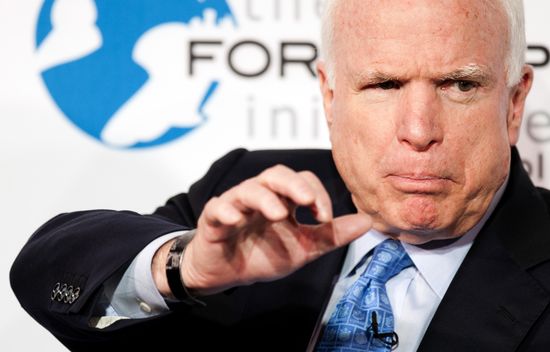
(Photo: US Republican Senator from Arizona John McCain speaks during 2012 Foreign Policy Initiative Forum in Washington, DC, November 27, 2012. By Jim Watson/AFP/Getty Images)

The Pro-Pot Minority?

Kleiman reads opinion polls on marijuana differently than I do. He argues that a minority of Americans support full marijuana legalization and commercialization:

There’s no doubt opinions have shifted strongly in the pro-pot direction over the past five or ten years. And the Colorado and Washington votes demonstrate that, with sufficient resources and skill, voting majorities for the full Monty can be established in some states. If attitudes continue to shift, support for full legalization may become the majority view nationally, especially if Colorado and Washington are allowed to proceed and no disaster follows.

But support for full legalization is not the majority view today. So advocates need to be cautious about triumphalist claims that legal pot is the "will of the people."

Agreed. That's a dumb argument, compared to all the smart ones being deployed. What the anti-prohibition movement confronts is what the marriage equality movement has long dealt with: a balance between irrational exuberance and angry victimology. My view is that triumphalism is utterly unwarranted, that good cheer after an epochal shift in attitudes is justified, but what matters most is making good arguments to reasonable people, and making them again and again and again until you're bored silly, but they get it. My experience in the marriage movement has been that democracy works, once you frame the discussion on your terms and make arguments that make sense. Then patience, patience … and more argument. Today, the arc of history seems to be shortening, like everything else.