Should Smokers Be Saved?

Jacob Grier defends tobacco against "a slew of new bans, taxes, and regulations":

New York is banning smoking in parks. California has banned it on many beaches. In much of sunny Los Angeles one can no longer smoke on restaurant patios. The entire town of Calabasas, California, is smoke-free in public places. San Francisco suburb San Rafael has banned smoking in all multi-unit residences. In Oregon it's essentially illegal to open a new cigar bar or smoking lounge. In North Dakota voters recently approved a ban that includes tobacco shops. In rainy Washington, even an indoor private smoking club protected by a twenty-five foot airlocked walkway was deemed to be in violation of the statewide ban. I could go on. Non-smokers understandably prefer to avoid secondhand smoke, but really, where's a smoker supposed to go?

He compares the taste for tobacco to more socially acceptable vices:

There is much more to tobacco than mass-produced cigarettes; premium tobacco is arguably every bit as artisanal as many of the other food and drink products that those of us in the culinary world obsess over. The unique leaf offers flavors that many find enticing, appearing occasionally in the works of creative chefs, bartenders, and baristas. At the French Laundry, Thomas Keller experimented successfully with desserts like coffee custard infused with tobacco. In Tampa, Cigar City Brewing crafts beers inspired by cigars. Tobacco bitters appear on fancy cocktail menus. In France, distiller Ted Breaux makes a liqueur called Perique that captures the essence of Louisiana pipe tobacco; it's a remarkable elixir with a light, tea-like quality, and alas, as of this writing not imported to the United States.


A Poem From The Year

Alone

From Idea by Michael Drayton (1563-1631):

You’re not alone when you are still alone;
O God!  from you that I could private be!
Since you one were, I never since was one,
Since you in me, myself since out of me,
Transported from myself into your being,
Though either distant, present yet to either;
Senseless with too much joy, each other seeing
And only absent when we are together.

Give me my self, and take your self again!
Devise some means by how I may forsake you!
So much is mine that doth with you remain,
That taking what is mine, with me I take you.
    You do bewitch me! O that I could fly
    From my self you, or from your own self I!

Please consider supporting the Poetry Society of America here.

(Photo by Flickr user JanLendL)

A Nation Vulnerable To The Elements

Alex Knapp worries that we won't be able to see the next Sandy coming:

[I]f it weren’t for NOAA satellites, weather forecasters likely would not have been able to predict that Hurricane Sandy’s "left hook" into the Eastern Seaboard, which enabled local governments to undertake emergency preparations for the storm.

Unfortunately, due to what Undersecretary of Commerce Jane Lubchenco called, "chronic management problems," it appears increasingly likely that the U.S. will have to suffer a at least a year without satellites starting around 2017 as the old satellites reach the end of their life cycle and the new ones are launched. And right now there’s no other alternative for getting that data. The government is scrambling to do what it can to minimize the amount of time between the death of the old satellites and the launch of the new, but right now it looks like there will be at least some small gap.

He later notes that "the Fiscal Cliff would include an 8.2 percent cut to NOAA’s weather satellite program," which means, if we go over the cliff, "the expected one year weather satellite gap could be much, much longer."

Moral Panic Sells

Particularly in the music industry:

Music history is littered with examples of "moral panics": be-bop jazz was blamed for white-on-black race riots in the mid-1940s, just as rap music was blamed when riots erupted in Los Angeles following the Rodney King trial. In both cases, sensationalized news reports and especially a focus on the "dangerous" elements in the music attracted young people in droves. Moral panics, like magnets, repel and attract. This is also true when disputes involve dueling scenes, like the fights between "mods" and "rockers" in the U.K. in the early 1960s or the battles between fans of heavy metal and punk that played out on the pages of Creem magazine in the early 1980s. It is equally true when outsiders attack: the Parents’ Music Resource Center’s efforts to ban heavy metal and rap music resulted in those Parental Advisory stickers. When rock fans staged the infamous Disco Demolition at Comiskey Park they may have kept disco in the limelight for an extra year.

A Novel That Talks Back

Rob Horning finds just one way that humans could ever "date" a robot:

It makes no sense to imagine robots with the agency to choose to love us. But if we stop thinking of robots as potential human surrogates and start thinking of them as something more akin to an engrossing novel or TV show — a medium — then it’s easy to imagine people dating robots. People read alone, they watch TV alone, they play games alone — why wouldn’t they enjoy the immersive experience a robot could be programmed to provide alone? Especially if the experience prompts us to forget our aloneness. 

The NRA Doesn’t Speak For All Gunowners

John Sides compares NRA-member gunowners to non-members:

[G]un owners who were not NRA members were more supportive of gun control than guns owners who were NRA members. Forty percent of non-NRA gun owners supported a national gun registry. Forty percent supported a ban on the sale of magazines with more than 10 rounds. Thirty-six percent supported a ban on semi-automatic weapons—a striking figure given that almost every gun sold today is semi-automatic and gun owners would be likely to know that. To be sure, this means that the majority of gun owners—regardless of whether they belonged to the NRA—opposed many forms of gun control. But on the other hand, this list of gun laws did not include some popular proposals. For example, gun owners, regardless of NRA membership, appear to support criminal background checks.

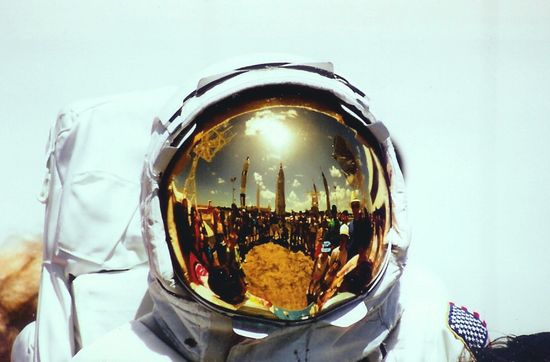
The Exploration Instinct

3498988186_d22f64e162_o

David Dobbs examines mankind's urge to explore:

“No other mammal moves around like we do,” says Svante Pääbo, a director of the Max Planck Institute for Evolutionary Anthropology in Leipzig, Germany, where he uses genetics to study human origins. “We jump borders. We push into new territory even when we have resources where we are. Other animals don’t do this. Other humans either. Neanderthals were around hundreds of thousands of years, but they never spread around the world. In just 50,000 years we covered everything. There’s a kind of madness to it. Sailing out into the ocean, you have no idea what’s on the other side. And now we go to Mars. We never stop. Why?”

(Photo by Flickr user a200/a77Wells)

“Preserving” The Bush Tax Cuts

Phillip Klein suggests the GOP see the glass as as half-full:

Democrats were opposed to both rounds of Bush tax cuts in 2001 and 2003 and have spent a decade blasting them as reckless policy that represented nothing but a giveaway to the wealthy. Yet even though these tax cuts were scheduled to expire after 2010, they were extended an additional two years. And now, they could still preserve 80 percent of them. If 80 percent of the cuts were made permanent, it would forever enshrine the “Bush tax cuts” as major middle class tax relief. Viewed narrowly, allowing rates to go up on those earning more than $250,000 would be a defeat for Republicans. But viewed in a broader context, the fact that a Democratic president coming off of a reelection still has to embrace 80 percent of the dreaded “Bush tax cuts” on the grounds that they’re good for the middle class, could be seen as a victory.