The Happiness Equation

Claude S. Fischer examines attempts to study and measure happiness. On the role that money plays:

The money-happiness question was initially raised by economist Richard Easterlin, who observed that growing affluence since the mid-twentieth century had not led to more reports of happiness in national surveys. (Actually, Freud raised a similar question in Civilization and Its Discontents, in 1929.) One explanation of the Easterlin Paradox, aside from adaptation and competition, is that increasing materialism ruined the pleasure Americans might have gotten from becoming wealthier. Some, including your correspondent, have argued that there is no paradox to start with, because the growing wealth since the 1970s has concentrated in the hands of the few. Average Americans haven’t gotten happier in part because average Americans haven’t really gotten wealthier.

The End Of Focus Groups?

Adam Higginbotham reports on advances in computers and biosensors that can read emotion. It's being used to monitor autistic children, to prevent the onset of meltdowns, and also in advertising. Higginbotham plays guinea pig:

After a camera check, as the machine makes sure my face fills the frame and is well enough lit to be analysed, a commercial for Doritos begins: two hefty frat-boy types in their living room; one complains that the other has eaten all the crisps. "Relax, bro-chaco," he replies, "this new phone I got will get us anything we want." He demonstrates, by asking the phone to send more Doritos, and then a sombrero, which magically plink into existence around him. His friend takes over: "Send three hot, wild girls." "Sending three Rottweilers," replies the phone. Uh-oh. After the punch line — three women in low-cut outfits left in the suddenly deserted room, asking, "So… why are we here again?" — there's another pause while the machine transfers the video of my face into the cloud for processing, inferring emotional state from my expressions. It then presents its analysis of my reaction on a five-layer graph mapping a video strip of the ad against fluctuating emotion tracks: smile, surprise, confusion/dislike, attention and valence, or the intensity of feeling. My response is apparently close to the global average: a slowly rising track of smile and surprise, peaking with the appearance of the barking dogs; broadly, the ad is a success.

Behind The Romney Victory Delusion

On Friday, Noam Scheiber took an exclusive look at the Romney campaign's internal polling and talked to Romney's chief pollster, Neil Newhouse, about why Romney thought he was going to win. Ed Kilgore zeroes in on the campaign's embrace of its own propaganda:

Aside from succumbing to the “enthusiasm” myth, it seems Romney and his staff also bought into the “momentum” myth: the powerfully seductive belief that sometimes-random polling gains represent an irresistible trend. Newhouse saw a significant jump in Mitt’s numbers in battleground states the Sunday before Election Day, and like his colleagues thought this was “momentum” that would probably continue right through November 6.

Harry Enten adds:

[T]he Romney campaign somehow came away with the belief that their candidate would win, even as their own optimistic surveys showed him only getting to 267 electoral votes. It came from their belief that they had momentum in Ohio, which, as discussed, was based on the faulty notion that you see big dips and dives in polls outside major campaign events. As I noted in the lead-up to the election, Romney didn't lead in a single public Ohio poll in the final weeks. Historically, this has always been a death knell. Romney didn't lead in a single internal Ohio survey, either.

Among the lessons Nate Silver draws:

A pollster working within a campaign may face a variety of perverse incentives that compete with his ability to produce the most accurate possible results to his candidate. He may worry about harming the morale of the candidate or the campaign if he delivers bad news. Or he may be worried that the campaign will no longer be interested in his services if the candidate feels the race is hopeless.

The Weekend Wrap

Bookwkend

This weekend on the Dish, Andrew analyzed the state of play as America approaches the fiscal cliff, provided reality checks on both climate change and legalizing marijuana, highlighted the British foreign secretary's thoughts on new Israeli settlements, and noted Timothy Geithner's economic optimism.

In matters of faith, doubt, and philosophy, Neil deGrasse Tyson wasn't sure if the universe has a purpose, Edward J. Blum explained how artistic depictions of Jesus mirrored America's fraught racial history, Adam Roberts argued that atheists have something to teach the followers of Jesus, Yoram Hazony deconstructed our attempts to describe God, and Glenn Loury told his son why he goes to church despite doubting God's existence. Leszek Kołakowski wondered if human beings can be truly happy, Deirdre McCloskey critiqued economics for not understanding love, and Elena Passarello listed the ways human speech is a miracle.

In literary and arts coverage, Stephen Marche declared that we're living in a golden age for writing and writers, Robert Zaretsky pondered Albert Camus's continuing relevance, Ben Schwarz detailed Virginia Woolf's romance with reading, and Joanna Scott recounted William Faulkner's trouble with horses. Joan Acocella asked why so many great books have bad endings, Leslie Jamison explored the function of faulty memories in memoir writing, Hephzibah Anderson dissected the origins of clichés, and Rob Orchard broke down the sex scenes in the Fifty Shades of Grey trilogy. William Deresiewicz contended that food wasnt art, Jerry Saltz put out a call on Facebook for artists to create fake paintings, and those noted artists of our time, pornstars, proved to be happier than most of us. Read Saturday's poem here and Sunday's here.

In assorted coverage, we asked Bill McKibben anything here and Alex Massie here. Ben Yagoda considered the resurgence of the word lady, Fran Abrams reflected on the increasing anxiety about the children in our midst, Life Hacks taught us to open wine bottles without a corkscrew, Darius Kazemi created the Amazon Random Shopper, Linda Besner appraised a study suggesting that maternal grandparents are the more important ones, Randall Munroe did the math that shows its not worth your time to pick up a penny, and Lindsay Abrams summed up research on the health benefits of coffee. MHBs here and here, FOTDs here and here, VFYWs here and here, and the latest window contest here.

– M.S.

(Photo by Kevin Dooley)
Fresh-Squeezed, Last Year

Nicola Twilley reveals how orange juice is available all year:

To engineer a consistent supply of a highly perishable product, Big Juice (Tropicana, Florida’s Natural, and their ilk) pasteurize, de-oil, and then strip the oxygen from their OJ before chilling it to 32°F and pumping it into million-gallon, refrigerated, epoxy resin-lined, carbon steel, aseptic storage tanks.
 There, according to Alissa Hamilton, author of Squeezed: What You Don’t Know About Orange Juice, it often sits for as long as a year, from processing season to processing season, before being rejuvenated with the addition of specially formulated flavor packs (to ensure each brand maintains its own trademark taste), and shipped to a distribution center in Jersey City on the refrigerated box cars of the CSX "juice express," a favorite of East Coast train spotters.


The Worst City To Live In?

Some candidates to consider:

Closer to home and its First World problems, VICE nominates LA.  One reason? "It's impossible to have a normal night out":

In London, or New York, or Paris, or any other city on Earth, going out means either walking/taking public transportation to a bar or club, then maybe walking to another place after that, then taking a cab home. This becomes problematic in Los Angeles, because public transportation does not exist. And I'm pretty sure cabs don't exist, either. This means everyone drinks and drives, and I'm not sure if you've seen those ads about it on TV, but drinking and driving is really, really, really not OK. Then, you have to find somewhere to park or pay a bunch of money to valet, and then line up to get in, and then before you know it you just paid $30 to get into a "yoga rave" that's ten minutes from ending, you've forgotten where you parked and, oh shit, you got a ticket. Fun times.

West Coast Wolfe

Michael Anton thinks Tom Wolfe perfectly conveys the culture of California despite being based in New York:

Over the course of his career, Wolfe has devoted more pages to the Golden State than to any setting other than Gotham. In his early years, from the mid-1960s through the early 1970s, the ratio was almost one-to-one. More to the point, the core insights on which he built his career—the devolution of style to the masses, status as a replacement for social class, the "happiness explosion" in postwar America—all first came to him in California. Even books in which the state figures not at all are informed by Wolfe’s observations of the West. Without California, there would be no Wolfe as we know him—no Bonfire, no Right Stuff, no Radical Chic or Me Decade, none of the blockbuster titles or era-defining phrases that made him world-famous.

And without Wolfe, we would not understand California—or the California-ized modern world. At the time of his most frequent visits, the state was undergoing a profound change, one that affects it to this day and whose every aspect has been exported throughout the country and the globe. Both have become much more like California over the last 40 years, even as California has drifted away from its old self, and Wolfe has chronicled and explained it all.

Meanwhile, Wolfe's latest novel, Back to Blood, was nominated for this year's Bad Sex in Literature Award. A portion of the offending passage:

Now his big generative jockey was inside her pelvic saddle, riding, riding, riding, and she was eagerly swallowing it…

Reality Check II

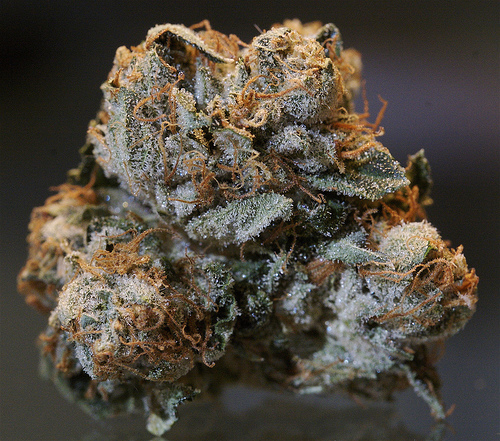
Kush_close

There's a new poll out on ending Prohibition on marijuana. This one's a CBS News' poll taken after the election, and it shows a 47 – 47 percent tie on whether marijuana should be legalized. When Obama was first elected, the same poll with the same question had the answer at 52 – 41 majority in favor of retaining Prohibition. And I'm not talking about medical marijuana here. I'm talking full-out legalization, regulation and taxation.

On medical marijuana, the majority is now 83 – 13 in favor. Debate over. More interesting to me is that of a majority – 53 percent – simultaneously believes that most of the medical marijuana prescriptions are "being used for other reasons." As we get more comfortable with acknowledging the hypocrisy, the hypocrisy itself begins to unravel.

(Photo: The dried bud of a Kush cannabis plant. From Wiki.)

Quote For The Day II

"If implemented, these [new settlement] plans would alter the situation on the ground on a scale that makes the two-state solution, with Jerusalem as a shared capital, increasingly difficult to achieve. They would undermine Israel's international reputation and create doubts about its stated commitment to achieving peace with the Palestinians," – William Hague, Britain's foreign secretary.