Commissioning A Knockoff

146584534

Art critic Jerry Saltz put out a call on Facebook for artists to create the perfect fake painting. Stanley Casselman stepped up:

When Stanley opened his door, I saw what looked like 50 large Gerhard Richters. I immediately had fantasies of getting rich, of opening a Fake Richter shop with him. Then I started looking more closely. All of the paintings seemed Richterian, but many had an Impressionistic, un-Richterian prettiness. Many looked too thought-out. Accidents looked intentional rather than discovered. His decisions stood out instead of taking me by surprise. Richter—who applies paint in scrims, in layers that emerge through one another—controls accident with a physical intelligence and subtle changes of direction and touch; his decisions are in an incredible call-and-response relationship to accidents. His abstract paintings look like photographs of abstract paintings. This creates glitches in your ­retinal-cerebral memory, so that you perceive this uncanny space between abstraction, accident, photography, process, the nature of paint, and painting. These didn’t.

Then, suddenly, one made my heart beat faster. Stanley grimaced. "That one’s not my best," he said. "You’re wrong," I told him. Then another struck me. He winced again, saying, "That’s a reject that had been cut out from another work." Then I understood that only when Stanley stopped thinking he was making a Richter could he make one.

(Photo: A woman passes by a painting entitled 'St John, 1988' by the german artist Gerhard Richter during the presentation of the exhibition 'Gerhard Richter: Panorama' at the Centre Pompidou in Paris, on June 4, 2012. By Joel Saget/AFP/Getty Images)

Is Food Art?

Sakir-10

Not according to William Deresiewicz:

If food were really a narrative medium, then all food would be narrative, just as the clumsiest and most simplistic story is. If food were really a narrative medium, it would also be able to speak about anything, to whatever degree of detail and specificity you want—not just, as with the curry, itself. Any made object can, in that sense, "tell a story," but only about its own making. A tall, green-eyed astronaut fell in love with a lawyer who recently lost her job: when you can cook me a dish that says that—and tell me how you’d change it if the astronaut were dark instead of fair—then we can talk about food as a narrative medium.

Food is ordered: but so are spreadsheets, or even regular sheets, when you make your bed in the morning. Food evokes emotions: but so do sunsets, or train sounds, or the cigarette smell of a bar. Food embodies ideas: but so does everything that’s made. To evoke is not to represent, and to embody is not to express.

(Photo from the geometric food art of Sakir Gökçebag, via Jobson)

The View From Your Window Contest

Vfyw_12-1

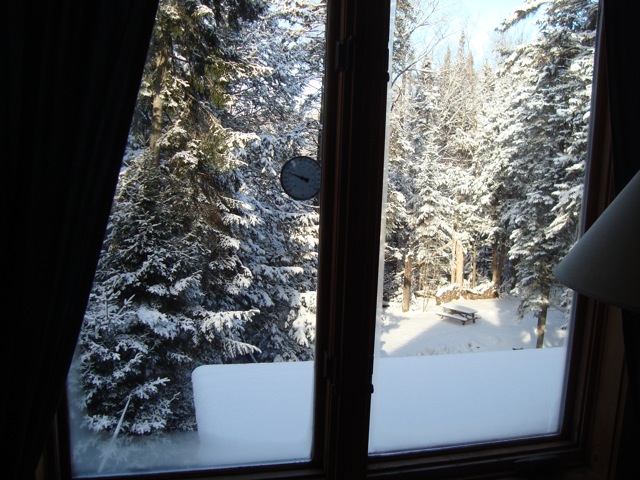
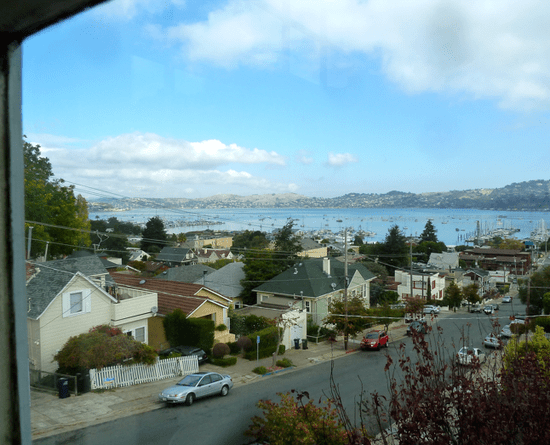
You have until noon on Tuesday to guess it. City and/or state first, then country. Please put the location in the subject heading, along with any description within the email. If no one guesses the exact location, proximity counts.  Be sure to email entries to VFYWcontest@gmail.com. Winner gets a free The View From Your Window book. Have at it.

The Gift Bot

As part of an art experiment, Darius Kazemi created the Amazon Random Shopper, a bot that randomly sends him gifts:

I built Amazon Random Shopper. Every time I run it, I give it a set budget, say $50. It grabs a random word from the Wordnik API, then runs an Amazon search based on that word. It then looks for every paperback book, CD, and DVD in the results list, and buys the first thing that’s under budget. If it found a CD for $10, then the new budget is $40, and it does another random word search and starts all over, continuing until it runs out of money, or it searches a set number of times.

He defends the "waste" of money:

The way I look at it is this: I’m spending $50 a month on art supplies. Some people might spend $50 a month on painting supplies: canvas, paint, brushes, etc. For me it’s a bit more abstract than that, but that’s what I’m doing.

His first shipment arrived recently. Rain Noe justifies the project:

Even without Kazemi's programming skills, many of us already have a similar crap-buying mechanism, though it only comes 'round during the holidays: They're called relatives.

(Hat tip: The Morning News)

Ask Massie Anything: What The Hell Is “Plebgate”?

From his bio:

Alex Massie is a Scottish journalist. A former Washington correspondent for The Scotsman, he has also written for The Daily Telegraph, Scotland on Sunday, The New Republic, The Daily Beast, The Los Angeles Times, Foreign Policy, National Review Online, The Sunday Telegraph, The New York Times, The American Conservative, Bloomberg Businessweek, The Observer, Slate, The Irish Independent, Newsweek and The Sunday Business Post. Since January 2009 he has written a blog that is published by The Spectator. In 2012 he was short-listed in the blog section for the Orwell Prize for political writing.

Follow that blog here. Watch his previous videos here, here and here.

Most Valuable Grandparents

Linda Besner explains the findings of a study suggesting that your mom's parents are the better half:

[Study authors Antti O. Tanskanen and Mirkka Danielsbacka] found that when one or both maternal grandparents were involved in a child’s life, the child’s behavioural and emotional problems were likely to be lower than average. When it was an equally involved set of paternal grandparents (or a single paternal grandparent), the involvement didn’t correlate with any diminishment of the child’s behavioural or emotional problems.

The researchers explain why this is consonant with contemporary theories of human evolution. "Difference between maternal and paternal grandparents has been explained with different reproductive interests: a daughter is not replaceable but a daughter-in-law is."

(Harsh words, kind of. I don’t have in-laws, and I’m not sure I want any if this is what’ll be going through their reptilian brains.) "It is in the paternal grandparents’ fitness interests to exploit the fertility of the daughter-in-law. By contrast, it is in the maternal grandparents’ interests to increase their daughters’ well-being for example by lengthening the birth intervals which can increase the survival probability of her already born children. Thus, maternal grandparents and matrilinear kin in general are expected to increase child survival more than paternal grandparents and patrilineal kin (Euler, 2011; Mace & Sear, 2005)."

A Penny Ignored Is A Penny Earned

XKCD_Penny

Randall Munroe does the math to prove it:

How much is your time worth? This obviously depends on a lot of things and varies from time to time and person to person. But for a broad estimate, I sometimes use a ballpark value of $10/hour—which is somewhere between the US minimum wage and the average wage—but you can adjust up or down to fit your preference.

If your time is worth $10 an hour, a penny is worth 3.6 seconds. If spotting and picking up a penny takes you more than 3.6 seconds, it’s a loss.

He goes on to calculate the cost and value of a penny given numerous other considerations.

Have Another Cup Of Joe

Lindsay Abrams sums up research on the health benefits of coffee:

Officially, the American Medical Association recommends conservatively that "moderate tea or coffee drinking likely has no negative effect on health, as long as you live an otherwise healthy lifestyle." That is a lackluster endorsement in light of so much recent glowing research. Not only have most of coffee's purported ill effects been disproven – the most recent review fails to link it the development of hypertension — but we have so, so much information about its benefits. We believe they extend from preventing Alzheimer's disease to protecting the liver. What we know goes beyond small-scale studies or limited observations. The past couple of years have seen findings, that, taken together, suggest that we should embrace coffee for reasons beyond the benefits of caffeine, and that we might go so far as to consider it a nutrient.