Playing Politics With Orphans’ Futures

Russian_Infant_HIV

A new Russian law bans Americans from adopting Russian children. Almost four dozen adoptions already in progress were terminated. Max Fisher largely blames Russia's domestic politics:

Is there something more to the ban than childish foreign policy? Could there be domestic considerations as well? As it turns out, the ban on American adoptions is remarkably popular in Russia. A new Russian survey finds that 56 percent support the ban and 21 percent oppose, a ratio of almost three-to-one. The support seems to stem from a belief that American families are dangerous, cruel, and at times violent to their adoptive Russian children. More than half of respondents who want to ban American adoptions cite either hostile American families or the fact that some adopted Russians have died in the U.S. A much smaller number say that Russian children would be best served by keeping them in their home country.

Jacob Sullum sees the ban as senseless:

The nearly adopted children affected by the new Russian ban are unambiguously worse off as a result, to the benefit of no one. It is hard to fathom how anyone could support such a policy, let alone almost every legislator in Russia's parliament. You say we abuse human rights? We'll show you! It would be comical if it weren't so cruel.

Recent Dish on international adoptions here

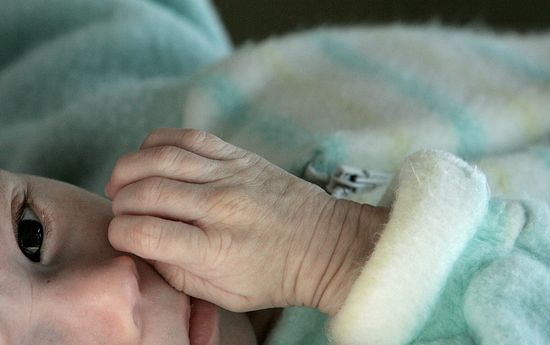
(Photo: A June 2006 photo shows Misha Gumenuk, 4 month old, during a medical treatment in an infectious diseases hospital in Moscow. More than 1,500 babies born to HIV-positive mothers are given up every year. By Maxim Marmur/AFP/Getty Images)
Face Of The Day

158770746

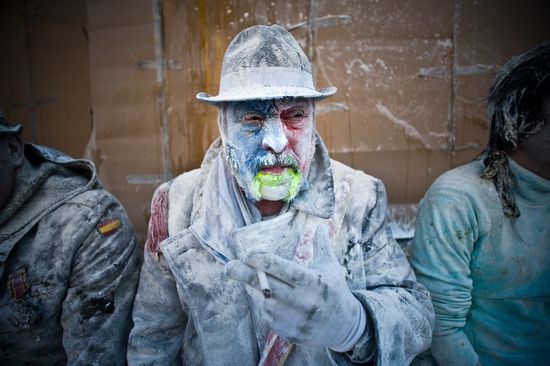
A reveller smokes during the battle of 'Enfarinats', a flour fight in celebration of the Els Enfarinats festival on December 28, 2012 in Ibi, Spain. Citizens of Ibi annually celebrate the festival with a battle using flour, eggs and firecrackers. The battle takes place between two groups, a group of married men called 'Els Enfarinats' that take the control of the village for one day pronouncing a whole of ridiculous laws and fining the citizens that infringe them, and a group called 'La Oposicio' that try to restore order. At the end of the day the money collected from the fines is donated to charitable causes in the village. The festival has been celebrated since 1981 after the town of Ibi recovered the tradition but the origins remain unknown. By David Ramos/Getty Images.

The Election’s Historic Black Vote

Pew breaks down the 2012 vote by race:

Blacks voted at a higher rate this year than other minority groups and for the first time in history may also have voted at a higher rate than whites, according to a Pew Research Center analysis of census data, election day exit poll data and vote totals from selected cities and counties.

Josh Marshall adds:

If you know the history of disenfranchisement in the African-American community, this is a pretty amazing milestone. I continue to think — and I’m not alone in this — that Republican sowed the wind with voter suppression tactics and reaped the whirlwind. Far from taking the edge off African-American turnout, which was the intent, it mobilized these voters to historic levels.

Kilgore provides more context:

Elections where African-Americans voted at higher rates than whites may be a brand new possibility at the presidential level, but not so much at the state and local level. I distinctly recall this happening in my home state of Georgia in 1998, producing a big pro-Democratic upset in a governor’s race with no African-American candidate present (significant increases in black turnout also helped Democrats win gubernatorial upsets in Alabama and South Carolina the same year—an entirely unexpected “Dixie Trifecta.”). What did happen in Georgia, however, was a late series of heavy-handed racially-tinged ads by a Republican candidate for Lieutenant Governor, run by his consultant, a guy named Ralph Reed, that helped mobilize African-American voters. You know, sorta like the poorly disguised 2012 ads attacking “welfare” and “voter fraud.”

No, It Isn’t The Season For Suicides

Aaron Carroll clears up a common misconception:

While the popular assumption is that holidays are a risk factor for suicide, people aren’t really any more likely to kill themselves around the holidays than any other time of year. In a study from Japan that looked at suicides between 1979 and 1994, the rate of suicide was the lowest in the days before a holiday, but the highest in the days after the holiday. In contrast, in a study from the United States, the number of suicides within a 35-year period did not increase before, during or after holidays – including birthdays, Thanksgiving, Christmas, New Year’s Day, or the Fourth of July.

However, a smaller study of adolescents in a different part of the United States did show an association between the dates when teenagers attempted suicides and the occurrence of holidays, with a peak in suicide attempts at the end of the school year.  Interestingly, in the United States, psychiatric visits actually decrease before Christmas and increase again afterwards.  Researchers speculated that this may actually reflect increased emotional and social support during holidays. The United States Centers for Disease Control concluded that holidays do not increase the risk for suicide. Suicide data from Ireland from 1990 to 1998 also failed to connect suicides with the holidays.  While Irish women were no more likely to commit suicides on holidays than on any other days, Irish men were actually significantly less likely to commit suicides on holidays.

Chart Of The Day

Ereading_Ownership

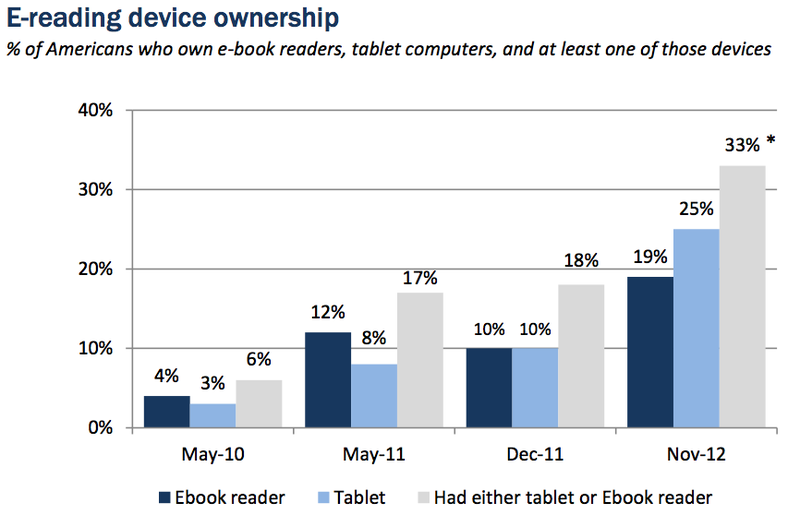
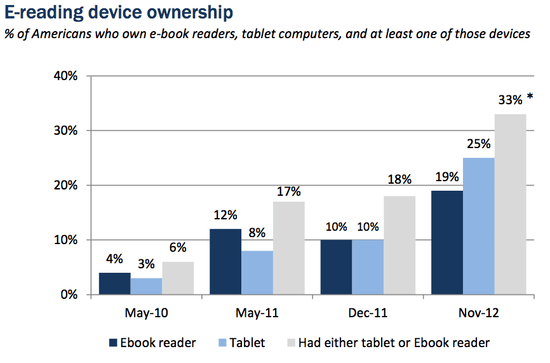
Ingrid Lunden goes over a new e-reading report:

According to Pew’s ongoing Internet & American Life survey, 25% of respondents — one in every four — now owns a tablet; while e-reader ownership is now at 19%. Biggest of all is the fact that now one in every three people owns some kind of device — tablet, e-reader or both — for e-reading. That’s more than a twofold rise for tablets over December 2011, when tablets and e-readers were level, with 10% of surveyed respondents said they owned one or the other. This most recent survey dates from November 2012 — meaning that the proportion is likely to rise even further after holiday sales shopping is taken into account.

Are We Going Over The Cliff?

Stan Collender suspects so:

Even though it will be one of the worst possible outcomes economically, It's hard to argue with the procedural simplicity of doing nothing because nothing would have to be debated, passed in the House and Senate, compromised or signed by the president. No votes, caucus meetings, press conferences or negotiating sessions. Chance of happening: 85%.

Jonathan Bernstein sees the cliff negotiations as political theater:

What is most likely is that everyone really knows that it’s easier to make a deal after January 1, but that no one wants to look as if they’re blocking it. In particular, once Obama flew back from Hawaii he needed something to do; that explains the White House meeting [today]. And once Obama was back, and with the Democratic Senate actually in session and conducting business, it was a potential public relations debacle to have the Republican House still enjoying their recess. So that explains the Sunday session.

Drum is on the same page:

[O]n January 1, taxes on the middle class go up and the economy slowly begins to slide into the great Republican Recession of 2013. That's the leverage that will finally force GOP leaders to get serious. Obama will never say so publicly, but I imagine he knows this perfectly well.

The Race For The Dish Awards

149787746

There are some seriously tight contests in the current voting – more than I can remember in the past.

For the Malkin Award, Neil Boortz and Charlotte Allen are neck and neck (break the tie here). In the Moore Award (for left-wing extremism), it's also extremely close between Amanda Marcotte and Jessica DelBalzo (vote here). Dick Morris looks like a shoo-in for the Dick Morris Award but Chris Christie and Erick Erickson are in a very tight race to win the much coveted Yglesias Award.

The poseur of the year is between Rob Horning on neo-liberalism and Robert Stacey McCain on the right's "manly endurance." May the best pretension win – but there's still time to cast your vote. The "Jehovah's Witnesses' anti-masturbation sign language" is battling it out with the "Fox News' Black Panther cam" for the Hathos Alert of 2012. This must be resolved. Take a sea-sickness pill, enjoy an orgy of hathos and then vote. In the Mental Health Break Award, both "Will The Real Mitt Romney Please Stand Up?" and "Dumb Ways To Die" are at 15.55 percent and 15.45 percent. Break the tie!

In the Face Of The Year, we also have a close one. It's between the dude meeting "Mitt Romney at Chipotle" and the anguished face of "Man Losing End-Of-Life Court Decision." I voted for the latter. As a face, it has everything. But you get to make the final call. And don't forget the "Chart of the Year" either. It's between the top ten defense budgets in the world and the demographics of Obama and Romney voters. Vote here.

To check out all the options and races at once, we have a single-serving post here. Have at it. And enjoy a slightly perverse review of the highs and lows and high-lows of the year of Our Lord, 2012.

(Photo: In this handout photo finish image supplied by Omega, Lisa Norden of Sweden is beaten by Nicola Spirig (Far Side) of Switzerland as they finish the Women's Triathlon on Day 8 of the London 2012 Olympic Games at Hyde Park on August 4, 2012 in London, England. By Omega via Getty Images)

The Year In Cannabis, Ctd

A new survey shows shifting attitudes among teens:

As states increasingly adopt laws allowing medical marijuana, fewer teens see occasional marijuana use as harmful, the largest national survey of youth drug use has found. Nearly 80% of high school seniors don't consider occasional marijuana use harmful — the highest rate since 1983 — and one in 15 smoke nearly every day, according to the annual survey of eighth-, 10th- and 12th-graders made public Wednesday.

More than one in five high school seniors said they smoked marijuana in the month before the survey, and 36% smoked marijuana during the previous year, according to Monitoring the Future survey of 45,449 students from 395 public and private schools. After four straight years of increasing marijuana use among teens, annual use among 10th and 12th graders stabilized and use by eighth graders declined slightly since 2010.

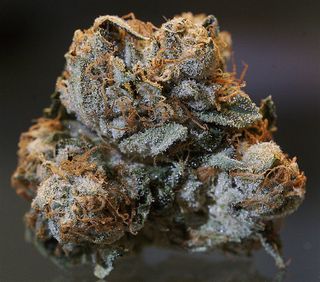
What to make of this? The first is that cannabis use in your teen years is not harmless, especially daily use. The brain is still developing and what can be harmless in adults as responsible recreation can harm kids' mental development. But the kids know that cannabis is used by very responsible Kush_closeadults, see it prescribed as a medicine in many cases, and know that you are more likely to overdose from water than from THC alone.

So how to get to these kids about the dangers of pot use in the teenage years? My view is that you legalize, regulate and tax it like tobacco or alcohol. Strict bans on sales to minors should be enforced. Adults can explain to their children that this drug may be pretty harmless among adults (much less harmful than smoking tobacco, for example) but can stunt development among kids. They should wait, in other words, as with alcohol. I cannot see this happening as long as marijuana is cool because it is illegal, is easily purchased in high school, and has no serious regulation to ensure quality. What we have now is an untenable situation: a culture where pot use has, in vast swathes of the country, been destigmatized, even as it is illegal. That breach needs to be filled.

The way to fill it is by ending Prohibition and get a handle on this problem with the young. Tobacco use is way down among teens, for example, as is much other drug use (in the same study that sees pot use soaring). They respond to facts. And until we have a wider debate about those facts – facts preposterously denied by the DEA – we will not get that rational response. One other small possibility: as cannabis becomes a routine recreational legal drug for adults, kids will find it much less exciting. When your parents do something honestly, simply and with a clear explanation, it tends to lose much of its teenage lustre.