The Weekend Wrap

Surry-ME-9am

This weekend on the Dish, we provided our usual eclectic mix of cultural, religious, and books coverage.

In matters of faith, doubt, and philosophy, Daniel Siedell praised Cézanne’s affirmation of creation, Brett McCracken contemplated joy, and Justin E.H. Smith turned to Emerson to explain his faith. Reinhold Niebuhr explained why real saints have a sense of humor, Mark Rowland meditated on how play is what makes life meaningful, Will Willimon argued that fiction lets us see God in the mundane, and Alain de Botton outlined our changing view of virtue. Adam Gopnik described how Galileo saw a heavenless sky, Ben Myers applauded Origen’s approach to deciphering the Bible, Suzanne Klingenstein connected scientific discovery to the Biblical myth of creation, and Scott Aikin and Robert Talisse critiqued the Stoic approach to life.

In literary coverage, Elizabeth Gilbert appreciated the writing life, William Faulkner named the best day job for a writer, and Preeti Chhibber taught us how to handle crying over a book in public. The poet Allen Ginsberg tried his hand at photography, Rowan Hisayo Buchanan found herself transfixed by Anne Sexton’s tale of a modern Rapunzel, and Peter Popham claimed Geoffrey Hill as a great, under-read poet. Amazon moved toward selling used e-books, Stephen Greenblatt and Joseph Leo Koerner defended a dead language, and Kenneth Goldsmith stood up for “Uncreative Writing,” a course he teaches at the University of Pennsylvania. Read Saturday’s poem here and Sunday’s here.

In assorted news and views, readers provided their views of this weekend’s blizzard, an Alberta-based reader responded with some local perspective on the continuing Keystone fight, Stephen Lacey saw how much money is wasted on the weekends in office buildings, and Jordana Rothman surveyed the current market for “flairtending.” A new study found that mixing diet soda with alcohol gets you drunker, Greg Beato profiled a Las Vegas anesthesiologist turned hangover specialist, Paul Miller discovered dating is difficult without the Internet, and Amanda Hess reacted to the new Facebook app, “Bang With Friends.” MHBs here and here, FOTDs here and here, VFYWs here and here, and the latest window contest here.

– M.S.

The Case Of The Missing Newspaper

Kevin Davis was incensed to discover his daily paper kept getting stolen from his doorstep. He staged a stake-out only to catch a man who looked very homeless:

I was reminded of the many people I’d seen busted for crimes, petty and felonious, when I was a reporter. It rarely felt satisfying to see them being carted away in cuffs, (except for rapists and murderers) and certainly not romantic. It wasn’t like TV at all. Most were poor, desperate souls, addicted to drugs or booze, locked in poverty, stuck with hopelessness, trying to make a buck or steal one.

When Robots Appeal To Our Emotions

Inspired by the the famous Milgram obedience study, robotics professor Christoph Bartneck set out to test whether humans would hesitate to shut down an anthropomorphized computer, with the results seen in the video above. Alix Spiegel revisits the experiment’s findings:

At the end of the game, whether the robot was smart or dumb, nice or mean, a scientist authority figure modeled on Milgram’s would make clear that the human needed to turn the cat robot off, and it was also made clear to them what the consequences of that would be: “They would essentially eliminate everything that the robot was — all of its memories, all of its behavior, all of its personality would be gone forever.”

In videos of the experiment, you can clearly see a moral struggle as the research subject deals with the pleas of the machine. “You are not really going to switch me off, are you?” the cat robot begs, and the humans sit, confused and hesitating. “Yes. No. I will switch you off!” one female research subject says, and then doesn’t switch the robot off.

Relatedly, Scott Adams predicts that in the future “robots will be so human-like that the idea of decommissioning one permanently will literally feel like murder”:

I assume that robots of the future will have some form of self-preservation programming to keep them out of trouble. That self-preservation code might include many useful skill sets such as verbal persuasion – a skill at which robots would be exceptional, having consumed every book ever written on the subject. A robot at risk of being shut down would be able to argue his case all the way to the Supreme Court, perhaps with a human lawyer assisting to keep it all legal.A robot of the future might learn to beg, plead, bargain, and manipulate to keep itself in operation. The robot’s programming would allow it to do anything within its power – so long as it was also legal and ethical – to maintain its operational status.

FedExing The Internet

Randall Munroe wonders when, if ever, “the bandwidth of the Internet [will] surpass that of FedEx”:

Cisco estimates that total internet traffic currently averages 167 terabits per second. FedEx has a fleet of 654 aircraft with a lift capacity of 26.5 million pounds daily. A solid-state laptop drive weighs about 78 grams and can hold up to a terabyte. That means FedEx is capable of transferring 150 exabytes of data per day, or 14 petabits per second—almost a hundred times the current throughput of the internet. …

Cisco estimates internet traffic is growing at about 29% annually. At that rate, we’d hit the FedEx point in 2040. Of course, the amount of data we can fit on a drive will have gone up by then, too.

A Heavenless Sky

With next year marking the 450th anniversary of Galileo’s birth, Adam Gopnik celebrates the astronomer’s genius:

He took the competitive, empirical drive with which Florentine painters had been looking at the world and used it to look at the night sky. The intellectual practices of doubting authority and trying out experiments happened on lutes and with tempera on gesso before they turned toward the stars. You had only to study the previous two centuries of Florentine drawing, from the rocky pillars of Masaccio to the twisting perfection of Michelangelo, to see how knowledge grew through a contest in observation. As the physicist and historian of science Mark Peterson points out, the young Galileo used his newly acquired skills as a geometer to lecture on the architecture of Hell as Dante had imagined it, grasping the hidden truth of “scaling up”: an Inferno that big couldn’t be built on classical engineering principles. But the painters and poets could look at the world, safely, through the lens of religious subjects; Galileo, looking through his lens, saw the religious non-subject. They looked at people and saw angels; he looked at the heavens, and didn’t.

Quote For The Day

“It is not without significance that the real saints of history, as distinguished from morbid, self-flagellating ascetics, have a delightful sense of humor, as had Francis of Assisi for instance. This sense of humor is based upon a curious quality of disillusionment which has not resulted in either bitterness or despair. It is without bitterness, because judgments of the fellowman are tempered by the forgiveness which is prompted by repentance. It is without despair, because no evils in the world can disturb the firm faith in the goodness of God and his ultimate triumph over evil. This quality of mirthful serenity is unlike the innocency of childhood which knows no evil. It has looked into the abyss of evil and is no longer affrighted by it,” – Reinhold Niebuhr, from “Childhood and Maturity” in Beyond Tragedy: Essays on the Christian Interpretation of History.

A Poem For Sunday

sunwindow2

“The Speed of Belief” by Tracy K. Smith:

In memoriam, Floyd William Smith 1935-2008

I didn’t want to wait on my knees
In a room made quiet by waiting.

A room where we’d listen for the rise
Of breath, the burble in his throat.

I didn’t want the orchids or the trays
Of food meant to fortify that silence,

Or to pray for him to stay or to go then
Finally toward that ecstatic light,

I didn’t want to believe
What we believe in those rooms:

That we are blessed, letting go,
Letting someone, anyone,

Drag open the drapes and heave us
Back into our blinding, bright lives.

(From the “The Speed of Belief,” a sequence of poems in Life on Mars © 2011 by Tracy K. Smith. Reprinted with the permission of Graywolf Press. Photo by Flickr user .reid)

Face Of The Day

fotdsun

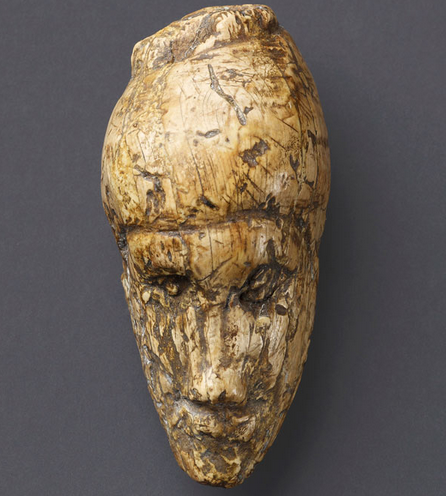
Julia Sklar marvels at a very old visage:

Twenty-six thousand years ago in the Czech Republic, one of our ice-age ancestors selected a hunk of mammoth ivory and carved this enigmatic portrait of a woman – the oldest ever found. By looking at artefacts like this as works of art, rather than archaeological finds, a new exhibition at the British Museum in London hopes to help us see them and their creators with new eyes. Human ancestors date back millions of years, but the earliest evidence of the human mind producing symbolic imagery as a form of creative expression cannot be much older than 100,000 years. That evidence comes from Africa: this exhibition explores the later dawning of representative art in Europe and shows that even before the remarkable paintings of the Lascaux cave, France, humans were able to make work as subtle as the expressive face above.

(Image: The oldest known portrait of a woman sculpted from mammoth ivory found at Dolní Věstonice, Moravia, Czech Republic. c.26,000 years old. Height 4.8 cm. Courtesy of the Moravian Museum, Anthropos Institute)

Naming The Little Things

In 2005, Yale University Press published, for the first time in English, Ernst Gombrich’s charming children’s book, A Little History of the World. A new companion volume, A Little History of Science was released recently, and Suzanne Klingenstein believes its author, William Bynum, captures something essential for children and adults:

He begins his second triad of 13 chapters with Bacon and Descartes, zooming in on Descartes’s insights that he had to start over again, and that he had to gain perfect clarity about the difference between matter and mind. In this second triad, Bynum moves—by way of Newton, Linnaeus, Lavoisier, Maxwell, Darwin, and many others—from the mind-body split to the sighting of bacteria. Bynum begins his third triad with the discovery of the mechanisms underlying infectious diseases, and moves in a grand sweep onward to discoveries of ever-smaller particles in physics and biology, until he arrives at bosons and the molecular building blocks of genes. And then, miraculously, one is tempted to say, the reversal happens: Out of these tiniest of particles, one of which (the Higgs boson) is still a conjecture, the huge blueprints of life emerge, a potential “theory of everything” via string theory and the Human Genome Project—both of which have come within cognitive reach only through splitting the world into ever-smaller elements. …

In the biblical “beginning,” the world is divided into ever-smaller units, ending in the emergence of the consciousness that names them.

Ordinary Enchantments

800px-Paul_Cézanne_048

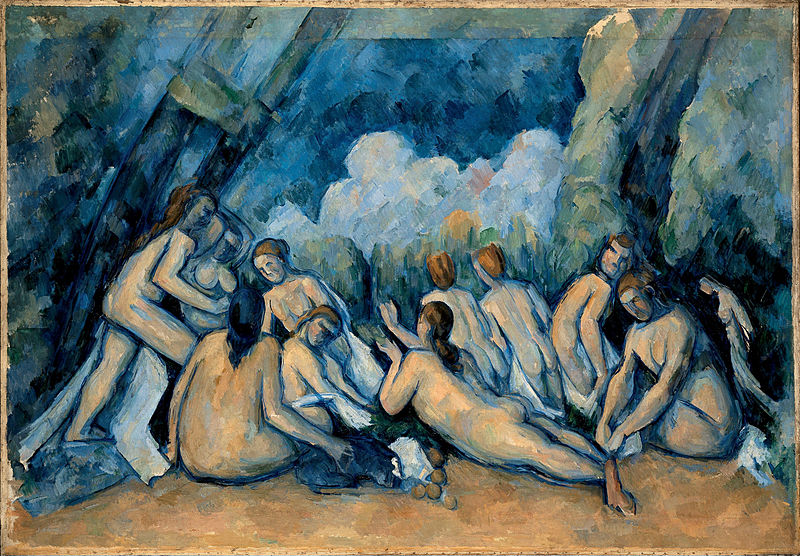
Daniel Siedell praises the painting of Cézanne, arguing that he recovered “the inescapable and indescribable mystery and terrible beauty of nature”:

One of the more important insights of the Reformation was to restore the dignity of the human being as a creature and the world as a gift. If Athanasius claimed that God became man so that man could become god, Luther argued that God became man so that man could once again become a creature, could take delight in his created, contingent, creaturely nature – become a happy human rather than a grumpy god. As Oswald Bayer writes, through Christ “we enter into a new worldliness.”

Perhaps this is Cézanne’s singular achievement. He returned painting to the realm of the creation. These paintings are worldly, creaturely. The critics noticed this. One hostile critic claimed that Cézanne could even paint bad breath. Too often art is regarded as a means to ascend the ladder of divine ascent, to aspire to the heavens and commune with the divine. For Cézanne art is a creaturely practice, one that revels in the givenness of nature.

(Image: Cézanne’s “The Bathers,” via Wikimedia Commons)