A symphony of shapes:
Year: 2013
The Tears Of A Bookworm
Preeti Chhibber describes “a few ways to handle leaky tear glands while surrounded by a bunch of strangers,” depending on the book that causes the crying. One example:
I finished Beautiful Ruins on a bus ride from Philadelphia to New York, sitting next to a girl I didn’t know. And you know what? It was gorgeous and I loved it and when I started crying there was a slight moment of panic, but then I thought “No! This is what it’s all about. Let it go. Who cares what this girl – oh, she’s asleep.” So I quietly sobbed and the one time she woke up, we had an unspoken agreement to not react to one another at all. It was glorious.
Pro Tip: There is no key takeaway, just cry however you want. The book’s worth it, the author did this to you, so just accept it and hope that no one instagrams you.
Relatedly, Sadie Stein shares a frightful childhood experience reading the Hans Christian Andersen tale, “The Little Match Girl”:
I was, to put it mildly, traumatized by the story. It haunted me. In the years since, I have learned that this is not an uncommon reaction; no fewer than two of my adult friends have revealed that, from time to time, “The Little Match Girl” intrudes on their thoughts and casts them into the doldrums. But as a seven-year-old, I was wholly unable to deal with my emotions. For days after hearing the story, I was quiet and withdrawn, my thoughts with the poor, cold match girl and her pathetic wares. My teacher, Mrs. Romer, noticed, and asked if everything was okay. I said yes, but one day, thinking of the tiny frozen body on the streets of wintry Copenhagen during a math lesson, I burst into uncontrollable sobs.
The fallout was humiliating. Mrs. Romer asked me to eat lunch with her privately so we could discuss what was bothering me; who knows what trauma she thought to uncover. I was too embarrassed to admit the actual source of my anguish—I knew it to be wildly babyish, as well as irrational—so I quickly concocted a lame story about my brother having the flu. I guess the implication was that I was afraid for his life; in any case, it was unconvincing enough that she called my parents.
The Right Job For A Writer
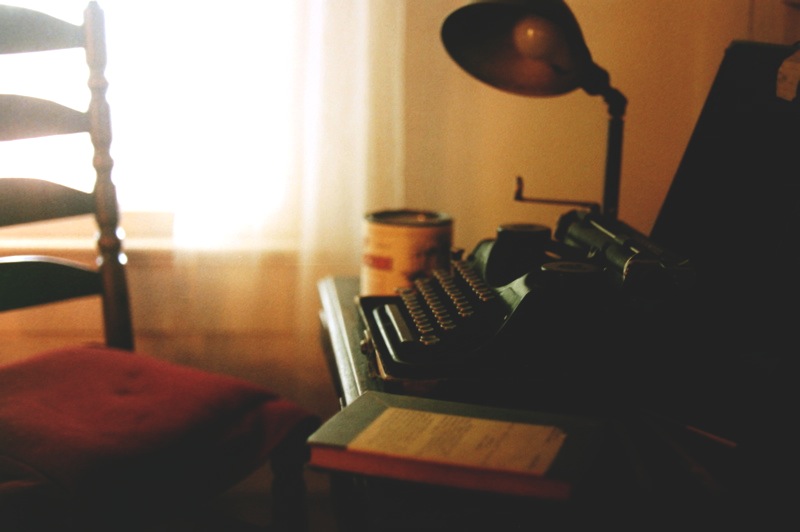
In a 1956 interview with the Paris Review, William Faulkner claimed, “the best job that was ever offered to me was to become a landlord in a brothel”:
In my opinion it’s the perfect milieu for an artist to work in. It gives him perfect economic freedom; he’s free of fear and hunger; he has a roof over his head and nothing whatever to do except keep a few simple accounts and to go once every month and pay off the local police. The place is quiet during the morning hours, which is the best time of the day to work. There’s enough social life in the evening, if he wishes to participate, to keep him from being bored.
(Photo: William Faulkner’s Underwood Universal Portable typewriter, resting on a tiny desk his stepson helped him build, via Wikimedia Commons)
Can Amazon Resell An Ebook?
Looks like they’re going to try:
[A] U.S. patent that Amazon Technologies in Reno, Nev., received last week indicates that the mega-retailer has its sights on digital resale, including used e-books and audio downloads. According to the abstract, Amazon will be able to create a secondary market for used digital objects purchased from an original vendor by a user and stored in a user’s personalized data store.
Marcus Wohlsen notes that “every digital copy is a perfect copy” and that a “customer given the choice between a ‘new’ e-book and a less expensive ‘used’ e-book will buy the used copy every time” because “extra expense of ‘new’ won’t get you anything better”:
[Bill Rosenblatt, a consultant and expert witness in digital content patent cases] believes that a digital resale marketplace wouldn’t ultimately make Amazon a lot more money on books or music, at least not at first. But he thinks it would move much more of Amazon’s digital content business beyond the interference of publishers, just as publishers can’t dictate the terms of, for example, the sale of used physical books on Amazon. Just as with physical books, publishers would only have a say — or get a cut — the first time a customer buys a copy of an e-book. The second, third and fourth sales of that “same” e-book would be purely under Amazon’s control.
Face Of The Day

Michael Zhang spotlights Oliver Turpin’s Snow Portraits:
Turpin shot a series of self-portraits, but instead of photographing his real face, he captured photos of imprints of his face in snow. After pressing his face into the snow for each imprint at night, Turpin was able to photograph the imprint by illuminating the snow from below. The resulting mugs are rather creepy and slightly reminiscent of the Shroud of Turin.
See more of Turpin’s work here and follow him on Twitter here.
Writers Could Have It Worse
Elizabeth Gilbert takes Philip Roth to task for encouraging Julian Tepper, a young writer, to “quit while he’s ahead”:
[I]s writing really all that difficult? Yes, of course, it is; I know this personally–but is it that much more difficult than other things? Is it more difficult than working in a steel mill, or raising a child alone, or commuting three hours a day to a deeply unsatisfying cubicle job, or doing laundry in a nursing home, or running a hospital ward, or being a luggage handler, or digging septic systems, or waiting tables at a delicatessen, or–for that matter–pretty much anything else that people do? Not really, right?
In fact, I’m going to go out on a limb here and share a little secret about the writing life that nobody likes to admit: Compared to almost every other occupation on earth, it’s f*cking great. I say this as somebody who spent years earning exactly zero dollars for my writing (while waiting tables, like Mr. Tepper) and who now makes many dollars at it. But zero dollars or many dollars, I can honestly say it’s the best life there is, because you get to live within the realm of your own mind, and that is a profoundly rare human privilege.
The View From Your Window Contest

You have until noon on Tuesday to guess it. City and/or state first, then country. Please put the location in the subject heading, along with any description within the email. If no one guesses the exact location, proximity counts. Be sure to email entries to VFYWcontest@gmail.com. Winner gets a free The View From Your Window book. Have at it.
Free Money At The Office
Stephen Lacey sees some:
If you’ve ever walked into your office building on a weekend, you’ve probably experienced one of the most easily identifiable energy-efficiency problems. Chances are good that the empty building was as warm or cool as it normally is on the weekday when the building is at full occupancy — sucking all that electricity to keep the building comfortable for no one except you. Lucky you.
[FirstFuel] remotely examined utility data for 60 million square feet of commercial buildings across the U.S. When it analyzed the sample buildings, it found that slightly more than half of energy efficiency opportunities could be realized with simple operational improvements.
“Party Triage”
Greg Beato profiles Dr. Jason Burke, a Las Vegas anesthesiologist turned hangover specialist. Beato wonders if treatment could change the way we party:
Redemption cocktails may not be the ultimate, instant miracle cure that eliminates hangovers before they ever happen, no IVs necessary, but in a way they offer something just as revolutionary: They’re medical treatment as entertainment, medical treatment as luxury indulgence. … In this model, recovery becomes its own phase of the party, a communal experience to share, a tweetable moment. Indeed, right now, the four patients have taken out their phones and started snapping photos of one another. “Hey, doc,” one of them asks. “Will you stand behind us in a pic, so it’s official?” Poses are assumed, cameras are aimed, everyone smiles. The party ended hours ago, but the fun never stops.
The Continuing Keystone Fight, Ctd
David Roberts called for activism in the Keystone XL fight. An Alberta-based reader responds with some local perspective:
Your David Roberts quote (Fuck you. Watch me) reminded me again that Americans know so very little about Canada and Canadians and what the tar sands represent to the people of Alberta. I live in Alberta outside Edmonton. You’d have to look long and hard to find anyone from here to the far north whose life isn’t touched to one, or many degrees, by the oil industry. By and large, we’ve ridden out the current recession thanks to the tar sands and aside from a small (compared to the overall population) number of activist groups, everyone here knows we have the tar sands to thank for our standard of living.
Without a pipeline, the bitumen will flow by just rail, where the likelihood of derailment makes a spill more likely than shipping by pipeline, and Albertans will support any means to ship bitumen because they know it is the source of the province’s economic well-being. In fact, the common response to activists around here (especially American ones) is a snarling “fuck off”. No one here is willing to downgrade their standard of living so Americans can feel better about not actually giving up their first world lifestyle, which makes development of the tar sands profitable in the first place.
Rebecca Penty reports, the company behind Keystone XL is already looking at other modes of moving oil from the tar sands to the coast. Another reader thinks the activist attitude is counterproductive:
[T]he dark side to activist logic is the valuing of emotion and symbolism over practical needs. Looking at the oil sands, sure, it’s awful for the environment. But you know what’s worse? Coal. Without the oil sands, humanity will carry on consuming 148 terawatt hours of energy a year, we’ll just do it in a haze of coal smog.
I look forward to the day when we reduce energy consumption and produce enough renewable energy to stop using fossil fuels altogether, but until that wondrous day comes, the environmental movement needs to recognize a lesser evil when it sees it.
 The Dish
