
Bigfork, Minnesota, 4.42 pm
Bigfork, Minnesota, 4.42 pm
PPP has been conducting polls on how Americans view their media outlets for four years now. Fox is both the most trusted media source and the least trusted at the same time. This hasn’t changed much over the years. But its continued evolution into pure partisan propaganda, and its creation of an entire alternate reality in the last election cycle has had an impact, especially on the middle:
41% of voters trust it to 46% who do not. To put those numbers into some perspective the first time we did this poll, in 2010, 49% of voters trusted it to 37% who did not. Fox has maintained most of its credibility with Republicans, dropping just from 74/15 to 70/15 over that period of time. But it’s been losing what standing it had with Democrats (from 30/52 to 22/66) and independents (from 41/44 to 32/56).
It’s the independent number that matters – as in the election. Guess which network is the only one a majority trusts? PBS. That alleged bastion of liberal bias – which Mitt Romney wanted to defund – is now trusted more than any other media source. Congrats, Roger Ailes. You’re doing for the liberal media what Karl Rove did for the Democratic party.
Tim Parks’ recently praised grammar police for their role in making literary innovation possible – particularly noting the editor’s part in finding which newfangled styles actually work. John Simon recounts his experiences editing three giants of the mid-20th century American intellectual scene, W.H. Auden, Lionel Trilling, and Jacques Barzun:
Auden, who was jovially insouciant, handed in smart but sloppy stuff that needed a lot of editing, which he readily and gratefully accepted. Trilling was more difficult. Always by telephone, one went over proposed changes, some of which, after some discussion, he accepted, some not.
Barzun, however, one was not allowed to edit. Everything, down to the last comma, had to be left as it was, even where — an admitted rarity — improvement was possible. When we spoke on the phone, I could conjure up my interlocutor. He was undoubtedly smiling his frosty smile, one part convivial and two parts condescending. Since he was tall, the smile, when delivered in person, would literally descend upon you, accompanying an elegant diction that itself had a sort of smile in it.
Sal Robinson, musing on both pieces, considers the nature of the editing task, urging those wielding the red pen to remind themselves everyday “to check absolute senses of rightness and wrongness”:
There is, indeed, a conservative tendency to editing at times — a worry that the book won’t sell or will be misunderstood, a leariness about putting between covers and into the public record something bizarre or unfamiliar. But I think it’s fair to say that in many of these cases we may be underestimating readers, who read all kinds of things all the time and absorb them willy-nilly, double quotes outside the period or no. And who (often but not always) turn to reading in the first place for linguistic surprise, for daring, for saying what can’t be said elsewhere.

The conversation continues:
Hitch: It makes me laugh when people say “fundamental,” because what it means is you believe that these books are the word of God. That’s what fundamental means, fundamentalist means. If they’re not, then in what sense are you religious? If I ask you—
Andrew: You can say that they are inspired—
H: If someone says to me, “I’m a Catholic,” I say, fine: Does this mean that you believe in the following: in the transubstantiation of bread and wine, etc. … On the whole they’ll say, “well, you don’t have to believe all of them…” Now excuse me, that may be possible now, but there would be no such thing as the Catholic Church if people had not been forced to believe this, compelled to believe, or—though I doubt it myself, really do doubt it—may actually have believed it at the time. Without it, what’ve you got but some menu of spirituality options that you might as well have as a Hindu?
A: Well you can have it as a Hindu, in some respects. Although, the kind of way of life as being portrayed in the Gospels as a way to live is a little different than Hinduism for example, or Buddhism. I think there are overlaps.
H: But Andrew, I wouldn’t bother with this, I would let these beliefs exist in a parallel universe except for argumentative purposes and dialectal purposes. It’s nice, I enjoy discussing with Jesuits—nothing could be more agreeable—as I would with a Hegelian or a Randian or any of the above. But much more than Hegelians and Randians, these people want to influence my life. They say I want your children to be taught things that aren’t true.
A: No, no, my point is that the kind of religion I’m talking about—because it is much more aware of the provisionality of its own knowledge—is a much humbler approach to the divine. And certainly, someone like me would say, “This is what I believe but even I, at some level, cannot give you reasons for this; I cannot explain it entirely; I think this is how I’m trying to figure it out for myself”. The last thing on Earth such a religion would do is tell you how to live your life. Now I understand most religions are not that way, but I am trying to say that at some level, some way of being at peace with one’s own mortality and have some understanding of why we’re here, does not necessitate—even though it’s often accompanied by—the desire to control anybody else’s life. I don’t see Jesus trying to control anyone else’s life.
H: Why don’t you let me make the assumption, or make the claim, that I take the words and the positions of a true believers seriously and that I respect them. When I examine these beliefs I find that they cannot be private. It is not possible for someone to really believe this, and especially its redemptive character, and watch me go straight to hell. They would be failing in their duty, they must save me, even if it means killing and burning me would be best.
A: Not if what stops them is their understanding of their own doubt. Doubt and faith can co- exist.
H: How can this be allowed if you know God’s will?
A: You don’t know it, you think you know it.
H: When I was a Marxist I used to think, or sometimes was tempted into thinking, “look, people may not realize they need this, but they really do and the consequences of not adopting—“
A: Well, there you are, that was a religion you had.
H: Well, it was not a religion in the sense that I accept but I’ll take it as a dogma. The feeling one had was, “many don’t seem to want what we’re telling them, but the consequences of not adopting an international socialist program would be so bad that one might have to give people the occasional nudge. It’s for their own good. Marxism has its glories, but its principal failing must have to be accepted as that, the idea of false consciousness.
A: Ratzinger has this concept, too. He gave this astonishing talk in Dallas in 1991—I put it in my book—where he describes what he understands to be conscience. And the Second Council, though it took two millennia, did actually make a significant shift to say that we do recognize that the individual conscience alone is the ultimate arbiter of one’s own faith. Ratzinger, I think having pioneered that idea with Kung, subsequently pulled back from its implications.
H: Which are obviously heretical and incompatible with true belief.
A: Well his argument, in Dallas of all places…(laughs) “Ratzinger in Dallas.”
H: God is everywhere.
A: It’s like “Dusty in Memphis.”
H: All is decided by Heaven, all praise belongs to Allah.
A: His argument was: If your conscience tells you one thing, and the Holy Father through the authority of the Magisterium has determined something else, then it is not your conscience against the hierarchy; there is actually, beneath what you think is your conscience, your real conscience which must, because you’re made by God, understand already, that you’re wrong. It’s the false consciousness mode, again. You may not realize that you need their authority, but you do. But that is not the obliteration of conscience altogether…
H: I could, in a Platonic sense—in the proper sense of the word, deriving from Plato—I could concede, or even concur, that that might be true. What I could not accept is that Ratzinger could know and not me. That he had the right to interpret it. Who is this Herr Ratzinger? By what right does he arbitrate it? Do these people want power in this world or the next? It’s always this world. That’s how religion strikes me as absolutely material, nothing to do with the spiritual or after-existence. They want power now and they’re very wise to. When else would you want to have power?
A: Well of course, there’s no other place to have power.
H: It could be that astrology was true. It could be, for example—I can’t prove it isn’t—that the movement of the planets determine my future, and that that’s what they’re there for; they know that I’m Aries. Though why and how they manage to cover the shift between the Julian and Gregorian calendar would still be a mystery to me—it wouldn’t be the main mystery—but okay, let’s agree. The planets know my future and they determine it. I could agree to that, and I could agree that there could be a computer in a building that I had never seen that was running this permanent experiment: there’s my life, being lived by me, and there’s a computer predicting it, day by day, before I could see it.
Once I could see the computer, it wouldn’t be true. Once I’d read my horoscope, it wouldn’t be true, by definition. So all the other perfectly brilliant arguments against astrology—such as identical twins don’t have the same future, most of the planets weren’t discovered when the Zodiac was drawn, many other such objections—are nothing to me: No one can tell me that they know what the planets are doing.
So there couldn’t be astrological priesthood. So, ever since I had learned to think in the least, and among other things, see through astrology I saw through everything else in much the same way. It could be the case – I’m not, and no one else is, clever enough to tell me it isn’t – but no one is clever or moral enough to tell me that it is. So I return to my point, we begin by excluding those who claim to know. And I think that is Occam’s Razor in practice.
A: Well it does make religion much more private, meditative. I mean Gandhi, for example, was not going around seeking that much power, at least in his religious mode.
H: I wish that was true.
A: Jesus, specifically, does not seem to be interested in actually acquiring power in the Gospels, to any degree.
H: No, a very modest guy. Unassuming, as long as you accept him as in some way, the son of God. He never claimed to be exactly that, but spoke rather loquaciously about his father and suggested that he knew the way to paradise. As long as you accept these incredibly arrogant claims on his part, he’s a very modest guy, almost unassuming, self effacement…
A: (Laughs.)
H: He’s not like the Prophet Mohammad, really interested in material gain, warfare, spoil, conquest. No, he’s not like that.
A: At all.
H: Gandhi, I think, was a bit more ambitious than you allow.
A: But, these arrogant claims nevertheless were not, by him at least, turned into a doctrine or a church as he lived.
H: Well, his disciples couldn’t have been Christian, for one, because they had not read any of the Gospels. They couldn’t have been able to, among other things, they were written long after they were around. So, they can be excluded as non-Christian. And he too, because there is really no evidence—and this is conceded by most serious Christians, too—that he desired to found a church or have one founded in his name. It’s very plain that he expected his followers to see him again in their own lifetimes.
A: And it’s very clear that they expected to see him again in their own lifetimes.
H: And they were wrong, weren’t they?
A: Yeah.
H: So every time people say “Christ is risen” at Easter for the next 2,000 years they’re wasting their time, and other people’s. It’s just not gonna happen and to sow the false hope that it will—
A: Well, the Christ has risen thing is not about the Second Coming, it’s a reference to something that has already occurred.
H: Yes but it’s a promise. If you can do it once…
A: I think you could shear, if you will, Christianity of the Second Coming.
H: All you have to believe in then is resurrection, which in the Bible occurs routinely. It’s a commonplace. According to the Gospels, the graves are opened all around Jerusalem at around the time of the crucifixion and many strode out of their tombs and greeted people in the streets. At least two people are resurrected on request by the Nazarene, Jairus’ daughter and Lazarus, who nobody interviews about their extraordinary experience and nobody finds out about their subsequent life.
Did they die again? We don’t even know. Were they resurrected in the form of the body that had previously died on them? We’re not even told that. Resurrection, however, was not considered particularly remarkable at that time. But never mind, I concede all this: Jesus rose again from the dead. It doesn’t prove one thing about the truth of his doctrines.
A: No.
H: Resurrection’s an old myth. It doesn’t vindicate the claim of someone who makes it.
A: Well in my mind the big—and you know, I’m committing heresy throughout this entire conversation—
H: And you’re better for it.
A: For me, the Incarnation is a much more central doctrine than the Resurrection. The Resurrection, in some ways, is the necessary consequence of the Incarnation, because it’s hard to think of God dying a mortal death.
H: Not for me. Actually, I take that back, it’s hard for me to think of him living.
A: Right. Well, it’s hard for me to think of him dying. (Laughs.)
H: Alright, that’s one difference I’d split.
To be continued.
(Photo: Pope Benedict XVI attends the 2012 World Meeting of Families at Meazza Stadium on June 2, 2012 in Milan, Italy. By Vittorio Zunino Celotto/Getty Images.)
Nature advocates for approval of the pipeline, in order “to break out of the mould and lay the foundation for something larger”:
[T]he pipeline is not going to determine whether the Canadian tar sands are developed or not. Only a broader — and much more important — shift in energy policy will do that. Nor is oil produced from the Canadian tar sands as dirty from a climate perspective as many believe … By approving Keystone, Obama can bolster his credibility within industry and among conservatives. The president can also take advantage of rising domestic oil and gas production to defuse concerns over energy security. … But all will be for naught unless the president can build on these trends and somehow reset the climate discussion.
David Roberts counters, stressing the difference between wonks and activists:
Economists and Very Serious People keep telling the movement that it can’t stop the tar sands entirely. The only sensible response is, “F*ck you. Watch me.” … As I’ve said many times, wonk logic and activist logic are different. A wonk ranks fossil fuel projects by tons of carbon per unit of energy. An activist looks for opportunities to break through the news cycle, to force confrontation, to create a symbol, to build a movement. Neither logic trumps the other.
Embroidery is so fucking rock ‘n roll:
Nate Rawlings details the logistics of shipping our military hardware in Afghanistan back to America:
One of the first considerations is cost: is it worth the trouble and expense to ship a given item home? A quick trip around the yard reveals hundreds of white four foot by four-foot cardboard containers called “kicker boxes,” each of which costs $1,200 to ship back to the United States or other military depots around the world. As Pagan rummaged through a random box, he pulled out several small pieces of gear worth about $20,000 each. Many of the boxes, he explained, can contain as much as $200,000 worth of equipment.
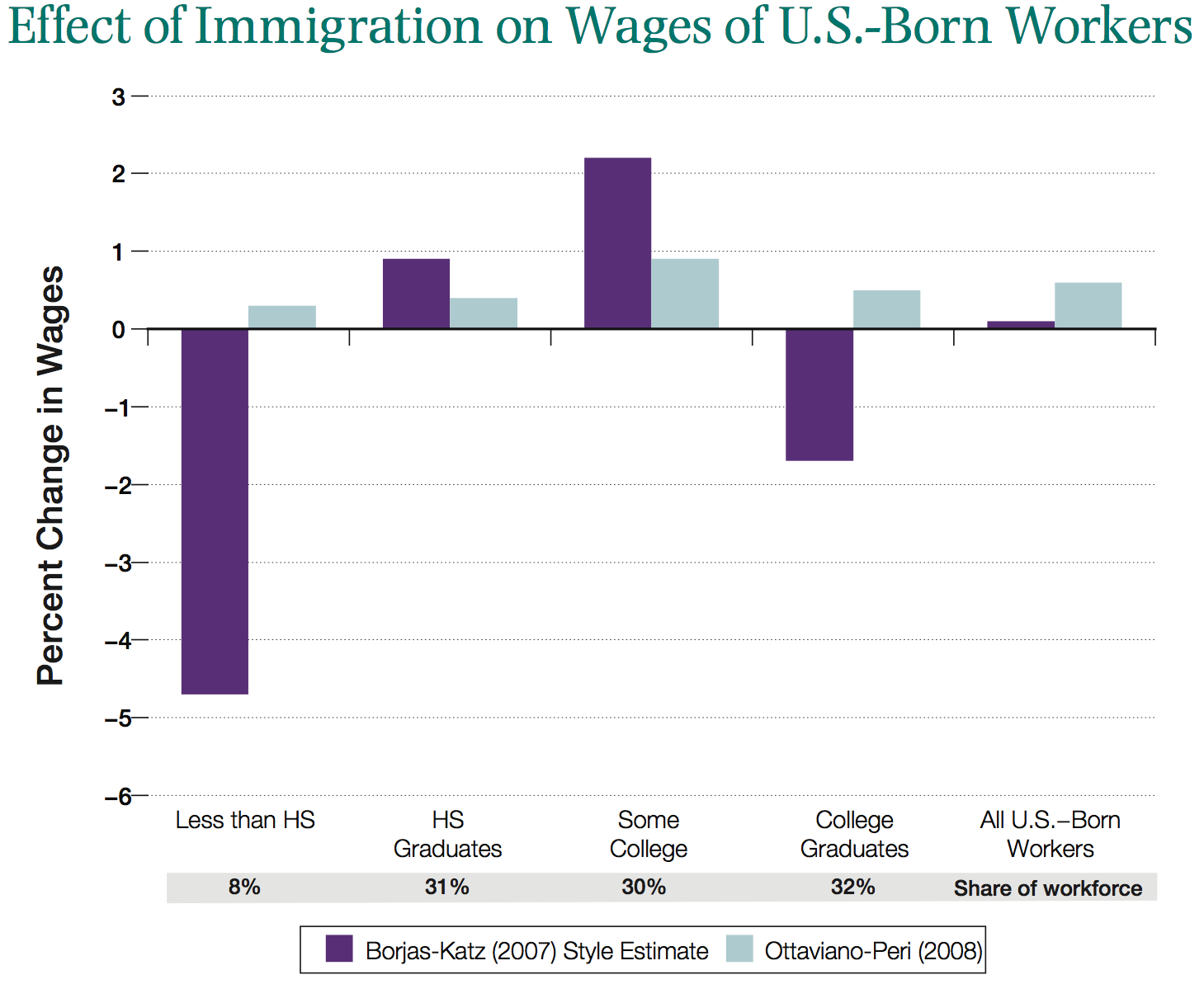
Catherine Rampell finds that “the general takeaway from conservative and liberal economists is that immigration is good for Americans’ living standards over the long run.” But, she notes, there “is some disagreement about whether the wage benefits of immigration are evenly distributed among all workers”:
The chart [above] was created [pdf] by the Hamilton Project and is based on this 2008 study. It shows the results of two different economic models designed to estimate the effect that immigration from 1990 to 2006 is likely to have had on wages for American workers (after adjusting for inflation).
The purple bars represent estimates based on research by George Borjas and Lawrence Katz, and show that immigration may have lowered the wages of American-born high school dropouts by 4.7 percent and those of college-educated workers by 1.7 percent. The blue bars show the results of a different model, created by Gianmarco I.P. Ottaviano and Giovanni Peri, that finds that all educational groups likely benefited to some small degree.
Paisley Currah, chair of the political science department at Brooklyn College, addresses the controversy:
By cosponsoring student-initiated events, we’re not endorsing the ideas expressed. We’re not providing money. What we are doing is acknowledging students’ contributions to the intellectual life of the campus and supporting the open and free exchange of ideas.
And there’s no political litmus test. In my 18 years at Brooklyn College, I cannot recollect our department turning down a single cosponsorship request. Since this controversy broke—despite claims to the contrary—no group has contacted the department requesting cosponsorship of a specific event or actual speaker representing alternative or opposing views on BDS.

A reader writes:
Just a quick response to the reader who said that you had too much white space, needed borders, etc. I love the white space, love how it looks clean but still feels new (not like it’s just the tumblr minimalist theme again!)! It feels like I’m reading a book, only bloggier. Also, just an added fun fact from someone who is a grad student studying the history of the book: medieval manuscripts often had very large margins, partially for glossing, commentary, and marginalia, but also partially to elevate the text (not the the Dish needs elevation). Cheers and good luck – I’ve sent in my $50.
Another also likes the spartan look of the new Dish:
It’s so sleek and clean and stylish. I had never realised that the adverts annoyed me until I see the site without them. There’s a parallel you might want to look into – the city of Sao Paulo banned all outdoor advertising and people’s mental health hugely improved.
Another:
So this is dorky, but i got a weird rush of pride and community upon signing into the Dish on my devices and seeing that light blue “Subscriber” block appear atop the screen. So I need a t-shirt now with the new Dish baying beagle logo on the front, and on the back, across the shoulder blade, the light blue Subscriber button. Make it happen. Take my money. Or ship me a free one for the merch idea. I’ll pay for the mug.
Merchandise is definitely on our radar, but we want to wait a while until we get our bearings with the new pay-meter and everything else we are grappling with regarding the new Dish. Another reader says, “My favorite thing about the new site is the beagle in my RSS reader”:
Another:
As a programmer, I’ve just noticed something that totally blew my mind and gained me a new respect for the Dish’s technical skills (which are not usually that high, by Andrew’s own admission). When you scroll down, not only is it an infinite scroll (nothing new here, but still kudos), but the URL changes to reflect that you’ve just moved into the next page, allowing you to copy the URL and arrive to the same spot again if you want to. RESPECT.
Another:
Love the infinite scroll, but the archives … where to begin. I first went to the very beginning, the prequel to the Bush Presidency. I have so many questions. Do you go back and read them sometimes? What a record of thought this all is, and I hope it goes on for a very long time.
We are planning to excavate all kinds of excruciating content from the Dish archive, including a feature called “Sullyfreude”, which will highlight my most embarrassing or Dick Morris-esque analysis. But we figured you’d probably get there first. Another reader:
As a stay-at-home dad, I have to make careful and thoughtful choices about how I will spend our one income (from my wife’s work). As I watched discussion of your new pay model, I thought I would be one of those who would wait and see whether or not I would want to subscribe. I mean, I love the Dish, and it is an incredibly low entry price, but it still a choice of spending money of which I need to be prudent.
Well, I have now visited the site two or three days in a row since you have migrated. I see absolutely no distinction between what a paid subscriber would receive and what a non-paid reader like myself is receiving. What is the value proposition for being a subscriber?
That’s because after two days, we’ve been going easy on the meter. We’ll adjust as we go along. We want to keep the majority of the site free, but the deeper analyses, reader threads, my own writing, and other features will slowly become less accessible to the non-subscriber. It’s a balance, and we’re trying to figure our way forward with it. Since we’re among the first to do this with a blog, we’re agnostic about what might work and will adjust as we learn and you inform us – for which much thanks. Another reader offers some interesting insight:
I have been a reader of your blog for years and on occasion would hit the ‘read on’ button. Now that I am a subscriber, I am ‘reading on’ more frequently. Just trying to get my money’s worth? Maybe. Whatever the case, I now see a more complete picture. I don’t agree with you on everything and sometimes I don’t even understand what you say, but I enjoy the challenge.
Another makes a good suggestion about our business model:
I spent many years working in the nonprofit sector. While I am sure you have your business model pretty well figured out, if you operated as a nonprofit entity or even a LC3 – which is like a LLC married to a nonprofit – it would allow you to take grants like a nonprofit, creating a new revenue source. Propublica is a current example of a nonprofit news agency. In fact, your “pay as much as you like” subscription is much more akin to a nonprofit donation than it is a fee for service for-profit. As a nonprofit you would still be able to pay a competitive salary to you and your staff. However, instead of subscription fees going to pay shareholders needing to make a profit, and instead of business decisions being made to maximize shareholder profit, subscriptions (or donations) would go towards your contribution to the common good – that common good being an informed democracy.
As a donor to a nonprofit news agency, my value proposition is supporting an informed democracy and therefore there is no need to differentiate between the benefits received for a donor or non donor, vs. with a for-profit subscription service there is a need to differentiate benefits or access between a subscriber or non subscriber because subscribing suggests a received benefit for my purchase. Thanks for listening and thanks for the continued good work!
Another:
When you first announced that you were going to your new site, I was excited for you but didn’t want to pay yet because I was VERY CONCERNED (I sent you an email about it) about continuing to read the site on my preferred RSS feed, Google Reader. I’m thrilled to see that the blog still functions perfectly as an RSS; I noticed nothing different from Friday -> Monday.
Then an evil little part of my brain said to me, “Nothing’s changed – it was free for you before, it will continue to be free for you now; save your money.” But yesterday, I sent you the InFocus slideshow of the Vikings (I couldn’t have been the only one!). I actually squealed a little bit when you replied to my email with “oh joy”, and then you used one of the pictures as the Face of the Day with a comment about the beards. I felt like I really WAS a part of the community.
Needless to say, I just sent in my subscription (plus some extra $). I could keep reading your site for free, but I feel like being a part of the community means not just hanging out on the periphery and watching the show from afar; it means being a full participatory partner and bearing the various (minor) costs associated with that membership. Happy to be onboard.
And we’re happy to have you. Another:
Congratulations on the launch! The site looks great and I’m looking forward to getting used to the new format. Only one slight suggestion for you, and I know this flies in the face of your love for the new white space. The Dish header, with the beagle, could really use one off-setting color as a background. Maybe just a stripe not wide enough to cover the whole thing. That is all. No suggestions that would slow page load or anything.
All suggestions are welcome and appreciated, even if we don’t use them. Here is one from last week we did use:
One thing I love: clicking on an external link opens a new tab in my browser! I don’t know why more sites don’t do that.
We also just brought back the “Email” buttons at the bottom of every post, at the request of many readers. We are trying to implement as many feasible suggestions as we can. After all, it’s your blog too – and now you help pay for it.
(Photos of Dish readers, used with their permission)
 The Dish