Britain, France, And SCOTUS

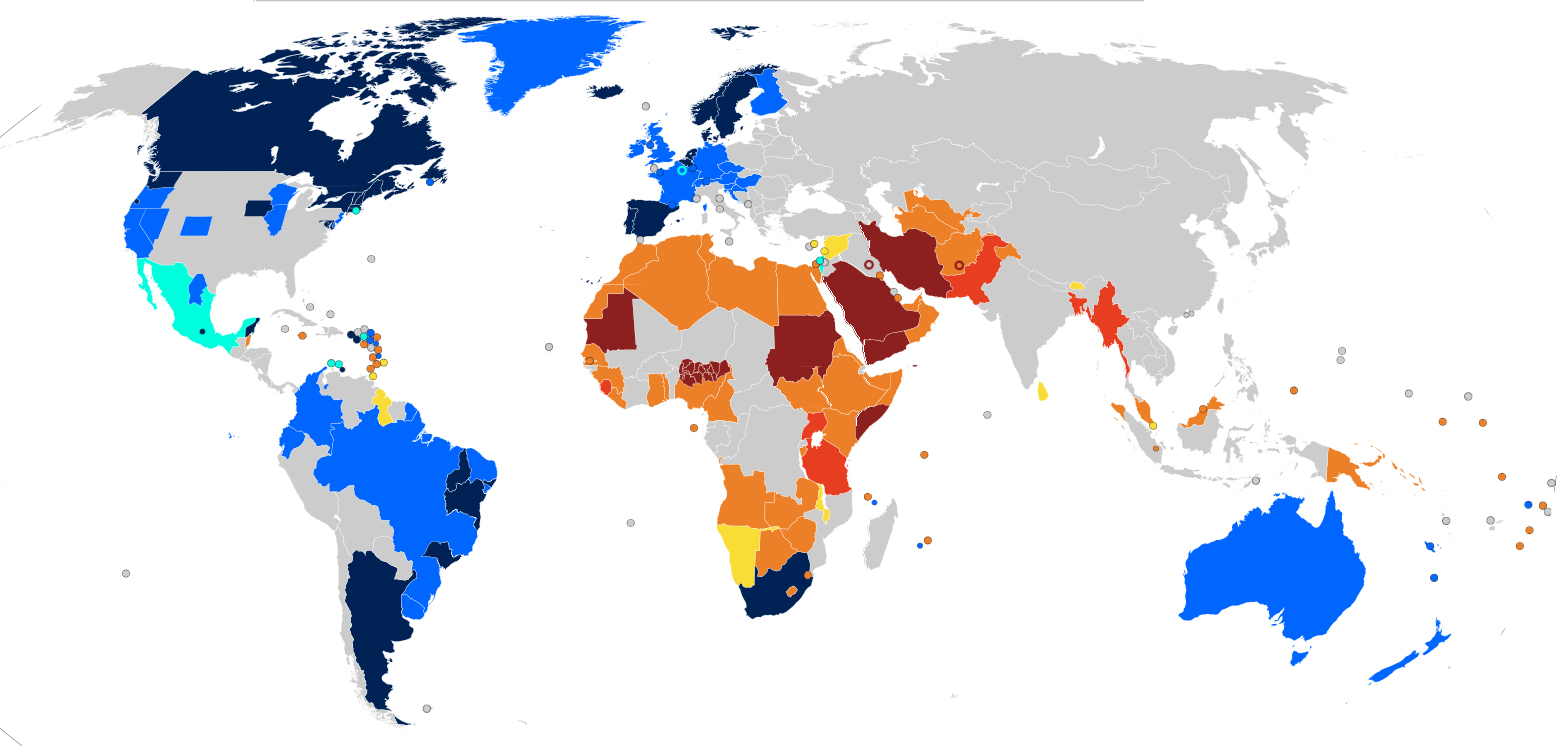
Marriage Globe

Two of the wealthiest Western democracies are now on the verge of having full marriage equality: Britain and France. The vote yesterday in the Commons – 400 – 175 – was echoed in the French National Assembly five days ago – 249 – 97. These were not close votes. Yes, they have divided the British right – with a slim majority of Tory MPs in Britain deciding not to follow David Cameron’s modernizing lead. But those dissenters should not be confused with the Christianist opposition in the GOP. In the UK, gay couples in civil partnerships have almost all the rights of heterosexual married partners, including immigration rights, which John McCain just dismissed as utterly unimportant to him. The Conservative opposition in Britain was nonetheless in favor of consigning gays to a separate but equal category of civil partnerships. The Christianist opposition in America is in favor of denying gay couples any civil recognition or protection of any kind.

The difference is that between a conservative party seeking to govern a country and a religious party seeking an eternal culture war. But when the Supreme Court comes to weigh the issue next month, I think the fast-growing support for equality in America, especially among the young, the growing number of states in the US with marriage equality, and the overwhelming embrace of equality by many countries both physically close – Canada and Mexico – and historically close – Britain and France – will have an effect. That’s why you can scour the conservative media today and find nary a mention of the epochal shifts in America’s oldest ally and its mother-country.

Justices do not rule in a cultural or historical vacuum. They could still vote narrowly and duck a big national resolution (as I hope they do). But Kennedy in particular could also see the emerging future in the West as a decisive factor, believe he has played a critical judicial role in this civil rights movement in America (as he has), and decide to go big. It’s his legacy. And it will last.

Image from Wiki. Very soon, Britain and France will be dark blue too.
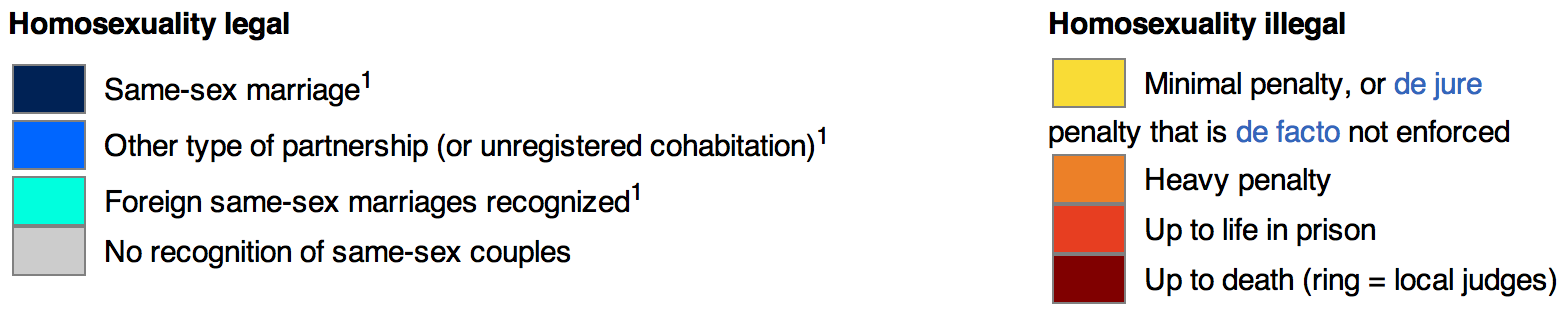
Key

The “Old” vs. “New” Media Debate

Jay Rosen does his best at mediating it. First, the things that “disaffected newsroom ‘traditionalists'” get right:

You cannot cut your way to the future. The term “content” is a barbarism that bit by bit devalues what journalists do. Pure aggregation is parasitic on original reporting. Untended, online comment sections have become sewers, protectorates for the deranged, depraved and deluded. That we have fewer eyes on power, fewer journalists at the capital or city hall watching what goes on, almost guarantees that there will be more corruption. Bloggers and citizen journalists cannot fill the gap.

I agree, unless we can find an economic model that can build up blogs’ staffs so they can begin to hire reporters. Then we may be onto something. That’s one of our long term goals here at the Dish –  but we can only get there if you become a member and help. The subscribe button – hint, hint – is at the top right hand corner of the page.  But the “traditionalists” get a lot of things wrong, too:

Listening to demand is smart journalism, so is giving people what they have no way to demand because they don’t know about it yet. If you are good at one, the other goes better. “Do what you do best and link to the rest” isn’t a slogan, it’s your only hope for comprehensive coverage. … In the aggregate, the users know more than you do about most things. They are in many more places than you can be. They also help distribute your stuff. Therefore talking with them is basic to your job.

The latter seems under-valued to me – and partly because of comments sections’ signal to noise ratio. Hence our decision to spend a great deal of time and attention on our email in-tray, and to integrate your knowledge of the world into the Dish’s content.

Missing Rinks

rinkWatch

Here’s an interesting experiment in citizen-reported climate change: reporting on whether your outdoor skating rinks are holding up under the carbon pressure. The creators of RinkWatch explain their inspiration:

Remember the story of how Wayne Gretzky learned to play hockey on the backyard rink his father made for him in Brantford, Ontario? [A recent] report says some day that will no longer be possible – at least, not in Brantford. This prompted a group of geographers at Wilfrid Laurier University to create RinkWatch. We want outdoor rink lovers across North America and anywhere else in the world to tell us about their rinks.  …

You may not think of it as science, but that’s exactly what you will be doing – making regular, systematic observations about environmental change in your own back yard. You will be joining a growing league of citizen-scientists from across North America.

(via co.Exist)

Prohibition Update

Two new pieces of legislation were filed yesterday that seek to bring federal enforcement in line with public opinion on marijuana policy. Erik Altieri details the proposals. Meanwhile, legislators in Washington state are considering expunging past possession offenses “up to 40 grams”. That liberates a whole group of people to get a job again, or a mortgage or a college loan. Removing these impediments could help integrate these people back into the economy, with some impact on employment and growth.

Who Leaked The Assassination Memo?

Shafer wonders:

Washington often leaks in directions to further stoke policy fires that are already burning. (See this taxonomy of leaks compiled by Stephen Hess.) Such a Washington fire has been burning for many months, with Congress demanding that the Obama administration explain its targeted killings of U.S. citizens. Yesterday, before the Isikoff story broke, 11 senators sent the president a formal request that any and all legal opinions devised by the White House about the targeting of citizens be forwarded to the Judiciary and Intelligence Committees.

This request makes the senators, or members of their staffs, prime suspects of the leak.

Reax to the memo here. Mine is forthcoming.

The Facts On Fat

[youtube http://www.youtube.com/watch?v=9YsP7mb5R4c]

A new study forced Aaron Carroll to reconsider his understanding of obesity and weight loss:

My family loves watching “The Biggest Loser.” But I’ve found myself telling my kids again and again that what’s shown on TV isn’t the best way to lose weight. I tell them that slow and steady works better in the long-run than rapid weight loss. I also tell them that setting unrealistic weight goals can actually sabotage your efforts.

So imagine my shock to discover that what evidence exists in this new study hints towards ambitious goals being a good thing, and that quicker weight loss isn’t less likely to be kept off in the long-term.

Happy Meals, Ctd

Timothy Noah and Vaughan Bell recently debated the “emotional labor” of food service. Sarah Jaffe believes women have it worst since they’re expected not only to smile, but flirt and tease:

I spent years as a waitress—in high school, then college, then as a struggling freelance writer—in that time I received pats on the ass, scribbled phone numbers in lieu of tips, and many, many personal questions I’d have preferred not to answer. Requiring feigned intimacy on the part of the worker allows the customer to ignore normal boundaries and pretend that a smile is an invitation to cross. Like the Pret workers, one of my bosses hired secret shoppers to make sure that servers went the extra mile; we were downgraded for not thanking our customers by the names we mispronounced off their credit cards. Not only our tips—which were our livelihoods, seeing as we only made $2.13 an hour, the legal minimum for tipped restaurant workers that hasn’t changed in 22 years—but our jobs were at stake if we didn’t smile hard enough.

A reader adds:

I read this about an hour after my performance review at work.

Included in the review is an anonymous survey of my co-workers.

I scored 100% “excellent” or “good” in the category of “Courteous.”

“Well,” I said to my boss, “I’m glad to see I’m not rude to people!”

“You’d be surprised,” he said.

Now, I am a university technology analyst. I have near zero customer interaction in the regular course of business. There are times when I want to scream epithets at my co-workers for their demands, expectations, and requests. But I have this notion that “well served” is how I want people to feel when working with me, and that this is likely highly correlated with my future employment and success here. So I keep the epithets to myself.

Is this really all that much to ask at the sandwich shop?

I don’t really see why not. And, as all fans of Fawlty Towers know, you can always go to Britain if you want freedom from the oppression of being nice to customers:

Taxing Traffic Jams

Yglesias takes seriously the dilemma of traffic in America’s biggest cities and the potential rewards of solving the problem:

Naturally an underpriced valuable commodity leads to overconsumption. Traffic jams, in other words. Every once in a while Ben & Jerry’s holds a “Free Cone Day” that invariably leads to long lines. Roadways in dynamic metro areas are basically holding Free Cone Day five days a week. Charge people enough money to eliminate routine congestion and you’ll find yourself with fewer traffic jams and an enormous pool of revenue that can be used to maintain your basic infrastructure and upgrade your bus service.

The Geography Of Torture

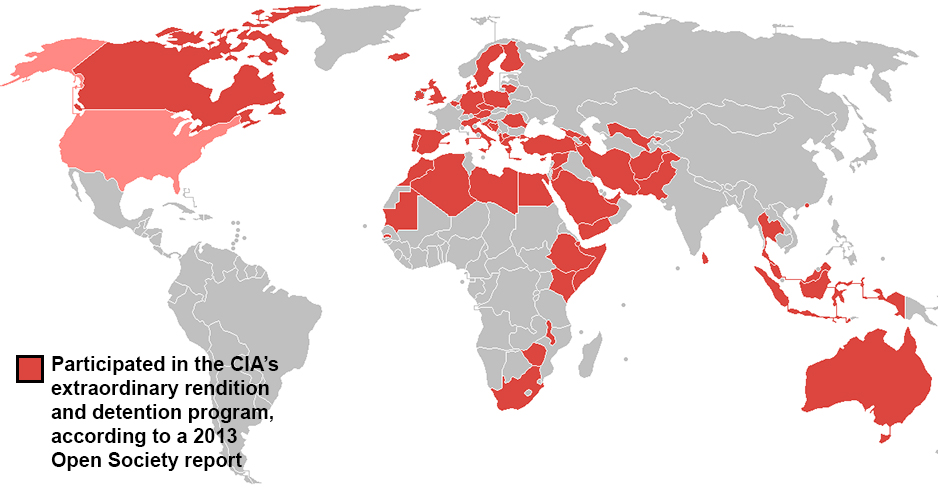
rendition map

Ackerman summarizes a new report (pdf) on America’s rendition program:

A new report from the Open Society Foundation details the CIA’s effort to outsource torture since 9/11 in excruciating detail. Known as “extraordinary rendition,” the practice concerns taking detainees to and from U.S. custody without a legal process — think of it like an off-the-books extradition — and often entailed handing detainees over to countries that practiced torture. The Open Society Foundation found that 136 people went through the post-9/11 extraordinary rendition, and 54 countries were complicit in it.

Max Fisher’s map of all of participating countries is above. He is particularly disturbed by the section on Syria:

According to a 2005 article by the New Yorker’s Jane Mayer, quoted in the report, Syria was one of the “most common destinations for rendered suspects.” Government forces, according to the report, held some U.S.-provided detainees in a prison known as “The Grave” for its coffin-sized cells and subjected them to “torture involving a chair frame used to stretch the spine (the ‘German chair’) and beatings.”

Universal Free Wi-Fi?

Derek Mead gets excited about a new proposal from the Federal Communications Commission:

Internet access is an essential need on par with education access, but at what point do regulators recognize that? When will government officials acknowledge that widespread, guaranteed access is essential to fostering growth in the country? Somewhat surprisingly, that time is now, as the FCC is now calling for nationwide free wi-fi networks to be opened up to the public.

Jon Brodkin throws cold water, noting that this is “just the White Spaces proposal that’s been around for a few years”:

White Spaces takes the spectrum from empty TV channels and allows the airwaves to be used for Wi-Fi, or “Super Wi-Fi” as it’s sometimes called. Using lower frequencies than traditional Wi-Fi, White Spaces signals would be better at penetrating obstacles and thus travel farther. But the FCC isn’t going to build the network itself. The agency allocates spectrum for certain uses to spur private investment—someone else will have to find a reason to build it. … Free Wi-Fi everywhere you go? Keep dreaming, you crazy dreamers.