Kevin Hartnett highlights a paper from Rourke O’Brien arguing that the wealth gap between black and white families can be partially explained by the generosity of middle and upper-income blacks:
Middle-income blacks are more than twice as likely as middle-income whites to have a poor sibling and more than four times as likely to have parents below the poverty line. And because of these relationships, they’re called upon more often to provide financial assistance.
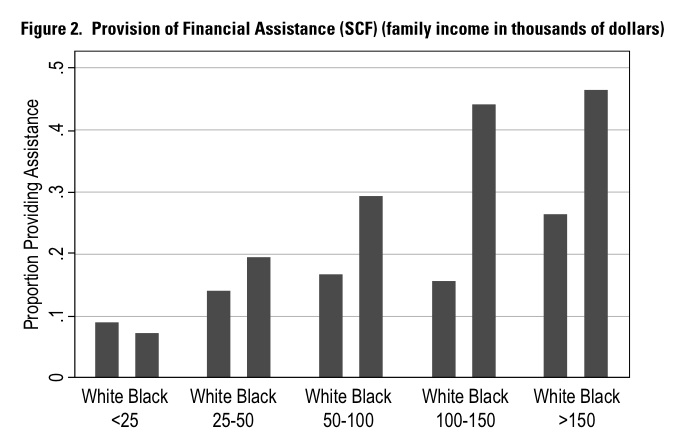
This chart from O’Brien’s paper shows the magnitude of the difference. Black families earning more than $100,000 a year are about twice as likely to have given money to friends and family compared to white families.
These transfers of money can have a big impact on wealth accumulation.
Below is a brilliant, inspiring interview with the late, great Aaron Swartz about how the Internet challenges entrenched media power structures. It’s an eloquent case for what we’ve been trying to do with the Dish, and for how that media transformation will also change politics and culture more profoundly than most now recognize. Worth watching in full:
And subscribe! The button is on the top right hand corner of the page.
Eliza Strickland profilesAdrian David Cheok, an engineer who created a system “that would let pet owners send their lonely animals a pat during a busy workday at the office.” His next project? Taste:
Cheok has a “digital lollipop” in the works that electrically and thermally stimulates the tongue to produce basic flavors—bitter, sour, salty, sweet. He dreams of a system that would let friends in Paris send you a taste of their wine over the Internet. “The ultimate Internet,” he says, “will integrate all our senses.”
That would be prison, according to sociology professor Donald T. Hutcherson II, who mined data from the US government’s National Longitudinal Survey of Youth:
Included in the survey are questions about how much money individuals make legally and illegally. Because the survey also ascertains whether people have spent time in prison, Hutcherson pored through data from tens of thousands of queries to a large number of young people to establish whether illegal earnings went up or down after individuals served time.
If prison reformed criminals, illegal earnings once people were released ought to have gone down. But if prison was a “finishing school” for criminals, illegal earnings after serving time should have increased. “Spending time in prison leads to increased criminal earnings,” Hutcherson says. “On average, a person can make roughly $11,000 more [illegally] from spending time in prison versus a person who does not spend time in prison.”
Rebecca Solnit compares today’s tech boom to the Gold Rush, noting how inflated prices can accompany influxes of vast, new wealth:
San Francisco exploded in the rush, growing by leaps and bounds, a freewheeling town made up almost exclusively of people from elsewhere, mostly male, often young. In 1850, California had a population of 120,000 according to one survey, 110,000 of them male. By 1852 women made up ten per cent of the population, by 1870 more than a quarter. During this era prostitution thrived, from the elegant courtesans who played a role in the city’s political and cultural life to the Chinese children who were worked to death in cribs, as the cubicles in which they laboured were called. Prices for everything skyrocketed: eggs were a dollar apiece in 1849, and a war broke out later over control of the stony Farallones islands rookery thirty miles west of San Francisco, where seabirds’ eggs were gathered to augment what the chickens could produce. A good pair of boots was a hundred dollars. Land downtown was so valuable that people bought water lots – plots of land in the bay – and filled them in.
Solnit sees the same phenomenon manifesting itself in San Francisco’s real estate market today:
There were rumours that these young people were starting bidding wars, offering a year’s rent in advance, offering far more than was being asked. These rumours were confirmed.
(Daguerrotype of “San Francisco harbor (Yerba Buena Cove), 1850 or 1851, with Yerba Buena Island in the background” from Wikimedia Commons.)
Jennifer Hollands reports on the medicinal value of toxins:
Ironically, the properties that make venom deadly are also what make it so valuable for medicine. Many venom toxins target the same molecules that need to be controlled to treat diseases. Venom works fast and is highly specific. Its active components—those peptides and proteins, working as toxins and enzymes—target particular molecules, fitting into them like keys into locks. Most medicines work the same way, fitting into and controlling molecular locks to thwart ill effects. It’s a challenge to find the toxin that hits only a certain target, but already top medicines for heart disease and diabetes have been derived from venom. New treatments for autoimmune diseases, cancer, and pain could be available within a decade.
(Photo: Vipera berus male, one fang with a small venom stain in leather glove. By Piet Spaans. Via Wiki.)
Last week, Ronaiah Tuiasosopo sat down with Dr. Phil to talk about his role in the Manti Te’o scandal. Those whose gaydar went off over the story have some vindication. RT created Te’o’s non-existent girlfriend, Lennay, impersonated her voice on the phone (see above), in order to have a virtual romantic relationship with MT. Timothy Burke and Jack Dickey, the first to report on the hoax, summarize:
Tuiasosopo explained that he felt a lot of real feelings toward Te’o: When he called Manti, and a girl picked up, he got angry. The night Te’o’s grandmother died, Te’o supposedly told Lennay that he never wanted to speak to her again—that’s why Tuiasosopo killed her off that night.
Of course, one has to take a lot of this with a pinch of salt, given RT’s propensity for total delusion. And he’s obviously a young man with a lot of conflicts with his longings for love with another man:
“If you look at this situation and everything that I’ve been through, I would say yeah I’m gay. But honestly I’m so confused,” … As a devout Christian, Tuiasosopo feels he’s afflicted with a case of “the gay” and needs to “recover” from it as one would recover from a drug or alcohol problem. “It takes a lot of courage to recover from homosexuality and this type of thing and coming back to your real life. As hard of a task it is, I’m going to do all I can to live right.”
One other aspect worth mentioning – this was clearly about love, not actual sex – and virtual love at that. One lesson to glean from this is that healthy homosexuality is at core an emotional orientation before it is a sexual one. The second is that love can indeed be virtual.
MT also lied, he says, in part because he thought no one would believe he could have had a serious, meaningful relationship with someone who existed only online – hence making up meeting her afterwards. But I don’t see online interaction as easily separable from real-life human interaction any more. We spend more and more time communicating with one another virtually rather than physically. But these communications are still between human beings, with all our foibles and needs and crushes and hatreds and, if we’re lucky, wit and humor. We do not cease being human online; but we do wear a kind of mask, concealing some things, revealing others – whether on a blog or a hook-up app or a list-serv or a Facebook wall. And if you spend more hours a day communicating that way, you haven’t stopped living. You’re actually slowly becoming another person on top of your regular self. How many times have you had lunch with someone and see them pick their phone up and text someone? At that moment, they’re two people in one – playing different roles simultaneously. It’s not surprising that in some lively imaginations and young souls, things can get confusing.
This is the current reality for a lot of us. We meet many more people virtually than on the street or in our physical daily lives. We also get to know them more. The anonymity of the web can allow people not just to trash talk in a way they wouldn’t in real life but to sext and love-talk with strangers they’ve only seen pictures of. Some of this may actually be more authentic an expression of ourselves than anything we have the courage to say to someone’s face.
What I’m saying, I guess, is that the more time we live virtually, the more we will reproduce aspects of our pre-virtual life online. Including love. And this strange, amazing story was about love, not sex. It was about a panicked, conflicted young gay man knowing he would be rebuffed by his straight crush and setting up a fantasy where he could become a virtual woman to have a relationship with him.
For some generations, this is going to seem extremely weird. For younger ones, less so, I have a feeling. Increasingly, we seem to live parallel lives – as a person with a body and as an online avatar. Comedy and tragedy will doubtless ensue. That’s what masks can do.
Previous Dish on the media’s role in the Manti Te’o hoax here and here. The thread on Te’o’s role in the hoax here, here and here.
Michael Moynihan chats with Alex Gibney about his new documentary on the Catholic sex abuse scandal. Gibney thinks the Church’s celibacy requirement played a role:
What’s peculiar about the Roman Catholic Church is that at the heart of its doctrine is a lie—the lie of forced celibacy. One of the former priests … did a study for the church to try to understand the sex lives of priests and found that over 50 percent of priests, that he could ascertain, were not observing celibacy. So that leads to a system of secrecy and blackmail, a kind of protective quality, with anything that has to do with sexuality. So as a result, I think that predators intuitively or instinctively sought out an environment like that.
In another interview with Scott Horton, Gibney notes that Cardinal Dolan is also neck-deep in this corrupt web:
Horton: Weakland was succeeded by Timothy Dolan, who led the church’s efforts to address the problem in the Milwaukee archdiocese. He has since emerged as the church’s leading spokesman in the United States. Dolan claims to have “cleaned up” the problems in Milwaukee. Is that a fair characterization?
Gibney: No. What Dolan did was try to protect the Archdiocese of Milwaukee by taking money off its books to avoid paying abuse claims.
According to an article in the New York Times, $75 million “disappeared from the church’s investments in 2005.” Then, in 2007, Dolan moved $55 million of church funds to a cemetery trust. Dolan has claimed that he did this merely to make sure that the gravestones were properly cared for. At that price, one could assign a personal valet to every stone.
In the film, we focus on the pristine headstone of Father Murphy. Even in death, he is treated better than the survivors of his abuse.
Gibney’s view of the Pope talking to Moynihan:
I don’t see Ratzinger as a monster. I see him as a deeply flawed human being who aided and abetted criminality. I think he is offended by men who abuse their power by abusing children. He says he is disgusted by [the abuse], and I believe him. But he lives within this institution, with this group of men who exist between mortals and the angels, and he favors protecting the institution to protecting the children. That to me is his great crime. It makes him weak, and, ultimately, I think it makes him a criminal.
Me too. He has indeed instituted new guidelines and protocols and protections for children – finally. He has not been as negligent as Pope John Paul II, who refused to see evil in Maciel because the money was so good, and the theology so reactionary. What I cannot get my head around is Benedict’s profession of “shock” at these incidents in his first statements, when we know he personally authorized the transfer of a child-rapist as Archbishop in Munich and had been in charge of all the cases of sex abuse in the entire world since 2001. And he was shocked! Like Bush by Abu Ghraib!
One wonders: Can he grasp the enormity of what has happened? Does his own veneration of the priesthood and lifetime of being obeyed without question render him incapable of seeing things from the side of a raped child who has struggled to achieve some kind of sanity and healing in adulthood? This is not some ordinary person here. This is the man who represents Christ on earth. I cannot see how he can not resign, why he has not resigned – and begged for forgiveness on behalf of the entire hierarchy. I cannot see how, after a catastrophe of this proportion, we still are barred from even debating married or female priests.
At some point, obedience to authority and to an institution is not a virtue. It is a crime.
By January 1984, New York City under Koch’s leadership had spent a total of just $24,500 on AIDS. That same year, San Francisco, a city one tenth the size of New York, spent $4.3 million, a figure that grew to over $10 million annually by 1987. The mayor of San Francisco during those years was Dianne Feinstein, who like Koch was no radical. She came from the centrist coalition that included Dan White, the city supervisor who murdered Supervisor Harvey Milk and Mayor George Moscone, whose office Feinstein assumed in the wake. Like Koch, she had a troubled relationship with the gay community (she infamously vetoed a domestic partnership bill in 1983). And like Koch, she was, above all, a political opportunist with national ambitions who happened to live in a liberal city with a large, politically active gay population. But she was straight, and paradoxically, that made a difference in how those two cities treated people with AIDS in those formative years.
David France, the director of How To Survive A Plague,refuses to label Koch a murderer:
I chose not to interview Koch for How to Survive a Plague. His inaction was simply a fact, nothing I cared to hear him defend. I do not agree with Larry Kramer, who charges Koch with the murder of so many back then. What people died of in Koch’s New York was a viral infection. How they died and how quickly they died — those are the things he might have helped ease. And he didn’t. It is as though he couldn’t empathize with the dying or the rest of us who stood helplessly at their bedsides.
France says, “I was startled when I learned that Koch had seen my film”:
What happened to him in that darkened theater remains a mystery. But by the time he was home — and working up a review of the film for the West Side Spirit — he was apparently a changed man. He called the demonstrations against him “necessary to keep the issue on the front burner” and called upon Obama to grant them Presidential Medals of Freedom, the nation’s highest civilian honor. Whether this was the beginning of a mea culpa is not known. But he plainly saw that history — his history — in a different light.


 The Dish