Philosopher Huw Price thinks “we humans are nearing one of the most significant moments in our entire history: the point at which intelligence escapes the constraints of biology.” He frets that “if technology does get to this stage, the most important fixed point in our landscape is no longer fixed”:
Technology will have modified the one thing, more than anything else, that has made it “business as usual” so long as we have been human. Indeed, it’s not really clear who “we” would be, in those circumstances. Would we be humans surviving (or not) in an environment in which superior machine intelligences had taken the reins, to speak? Would we be human intelligences somehow extended by nonbiological means? Would we be in some sense entirely posthuman (though thinking of ourselves perhaps as descendants of humans)?
Aramaic, a Semitic language related to Hebrew and Arabic, was the common tongue of the entire Middle East when the Middle East was the crossroads of the world. … In a highly connected global age, languages are in die-off. Fifty to 90 percent of the roughly 7,000 languages spoken today are expected to go silent by century’s end. We live under an oligarchy of English and Mandarin and Spanish, in which 94 percent of the world’s population speaks 6 percent of its languages. Yet among threatened languages, Aramaic stands out. Arguably no other still-spoken language has fallen farther.
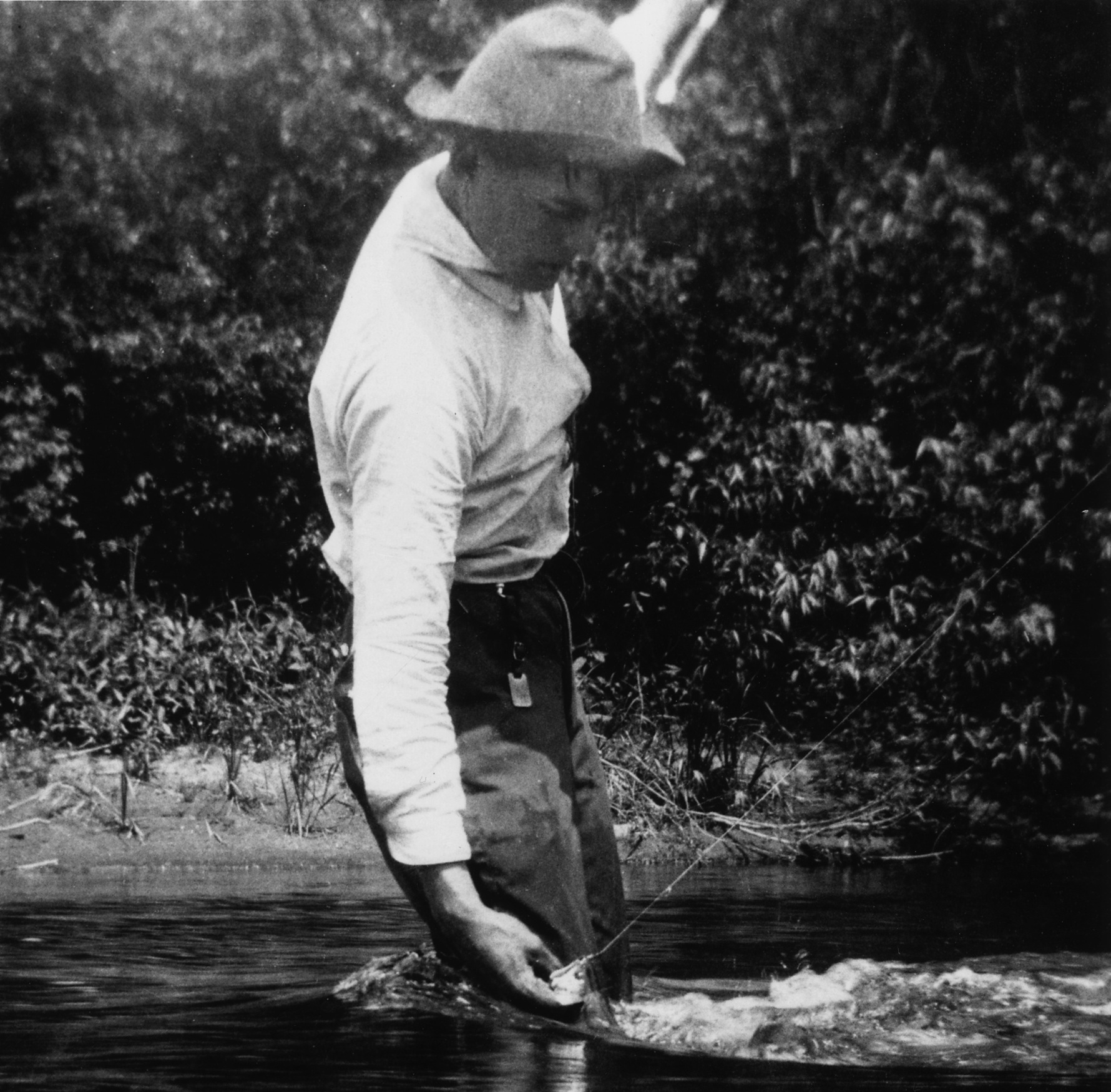
Will McDavid ruminates on one of Ernest Hemingway’s most compelling short stories, “Big Two-Hearted River,” which he describes as “a story about war, woundedness, and living with memories and ghosts”:
The story’s central symbol, of course, is the river. Nick can tell his position from the river; the river allows him to engage his emotions for the first time all trip; the river exerts pressure upon him and is dangerous. The river here is a symbol for Nick’s own emotional life, the two-heartedness he feels in the need for mundane stability (the shallows) and the need for emotional excitement (the deeper, faster water). As Nick tries to reel in the large trout, Hemingway notes that he’s leaning backward into the river, and it’s mounting against his thighs. He’s bracing himself against the river’s pressure, but his emotions are mounting, and they almost overwhelm him. At the same time the nicotine is giving him some emotional distance from the fight with the trout, he’s stepped out of the river, too. The emotional avoidance is far from ideal, but Nick is wise about knowing himself and processing only as much as he is capable of handling at a given time. Temptation tells him to immerse himself in the river and process everything at once; the voice of grace gives him room to take it in as he must – it gives him time, space, and permission to engage his emotional life gradually, without too much excitement all at once. The voice of grace frees him to listen to the voice of simple prudence.
(Photo: Hemingway fishing in Michigan in 1916, via Wikimedia Commons)
The Dish has debatedat length whether the religious novel is dead, a discussion kicked off by a Paul Elie NYT article. Millman joins the debate:
I must admit, I both do and don’t want to believe Elie is right, personally, about belief and American storytelling today. I both do and don’t want to believe it, because one of the scripts I wrote that I’m most fond of is engaged precisely on the territory that he says isn’t being tackled. It’s about belief – and the transforming power of surrender to the divine – and it’s also about the sociology of religion in America today (not at all the same thing). I’d like to think it’s a story he’d appreciate. And I’ve gotten pushback from some producers on the grounds that it’s “too religious” or I don’t do enough to “explain” this foreign world to audiences. I’d like to think that only means I’m on to something – that I’ve got a story that “needs to be told.” And yet I not only don’t feel the script I wrote is foreign to audiences – I don’t feel it’s foreign to contemporary cinema. Of course I believe it’s a unique snowflake; but I don’t think it’s the only snowflake in the blizzard.
Created and written by husband and wife team Ben Sinclair and Katja Blichfeld, executive produced by them and Sinclair’s manager, Russell Gregory, and brought to life by a stellar cast and crew, High Maintenance follows a cycling weed man as he makes his deliveries to different New Yorkers in their native habitats. Nuanced in its voyeurism and deft in its subtle comedic breaks, this is more than a funny show. It’s honest and true, unapologetically and consistently straight with no regard for Internet video conventions or goofy stoner genre norms.
A recent study in the New England Journal of Medicinedebunks the longstanding myth that sex “burns 100 to 300 kcal for each participant.” Kevin Charles Redmon summarizes the findings:
An average guy, supposing he weighs about 150 pounds, burns closer to 3.5 calories per minute having sex. The authors write, “Given that the average bout of sexual activity lasts about 6 minutes, a man in his early-to-mid-30s might expend approximately 21 kcal during sexual intercourse. Of course, he would have spent roughly one third that amount of energy just watching television, so the incremental benefit of one bout of sexual activity with respect to energy expended is plausibly on the order of 14 kcal” (emphasis added).
So there you have it. Sex is better for you than watching Downton Abbey…but only by 14 calories.
He’s not looking for the big names of street art but for what he calls ‘the little guy’, the one who’s drunk, angry, frustrated, bored or who just want to look like a bad boy (and miserably fails in the attempt.) The result is funny but somehow it has more soul than the works you can admire at the MOBA (the Museum of Bad Art.) And that’s probably because Hocking knows that a graffiti can never really be taken out of its context. His photos show the comedy but also the tragedy of abandoned buildings, of a city hit by crisis, of its disenchanted inhabitants.
Andrea Denhoed recounts the sad tale of a friend who, as a commentary on his solitary life, staged a fake wedding to a deaf Ukrainian woman on Facebook:
We all know that there are fake people on the Internet, just as we know that there are e-mail scammers, sexual predators, and virus authors, and what we envision are reptilian-looking loners sitting in basements, growing sallow by the blue light of their monitors. But maybe we should be picturing Manti Te’o, or the sweet-faced woman at the end of “Catfish.” We’re on guard against Ukrainian scammers being manipulative and mercenary when what we should be concerned about is Tim being lonely, resentful, reckless, and attention starved.
When we talk about the “dark side” of the Internet, we’re usually talking about criminal deception, or sometimes about porn, but what about the time we spend refreshing our inboxes like lab mice hoping for a pellet, or the vast unacknowledged expanses where we let our brains go stupid and set them free to graze on things like “The Ultimate Girls Fail Compilation 2012,” which currently has more than sixty-six million views on YouTube, but none of the buzz and analysis that follows “legitimate” viral videos?
The Internet is perhaps the closest thing we’ll ever have to the ring of Gyges—the invisibility charm that allows its wearer to be alone while having access to the outside world—which Plato posited as the truest test of how a person will act when freed from accountability or restraint. We might not be doing anything evil, but we’re not doing anything we want the world to see.
Meanwhile, developers have come up with Informacam, “an app that collects and analyzes the metadata stored in digital photos and video”:
Users download the app to their phones, where it integrates with the cameras. Once installed, Informacam can identify where and when a photo was taken, and even the weather at the time. “We collect more than twice the metadata of .JPEG,” says Nunez. “You actually get a trajectory of where the video or image was being taken at the time it was taken. It paints a digital environment of what was happening around you when you were filming, with a full chronology.”
Bryan Nunez, technology manager at Witness.org, sees Informacam providing important legal protections for everyday civilians, too. For example, through Informacam, each edit or outright alteration of an image is meticulously recorded, as well as time- and location-stamped—the kind of metadata details that could assist even the least-savvy digital investigator unravel a Catfish style hoax.


 The Dish