A young Kashmiri Muslim looks off as Muslim women pray at Hazratbal shrine on the Friday following Eid-e-Milad , or the birth anniversary of Prophet Mohammad on February 01, 2013 in Srinagar, the summer capital of Indian administered Kashmir, India. Thousands of Muslims from all over Kashmir visit the Hazratbal shrine in Srinagar to pay obeisance on the Friday following Eid-e-Milad , or the birth anniversary of Prophet Mohammed. The shrine is highly revered by Kashmiri Muslims as it is believed to house a holy relic of the Prophet Mohammed. The relic is displayed to the devotees on important Islamic days such as the Eid- Milad when Muslims worldwide celebrate. By Yawar Nazir/Getty Images.
Year: 2013
A Constitutional Right To Vote
Bouie wants one:
In our large, polarized democracy, voting has been an issue fraught with partisanship and ideology. But the ability of states to restrict participation stems from the peculiar fact that Americans don’t enjoy the right to vote. We came close once. Following the end of the Civil War, an early draft of the 15th Amendment featured a blanket right to vote (excluding women); this was rejected in favor of limited suffrage for freedmen. The reason? Southern Republicans didn’t want to enfranchise former Confederates, Western politicians feared that Chinese would participate, and Northern states worried that they would have to abandon their own restrictions on voting.
Supporters believe that “an affirmative constitutional right would, at the very least, force state lawmakers and election administrators to think twice about measures and election procedures that harm voters.” Justin Green has questions:
Is having to wait in line a violation of the right to vote? Are voter-ID laws in violation of such an amendment? Are states with shorter intervals for voter registration in violation? Are felons exempted from this right? If so, is there anything that might strip said right? Bouie brings up several of these as reasons for such a right, but I’m uncertain to what extent he feels we should empower federal authorities to act.
Clusterchuck, Ctd
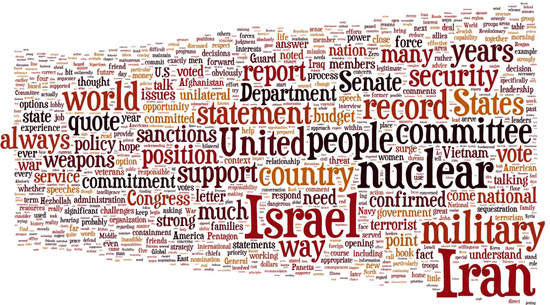
Take a look at the word cloud from yesterday’s hearings on the nomination for the defense secretary, from Yousef Munnayer:

Obviously, this was a hearing about Israel and Iran. Try and find the words “Afghanistan,” where we are still at war, or “Iraq”, where we just ended a war, or “troops” or “veterans”. Now try and find our biggest global partner, China. Or our most loyal ally, Great Britain. Or the impending sequestration, which will mean the biggest and crudest defense cuts in years. It’s like finding Waldo.Youssef has much more.
Yes: Israel is about five times as big as “America” and even bigger than “United” and “States” in this cloud.
To see what is in front of one’s nose needs a constant struggle.
An Early Non-Adopter, Ctd
Freddie tackles Matt Lewis’s anti-Twitter tirade:
Lewis talks about the ways in which Twitter has raised his profile and publicized his work. That’s the good thing about a public medium! But when you say things in public, some times mean people say mean things about what you’ve said in public. That’s the bad thing about a public medium! There are options you have to get the publicity; there are options you have to avoid the meanies. There are no options that give you both. Lewis completely undoes his own point when he mentions having a private, invite-only Twitter feed. Don’t like mean people? There you go, Matt: make your tweets private. But he wants both, the publicity and the protection, and you can’t have that.
Lewis’s problem is not with Twitter. It’s with that basic contradiction.
Channel Surfing In Beirut
Mitchell Prothero clicks through the TV in Lebanon, where there is a channel for every sect, creed, and militia:
As a result of Lebanon’s sometimes comical, often tragic political scene, locals and foreigners alike often overlook that the country boasts perhaps the freest media environment in the Middle East. Like its famed religious eclecticism, however, media diversity does not translate into a melting pot — rather it just provides each side a foxhole from which to launch potshots at its enemies. The result is channels that reinforce all their viewers’ prejudices and biases in a manner that can make Fox News look pretty close to its comical slogan of “fair and balanced.”
(Video: Lebanese political analyst Joseph Abu Fadel, an outspoken supporter of the Syrian government, physically assaulted Syrian opposition activist Muhieddine Ladkani Tuesday night on Al-Jazeera TV.)
The Pro-Life Movement And Gun Control, Ctd
A reader writes:
If guns are lawful, suicide becomes much easier and requires much less effort and thought. If you have a loaded gun at hand, a passing suicidal thought can be carried out immediately and almost certainly fatally. Other methods of killing yourself take time and effort and have a much lower success rate. People have time to decide that they might as well live.
When Australia introduced much stricter gun controls in 1996 following the Port Arthur massacre, they were accompanied by a buyback scheme and had the political advantage of being introduced by a right-wing government, which stopped partisan politics being played with it. The drop in the suicide rate was substantial and there doesn’t seem to have been a corresponding rise in other ways of taking your life.
Another:
This is actually the exact reason I never see myself owning a gun. My sibling and several of my friends attempted suicide when they were young adults, but none were successful. They all survived because guns weren’t easily available to them. I hope to never suffer from depression to the degree I want to kill myself, but I know due to family history it’s possible and I don’t feel comfortable having such an easy means of suicide. I also hope gun owners think twice about letting their teenage children know how to access their guns.
Another points to “more evidence that guns make suicide rates higher”:
In 2006, after years of suicides among young men in the Israel Defense Forces, authorities forbade the troops from bringing their rifles home on weekends. Suicides dropped by 40 percent, according to a 2010 study by psychiatrists with the IDF and the Sheba Medical Center. … Firearms were used in 68 percent of Army suicides in 2010, according to an Army Health and Violence report released this year. Most often, soldiers shot themselves to death at home or in the barracks. By comparison, more than half of suicides by U.S. civilians annually involved firearms, according to data from the Centers for Disease Control and Prevention.
Another reader:
One of my daughter’s classmates committed suicide last May. He went down into the basement, took out one of his father’s guns, and put the barrel in his mouth. He left behind three grieving brothers, all sad and angry young men. I don’t have the guts to ask if the guns have been removed from the house. I hope, for the boys’ sakes, the guns have been destroyed. Sometimes, suicide can be contagious.
Earlier post here.
Mental Health Break
No need for psychedelics, New Yorkers:
Wonk Politics
Bhaskar Sunkara bemoans the rise of technocratic bloggers like Ezra Klein:
Klein is the archetype for the bankruptcy of modern liberalism, so much so that he disavows being a liberal at all. He’s a technocrat, obsessed with policy details, bereft of politics, earnestly searching for solutions to the world’s problems through the dialectic of an Excel spreadsheet.
Conor Williams disagrees:
The wonks aren’t really the problem. After all, there’s nothing intrinsically wrong with fact-based policies. They beat the hell out of the alternative. Sophisticated policy analysis is fine, even necessary, once we’ve (politically) hashed out the relevant value-laden objectives that we’re after. Snazzy charts alone can’t settle whether or not the United States should pursue educational equity or stratification. That’s a moral and political question. Wonky analysis can help us get a better sense of which policies might encourage one or the other (only when it’s done right, though). Wonks can be useful, so long as we remember the appropriate contours of their expertise.
The Painfully Slow Recovery Continues
The economy added 157,000 jobs in January and the unemployment rate ticked up slightly to 7.9%. Using the Hamilton Project’s jobs calculator, Plumer finds that, if “the United States keeps adding 181,000 jobs per month [the average during 2012] then it will take nine years and three months to get back to full employment”:
With faster jobs growth, the country could get back to full employment even quicker. The Hamilton Project calculatesthat we could close the jobs gap entirely by the 2016 election if the economy added 321,000 jobs per month. The problem? That was the average rate for the best single year of job creation during the 1990s dot-com boom. Hard to envision now.
Greg Ip also puts the report in perspective:
[E]ven if the current pace is maintained, it’s still inadequate for an economy still so far from its productive potential. There is nothing in the report to deter the Federal Reserve from continuing to buy bonds with newly created money (quantitative easing). David Greenlaw of Morgan Stanley reckons that if job growth continues at 175,000 per month and the labour force participation rate remains steady, the unemployment rate won’t fall to 6.5% (the Fed’s threshhold to consider raising rates) until early 2017. If job growth picks up to 200,000 per month, it will happen in January, 2015.
Neil Irwin’s view of today’s numbers:
Nothing about the new jobs numbers, then, should radically transform anyone’s assessment of how the U.S. economy is performing. Job creation is steady and strong enough to bring the unemployment rate down over time — just not very quickly. The January unemployment report was, more than anything, affirmation of that fact.
Felix Salmon’s related thoughts:
To be honest, this month’s payrolls report probably isn’t even the most important data release of the day, let alone the month: the data from the manufacturing sector of the US economy is much less ambiguous, with the ISM report coming in strong and GM sales looking impressive. It’s an open question, of course, as to whether and how industrial strength is going to make its way through into full employment. But don’t look to the headlines atop this month’s payrolls report for answers. If they’re in there at all, they’re deeply buried, and not easy to find.
Bouie focuses on the revisions in today’s jobs report:
November’s job growth was revised to 247,000 (up from 161,000) and December’s was revised to 196,000 (up from 155,000). These are big revisions, and when analyzed as part of a trend, it’s clear that the government was been underestimating job growth for most of 2012, to the tune of 28,000 jobs a month. It should be said that this makes Barack Obama’s re-election victory even easier to explain. If the president’s standing was higher than expected, it’s because economic conditions were much better than we thought.

Latinos Haven’t Been Bribed
National Review argues that Latinos lean left because they “are disproportionately low-income and disproportionately likely to receive some form of government support.” Josh Barro thinks this misses something important:
[L]et’s imagine that Hispanic Americans’ demographic positioning looked different. Let’s say they were disproportionately unlikely to have children out of wedlock, and had higher incomes and educational achievement than whites.
By National Review’s logic, this should make them a natural conservative constituency, ready to line up with Paul Ryan and Pat Toomey. But Asian Americans — who do have these characteristics in the aggregate — vote Democratic in roughly similar numbers to Hispanics. This should be a clue that Republicans’ failure with non-whites is not just about voters’ economic circumstances.