Will The Scouts Lose The Millennials? Ctd

6a00d83451c45669e2017d40a50e9f970c-550wi

A reader writes:

As a father of two Eagle Scouts, with a third son on his way, and as the token liberal in my Scout troop, I would like to temper the enthusiasm of the recent announcements by the BSA. The key is not to forget who the “local sponsoring organizations” are. The largest sponsor is the Mormon church, but if taken collectively, Catholic parishes are almost as large. All I can think is that this will generate noise but not much progress at ground level. However, while I am happy for the scouting professional who wrote in and others like him who can proudly continue their service, free of shame, I plan on continuing having to explain (to otherwise fairly bright people) the difference between homosexuals and pedophiles.

Another:

Thank you for staying on this story. It means a lot in our house. Dad was an Eagle Scout, and I as a Girl Scout have my Leadership Award. I couldn’t wait to get my son into Scouts to continue the family tradition, and so that he could learn lots of great skills and gain confidence. (He says just wearing the uniform makes him stand up straighter. He’s 8.)  But I’m bisexual, and I’m raising my son with tolerance.

We’re lucky, our Cub Scout pack is very open. We not only accept everyone as-is, we leave religion at home too (we talk about the importance of faith, but leave your choice for how you follow that up to each Scout and their families). I love our pack and all the people in it. It breaks my heart that the Boy Scouts are linked to such intolerance – how do I square that with everything else I’m teaching my boy?

So I called the BSA phone line you posted and voiced my opinion. I should add that a live person answered, and asked me very quickly, “Are you for or against the motion?” without saying what the question was. I was a bit taken aback, which way was the right answer? So I said, “I would like you to lift the ban,” and she worked it out. Just a tip for those who call, wouldn’t want one of those Prop 8 situations where “for” is really “against” or something.

Another shifts focus:

There remains the ban on atheists in the Boy Scouts. While being gay is difficult, it is becoming more acceptable.  Atheists/Doubters/Skeptics?  Still in the closet for most of America.

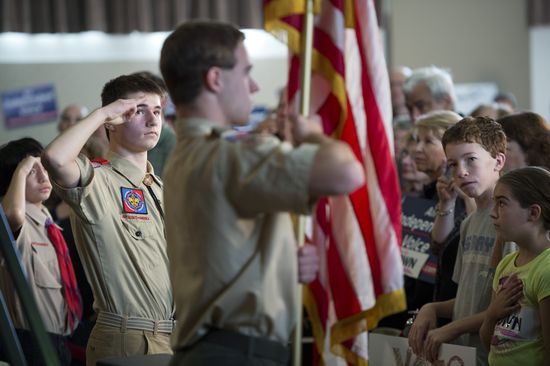
(Photo: A Boy Scout Color Guard stands at attention during a rally for Senator Scott Brown, R-Mass., in Cumnock Hall at the University of Massachusetts Lowell campus in Lowell, Mass. By Tom Williams/CQ Roll Call)

Advice To The Right On Pop Culture

After this embarrassment, Conor piles on to a recent NRO discussion of hip-hop:

Hint: Perhaps the crack epidemic, the unwed-teen birthrate, the dissolution of families, the epidemic of crime, AIDS, and all sorts of other ills besides are better symbols of decline in the West than the subset of rap music that depicts those realities.

McCain’s Beloved “Surge”

It didn’t work, as we all know by now, on its own utopian terms. It did help us get out with less humiliation. But McCain still insists he was right about everything from the get-go:

The good news is that we almost got a real debate on this question. Not exactly, because describing the “surge” as a p.r. exercize to disguise the complete failure of the Iraq War is not something Washington can yet cop to – just as it has great difficulty copping to the fact that the last president was and is a war criminal, under the strictest legal definition of that term.

But Hagel is right: without the switch in Anbar and the exhaustion of ethnic segregation and warfare, those extra troops could have been there indefinitely – and, if McCain had won in 2008, would be there still most likely. What’s striking to me is not McCain’s fury or douchiness (what’s new?) – but his complete assumption that he couldn’t possibly be wrong, his insistence that this debate is already over, and his refusal to allow for the notion that this question may only eventually be resolved by a more distant historical judgment.

After Iraq and Afghanistan, McCain’s views on military intervention have not changed. Hagel’s have. Somehow, I think Hagel is closer to where the country actually is.

The Pro-Life Movement And Gun Control

6a00d83451c45669e2017ee819ce84970d-550wi

I’m a respecter of the Second Amendment, its role in America’s revolution and founding, its cultural and historical meaning across a newly conquered continent where the rule of law did not exist for vast areas for long periods of time. And I’m basically for much of the relatively obvious stuff we can now do: end the gun show loophole, increase resources to the ATF, ban some magazines and assault weapons, take the NRA down a few notches, etc.

But one thing about the victims of guns does tend to get lost: the clear majority of deaths by gun are suicides. Among the over-20s, 60 percent of gun deaths are from suicides, compared with 37 percent for homicides.

Maybe I should have known this, but it came as a surprise. The majority of gun deaths in America are self-inflicted. Some pro-life Catholics have reached the conclusion that murder and suicide are not Christian values and that preventing them if we can by gun control is a Christian duty. I think the argument is much more complex when it comes to homicide – and, given the ubiquity of guns in America, I can see the argument that widespread gun-ownership for self-defense can actually protect life by deterring crime. I can also see the argument that owning a gun may help you defend the lives of your own family if attacked – although its roots in Jesus’ teachings are precisely zero.

But what if high levels of gun ownership make death in your own family more likely? Is there evidence that high gun ownership is related to higher levels of suicide? There is. A study of seven New England Northeastern states (pdf) with varying gun laws and suicide rates came to this conclusion:

The strong and positive correlation between firearm prevalence and suicide was accounted for by substantially elevated firearm suicide rates in states with higher levels of firearm ownership. This association held for the population as a whole and for every age group. By contrast, aggregate rates of nonfirearm suicides in states with higher firearm ownership did not differ across the seven states.

One key reason is that of all methods of suicide, guns are by far the most effective in actually killing you:

Of all suicide attempts, suicide by firearm accounted for only 5%, while poisoning/cutting/piercing accounted for 85%. However, the fatality rate for attempts varies wildly. Overall, 13% of all attempts were successful, while 91% of gun attempts were successful and only 3% of the poisoning/cutting/piercing attempts were fatal. Suffocation/hanging (6% of all attempts) was successful 80% of the time.

A bigger follow-up study came to the same conclusion:

Almost twice as many individuals completed suicide in the 15 states with the highest levels of household firearm ownership (14,809) compared with the 6 states with the lowest levels of household firearm ownership (8,052). For each age group and for both sexes, there were close to twice as many suicide victims in the high-gun prevalence states, a finding that was driven by differences in firearm suicides (i.e., nonfirearm suicides differed little). Overall, people living in high-gun states were 3.8 times more likely to kill themselves with firearms.

It seems to me that this is one piece of evidence that having fewer guns in American houses would lead to far fewer successful suicide attempts. As the authors note:

If 1 in 10 individuals who attempted suicide with firearms in 2002 were to have attempted with drugs instead, the number of suicides in the United States would decrease by approximately 1,700 suicides per year.

That’s a lot of life. It’s worth recalling too how many veterans have killed themselves with their own guns:

Veterans commit suicide at a rate that is twice the national average. In fact, the annual military death toll from suicides has for several years exceeded the number killed on the battlefields of Iraq and Afghanistan.

(Photo: A Boston Police officer was one of the pallbearers who helped carry the cremated remains of Hamilton police officer Kenneth Nagy at a funeral mass held at St. James Roman Catholic Church. Nagy committed suicide after a shooting in Beverly of a Beverly police officer who worked with his wife. By John Tlumacki/The Boston Globe via Getty Images.)

Mali Is Not Afghanistan, Ctd

6a00d83451c45669e2017d40a5673a970c-550wi

Laura Seay rolls her eyes at the “Africanistan” metaphors:

The French did not invade Mali; the Malian government asked them to come assist in repelling the Islamists. France also intervened with the clear expectation and understanding that the bulk of peace-building in Mali will be conducted by an African force, and that local and regional African leaders will have long term responsibility for the crisis. The French do not seem to have plans to stick around, build forward operating bases, and attempt to govern on their own terms. Furthermore, the stated goal of the French intervention is to rid northern Mali of Islamist militants rather than the more ambiguous goals of the U.S. “War on Terror.”

At one point, of course, Afghanistan wasn’t “Afghanistan” either, as it? Earlier Dish on this topic here.

(Photo: French troops on January 30 patrol along the Niger river in the northern city of Gao, a key Islamist stronghold until it was retaken on January 26 by French and Malian troops in a major boost to the French-led offensive against the Al Qaeda-linked rebels, who have been holding Mali’s vast desert north since last April. French troops on January 30 entered Kidal, the last Islamist bastion in Mali’s north after a whirlwind Paris-led offensive, as France urged peace talks to douse ethnic tensions targeting Arabs and Tuaregs. By Sia Kambou/AFP/Getty Images)

Parenting And Pot

Mark Oppenheimer admits he’s “been meaning to start smoking pot again”:

The pot smoker I want to be resembles the drinker I once was: occasional, responsible, social, after-hours. And I hope I am raising my daughters with a sane attitude about alcohol and drug use. I want them to come of age in an America where, should they choose, at an appropriate age, they can buy the least harmful drugs the way we all buy alcohol: at cost, from a reputable dealer, without risk of arrest or gunshot wound or being harshly judged. You know, like in the Netherlands. But with no boys around.

But I still can’t figure out how to be comfortable as a dad who smokes pot. I know I don’t want to get high in front of the girls: I don’t want them to see me stupid or out of control. I think that would frighten them. I definitely don’t want to be a cliché. And I don’t want to rob them of the slightly subversive thrill that will come, some day, with hiding their weed from Dad.

Malkin Award Nominee

“This is the first show in the history of cable television where male viewers actively root for the heroine to keep her clothes on,” – Kurt Schlichter, in a Breitbart-rant against “Girls”.

One tip for “conservatives” tackling pop-culture. Not everything in the arts or literature fits into a liberal-conservative divide. Almost nothing of any quality does. Most good shows, like Girls, are far, far too interesting to be compressed into that kind of ideology. And real conservatives – who regard politics as a necessary evil and life as the great adventure – do not encounter every cultural offering and rate it on some dreary lib-con spectrum of acceptability. That’s what ideologues do. And at one point in the distant past, the entire point of conservatism was to insist against the dictates of ideology, rather than rely entirely upon them to understand everything.

Breitbart actually understood this a little. He was happy to leave politics aside at times. His followers would not even know how to approach a work of art or literature without asking first: is it right or left?

Dish Independence: Your Questions, Ctd

6a00d83451c45669e2017d40a16c9a970c-800wi

Previous answers to reader queries here and here. Another writes:

I don’t get it. I thought no adverts. But there is one on the site today – for Turbo Tax.

The new ad-free site doesn’t launch until Monday (pre-subscribe here!). Another asks:

Does the subscription price go up after today?

Nope, still just $19.99 a year. And you’ll still be able to set your own price if you feel like contributing more to the Dish’s future. Read our manifesto here. Another reader:

I’ve been following the updates and progress of the new Dish model, but I haven’t yet opted in. I’m sure I will, but I’m still wondering about something I haven’t seen discussed, namely: what will it look like? Will it be responsive – that is, look good on my iPhone or iPad?

“Responsiveness” (it means the text automatically adjusts to the size of your screen) was one of our top priorities with the new site, so it should be much more readable on mobile devices of all shapes and dimensions. Another:

In June I will be leaving by job, moving countries and heading back to school. Right now I mostly access the Dish either from my work laptop or my iPhone. By April, I will have a different laptop, a new credit card (because I’m moving countries), and a new iPhone on a different phone network. I will not have access to any of the devices I currently use. If I buy a subscription to the Dish now, how will you recognize me in the future? Is there a password/login system I’ll need to use?

During the subscription process you select an email address and password that becomes your login  for the new site. Once you’ve logged in on a device, you won’t have to re-enter that information every time you visit from that device. And you can use the same login on multiple devices. Another:

Will there still be the “Andrew’s Recent Keepers” bar on the side? Although I do like reading a lot of your posts, I don’t have enough time to read everything now and then, so the Keepers helps me decide what to read, as I’m sure it does for other readers.

We are keeping the Keepers and adding a new section featuring recent threads. Another:

Could my hard earned $19.99 please buy me a useful search function and/or a tag feature? Finding old Dish posts on one subject is way harder than it ought to be.

Searching should be easier with the new site. We may do tags in time, but not for the launch. Another reader:

On your new indie site, can you please make the links open in a new tab?  One thing I’ve hated is getting catapulted off the Dish every time I want to click something you’ve hyperlinked.

Consider it done. Another:

I’m curious whether, operating under your new subscriber model, you will put safeguards in place to make sure you aren’t influenced to publish the opinions of contributors over non-contributors.


The world of advertising-supported journalism has (or should have) a firewall to protect its editorial decisions from business influence. A subscriber-supported blog, particularly one like yours where readers’ letters make up an important part of the dialogue, should be
similarly protected from financial interest. Can you assure your readers that their financial contributions (or lack thereof) will have no bearing on whether their letters are published, and, if they are, on the content of your possible reply?

This isn’t a pay-to-play blog, rest assured. When we scan the in-tray, we have no way of knowing who’s a member and who isn’t. Nor the time to figure it out, for that matter. Another:

What will the privacy policy be with a paid Dish subscription? Right now my browser “privacy” plug-ins appear to detect (and, I hope, block) Facebook Social Plugins, NetRatings SiteCensus, Omniture, Quantcast, Scorecard Research Beacon, Soundcloud, and SiteMeter, all embedded in the Dish’s main page. Can you be clear and detailed about what data the new Dish will be collecting on readers’ activity on the site, what services will be used to do that collecting, and how long that data will be archived (and where)?

We will have a new privacy policy posted on Monday. One more reader:

If the Dish has “grown to be much bigger than one blogger”, shouldn’t the URL reflect this?  And shouldn’t there be author credits for the work produced?  Then it would seem much more like a publication, a la TPM and Boing Boing, than the ruminations of just one voice. Your backup deserves credit, no?

We actually decided to make the resting URL http://www.dish.andrewsullivan.com. But typing in andrewsullivan.com or any of the URLs from Time, the Atlantic or the Beast will get you to the right place. As far as author credits, in order to give the Dish a single, cohesive voice, we adhere to the Economist model, which lacks bylines. It’s hard to describe how the process works – but it’s an organic structure, with an increasingly collective voice centered around a single personality.

Here’s a shot at explaining it. Readers, interns, editors, executive editors and then finally what’s left of my own frontal cortex hone and hone the product (throwing out fails, winnowing near-misses, polishing threads) until it’s ready to serve. Most posts are collaborations between two or more of us, apart from the obvious longer posts from me – and the process has just kept getting more refined, as we add layers of research, writing and editing (and staffers). The goal is to edit a collective brain for that collective brain’s own consumption. It never ends. Human thinking will remain as permanent as human eating.

That’s why, in a weird way, the name “Dish” (which was a not-terribly-inspired name conjured up in a few minutes 13 years ago) turned out to be more appropriate than I first imagined. What we do here is a little like a kitchen. I started cooking myself, creating recipes or formats, if you like, then gradually added new ingredients – forms of technology and communication (there was no real world of web video when the Dish was founded, for example, and no Facebook) – then involved others in the prep, then new dishes emerged from the new kitchen sous-chefs spontaneously, and now, we hope, we have a newly independent restaurant, along with paid aboyeurs.

Or did I just win a Poseur Alert?

(Photos provided by Dish readers)
Why Did Sexual Norms Change?

6a00d83451c45669e2017d40a45ddc970c-550wi

Douthat recently argued that Roe changed “the obligations associated with pregnancy” and legitimized “male irresponsibility where sex and its consequences are concerned.” Naomi Cahn and June Carbone see things differently:

We think the big story of the past 40 years is the disappearance of the shotgun marriage. The shotgun marriage used to hide nonmarital pregnancies. It has disappeared not because of abortion, but because it didn’t work. The shotgun marriage kept couples together only when women had no ability to leave. The sexual brinkmanship of the 1950s (as teens discovered the car and lovers’ lanes) increased the number of brides pregnant at the altar to highs last seen in the 18th century and fueled the divorce revolution of the 1970s.

Douthat is right that a young woman with a promising future preferred the security of the pill and abortion to early marriage to a man who happened to get her pregnant. He refers to a perceptive study by economists George Akerlof and Janet Yellen that observed that once women took charge of their own reproductive futures, men no longer had to “volunteer” to marry the women they had impregnated. The economists, however, were referring to the combined effect of abortion and the pill; a more recent study by economists Claudia Goldin and Lawrence Katz found that, between the two, contraception was a key development in the norm shift that began with college graduates. Douthat leaves that part out.

And that’s a huge lacuna. Reliably separating sex from reproduction in advance seems to me the core transition here – and acceptance of it logically collapses the argument against a unique homosexual iniquity (see my 2003 review, We Are All Sodomists Now.) It’s Griswold, not Roe, that is at the core of the case for gay equality, because it is about a right to non-procreative sex, i.e. sodomy.

But it’s more than a little interesting that Ross has to go back to the days of shotgun marriages to restore the moral order he believes was and is better for humankind’s happiness. Why? Because heterosexuals’ unique need for shot-gun marriages after an accidental pregnancy is now the final, desperate argument of those fighting marriage equality.

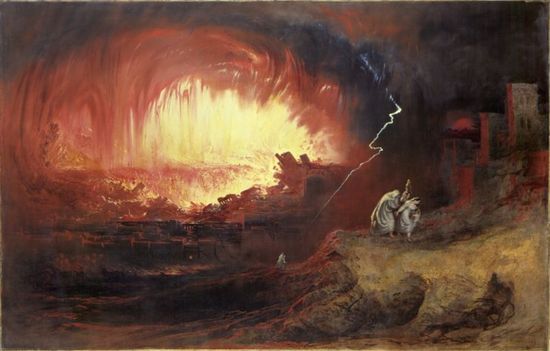
(Painting: The Destruction of Sodom and Gomorrah by John Martin, 1852.)