A sobering analysis of the proliferating military flashpoints in East Asia.
Year: 2013
A Guide To Actual Anti-Semitism
Beinart goes all Buzzfeed on us.
Sunlight On One Anti-Hagel Group
It’s run by a Republican Likudnik obsessed with Greater Israel. Who’d have thunk it? Here’s one of their ads in the last campaign: pro-torture fear-mongering of the crudest kind:
Meanwhile, McCain is currently grilling Hagel with clear animus. The live C-SPAN feed is here. The Likud wing of the GOP isn’t giving up any time soon:
For Hagel’s opposition, the best-case scenario is that only a few Republicans break ranks and a couple of Democrats do break ranks, giving the Hagel opposition the 40 votes needed to filibuster the vote on the nomination. They recognize that is unlikely and a filibuster of a cabinet nominee is extremely rare, but they plan to continue their effort well past Hagel’s confirmation hearing, hoping that more embarrassing quotes from Hagel’s past surface or a new scandal comes to light.
But you can also see why the neocons are so alarmed when you review Hagel’s course materials at Georgetown:
One even clearer clue to Hagel’s views — and to one reason he meets some of his most intense opposition from those who fear cuts to America’s massive defense spending — is the figure who permeated both the undergraduate and graduate courses: former president and five-star general Dwight D. Eisenhower.
Hagel, who fought in Vietnam, would be the first Secretary of Defense to have seen combat as an enlisted soldier. The Senator even kept a large portrait of the former president, painted for him by his brother, in his office at Georgetown. In his book, Hagel wrote that Eisenhower is the man he’d “put up on my Rushmore.” And in his class, the Senator assigned his students Eisenhower’s 1961 farewell address, in which the president first named — and denounced — “the military-industrial complex.”
A Republican who favors the foreign policy mindset of Dwight Eisenhower? The stakes are high.
The Founder Of The Black Shorts
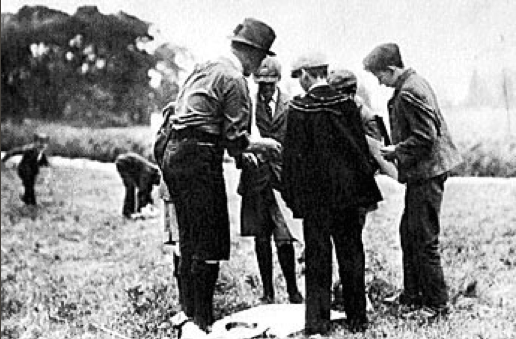
Jennie Rothenberg Gritz digs up some unsettling history of the original founder of the Boy Scouts of America, Robert Baden-Powell:
[He] was equally enthusiastic about the fascism that began spreading through Europe after World War I. He visited Italy in 1933 and wrote admiringly about the “boy-man” Benito Mussolini who had absorbed his country’s Boy Scouts into a thriving new nationalist youth movement. The dictator explained that he’d accomplished this feat “simply by moral force” – an explanation Baden-Powell felt “augers well for the future of Italy.”
If Baden-Powell had had his way, the Boy Scouts might have formed close ties with the Hitler Youth. In 1937, he told the Scouts’ international commissioner that the Nazis were “most anxious that the Scouts should come into closer touch with the youth movement in Germany.”

But at least he was able to give Pink Floyd some inspiration:
You should remember that being one fellow among many others, you are like one brick among many others in the wall of a house. If you are discontented with your place or your neighbors or if you are a rotten brick, you are no good to the wall. You are rather a danger. If the bricks get quarrelling among themselves the wall is liable to split and the whole house to fall.
No wonder he had such a soft spot for Mussolini’s politics; or that the Mormon Church dominates Scouting in the United States. Jennie quotes Hitchens (who highlighted the brick in the wall quote), and profiled the man in 2004:
Baden-Powell was not a megalomaniac (though he did at one point say that the Scout motto, “Be Prepared,” was inspired by his initials, which were also his scouting nickname). Nor was he a sadistic, repressed pederast. He was a racist and an imperialist and a monarchist, all right, but most of the time to a temperate degree. The British skill at “pig-sticking” was, he asserted (in another reference to a subject he could hardly bear to stay away from), proof of a natural superiority. He had charm and courage, and a knack with the young, and he could draw excellent freehand illustrations.
That’s one of his above: of a boy viewed from behind.
(Photo: Robert Baden-Powell and the first Scout at the first Scout encampment, August 1907, Brownsea Island, England.)
Immigration And The English Language
Earlier this week, Obama addressed the emotional nature of the immigration debate:
Waldman sees language requirements as central to getting immigration reform passed:
[W]hy is the “make them learn English” provision so politically important? Because it’s the key that unlocks wide public support for immigration reform. As a group, Americans have contradictory feelings about immigration. We can’t divide the country into “pro-immigrant” and “anti-immigrant” groups, even if you might be able to make such a division among politicians or talk-show hosts. Apart from a small population of hard-core nativists, most Americans acknowledge that we’re all descended from immigrants of one kind or another, whether your ancestors walked across the Bering Strait land bridge, came over on a slave ship, or drove down from Toronto. They also appreciate that immigration gives our country vitality, and that immigrants are exactly the kind of hard-working, ambitious strivers that drive our economy and culture forward.
But at the same time, many feel threatened when they see the character of their towns and cities change, and nothing embodies that change more than language. When people walk into a store and hear a language being spoken that they don’t understand, they suddenly feel like foreigners in their own neighborhood, alienated and insecure. I’m not putting a value judgment on that feeling, but it’s undeniable.
Drum agrees. Yglesias has related thoughts. One of my main problems with liberalism has long been its occasional tone-deafness when it comes to small-c conservatism. A country is not just about laws; it’s also about custom and tradition and habits and landscapes and memories. It’s a living organism; and one of the things that makes a unum out of a pluribus is the always-evolving English language. I think culture matters as a way of uniting such a fantastically diverse country as America. I think symbols matter. Even as a secularist, I have no real problem with public nativity scenes or rhetorical invocations of the Almighty (think of Obama’s Second Inaugural).
Don’t get me wrong: I don’t want to control anyone else’s life. But as an immigrant, I value accepting and adapting to the existing customs and traditions of my new home. I came here in part to start over. I came not to be an Anglo-American or a gay American, but just an American. One day, I’ll even spell advertising correctly. And when that is the emphasis in immigration policy debates, immigrants will win. As, in America, they so often have.
The View From Your Window

Long Beach, California 8.30 am
The New GOP Strategy On Marriage
Barro watches marriage equality progress in Illinois:
Republicans want gay marriage enacted in such a way that they get as little credit or blame as possible, while assuring the issue falls off the political radar. Call it the no-fingerprints strategy: They don’t care if gay marriage becomes law so long as they can say somebody else did it. It’s not just Illinois; we’re seeing similar phenomena with Republican lawmakers in blue-leaning states, including New York, New Jersey and New Hampshire.
In the case of New York, he notes that “national coverage tended to focus on the four Republican state senators who voted yes,” but that the Senate majority leader, who voted against the bill, could have derailed it:
The organizing rules of the New York State Senate vested full control over the legislative calendar in Skelos; if he had wanted to block gay marriage, all he had to do was refuse to schedule a vote. Instead, he allowed the bill to pass.
Robot Fact-Checkers
Lauren Indvik details a prototype from the WaPo:
A software program recognizes and transcribes speech into text, which appears to the right of the video. As statements are transcribed, they are run against WaPo‘s database of facts, matching keywords to determine if an assertion is accurate. If it is, a “true” label will flash above the statement. Misleading statements will likewise be identified.
Hallie Batem ponders the situations in which the Truth Teller will fail and succeed:
[S]ome of the most skilled orators work in the gray areas where figures may be literally true, but misleading in certain contexts. Take Bill Clinton’s speech at the Democratic National Convention …
Clinton didn’t lie when he said, “In the past 29 months, our economy has produced about four and a half million private sector jobs.” But the “29 month” threshold was carefully chosen to reflect positively on President Obama’s leadership. Had that threshold been stretched out by a few months, the economic growth under Obama wouldn’t look so impressive. A robot might not catch that. A person, like FactCheck.org’s Robert Farley, did. …
In the wake of the London riots, the Guardian posted a visualization of how rumors were spread then quickly debunked on social media, and the results showed that Twitter might really be a “truth machine” as some have suggested. If algorithms could harness this data in real time for the sake of fact-checking, could it help journalists avoid potentially devastating reporting errors during breaking news events?
Mapping Out Mass Murders
The DHS and NJ law enforcement officials analyzed data on 29 mass shootings. Ackerman summarizes the findings:
The basic pattern found by the New Jersey DHS fusion center, and obtained by Public Intelligence(.PDF), is one of a killer who lashes out at his co-workers. Thirteen out of the 29 observed cases “occurred at the workplace and were conducted by either a former employee or relative of an employee,” the November report finds. His “weapon of choice” is a semiautomatic handgun, rather than the rifles that garnered so much attention after Newtown. The infamous Columbine school slaying of 1999 is the only case in which killers worked in teams: they’re almost always solo acts — and one-off affairs. In every single one of them, the killer was male, between the age of 17 and 49.
Will Netflix Originals Pay Off?
Andrew Wallenstein sees a problem with the company’s plan to release the full seasons of Arrested Development and House Of Cards all at once:
A relationship with a program that might otherwise drag out over months on a linear channel is telescoped into hours. And therein lies the paradox inherent in Netflix’s business model: Allowing consumers to consume at their own speed contradicts the company’s financial imperative to keep them on the service paying the seductively cheap flat monthly fee of $8 for as many months as possible.
He notes that, if “the 13 episodes of “Cards” were parceled out in the traditional weekly, installments, you could hook a viewer to pay for at least three months instead of just one.” Alyssa suspects that Netflix will eventually have to raise prices to stay afloat.
 The Dish
