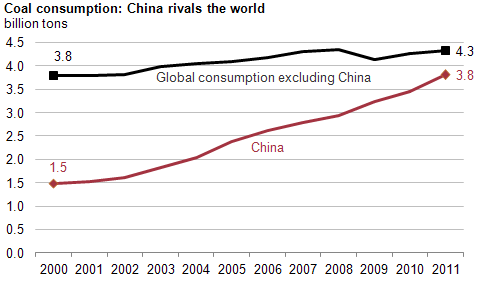
Chinese coal use slipped a bit in 2012 as the country’s economy slowed. And the International Energy Agency expects Chinese coal demand to taper off in the coming years, growing at a slower 3.7 percent annual pace between 2011 and 2016. Other projections suggest that China coal use will peak by 2030, as the nation shifts to cleaner forms of energy.
There’s just one catch: India is also growing rapidly and demanding ever more coal. By 2017, the IEA expects India to become the world’s second-largest coal consumer, surpassing the United States.
A new study from researchers at the University of Montreal looked at cortisol levels (a hormone associated with chronic stress, anxiety, and depression) in lesbian, gay, and bisexual individuals. Though the study was originally intended to check for differences between this group and a group of heterosexuals, Joseph Stromberg is more interested in their secondary finding:
Their main findings were something of a surprise—among their sample of 87 participants, gay and bisexual men actually had a slightly lesser chance of depression and anxiety, along with lower stress levels (as indicated by cortisol and 20 other biomarkers) than heterosexual men. Perhaps most significant, though, was the secondary finding that they hadn’t even been searching for: In their study, lesbian, gay and bisexual individuals all tended to have lower stress levels and a smaller chance of depressive symptoms if they’d come out to friends and family than those who’d kept their sexual orientation a secret. “Coming out,” the authors write, “may no longer be a matter of popular debate, but of public health.”
His qualifier: “the study’s limited sample size means that these results can’t be interpreted as definitive, and further study is needed to confirm that they hold true on a widespread level.”
Looks like a shoo-in for a Poseur Alert. “Enacting a hero’s journey”? Puh-lease.
Another reader:
If there is one cause that doesn’t need a rebel, it is sex. Having sex, enjoying sex, is enough of its own reward that I don’t think we also need to burden it with the strings of “brave rebellion” or Christlike exaltation, thank-you-very-much.
Another:
Here’s a tip, for anyone who thinks adultery is nothing more than a “physical enactment” of a “glorious and terrifying truth” – start with saying the actual truth, you fucking coward. You want to live a polyamorous relationship? Fine. Tell them that. That’s honesty.
Another:
Do we live in a prudish society? Yes. It’s a hell of a lot better than living in Saudi Arabia, but America is still puritanical in its own way. But let’s talk about the main crux of the article: adultery. Basically Richardson says that monogamous relationships are bad for us and that men who only sleep with one woman get a backlog of semen, while monogamous women become cold and frigid. Men are horndogs, women are frigid. Bill and Hillary. It’s a tired cliche.
I’ve been in a few relationships in my day. I’ve never cheated. Did I want to cheat? Sure. I’d see a cute girl and the thought would definitely go through my mind. But here’s the thing: I chose not to cheat. I am not some animal in heat who can’t help himself. I can make choices. And those choices are not going to irreparably harm my fragile male ego.
Or as another puts it, “Sex is great, betrayal is not.” Another:
I’m all for tearing down the religiously derived cultural taboos associated with our sexuality. And my reservations with the religious connotation notwithstanding, I’m even fine with thinking sex as a “moment of grace” – something that elevates the human experience in a profound and deeply felt way.
But holding up adultery as an act of heroism? I mean, not just excusing, but actually praising them? Come on.
I think you’ll have many people making this point, but what Richardson seems not to acknowledge is that it’s not the sex act that makes those two instances of adultery wrong. It’s the breach of trust and integrity in the context of a solemn commitment. If Richardson wants to continue the conversation about the place of marriage in our society and its value, that’s fine. If he wants to argue against a cultural pressure to construct that “invisible prison” for ourselves, great. But the point is that we construct that prison for ourselves, and in doing so we forge an agreement of mutual trust with another human being. It’s the violation of that trust, willingly accepted, that’s wrong.
Was Larry Craig committing an “honest” act when he stopped suppressing his true, deeply felt desires? I guess in a vacuum you could argue that. But he was committing a superseding cowardly act by pledging fidelity to a wife whose trust exposed herself and their family to a great deal of emotional turmoil. True courage would have meant accepting his identity before those whose trust and emotional dependence he willingly took upon himself. In so doing, his sexual escapades in a bathroom stall would have wrought no damage upon innocents, and would qualify, in my view, for the treatment Richardson affords them.
That’s the simple and obvious test: is there a victim? There is something to be said about a certain “prudeness” that pervades much of American culture. But you can make that point without openly lauding adulterers. I don’t have any problem at all with blowjobs or gay sex in bathroom stalls if that’s your thing. It’s the damage your visit upon others that’s wrong. I don’t really see how one can argue otherwise.
One more:
I won’t go into the smarmy, trendy, postmodernist tone this piece strikes, though Richardson certainly makes that a big enough target. What I will say is that I think the only thing he gets right is his inching towards an understanding of sexuality as something natural. I think that premise in talking about sex helps us reach toward a fuller understanding of both homo- and heterosexuality, and how sexuality pervades so much of our psychological lives and social interactions.
As for the idea that “adultery is a brave rebellion against the invisible prison we build for ourselves,” biologically speaking, that may well be. But what exactly does Richardson mean by “brave” here? What exactly is “brave” about something that comes completely natural to us without even thinking about it? What’s “brave” about fucking the intern and not telling your husband or wife? Richardson doesn’t come close to approaching the social complexities that come with our decisions surrounding sexuality and how it affects those around us (indeed, something he would likely count as a quaint remnant of a more “traditional” worldview). The bottom line (and I unfortunately speak from experience here) is that you can really emotionally wound people with your lustful caprice. Like, really fucking hurt people.
Not to mention the completely moot point that in espousing such a liberated view on sexual moors, Richardson falls into a trap he likely wishes to escape: prescribing behavior to others about their sexual behaviors.
“The world has changed beneath us. Shrillness and extreme language are driving away the voters who could help us build a majority. We’re not speaking to them as reasonable conservatives. Republicans have to decide if they want to govern or play ideological parlor games. Young people today have a more tolerant, hands-off perspective. Their libertarian philosophy, for example, has to be taken into consideration. Yet we keep projecting anger at the gay community and the Hispanic community, even though they’re open to many of our ideas,” – Jim Gilmore, former RNC chair and governor of Virginia.
A reader cited 9.5 billion animals slaughtered each year in the U.S. Another side of the question is would it be better if these animals never lived at all? Because that’s what would happen if we were all vegans. If we could ask them, what would the animals say? I suspect a dairy cow might think that being born and having a life in exchange for milk was an acceptable bargain, while a crated veal calf might think a brief life of misery was not. We raise domesticated animals for our own benefit, but as a result billions exist who would not otherwise.
Another:
I lived a very strict vegan lifestyle for nearly two years in my late teens. I was motivated by the ethical arguments surrounding the conversation. John Robbins’ Diet for a New America changed my life. While I am no longer vegan, I can state that it impacted by life beneficially on many levels. I was forced to learn to cook for myself as there was not a lot of vegan restaurant options in Northern Nevada in the ’90s. I learned to eat and love healthy, whole foods that I would have not dreamt to even consider palatable in my earlier years.
Most importantly, I would say that my vegan years color my understanding of capitalism. Factory farming is a detestable system that is hidden from the vast majority of the population. They are animal concentration camps that are kept out of sight because of the horrors found within. These farms are highly efficient, but they come at cost to our environment and our humanity. My time as a vegan taught me that my money is powerful, that it can go to evil places if I’m not careful. Veganism taught me to be as moral a consumer as I can be.
Rhys Southan rejoins the debate by responding to Dish readers via email:
Thank you for starting a discussion around my essay, “The vegans have landed.” I’m writing to respond to some of the criticisms of the essay that that you received and quoted in “Vegan Ethics, Ctd,” which are similar to some of the other comments I’ve seen.
In the wake of the Newtown shootings, NPR ran an item accompanied by the above picture. The news outlet was later contacted by the woman shown in the picture, Aline Marie, who noted that “no one asked [her] permission to post [the picture].” Coburn Dukeheart relates her feelings about the experience:
“I sat there in a moment of devastation with my hands in prayer pose asking for peace and healing in the hearts of men,” [Aline Marie] recalls. “I was having such a strong moment and my heart was open, and I started to cry.” Her mood changed abruptly, she says, when “all of a sudden I hear ‘clickclickclickclickclick’ all over the place. And there are people in the bushes, all around me, and they are photographing me, and now I’m pissed. I felt like a zoo animal… yes, it was a lovely photograph, but there is a sense of privacy in a moment like that, and they didn’t ask.”
Dukeheart also spoke with the photographer, Emmanuel Dunand:
[W]hen he took Marie’s photo, he knew she was suffering, but that he simply didn’t want to bother her. He thought that leaving her alone was the most respectful thing to do.
NPR solicited reader comments on whether photographers should “interact with their subjects in moments of grief” to ask permission and names, or if it is “more respectful to leave them alone.” Dukeheart summarizes the responses here.
(Photo: Aline Marie prays outside St. Rose of Lima church in Newtown, Conn., on the day of the school shooting. Marie noted in her message to NPR that she was “not asking [them] to take the photo down, nor [was she] offended.” By Emmanuel Dunand/AFP/Getty Images.)
Identical twins can be up to 12 percent different. This being the case, the term “identical” has been replaced by “monozygotic.” The difference is caused by epigenetics, which is, in [The Epigenetics Revolution author Nessa Carey’s] words, “the set of modifications to our genetic material that change the ways genes are switched on or off, but which don’t alter the genes themselves.” … Carey encourages us to think of DNA as a script, rather than a template. With a template you stamp out identical gingerbread cookies. With the same script you can make two very different movies. My monozygotic twin and I, whether because of environment, predilection, or epigenetic switches, are two very different movies.
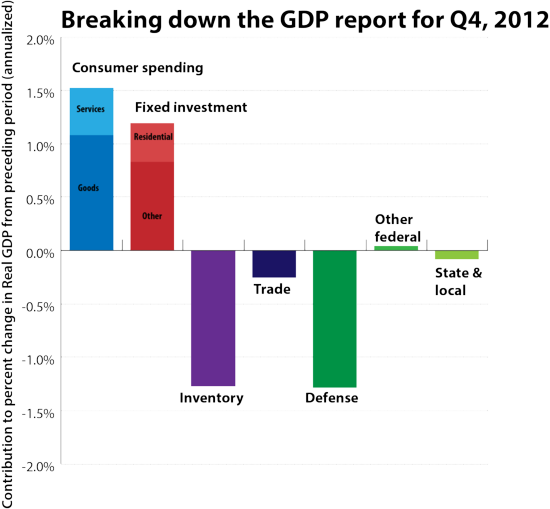
Q4 GDP was -0.1%. Dylan Matthews breaks down the decline:
Plumer looks at the causes of the economic contraction. The big one:
Government defense expenditures plunged by a staggering 22.2 percent between October and December. According to the Bureau of Economic Analysis, the Pentagon spent significantly less on just about everything except military pay. Had the Pentagon not cut back on spending, the economy would have grown at a weak but positive 1.27 percent pace.
Neil Irwin says this was “a bad quarter for the U.S. economy, but not nearly as bad as the overall negative number would suggest”:
A drop in business inventories was the second major drag on growth. Firms drew down their inventories by more than $40 billion, which subtracted 1.25 percentage points from GDP growth. With companies focusing on selling goods already sitting on their store shelves and in their warehouses, production in the nation’s farms and factories was not as high as one might expect given consumer and business spending. But businesses can’t simply run down their inventories forever, and that bodes well for future growth. Final sales, which add inventories back in, rose at a 1.15 percent rate.
The final reason for the shocking G.D.P. figure was a sharp fall in American exports, sufficient to knock nearly one per cent off the growth figure. This was the first drop in exports since the first quarter of 2009. If sustained, it would be very worrying—indeed, it would raise the spectre of another global recession. But the world economy doesn’t look that bad. Europe and Japan are still in poor shape, but growth in China and other developing countries appears to be picking up. The latest forecast from the International Monetary Fund is that the world G.D.P. will expand a bit faster this year than last year (3.5 per cent compared to 3.2 per cent). Even if global growth merely holds up at last year’s levels, U.S. exports should pick up a bit.
Drum wishes the report “persuaded some people that government spending really does affect economic growth”:
The meter and new ad-free site arrives Monday; we migrate (I seriously have no idea what that means) from the Beast over the weekend. But we just passed $500K in pre-subscriptions. Which is to say: holy shit. Seriously: this is still a little hard to absorb. But thank you so much.

 The Dish