The GOP Calculus On Immigration Reform, Ctd

6a00d83451c45669e2017ee8017d4e970d-550wi

Douthat suspects that immigration reform would be a net loss for Republicans:

By definition, creating a path to citizenship turns illegal aliens into potential voters, and any serious analysis of Hispanic opinion tells you that those new voters’ interests and beliefs will tend to align with the Democratic Party. No, not necessarily forever, but across the next few decades of American politics there is simply no plausible case that gratitude to Marco Rubio and Jeff Flake will convert a liberal-leaning voting bloc into a true swing constituency, let alone a Republican-tilting demographic. Which makes it very, very easy to imagine a future where immigration reform helps Republicans win a slightly higher percentage of the Hispanic vote, but costs them many more votes in absolute terms by accelerating the ongoing demographic shifts in the electorate.

Bouie, on the other hand, finds that immigration reform is unpopular with working-class blacks. He notes that “losing black voters—even if it’s just a few percentage points—could disadvantage the party in southern states like Virginia and North Carolina, where overwhelming black support is required to stay competitive”:

[I]f Republicans are feeling ambitious, this divide could form the basis for outreach to working-class blacks. Historically, Republicans have been able to win 10 percent of African Americans in presidential elections. A return to that performance would make several states—Ohio and Pennsylvania, for instance—far more competitive than they are at the moment. Insofar that the GOP wants to cleave the Democratic coalition, immigration might offer a way to reach one group of working-class voters.

Earlier analysis here.

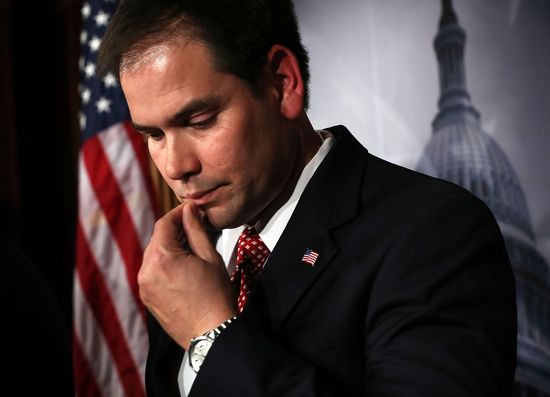
(Photo: Senator Marco Rubio (R-FL) listens during a news conference on a comprehensive immigration reform framework on Capitol Hill on January 28, 2013. A group of bipartisan Senate members have reached to a deal of outlines to reform the nation immigration laws that will provide a pathway for the 11 million illegal immigrants in the country to citizenship. By Alex Wong/Getty Images)

Trashing The Treasures Of Timbuktu, Ctd

Malian Islamists on the run from French troops just torched a famed library of Islamic learning. Paula Froelich has more:

[T]hese libraries were spectacular, containing thousands of ancient leather-bound books written in Arabic, Hebrew, African tribal languages, Turkish, and many other tongues, and covering topics like astronomy, poetry, music, politics, grammar, medicine, law, conflict resolution, and women’s rights. The oldest books were from the eleventh century, when the Salt Road trading was at its peak and international traders would converge on Timbuktu. The information in these tomes was still so salient that, as the crumbling pages of the books were being preserved, people from all over the world were still trying to translate and study them to see if there was some knowledge they could use today. …

There is more than a heavy dose of irony about the book burnings, especially since many of the books burned by Islamists were Korans, and worth millions of dollars. Why burn the books when selling them could’ve been so much more profitable and at least kept the artifacts intact?

Walter Russell Mead curses the cultural vandalism:

People sometimes talk about the war against radical Salafi jihad groups as a clash of civilizations. In reality, as the torching of the great library of Timbuktu, a world class repository of Islamic history, religious writing and culture, shows, this is a war against civilization being waged by barbarian know-nothings.

Dish coverage of the destruction from last fall here.

How Do You Solve A Problem Like Amtrak’s WiFi? Ctd

A reader warns:

Your reader probably shouldn’t “just jailbreak my iPhone and use it as a hotspot.”  As of this past Saturday, such activities are now illegal.

Update from a reader below correcting that claim. Another reader:

If they can do it on high speed rural trains in France and mountainous and tunneled areas of Germany, surely Amtrak has no excuse. Wifi router on board connected to a satellite system and a contract with a wireless provider for the few tunnels they have and – boom – it’s done. Ok, maybe they need to start with a customer base, but that may be a chicken/egg argument.

Another goes into detail:

Continue reading How Do You Solve A Problem Like Amtrak’s WiFi? Ctd

History Of The Goose Step

Wayne Curtis gives a lesson:

The step — the Prussians called it Paradeschritt or, later, Stechschritt — apparently took root with guards in the Holy Roman Empire, and then found its way to Prussia around 1730. It persisted until 1940, which was the last year the Nazis taught newly drafted soldiers how to goose step, instead shifting to more practical skills. (It was renamed the “Roman step” when Benito Mussolini brought it to Italy in 1938.)

In truth, it’s not a very sensible way to get around (goose-stepping injuries weren’t uncommon among soldiers), but it was taught to instill discipline among the troops. More so, it served well in ceremonial public displays — to demonstrate a leader could turn men into machines. The step invariably involved boots brought down in unison, smartly and loudly, giving a platoon the invincible sound of a well-lubricated machine.

Egg Donors Beware?

Alison Motluck worries that fertility doctors may be downplaying the medical risks for donors. She highlights a major fault with their business model: doctors’ conflict of interest, since they have “two patients—the recipient and the donor” whose interests often collide:

In other areas of medicine that use donors, such as bone-marrow transplantation, physicians have taken steps to protect donors by separating their medical care from the care of the recipient. Applied to fertility medicine, this could mean giving the egg donor her own doctor, responsible only to her and keeping only her health in mind. A separate doctor could care for the recipient. Given that the recipient is the paying patient, however, this would be a challenging ideal to uphold in practice.

Egg donors deserve at least the same treatment as other patients—and, arguably, better. After all, they are young and healthy, and they undertake medical treatment for another person’s benefit. They deserve to know the truth about the health risks they face, and, wherever possible, to have those risks reduced.

Our ADD Media, Ctd

6a00d83451c45669e2017ee7fbe84f970d-550wi

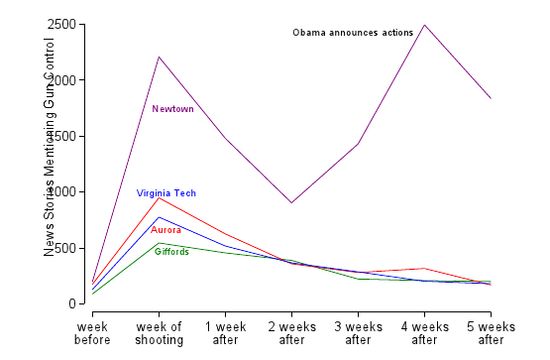
Danny Hayes believes that the gun control debate after Newtown has persisted (contrary to his expectations) because the media has covered the shooting “in a fundamentally different way than they have others”:

As I wrote in the days after Sandy Hook, coverage of gun control typically spikes following a mass shooting. But it pretty quickly recedes. … Just two weeks after the shooting, gun control looked like it was headed to the dustbin of history again. In particular, the fiscal-cliff debate (and the attendant congressional f-bombs) sucked almost out of the oxygen out of the Washington media air. In the week surrounding the New Year, “fiscal cliff” appeared in the news four times as often as “gun control.” But coverage shortly moved on to a third phase. Whereas gun control had evaporated from the news within about a month of the earlier shootings, in the case of Newtown, it surged back in mid-January.

He also points to the importance of “gun control” in the media’s coverage:

Even before the 27 victims had been laid to rest, gun control was a far more prominent part of the Newtown narrative than it had been in previous incidents. And in contrast to the Virginia Tech, Aurora and Giffords shootings, it has come to dominate the media narrative. The week that Obama issued the executive actions, more than 60 percent of stories that mentioned Newtown also included a reference to gun control.

(Chart: The number of news stories including the phrase “gun control” in the wake of various shootings.)

Meter Drag

Hunter Oatman-Stanford investigates the slow evolution of the change-fed parking meter:

Today, parking covers more of urban America than any other single-use space, yet the vast majority of meters are outdated, coin-only devices, charging a flat-rate during operating hours across all zones. “From the user’s point of view, most American parking meters remain identical to the original 1935 model,” writes [Donald Shoup]. “You put coins in the meter to buy a specific amount of time, and you risk getting a ticket if you don’t return before your time expires. The main change in 70 years is that few meters now take nickels. In real terms, however, the price of most curb parking hasn’t increased; adjusted for inflation, 5 cents in 1935 was worth 65 cents in 2004, less than the price of parking for an hour at many meters in 2004.”

He praises the model in San Francisco, where rates can be adjusted depending on vehicle occupancy and turnover:

Since the project’s debut, meter rates have been adjusted every six weeks to reach an optimal hourly charge that will keep between most meters occupied with a few always open for new vehicles. Recently, the San Francisco Examiner found the project to be an overall success, with parking rates and fines actually decreasing across the city even as spaces become more available.

Piracy In The Caribbean

Gregory Ferenstein sets the scene:

Apparently, the government of Antigua is permitted to suspend up to $21 million in copyright annually, because the U.S. defied a World Trade Organization ruling that permitted it to host online gambling. “A few years ago 5% of all Antiguans worked at gambling related companies. However, when the U.S. prevented the island from accessing their market the industry collapsed,” explains TorrentFreak. In revenge for snubbing the WTO, Antigua plans to “capitalize” on the right to offer copyrighted materials, which means there might be some fee associated with the service.

Brendan Sasso is less sure:

[Lawyer for the International Intellectual Property Alliance Michael] Schlesinger argued that the WTO ruling does not free Antigua from its other international obligations to respect intellectual property rights. “Countries have international obligations aside and apart from their WTO obligations,” Schlesinger said, arguing that Antigua is prohibited by the World Intellectual Property Organization form setting up a piracy website.