Foreign Fast Food

Jeb Boniakowski dreams of “McWorld,” a place in Times Square that would serve all the world’s variations of the McDonald’s menu:

Everyone talks about how globalization “McDonalds-izes” the world, but the funny thing about a place like New York is that you can get basically every kind of food *except* whatever they serve at the foreign outposts of our proud American chains. I would say I know more people who have had a lamb face salad from the Xi’an Famous Foods in the Golden Mall in Flushing than have had the poutine from the Montreal McDonalds, never mind something you really have to travel for, like a Chicken Maharaja Mac.

Continue reading Foreign Fast Food

Learning By Heart

Brad Leithauser sees value in poetic memorization:

The best argument for verse memorization may be that it provides us with knowledge of a qualitatively and physiologically different variety: you take the poem inside you, into your brain chemistry if not your blood, and you know it at a deeper, bodily level than if you simply read it off a screen. [Catherine] Robson puts the point succinctly: “If we do not learn by heart, the heart does not feel the rhythms of poetry as echoes or variations of its own insistent beat.”

Will The Sequester Give The GOP Leverage?

Ezra Klein thinks not:

[T]he sequester doesn’t touch Medicaid, Social Security or Pell grants. It exempts most programs for low-income Americans, like food stamps. Veteran’s benefits are home free, as are federal retirement benefits. Medicare providers see cuts, but Medicare beneficiaries don’t. And fully half of the cuts come from the military — a huge reduction in defense spending that Democrats couldn’t dream about achieving any other way.

That’s not to say Democrats will love the sequester. It slashes deep into everything from the National Institutes of Health to the Office of Vocational and Adult Education to the Environmental Protection Agency. Worse, the cuts are done with a cleaver rather than a scalpel. Rather than giving agencies control over how to apportion the spending cuts, every affected program simply sees the same reduction. Democrats don’t much like that, but given the sequester’s disproportionate focus on the military, it’s even worse for Republicans.

Our Family Time Shortage

6a00d83451c45669e2017c36581e96970b-550wi

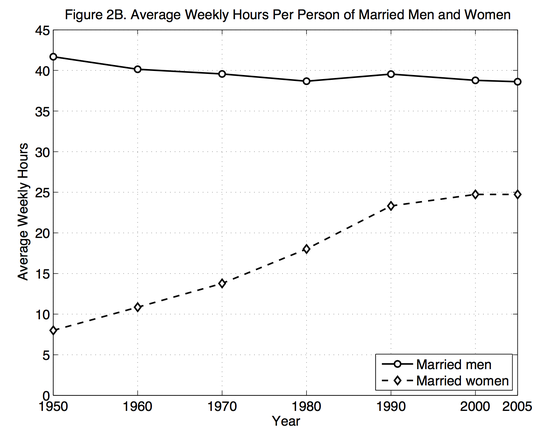
Yglesias asks, “what do people have less of than they had 40 years ago?” Krugman nominates family time:

[W]hat we have is a situation in which American families have more stuff, but they have managed to afford that stuff only by being two-income families, with ever less family time — unlike their European counterparts, who have gained in shorter hours and vacations what they lost in stay-at-home wives.

(Chart from (pdf) the Federal Reserve Bank of Minneapolis)

The Formula For Lifespans

Robert Krulwich reveals it:

Life is short for small creatures, longer in big ones. So algae die sooner than oak trees; elephants live longer than mayflies, but you know that. Here’s the surprise: There is a mathematical formula which says if you tell me how big something is, I can tell you — with some variation, but not a lot — how long it will live. This doesn’t apply to individuals, only to groups, to species. The formula is a simple quarter-power exercise: You take the mass of a plant or an animal, and its metabolic rate is equal to its mass taken to the three-fourths power.

How Do You Solve A Problem Like Amtrak’s WiFi? Ctd

A reader writes:

If it’s really so hard to provide good wifi, how is it that airplanes can do it? Not too many cell towers at 30,000 feet and 500mph, last I could see.

Another:

How to fix Amtrak? Well, if they decided to charge $12 per day like GoGo does for flights, they could probably boot enough people off the system to get speeds up for the ones who stay on. And maybe this would raise enough revenue to build dedicated, track-side wifi facilities for areas with poor service. But even GoGo isn’t infallable (it usually quits several times during a flight and needs to be rebooted) and it’s certainly pricey. I guess I really should just jailbreak my iPhone and use it as a hotspot.

Before the Northeast Corridor got wifi, Amtrak’s Downeaster from Boston to Portland, Maine was wired for service in 2007. The first iteration was, by all accounts, pretty horrible. It used only one provider, so when that signal wasn’t available, it was toast. The revamped wifi is better, but it still runs in to a major problem: outside of major population centers, good service is aimed at Interstate Highways.

If you ride the bus from Boston to Portland (which also has wifi – the train and bus are in a sort of symbiotic competition, unlike further south on the Northeast Corridor where the bus is a budget product and the train is a luxury, although if you really want a bus experience, you can take the Greyhound, which Concord Coach and Amtrak have almost completely driven off the route) connection speeds top out slower, but service is more constant. The train traverses some more rural areas in New Hampshire and Maine, at which point the service grinds to a halt. I have found that when the Dish stops loading (oh, I guess I read other things on the train, too, from time to time) I can look at my phone and it invariably shows little or no service. At which point I look out the window or – horrors! – read a book. (Or go down to the cafe and get a beer.)

The MBTA in Boston has wifi on commuter trains as well, which works better because the trains traverse more settled areas at generally lower speeds and fewer people use the service (especially outside peak commute times). Still, on the outer reaches of some of the lines where the train passes through horse farms between stations, service can be shoddy. But it’s free, so we can’t complain too much.

Who’s Really Behind The Anti-Hagel Ad Campaign?

6a00d83451c45669e2017d408833e7970c-550wi

Surprise!

The biggest individual financier of the so-called super PACs that sought to defeat Mr. Obama, Sheldon Adelson, is so invested in the fight over Mr. Hagel that he has reached out directly to Republican Senators to urge them to hold the line against his confirmation, which would be almost impossible to stop against six Republican “yes” votes and a unified Democratic caucus… But it is unclear whether he is directly financing any of the anti-Hagel advertising.

So one of Netanyahu’s point-men in the US is a key opponent of Hagel. Republican fundraiser, Foster Friess, also cites Israel as the core issue against Hagel in the article, although he is skeptical of the impact of big ad buys. So one assumes it’s supporters of the Greater Israel Lobby who are behind the far-right attacks on a Republican nominee. (If LCR wants to prove this isn’t so, and they weren’t bought by outside interests, they have my email address and I’d be delighted to publish the truth). But what of the strangely anonymous left-wing group, “Use Your Mandate”, publishing fliers against Hagel on issues like gays and women? Andrew Kaczinsky investigates:

A new group opposing Chuck Hagel bills itself as a gay-rights organization made up of mostly Democrats — but it has close ties to the Republican Party. The New York Times Times reported that Use Your Mandate uses Del Cielo Media, a prominent Republican firm, to purchase its television advertisements, the same as used by the Emergency Committee for Israel.

He finds elaborate methods used to disguise the source of the fliers.

This is, of course, a free country and people should be free to spend their money as they see fit on political causes, even doomed ones. But there surely has to be some accountability and transparency at some point, especially if one group is portraying itself dishonestly. The point of free speech is in part to express yourself – with your name proudly attached. So why do these neocons refuse to identify themselves? Why are they hiding? What could they conceivably have to hide?

Some thoughts on the “night-flower” strategy here.

(Photo: Former Sen. Chuck Hagel, R-Neb., nominee to be Secretary of Defense, arrives to meet with Sen. Ben Cardin, D-Md., in the Hart Senate Office Building on Wednesday, January 23, 2013. By Bill Clark/CQ Roll Call via Getty.)
Yglesias Award Nominee

“Since 1965, arguably the most important conservative politician after Ronald Reagan is Newt Gingrich. He achieved some remarkable, impressive things. But he practiced a style of politics that was quite different from Reagan’s. It was characterized by apocalyptic and incendiary rhetoric, anger, impatience, and revolutionary zeal. While his positions on issues were often conservative, Gingrich’s temperament and approach were not. Yet it is the Gingrich, not the Reagan, style that characterizes much of conservatism today. It would be better for conservatism, and better for America, to recapture some of the grace, generosity of spirit, and principled politics of America’s 40th president,” – Pete Wehner, Commentary.