Moral Perversity In David Mamet

This is a first sentence only a teenage anarchist could write:

The police do not exist to protect the individual. They exist to cordon off the crime scene and attempt to apprehend the criminal… Violence by firearms is most prevalent in big cities with the strictest gun laws. In Chicago and Washington, D.C., for example, it is only the criminals who have guns, the law-abiding populace having been disarmed, and so crime runs riot. Cities of similar size in Texas, Florida, Arizona, and elsewhere, which leave the citizen the right to keep and bear arms, guaranteed in the Constitution, typically are much safer.

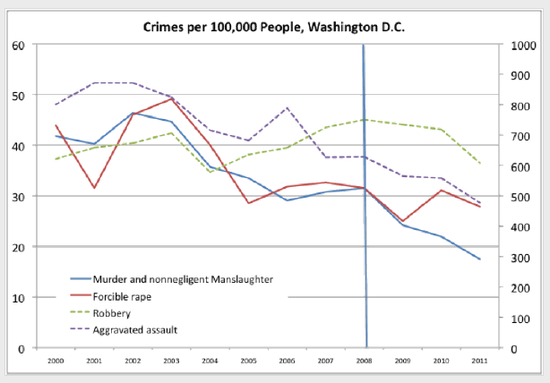
Look: for over two decades I lived on a street corner in DC actually named after a gang. I recall four people being shot dead in my alley or on the sidewalk outside during that time. I have regularly heard gunshots at night. And the police did protect me. By patrols, by check-points, by klieg-lighting at night, by conversations and consultations, they kept the neighborhood safer. Not safe, but definitely safer. Can they be there every time someone might get mugged? No. Do far fewer people get mugged now than they did a decade ago because of police work, among other things? Abso-fucking-lutely. That is what they exist for: to prevent crime, not just bring criminals to justice in the afermath. And in DC, over the last couple of decades, a new city emerged:
6a00d83451c45669e2017ee7fb8da2970d-550wi

You will see in Mamet’s imaginary dystopia, this is a city in which “crime runs riot.” But every category of crime is down over the decade – with murder down almost a half in ten years. But how does it compare with comparable cities in Texas, Florida and Arizona – which Mamet cites as key evidence? First up: it’s worth noting that the FBI discourages simple ranking of cities by crime, for all sorts of reasons extrapolated here. So I will not throw this data out there, as Mamet did, without that caveat. Checking the numbers, however, for last year you find that in terms of aggrevated assault per 100,000 people, Miami and Houston have a rate of 361 and 329 respectively (third and fourth in the nation after Detroit and Baltimore. Chicago weighs in at 222 and DC at 154.

Robberies? The allegedly Marxist regimes in Chicago and DC clock in at fourth and tenth. That might seem to buttress Mamet’s point until you see that Miami and Houston are at fifth and sixth as well and that Phoenix and Dallas are not far behind.

Murders – which may be in Mamet’s mind, the most important thing that guns deter – has seen a resurgence in Chicago this year. But its rate per 100,000 (6.8) in a crime wave is still not that far from Miami/Fort Lauderdale’s (6.1). As for DC, compared with cities in Arizona, Florida and Texas, which Mamet cites, the numbers per 100,000 residents are these: Houston (5.4), Phoenix (4.9), Tampa (4.7), Dallas-Fort Worth (4.5) and DC (4.4). Again, I would reiterate that these are very crude numbers – but they do rebut the claim that cities in Texas, Arizona and Florida “are much safer” than Washington DC or Chicago. Four Three out of the top ten cities for crime are in Florida, Arizona and Texas.

As for Mamet’s claim that “there are more than 2 million instances a year of the armed citizen deterring or stopping armed criminals”, the evidence, so far as we can glean, seems to come from a 1993 study by Gary Kleck, which is also contained in this 1995 paper (pdf) by Kleck and Gertz, which finds 2.5 million annual “defensive gun uses” by individuals each year. This puts defensive gun use at about five times the frequency of criminal gun use. But another study (pdf) by McDowall and Wiersma criticized the Kleck results by noting that “defensive gun uses” were not defined by actual use of guns in self-defense, but by claims of deterrence by people carrying concealed guns. Which may account for the difference between that datapoint and the National Crime Victimization Survey, which found that “gun offenses exceeded protective incidents by more than 10 to 1.” That’s not another slightly different result; that’s a different universe from Mamet’s anarchist mindset.

I’m not making an argument for or against gun control here. I’m just trying to show that Mamet’s broad generalizations are empirically wrong and need to be corrected.

An Editor Now At Large

Michael Kinsley marks his return to TNR by reflecting on his on-again, off-again relationship with the magazine:

This time, I return not as the editor (please direct your complaints and article submissions elsewhere) but as “editor-at-large.” I see this as a sort of avuncular role, in which my primary duty will be cornering the young people in the office and forcing them to listen to tedious anecdotes about the old days. I also plan to write self-indulgent, lachrymose memoirs of journalistic colleagues and friends as they, one by one, drop off their perches.

Heh. I always preferred Michael Lewis’s description of being a “senior editor” at TNR: “I am senior to no one and I edit nothing.” The best job in journalism, in my book. Another Kinsley classic:

Every editor has a set of stock excuses for turning down articles with minimal damage to an author’s feelings. I usually went with a vague, “Doesn’t meet our needs right now.” It always amazed me when a disappointed author would cross-examine an editor, pointing out the logical flaws in the reason offered for not publishing his or her masterpiece. “What do you mean, you just ran a piece on a similar topic? That one was about tourism in Bolivia. This one is about Trotskyism in Bulgaria. You’re not making any sense!” I used to think, “Well of course I’m not making any sense. I’m lying to avoid saying, ‘Your piece is unpublishable crap.'” What I usually said was a cowardly, “Let me have another look.”

He wasn’t as kind to the interns. I repeat myself like an editor-at-large might, but I will never forget giving Mike a first draft of a long and carefully wrought piece (I had yet to be turned into a proper hack), and getting the edit back within a few hours. About two thirds of the piece had been highlighted with the immortal words:

This is crap. Cut it.

I did.

Leaning Into The Pain

6a00d83451c45669e2017c3658347b970b-550wi

“‘Look up, not down,’ [Aaron Swartz] urged readers of his weblog; ‘Embrace your failings.’ ‘Lean into the pain.’ It was hard to take that advice himself. He kept getting ill, several illnesses at once. Migraines sliced into his scalp; his body burned. And he was sad most of the time, a sadness like streaks of pain running through him. Books, friends, philosophy, even blogs didn’t help. He just wanted to lie in bed and keep the lights off.

In 2002 he posted instructions for after his death (though I’m not dead yet! he added). To be in a grave would be all right, as long as he had access to oxygen and no dirt on top of him; and as long as all the contents of his hard drives were made publicly available, nothing deleted, nothing withheld, nothing secret, nothing charged for; all information out in the light of day, as everything should be,” – from the Economist‘s heart-breaking and deeply personal obit for a genius and dreamer whose life was cut short by a prosecutor who didn’t so much over-reach as persecute and bully.

Christianism And Violence, Ctd

Zack Beauchamp adds to the conversation about Jesus and the Second Amendment. He makes a key point about Hobbes and Locke (but especially Hobbes): self-defense was indeed the basis of a Hobbesian political order and the defense of private property integral to Locke’s. But the idea – asserted by David Mamet in an embarrassing screed – that Hobbes did not for those reasons establish a Leviathan with a monopoly of force is preposterous. That was the whole point. Hobbes emerged from Mamet’s paradise: a polity with no police force in which self-defense was critical and when political differences emerged, civil warfare was the natural response. Hobbes lived through Mamet’s moronic utopia and found it so terrifying he changed global consciousness to rein it back in.

More on the Mamet piece soon. God it was awful.

First, Do No Harm

6a00d83451c45669e2017c3657a1d4970b-550wi

In an interview with TNR, Obama discusses his foreign policy philosophy:

I am more mindful probably than most of not only our incredible strengths and capabilities, but also our limitations. In a situation like Syria, I have to ask, can we make a difference in that situation? Would a military intervention have an impact? How would it affect our ability to support troops who are still in Afghanistan? What would be the aftermath of our involvement on the ground? Could it trigger even worse violence or the use of chemical weapons? What offers the best prospect of a stable post-Assad regime? And how do I weigh tens of thousands who’ve been killed in Syria versus the tens of thousands who are currently being killed in the Congo?

Those are not simple questions. And you process them as best you can. You make the decisions you think balance all these equities, and you hope that, at the end of your presidency, you can look back and say, I made more right calls than not and that I saved lives where I could, and that America, as best it could in a difficult, dangerous world, was, net, a force for good.

And some thought he is a liberal. George W Bush was a utopian liberal. This dude’s a pragmatic, small-c president. But he still couldn’t resist Libya and the still-unfolding consequences – like a new safe harbor for Jihadists. Drezner unpacks the quote:

Obama looks at Syria and sees a grisly situation where the status quo doesn’t hurt American interests — in fact, it’s a mild net positive. Given that situation, Obama’s incentive to intervene is pretty low.

Does this mean Obama is amoral or un-American? Hardly. That answer suggests two things. First. liberal values do matter to Obama — they just don’t matter as much as other things. Second, to be fair, contra academic realism, there is a set of ethical values that are attached to realpolitik, and I think they inform Obama’s decision-making as well. It seems pretty clear that Obama’s first foreign policy instinct after advancing the national interest is the foreign policy equivalent of the Hippocratic oath: first, do no harm.

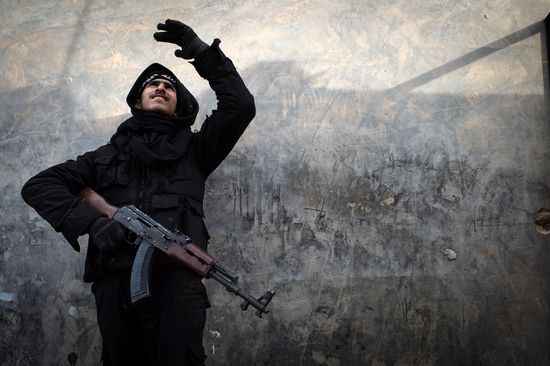
(Photo: A Rebel fighter tries to locate a government jet fighter in the city of Aleppo on January 18, 2013)

How Dangerous Is The Debt?

Bruce Bartlett claims that “our long-term deficit situation is not nearly as severe as even many budget experts believe”:

6a00d83451c45669e2017ee7fb3b6b970d-320wi[I]t is silly to obsess about near-term nominal budget deficits. What matters is the deficit as a share of GDP minus interest spending, which economists call the primary deficit. On that basis, we are much closer to fiscal sustainability than even most economists realize.

Relatively small adjustments to the growth path of federal revenues and Medicare would be sufficient to eliminate the primary deficit. Taking a meat ax to every federal program, as Republicans demand, is neither necessary nor desirable.

The always-worth-reading Martin Wolf at the FT comes to the same conclusion (the above graph is from Wolf and the FT). Stan Collender seconds him:

What Bruce shows — convincingly — is that, contrary to those that say federal “spending” is the long-term problem, the real problem is spending in just one area — interest payments on the national debt. Spending on virtually every other area of the budget is flat over the long term while interest starts to rise precipitously in 2020 and keeps rising over the next 60 years.

Collender think that “this situation argues persuasively for the government to convert its debt from short- to long-term so that the current low interest rates can be locked in for as long as possible.” I have to say that as the years have gone by since the 2008 crash, I find it hard to judge the British experiment in austerity-now over the American experiment of stimulus-now-austerity-long-term, without losing one more sliver of my fiscally conservative bona fides. Of course, the American version was not some act of genius: it’s the result of an overly-rosy administration assessment of things in January 2009, and the GOP take-over of the House in 2010. But that combination sure turned out better than what could now be a triple-dip recession in the UK.

Nonetheless, the long-term spending situation, especially on Medicare, requires urgent attention.

The slow-cost “easter eggs” in the ACA are not working very well – either RAND’s projection of huge potential savings of medical electronic records (so far) or paying-for-quality. At some point, IPAB is going to have to get real powers, or Medicare power-of-attorney conversations need to be recovered from Palinland, or the simple massive costs of medical devices and practices in America are going to have to be driven down by a single payer system. Or millions of seniors are going to have to go without comprehensive healthcare. I’m not an optimist on this, although I second Bruce’s point about excessive alarmism. I just don’t want Obama to be lax on Medicare spending. The future debt projections are a key part of his legacy, as The Economist reminded us here.

Remove The Hounder Of Aaron Swartz, Ctd

Declan McCullagh passes along the latest:

State prosecutors who investigated the late Aaron Swartz had planned to let him off with a stern warning, but federal prosecutor Carmen Ortiz took over and chose to make an example of the Internet activist, according to a report in Massachusetts Lawyers Weekly. Middlesex County’s district attorney had planned no jail time, “with Swartz duly admonished and then returned to civil society to continue his pioneering electronic work in a less legally questionable manner,” the report (alternate link) said. “Tragedy intervened when Ortiz’s office took over the case to send ‘a message.'”

The report is likely to fuel an online campaign against Ortiz, who has been criticized for threatening the 26-year-old with decades in prison for allegedly downloading a large quantity of academic papers. An online petition asking President Obama to remove from office Ortiz — a politically ambitious prosecutor who was talked about as Massachusetts’ next governor as recently as last month.

Sign that petition here. Earlier coverage here.

(Hat tip: Jay Rosen)

Canine Cosmetic Surgery

6a00d83451c45669e2017d4072c2f4970c-550wi

Emily Anthes is against the practice of surgically shortening a dog’s tail for aesthetic reasons:

A fast, wagging tail can signal excitement and playfulness, whereas a tail tucked between the legs is a sign of submission. A dog that’s feeling aroused, confident, or aggressive may hold his tail up high, while a relaxed pooch lets his tail hang down lower and looser. These tail movements provide important clues about how a dog is feeling–especially to other canines that may be sharing the same sidewalk or dog park.

She summarizes a study that tested robotic dogs, pictured above, in dog parks:

Large dogs approached a short-tailed robot with a wagging tail just as often as one with a motionless tail (85.2% and 82.2% of the time, respectively). These findings suggest that the dogs were less able to discriminate between a tail that’s wagging playfully and one that’s standing still and erect when the tail itself is short.