The Man In Black’s Crusade

This embed is invalid

Danny Robins lauds the prison-reform campaign of the late, great country singer, Johnny Cash, including the many unpaid concerts he played for inmates:

He played his first prison concert in 1957 at the Huntsville State Prison in Texas. Many more followed.The unique energy of these appearances was captured in 1968 on the At Folsom Prison recording. The album cemented Cash’s outlaw image and reignited his career, which had been floundering in the mid-60s as he battled drug addiction.

Columbia Records, which had only reluctantly agreed to Cash’s request to record at the prison and then half-heartedly marketed the release, was taken aback. But Cash had undeniably caught the public mood.

(Video: Johnny Cash sings “San Quentin” to inmates at San Quentin State Prison in CA)

A Church-State Cage Match?

Reflecting on recent church-state legal disputes in Europe and America, Peter Berger offers a hypothesis as to their cause:

The new American secularism is in defense of the sexual revolution. Since the 1960s there has indeed been a sexual revolution in America. It has been very successful in changing the mores and the law. It should not be surprising that many people, especially younger ones, enjoy the new libidinous benefits of this revolution. Whether one approves or deplores the new sexual culture, it seems unlikely to be reversed. Yet Christian churches (notably the Catholic and Evangelical ones) are in the forefront of those who do want to reverse the libertine victory. Its beneficiaries are haunted by the nightmare of being forced into chastity belts by an all too holy alliance of clerics and conservative politicians. No wonder they are hostile!

Walter Russell Mead disagrees, arguing that for much of Western history “the church and the people agreed more than they disagreed” about basic issues of public morality, and the breakdown of this consensus has complicated our political life in ways Berger misses:

In a democratic society, laws about marriage reflect the majority’s views. A century ago, this wasn’t a problem because the majority of individuals, as well as churches, agreed about what marriage was. Today, no such consensus exists.

Where we disagree with Berger, then, is that the conflict over public morality isn’t a cage match between a unified Christian body and a unified secular movement. Society is becoming so diverse that any civil law on marriage will coincide with fewer people’s beliefs about what the law should be. This breakdown of cultural consensus is going to haunt American jurisprudence and political discourse for the foreseeable future.
The English Malady

In a fascinating review of two recent books on the history of suicide in 18th and 19th century England, Freya Johnston muses on the sources of the nation’s sadness:

Many eighteenth-century writers argue that trade supports human virtue. Yet trade, reliant on slavery, also generates luxury and the kind of enervation associated with melancholy. Poor people conveniently lacked the time and imagination to kindle suicidal thoughts into action; they were too busy working. A truly aristocratic temperament, on the other hand, was inherently proud and self-destructive, doomed to squander its tremendous gifts and resources. One “well born” correspondent summed the position up with exquisite absurdity in The World … in 1756: “I grew to think that there was no living without killing oneself”.

“It Is The Dignity”

6a00d83451c45669e2017d40527145970c-550wi

Garry Wills, in a personal meditation on the best and worst of the South, ponders the origins of the region’s self-defeating impulses under Obama:

I was made aware of the odd mix of gain and loss when I went back to Atlanta to see my beloved grandmother. She told me not to hold change between my lips while groping for a pocket to put it in—“That might have been in a nigger’s mouth.” Once, when she took me to Mass, she walked out of the church when a black priest came out to celebrate. I wondered why, since she would sit and eat with a black woman who helped her with housework. “It is the dignity—I would not let him take the Lord in his hands.”

Tradition dies hard, hardest among those who cannot admit to the toll it has taken on them. That is why the worst aspects of the South are resurfacing under Obama’s presidency. It is the dignity. That a black should have not merely rights but prominence, authority, and even awe—that is what many Southerners cannot stomach. They would let him ride on the bus, or get into Ivy League schools. But he must be kept from the altar; he cannot perform the secular equivalent of taking the Lord in his hands. It is the dignity.

Recent Dish coverage of the South here and here.

(Above: A partial view of a 1888 antebellum historical geography map created by John F. Smith. Via Laura Norén.)

Plato For Prisoners

Lisa Guenther, a philosophy profesor at Vanderbilt University, describes teaching Plato’s dialogues to death-row inmates in Tennessee:

Our last text in the Plato course was the Phaedo, the dialogue that recounts Socrates’ final hours before he is forced to drink the poison that will numb his body and stop his heart. The class was divided; some found Socrates’ arguments for the immortality of the soul compelling, and others thought he rejected the knowledge and pleasures of the body too harshly. Abu Ali Abdur’Rahman made a compelling case for transcendence: “If the way forward is blocked, then you’ve got to rise up.” Another prisoner argued that state execution twists the meaning of life and death: “They’ve stolen death. A perfectly natural thing has been taken and used as a tool… No one has the right to do that, to take death and use it for their own purposes.”

Accidental Dating Profiles

6a00d83451c45669e2017ee7e52242970d-550wi

Molly Erman test-drives Instagram for picking up guys:

This simple photo stream is an intimate (albeit edited) record of our lives — a roadmap, and at best, a humorous, even sexy one. It conveys a surprising amount of information: your neighborhood and surroundings, preferred alcohol, favorite locales, an exhaustive picture of your dining habits, whether you have a sense of humor at all, the general attractiveness of your friends, the overall creepiness of your point of view. The effect of that nonchalant percentage of GPOY (read: “Gratuitous Pictures of Yourself”), slipped delicately between photos of painted toes and rooftop sunsets, the lot of it aglow with the addition of a skin-illuminating “Rise” filter, is one of rosy, mysterious appeal. …

Instagram is a portrait of yourself beyond selfies, almost an accidental profile that spares you from having to list your favorite movies or perfect Friday night (and thus leap flailingly from the window while you’re at it).

On a related note, Zak Stone reviews a cool new app that collects Instagram photos from nearby happenings:

Instagram has a remarkable way of letting you know exactly what you’re missing. But a new app called Now aims to turn Instagram’s data into a key for social access rather than a way to breed loneliness, by parsing activity at locations with a heavy volume of Instagram uploads to figure out “where the party’s at,” as Nelly puts it. For example, if 100 photos are suddenly Instagrammed at a bar near you where a popular DJ is spinning, Now lets you know it might be a place to go have a good time.

(Photo by Molbot)

You Might Want To Skip That Nightcap

James Hamblin summarizes forthcoming research from the London Sleep Centre and the University of Toronto:

They describe, among other effects of alcohol on sleep, that as we drink more, we get less REM sleep early in the night. That means less dreaming. You’re just sort of hurtled into this conscious-less void.  Instead of REM, that time is spent in deeper sleep phases — which they say, interestingly, increases our likelihood of snoring. (Snoring can of course destroy relationships between entirely reasonable people.) And we don’t even get the benefit from that extra deep sleep, because once the alcohol wears off, those deep sleep phases are so disrupted that the net overall effect is a less restorative night.

Then, alone and tired and dream-deprived, we take solace in … more cognac?

Our Shameful War On Prostitution

6a00d83451c45669e2017ee7e75889970d-550wi

Melissa Gira Grant tears into it:

In Louisiana some women arrested for prostitution have been charged under a 200-year-old statute prohibiting “crimes against nature.” Those charged—disproportionately black women and transgender women—end up on the state sex-offender registry. In Texas a third prostitution arrest counts as an automatic felony. Women’s prisons are so overloaded that the state is rethinking the law to cut costs. In Chicago police post mug shots of all those arrested for solicitation online, a shaming campaign intended to target men who buy sex. But researchers at DePaul University found that 10 percent of the photos are of trans women who were wrongly gendered as men by cops and arrested as “johns.” A prostitution charge will haunt these women throughout the interlocking bureaucracies of their lives: filling out job applications, signing kids up for day care, renting apartments, qualifying for loans, requesting passports or visas.

She explains how “demanding cops protect women by ‘going after the johns'” also doesn’t seem to have worked:

A 2012 examination of prostitution-related felonies in Chicago conducted by the Chicago Reporter revealed that of 1,266 convictions during the past four years, 97 percent of the charges were made against sex workers, with a 68 percent increase between 2008 and 2011. This is during the same years that CAASE lobbied for the Illinois Safe Children Act, meant to end the arrest of who the bill describes as “prostituted persons” and to instead target “traffickers” and buyers through wiretaps and stings. Since the Act’s passage in 2010, only three buyers have been charged with a felony.

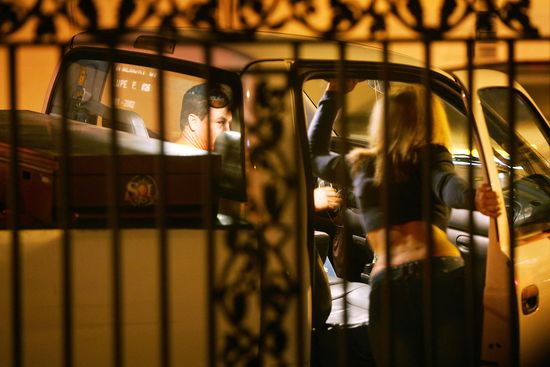
(Photo: A man stops to talk to a female police officer posing as a prostitute on Holt Boulevard – known to sex workers throughout southern California as ‘the track’ – during a major prostitution sting operation on November 12, 2004 in Pomona. Approximately 60 to 80 men are arrested each night during the sting operations. Cars driven by the arrested men are seized and become city property until a $1000 fine is paid. Each vehicle is then labeled with a large window sticker stating that the car was “seized for solicitation of prostitution” and the photos of the men appear in a full-page ad in the local newspaper. By David McNew/Getty Images)

An Old Fashioned High

Opium expert Steven Martin downplays the chances of the drug’s resurgence:

For one thing, despite its having all but disappeared, regulations against opium smoking are still on the books just about everywhere. But another major reason is the difficulty involved in smoking opium—or, more correctly, vaporizing opium—in the traditional way. You need chandu, opium specially processed for vaporizing, and you need a set of this very specific and distinctive paraphernalia, and it has to be in working order. And once you have all that, you need somebody who can teach you how to use it.I think anyone nowadays who happened to get hold of some raw opium would probably end up mixing it in their tea—but that’s just not the same thing. Not even close. Imagine somebody soaking a dried tobacco leaf in hot water and then drinking the result in hopes of replicating the experience of smoking a fine Cuban cigar. That’s what drinking opium tea is compared to vaporizing opium with the proper accoutrements.

Previous Dish on Martin’s experiences with the drug here.