First, a cool visualization showing how much languages involve silent letters:
Meanwhile, scientists have shown that even when we are reading silently to ourselves, our brains are still hearing:
What’s particularly new about this study is that it not only shows that silent reading causes high-frequency electrical activity in auditory areas, but it shows that these areas as specific to voices speaking a language. This activity was only present when the person was paying attention to the task. The authors believe that these results back up the hypothesis that we all produce an “inner voice” when reading silently. And it is enhanced by attention, suggesting that it’s probably not an automatic process, but something that occurs when we attentively process what we are reading. And the next time you read silently, remember that it’s not quite to silent to your brain.
Reviews of Penelope Niven’s new biography of Thornton Wilder have highlighted how little we know of the author’s love life, if he had one at all. Natalie Shapero believes Wilder’s play, Our Town, might reveal something about this “lonesomeness or closeted-ness or asexuality or whatever it was”:
From Emily’s place in the graveyard (an encampment of folding chairs set off to the side of the town), she decides, over the cautionings of the other dead people, to return to the world of the living for one day. She scarcely makes it through breakfast, though, before being unable to press on. It’s too hard for people to “realize life while they live it–every, every minute.” Before she returns to the little dead village of chairs, Emily says goodbye to an enumerated list of what she loves about life. In this monologue, she barely mentions other people. For the most part, she names sensory experiences of the world that we really have alone, interactions between our bodies and the physics around us. She says goodbye to the ticking of clocks, to hot baths, to sunflowers. She says goodbye to sleeping! As distinct from death. As part of what makes us alive. …
It is not someone summing up her life by locating her place in a grand social fabric. It is simply an affirmation of the experience of being a creature, to say that each small sensory moment has a deep meaning unto itself, that our wholly interior responses to the built world are what makes life worth it, even in this fantasy of return.
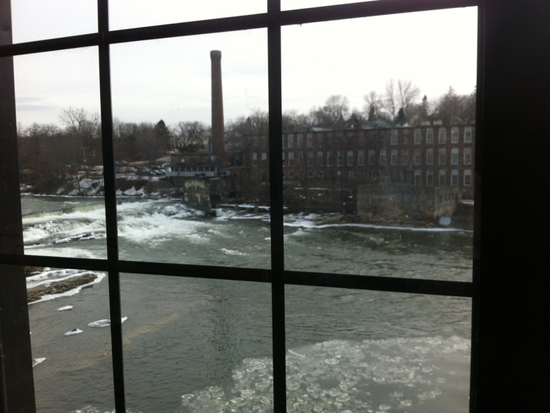
You have until noon on Tuesday to guess it. City and/or state first, then country. Please put the location in the subject heading, along with any description within the email. If no one guesses the exact location, proximity counts. Be sure to email entries to VFYWcontest@gmail.com. Winner gets a free The View From Your Window book. Have at it.
Christopher Jobson spotlights a captivating character:
The Avante/Garde Diaries recently released these two brief clips [one seen above] of an interview with master art forger Mark Landis who for the last 20 years created dozens if not hundreds of convincing art forgeries including works by Picasso which he then donated to institutions around the United States including over 50 art museums. Landis would often arrive at the museums dressed as a jesuit priest with elaborate stories of how he had acquired the artworks he subsequently donated. Incredibly, after a 2007 investigation it was determined that Landis may not have actually broken any laws. He never once tried to profit from the fake artworks but instead seemed to gain enough satisfaction from fooling curatorial staff members at various institutions.
The party, nationally and even locally, has focused on winning suburban and rural votes and has stopped reaching out to city dwellers. The cities-as-foreign-territory approach is bad politics for the Republicans: after all, successful cities like New York and Houston surge with ambitious strivers and entrepreneurs, who should instinctively sympathize with the GOP’s faith in private industry. The Republican move away from the cities is also bad for the cities themselves, which have hugely benefited—and could benefit a lot more—from right-of-center ideas.
One example is traffic:
The congestion can end only when America’s cities stop following what is, in effect, a Soviet-style transportation policy. In the Soviet Union, the government sold eggs and butter at prices far below their market value. The result: long lines and empty shelves. The nominal prices were low, but you couldn’t get your groceries. Today’s cities similarly provide free access to a valuable commodity, city streets. The result: traffic jams, the automotive equivalent of long lines and empty shelves. Until we turn to a market-based solution—following the examples of London and Singapore, where drivers pay for the congestion they create—our cities’ transportation arteries will stay clogged.
Nathaniel Rich reports on the physical toll depth-diving has on humans:
Today it is an economic and even geopolitical necessity for oil companies, in order to maintain pipelines and offshore rigs, to send divers routinely to depths of a thousand feet, and keep them at that level of compression for as long as a month at a time. The divers who do this work are almost entirely male, and tend to be between the ages of twenty-five and forty. Were they any younger, they would not have enough experience or seniority to perform such demanding tasks. Any older, and their bodies could not be trusted to withstand the trauma.
A primer on the dangers involved:
[In 1962], it was widely believed that no human being could safely dive to depths beyond three hundred feet. That was because, beginning at a depth of one hundred feet, a diver breathing fresh air starts to lose his mind. This condition, nitrogen narcosis, is also known as the Martini Effect, because the diver feels as if he has drunk a martini on an empty stomach—the calculation is one martini for every additional fifty feet of depth.
But an even greater danger to the diver is the bends, a manifestation of decompression sickness that occurs when nitrogen gas saturates the blood and tissues. The problem is not in the descent, but the ascent. As the diver returns to the surface, the nitrogen bubbles increase in size, lodging in the joints, arteries, organs, and sometimes the brain or spine, where they can cause pain and potentially death. The deeper a diver descends, the more slowly he must ascend in order to avoid the bends.
If you’re looking for an excellent read on the subject, check out Robert Kurson’s Shadow Divers.
After a stressful period in his life, Brett McKay found that his total T “was 383 ng/dL and my free T was 7.2 pg/mL – close to the average for an 85-100-year-old man.” He set out to improve his levels naturally, using diet, exercise, and lifestyle. One key element? Sleep:
Most Americans today are sleep deprived, which may be a contributing factor to declining testosterone levels in men. See, our body makes nearly all the testosterone it needs for the day while we’re sleeping. That increased level of T that we experience at night is one of the reasons we wake up with “Morning Wood.” (If you don’t have Morning Wood on a consistent basis, you might have low T).
But if you’re not getting enough quality sleep, your body can’t produce testosterone as efficiently or effectively. In one study, researchers at the University of Chicago found that young men who slept less than five hours a night for one week had lower testosterone levels than when they were fully rested. The drop was typically 10-15%.
After 90 days, McKay doubled his testosterone. Definitely, sleep helps – for everything. But serious long-term testosterone deficiency is a serious condition and needs medical treatment, unlike mere low-T. This time last year, mine went down to 121 ng/dL, less than half McKay’s level – which is not surprising after 20 years of surviving HIV – but tipped me into a major depressive period before I worked out what was wrong. So figure out if you have an underlying medical problem first. Some things cannot be cured by sleep alone.
Friday on the Dish, Andrew underlined the concessions of Krauthammer and Douthat that Obama has indeed matched Reagan in historical significance, whilegranting Bhaskar Sunkara that the Marxist Left is making a comeback (and it’s the GOP’s fault). He paused to recognize the British government’s bill legalizing gay marriage and actually shared Michael Moore’s view on Zero Dark Thirty as art. Also, Andrew pulled back the curtain a bit to introduce past and present Dishterns, before he heard the echo of a once-shrill voice recede another degree further from public life.
In political coverage, we continued to collect feedback about the end of the female-combat ban, from soldiers and readers, Steve Coll examined the unintended effects of America training foreign troops, and Ackerman introduced us to the Blackwater of the high seas. We made good on our promise to keep tabs on the GOP’s plan to rig the electoral vote, figured that Marco Rubio’s stardom will protect him from any of his anti-immigration colleagues, and sized up Bobby Jindal’s ambitions for 2016. Meanwhile, the US showed up solid on a map ranking budget transparency while Harry Enten explained how we’re currently shivering on a warming globe.
In assorted coverage, Peter Andrey Smith interviewed a sonic historian of the US, Alyssa Rosenberg wanted to break up Hollywood’s clique of obvious directors, and Ed Yong discovered the DNA flashdrive. We heard from more readers about the theory and practice of veganism, debated the effect ofpro-life attitudes on widespread single parenthood and featured an achingly funny review of a super-effective hair removal gel. Christopher Mims argued that broadband access is no now nonnegotiable, Felix Salmon suggested we make up our minds about the self-driving car, and a reader cautioned us not to dismiss the rise of the machines.
Gregory Crosby described his own “catfish” experience, yesterday’s reader storiesspawned a few sequels, and Timepublished its own tome of a correction. Wewatched the sun rise on Death Valley, California during the VFYW, gawked at feats of awesomeness in the MHB, and observed the call of the pro-life movement in the Face of the Day.

 The Dish