A Map That Nudges

Paul Marks describes the “vibrobelt”, a new navigation tool for cyclists that “uses vibrating actuators that indicate left, right, backward and forward turn directions”:

Developed in a masters project by Haska Steltenpohl of the Intelligent Systems Lab at the University of Amsterdam, the Netherlands, alongside supervisor Anders Bouwer, the system aims to give cyclists a “heads-up” navigator, allowing them to keep their eyes on the road after they have chosen their destination on a GPS smartphone. They simply set off and get directional nudges from the vibrators just before each turn.

To see if the vibrotactile navigation compared well with using a standard GPS map on a handlebar-mounted smartphone, 20 volunteers tried both methods on a variety of unfamiliar routes. While all the cyclists reached their destinations successfully, the researchers noted an important difference: when questioned about landmarks they had passed, the vibrobelt users proved much more aware of their surroundings en route than those who were constantly glancing at a GPS screen.

Update from a reader:

Cool! That would be very useful for deaf drivers, too. (I am one.) I just got an iPhone, and recently used it to check directions for something. I looked at the route while parked, memorized it, put the phone away, and then set off. I was focusing on the road and not the three girls I was ferrying (who were laughing and carrying on in typical 12-year-old fashion). I did notice as we got closer to home that my daughter, in the front seat, would glare in the direction of my phone at intervals but I didn’t think much of it.

After we dropped off the other girls and pulled into my driveway, I noticed her say “Shut UP, Siri!” It turns out that the iPhone had been telling me what to do the whole way home (who knew). This was obviously useless to me. And I couldn’t keep visually checking the phone while driving. The route was pretty simple and easy to memorize but if it had been more complicated, I can imagine the Vibrobelt being incredibly helpful.
Females At The Front

women-at-the-front

The outgoing defense secretary is lifting the ban on women in combat roles, thus expanding and formalizing the reality that women already fight on the front-lines:

Women currently serve in a number of combat positions, including piloting warplanes or serving on ships in combat areas. Since the start of the wars in Afghanistan and Iraq, 292,000 women have served in those combat zones out of a total of almost 2.5 million, Pentagon records show. In both wars, 152 women have died from combat or noncombat causes, records show, and 958 have been wounded in action.

Milblogger C. Blake Powers applauds Panetta, noting that the “efforts to restrict or remove them when someone suddenly realized that there was no rear area have cost time, money, and sometimes even blood needlessly.” Ackerman connects the big news with the DADT repeal:

Reminiscent of the drawn-out effort to remove the ban on gays and lesbians serving openly, the different military services will have a long time to open their most dangerous tasks to women. Initial plans from the services for implementing the repeal are due on May 15. Reportedly, the services have until January 2016 to seek exemptions for positions they believe should remain closed to women. Still, as CNN notes, eliminating “Don’t Ask, Don’t Tell” might have taken a long time, but when it ultimately ended in mid-2011, it happened all at once, with all military positions open to out gays and lesbians.

The Pentagon official who leaked the news made that connection explicit:

It’s likely to have the same effect as the repeal of Don’t Ask, Don’t Tell, the policy that allowed gays and lesbians to serve but required them to hide their sexuality. “The effect of that?” the official said. “A big zero.”

Previous Dish coverage of women in combat here.

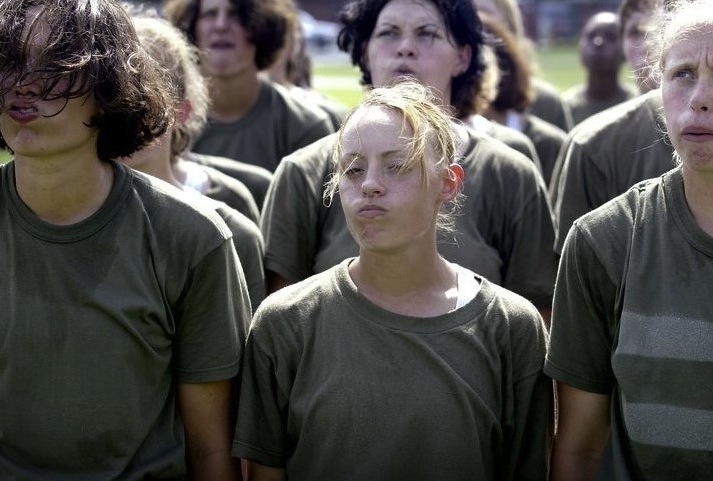
(Photo: Female Marine Corps recruits listen to instruction during hand-to-hand combat training at the United States Marine Corps recruit depot on June 23, 2004 in Parris Island, South Carolina. By Scott Olson/Getty Images)

The Daily Wrap

chicago-ice

Today on the Dish, Andrew reflected on what Bibi Netanyahu’s election victory means for Israel, the Middle East, and America. He questioned Douthat’s expectations for the Republicans to take the lead of their moderate Tory cousins, vouched for Obama’s partisanship in the face of an intransigent GOP and scoffed at Fox News’s comparison of Mali to Iraq. Meanwhile, Andrew answered a livid letter from one of Mel Gibson’s close friends, and on a related note, agreed with Mendelsohn that “gaydar” develops into a sensor for bullshit in general. He gave his take on the appeal of Oxford debates, from experience, and continued to shake his head vigorously at the Manti Te’o media fail.

In political coverage, we prepared for the looming decline of a newly-reelected Bibi Netanyahu and speculated whether there’s a chance left for Middle East peace, as Millman popped the bubble on the hope for Israeli centrist parties. Sam Harris lamented the perverse incentives that guide our society, while readersrebuked our post on the possible blowback of immigration reform and sounded off on Kenny’s valuation of living in the US.

Elsewhere, we revisited the real significance of Roe v Wade just as legal abortion appears to have become a majority view in the country, and Hillary stared down Congress in the Face of the Day. We also spied on the whole country with Brandon Martin Anderson’s census map, Keith Humphrey discovered a lack of class consciousness in American couples, while Canada apparently botched its new currency.

In miscellanea, readers shared their connection to Lena Dunham’s Girls, McArdle looked at Israel as a test-ground for electric cars, and we found an engrossing but depressing story of another predatory clergyman. Readers reassured us that dive bars aren’t extinct yet. Rebecca Jane Stokes chided mealtime Instagram-ers, and an ex-vegan dismissed the effects of an animal-friendly diet.

On the sportsy circuit, we debated the effect of doping on the integrity of the games, and witnessed the modern athlete’s brain on football. Finally, we grouped together a final batch of reader reax to the independent Dish, flicked gloomy songs into major keys for the MHB, and glanced into a backyard in Wimbledon, England for today’s VFYW.

– B.J.

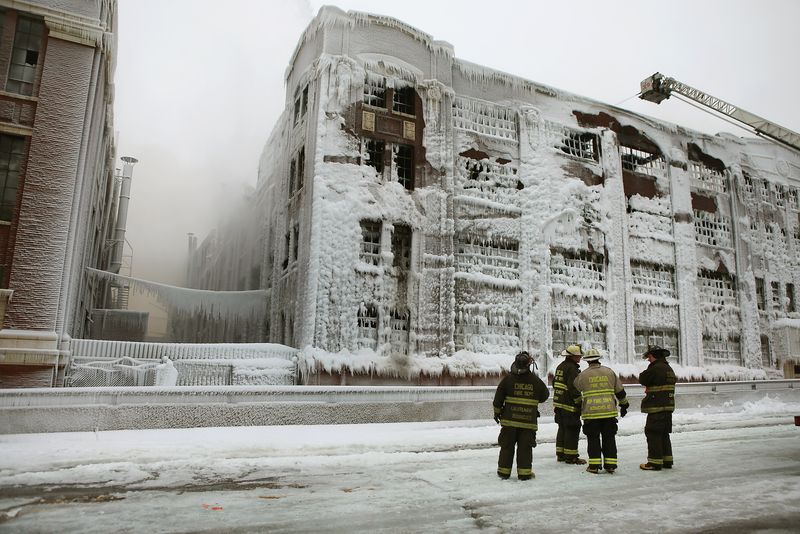
(Photo: Firefighters work to extinguish a massive blaze at a vacant warehouse in Chicago, Illinois on January 23, 2013. More than 200 firefighters battled a five-alarm fire as temperatures were in the single digits. By Scott Olson/Getty Images)

The End Of The Dive Bar? Ctd

A reader writes:

Maybe dive bars are going away in LA and DC, but here in Chicago they are doing just fine. There’s a place near me that has $1 PBR all the time.  I live in an old German neighborhood, which means my closest dive bars actually have pretty good beer and still manage to be affordable. Even in the areas that have been heavily gentrified it seems there’s always a couple dives that manage to stick around. I suspect in the end it’s just a question of economics.  At some point it’s not profitable to run a dive bar, but in Chicago with a lower cost of living than LA or DC, there are plenty of good dive bars.

Another:

I think smoking bans have been the death knell for the venerable “dive bars.” Oh SURE, it’s a healthier environment now … but whoever went to a dark, sleazy dive bar for the sake of HEALTH?

Another points to a great tumblr:

I’ve been contracted to write a massive beer book in a compressed time frame, and to clear my mind, I go for walks around Portland, Oregon. The strange and wonderful architectural oddities that are dive bars mesmerize me.

Vegan Ethics

Former vegan Rhys Southan surmises that vegans have an overly narrow view of the impact that humans have on animals:

Universal veganism wouldn’t stop the road-building, logging, urban and suburban development, pollution, resource consumption, and other forms of land transformation that kills animals by the billions. So what does veganism do exactly? Theoretically, it ends the raising, capture and exploitation of living animals, and it stops a particular kind of killing that many vegans claim is the worst and least excusable: the intentional killing of animals in order to use their bodies as material goods.

Veganism, as a whole, requires us to stop using animals for entertainment, food, pharmaceutical testing, and clothing. If it were to become universal, factory farming and animal testing would end, which would be excellent news for all the animals that we capture or raise for these purposes. But it would accomplish next to nothing for free-roaming wild animals except to stop hunting, which is the least of their problems.

James McWilliams, on the other hand, isn’t bothered by incremental progress:

Ethical veganism is not an all or nothing position. It’s a journey on a long continuum. It’s critical that we never stop articulating the ultimate goal: a world as free of animal exploitation as we can achieve.

No Cameras At The Table

Rebecca Jane Stokes applauds restaurants that ban snapshots of your meal:

I don’t like people taking photographs of their food at restaurants because it takes the food out of its context. Whatever people might say — and I’ve heard it so many times from so many diet proponents — food is inherently social. Do you need to have food around to have a good time with someone? No, of course not. But there is something primal and nourishing in sharing a meal with people you enjoy. Social interaction sustains us, so does ingesting food — and when both are of the highest quality in a place designed with respect for that, taking a quick pic with my iPhone feels like giving the entire event short shrift.

Can The GOP Find Its Way? Ctd

Though acknowledging that Douthat makes a “fair point,” Larison remains unconvinced that the GOP will change anytime soon:

The problem for the GOP, as it is for all defeated, flailing parties, is that its leaders are sometimes oblivious to the party’s most serious weaknesses, or else they mistake those weaknesses for strengths. Hard-line foreign policy is one example of a clear liability for the party that its leaders believe to be one of their great advantages, which is one reason why it never even occurs to them that they are losing current and possible future supporters by hanging on to failed policy ideas. (Another is that they can’t or won’t acknowledge that the policies failed.) Far more politically damaging for Republicans are the national party’s lack of any relevant economic policy agenda and its cynical, selective interest in fiscal responsibility.

Rewarding The Wrong Behavior

Sam Harris worries about perverse incentives:

A prison is perhaps the easiest place to see the power of bad incentives. And yet in many other places in our society, we find otherwise normal men and women caught in the same trap and busily making life for everyone much less good than it could be. Elected officials ignore long-term problems because they must pander to the short-term interests of voters. People working for insurance companies rely on technicalities to deny desperately ill patients the care they need. CEOs and investment bankers run extraordinary risks—both for their businesses and for the economy as a whole—because they reap the rewards of success without suffering the penalties of failure. Lawyers continue to prosecute people they know to be innocent (and defend those they know to be guilty) because their careers depend upon winning cases. Our government fights a war on drugs that creates the very problem of black market profits and violence that it pretends to solve….

We need systems that are wiser than we are. We need institutions and cultural norms that make us better than we tend to be. It seems to me that the greatest challenge we now face is to build them.

Revisiting The Great Migration

TNC reflects on Isabel Wilkerson’s The Warmth Of Other Suns, which is “a narrative history of the Great Migration through the eyes of actual migrants.” Among other take-aways is his conclusion that “America does not really want a black middle class”:

Some of the most bracing portions of Wilkerson’s book involve the vicious attacks on black ambition. When a black family in Chicago saves up enough to move out of the crowded slums into Cicero, the neighborhood riots. The father had saved for years for a piano for his kids. The people of Cicero tossed the piano out the window, looted his home, torched his apartment and then torched his building. In the South, when black people attempted to leave to earn better wages, they were often forcibly detained, and thus kept in slavery as late as the 1950s.

On a policy level, there is a persistent strain wherein efforts to aid The People are engineered in such a way wherein they help black people a lot less. It is utterly painful to read about the New Deal being left in the hands of Southern governments which were hostile to black people, and then to today see a significant chunk of health care, again, left in the hands of Southern governments which are hostile to black people. At this point, such efforts no longer require open bigotry. They are simply built into the system.