Can Google Read Your Doctor’s Handwriting?

Google Handwrite is new mobile tool that allows you to “write your search”:

Drew Olanoff is excited about the tool’s long-term possibilities for learning:

If Google wants to try and learn how to read your handwriting when nobody else in the world, including you, can, then more power to them. By learning how to read a multitude of handwriting samples, the company can then release functionality to scan documents of any type in, making it easier to convert them into digital format. This type of approach is how Google has tuned its Voice product, by allowing you to call GOOG411 to get restaurant information and phone numbers. You talk, Google learns. Now when you write, Google learns that, too.

The Peaceful Transition Of Power

Dylan Matthews is unimpressed by it:

It’s probably fair to say that the U.S. has had an unusually long run, in both number of transitions and length of time those transitions have spanned. But between Robert Walpole and David Cameron, the United Kingdom has gone through 74 changes of prime minister, all without bloodshed. How democratic UK elections were in the early 18th century is a matter of legitimate debate, but they weren’t that much less democratic than early American elections, restricted as they were to white, property-owning free men.

Jonathan Bernstein counters:

It is a big deal — a very big deal. And while other nations have gotten the hang of it, the US was very much a pioneer. Yes, we could argue about the Brits vs. the US, but either way when Jefferson replaced Adams it really was something amazing and rare in world history.

Backing Away From Backscatter

atrimage

David Kravets calls the TSA’s decision to pull the Rapiscan body scanners from airports “a rare victory” for the public:

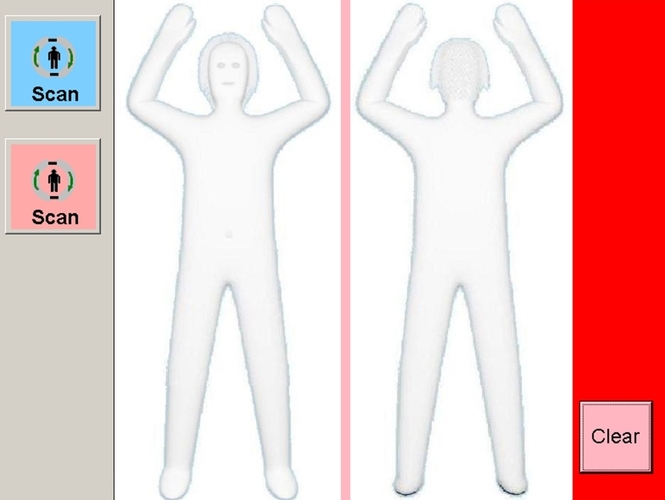
The Transportation Security Administration is pulling the plug on its nude body scanner program, a decision announced Friday that closes the door to a tumultuous privacy battle with the public scoring a rare victory. Travelers will continue to go through one of two types of scanners already deployed, but images of naked bodies will no longer be produced. Instead, software will instead show a generic outline of a person.

Bruce Schneier applauds:

This is a big win for privacy. But, more importantly, it’s a big win because the TSA is actually taking privacy seriously. Yes, Congress ordered them to do so. But they didn’t defy Congress; they did it. The machines will be gone by June.

(Photo: The new machines will use generic outlines like the one shown here rather than passenger-specific images. Via NPR, from the TSA.)

Will Congress Allow Obama Greatness?

Chait argues that Obama’s second term will be defined more by “what the Republicans in Congress decide to do” than by Obama himself:

We like our presidential dramas. We want the Obama era to revolve around Obama and produce a character narrative that will eventually produce grist for 800-page tomes that will be Father’s Day gifts decades into the future. Obama has done his job extremely well, by my reckoning. But that is all he is — the head of one, equal branch of government, a man we have hired to do a job. Our need to elevate him into a monarchial figure not only causes us to persistently misunderstand the world around us, but is also detrimental to the habits of self-government.

The Anti-Lance

Facebook post highlighting the inspirational story of Iván Fernández Anaya has been making the rounds recently. The Vancouver Sun marks the serendipity:

In a week that was dominated by stories about Lance Armstrong and Manti Te’o, it’s hard not to be a little cynical about the sporting world. The story of long distance runner Iván Fernández Anaya may serve as a welcome antidote. The Spanish runner, who trains in the Basque capital of Vitoria-Gasteiz, has become something of a cult hero for a kind gesture that helped an opponent win a race.

Carlos Arribas fills in the details:

[Fernández Anaya] was running second, some distance behind race leader Abel Mutai – bronze medalist in the 3,000-meter steeplechase at the London Olympics. As they entered the finishing straight, he saw the Kenyan runner – the certain winner of the race – mistakenly pull up about 10 meters before the finish, thinking he had already crossed the line. Fernández Anaya quickly caught up with him, but instead of exploiting Mutai’s mistake to speed past and claim an unlikely victory, he stayed behind and, using gestures, guided the Kenyan to the line and let him cross first.

Blanco, Whitman And Orwell

We’re scouring the web for literary critiques or praise of the Inaugural poem. I found it deeply moving and stirringly read. But am I wrong to hear strong echoes of Whitman, America’s national poet: the lack of rhyme, the tour d’horizon of the American particulars, the love of country, the multitudes, the people?

One ground. Our ground, rooting us to every stalk
of corn, every head of wheat sown by sweat
and hands, hands gleaning coal or planting windmills
in deserts and hilltops that keep us warm, hands
digging trenches, routing pipes and cables, hands
as worn as my father’s cutting sugarcane
so my brother and I could have books and shoes.

And Whitman:

I hear America singing, the varied carols I hear,
Those of mechanics, each one singing his as it should be blithe and strong,
The carpenter singing his as he measures his plank or beam,
The mason singing his as he makes ready for work, or leaves off work,
The boatman singing what belongs to him in his boat, the deckhand
singing on the steamboat deck,
The shoemaker singing as he sits on his bench, the hatter singing as he stands,
The wood-cutter’s song, the ploughboy’s on his way in the morning, or
at noon intermission or at sundown,
The delicious singing of the mother, or of the young wife at work, or of
the girl sewing or washing,
Each singing what belongs to him or her and to none else,
The day what belongs to the day—at night the party of young fellows,
robust, friendly,
Singing with open mouths their strong melodious songs.

One gay poet speaking to another across the centuries. Or more saliently, oneAmerican poet speaking to another after so many years and so much change. Orwell had the same democratic dream of what makes a nation, and why resistance to the multitides of change is not patriotism but lack of faith in it:

It needs some very great disaster, such as prolonged subjugation by a foreign enemy, to destroy a national culture. The Stock Exchange will be pulled down, the horse plough will give way to the tractor, the country houses will be turned into children’s holiday camps, the Eton and Harrow match will be forgotten, but England will still be England, an everlasting animal stretching into the future and the past, and, like all living things, having the power to change out of recognition and yet remain the same.

America lives. And it gained new life today.

What The Hell Just Happened In Mali? Ctd

A reader writes:

Greenwald is wrong about Mali. The US is involved in the French-led Mali operation, but is employing the same doctrine it did with Libya.  Far from generating anti-American sentiment, the French have beenwelcomed, even greeted as liberators. This is an operation that is unfolding in much the same way as the operation in Libya did: international consensus, low cost, low casualty numbers, efficient, timely, where the US leads from behind, and most importantly – winning the hearts and minds of the people for a change, instead of turning them against us.

Pacifica critiques MSM coverage of the situation:

I read the NYT front page articles on Thursday about French military intervention in MaliUS expert perspective on Mali threat, and the related attack in Algeria, and I was quite struck by the NYT angle on these stories. The thing I noticed most was how single-focused all the articles were on Islamists and terrorism, as though that was explanation enough for everything that was happening – French intervention, US promises to help the French, the many years of US covert involvement in the region, and the tragic hostage situation in Algeria. …

The NYT left out some rather important pieces of information that might give a slightly more nuanced context to the situation. For example, neither France’s relationship to Mali historically (Mali having been a French colony not all that long ago) nor its relationship economically (France is quite dependent on the region for a lot of important natural resources) were alluded to once.

While other US newspapers took a similar approach to covering the conflict, Pacifica had no trouble finding French news outlets that were addressing the economic and historic aspects of the story. This left her with more questions:

Is the US in such an information bubble that the media as a whole completely believes in the narrative of “hunting terrorists” as a reason for all military involvement everywhere? Have they been selling terrorism for so long that they no longer even ask themselves if it’s true?

A reader recommends:

Has anyone yet pointed you to this fantastic blog for information about what’s happening in Mali? I spent two years living in Mali (Peace Corps Volunteer) and I am frustrated that the news and information we hear about Mali is mostly generated by (well meaning but often ill-informed) people with little familiarity with the country.

(Photo: A Man looks at the front pages of newspapers on January 21, 2013 in a street of Bamako. French and Malian troops recaptured the key towns of Diabaly and Douentza on Monday in a major boost in their drive to rout Al Qaeda-linked rebels holding Mali’s vast arid north. By Eric Feferberg/AFP/Getty Images)

The Liberal Reagan, Ctd

Lib_ragan_ctd

“It is of course possible that the inauguration of a reelected president is his moment of maximum triumph. It is of course possible that Obama’s second term may turn out like George W. Bush’s, when the lyricism and passion of the second inaugural collided with the realities of strategic miscalculations and unexpected events. I have my doubts. What I do not doubt is that the generation of conservatives and Republicans who return one day to power will be forced to reckon with the consequences of the Obama revolution, just as a generation of defeated liberals were forced to confront and in some cases accept the revolution of Ronald Reagan,” – Matthew Continetti.

“I got tax increases without entitlement cuts, I flipped the script on the culture war, and now Marco Rubio is going to help me pass an immigration bill. I’m still up for a grand bargain, but I don’t need one: The economy’s limping back, the deficit should stabilize in the short run, and the long term — well, that’s my successor’s problem. I’d like to win on gun control and climate change, but I’ll settle for making the case and seeing whether a Biden administration (you only think I’m kidding) can finish the job. Sure, second terms can be dicey propositions. But as long as I don’t get impeached or start a land war in Asia, I’m feeling pretty good about my legacy. And oh, you centrist chin-strokers who kept saying I was no Clinton? You were absolutely right. I’m the liberal Reagan. Deal with it,” – Ross Douthat, in a column written as Obama’s Second Inaugural.

I’m glad they get it now. But it didn’t take a genius to see this years ago, i.e. May 24, 2007:

I went to see Obama last night. He had a fundraiser at H20, a yuppie disco/restaurant in Southwest DC. I was curious about how he is in person. I’m still absorbing the many impressions I got. But one thing stays in my head.

This guy is a liberal. Make no mistake about that. He may, in fact, be the most effective liberal advocate I’ve heard in my lifetime. As a conservative, I think he could be absolutely lethal to what’s left of the tradition of individualism, self-reliance, and small government that I find myself quixotically attached to. And as a simple observer, I really don’t see what’s stopping him from becoming the next president…

I fear he could do to conservatism what Reagan did to liberalism. And just as liberals deserved a shellacking in 1980, so do “conservatives” today.

My 2012 elaborations on this argument are here and here.

(Photo: A spectator on the National Mall holds a photoshopped picture of President Barack Obama and Dr. Martin Luther King Jr. during the 57th presidential inauguration in Washington, D.C., Monday, January 21, 2013.  By Gabriel B. Tait/MCT via Getty Images.)