Nicholas Carr laments the evolution of web search, regretting that “Google’s goal is no longer to read the web. It’s to read us”:
In its new design, Google’s search engine doesn’t push us outward; it turns us inward. It gives us information that fits the behavior and needs and biases we have displayed in the past, as meticulously interpreted by Google’s algorithms. Because it reinforces the existing state of the self rather than challenging it, it subverts the act of searching. We find out little about anything, least of all ourselves, through self-absorption.
He quotes the opening lines of Robert Frost’s poem “The Most of It”:
He thought he kept the universe alone;
For all the voice in answer he could wake
Was but the mocking echo of his own
From some tree-hidden cliff across the lake.
Some morning from the boulder-broken beach
He would cry out on life, that what it wants
Is not its own love back in copy speech,
But counter-love, original response.
His takeaway:
As Frost understood, a true search is as dangerous as it is essential. It’s about breaking the shackles of the self, not tightening them.
I feel I need to add another angle to this story that perhaps no one else has provided. I have been playingwhat is commonly referred to as MMOssince 2000. I started with Everquest and moved on to World of Warcraft. I was very active in the end-game raiding community. This is a small group in this world that tries to “push the envelope”. They are the first ones/only ones who actually see the big encounters designed for cooperative groups to take out and advance by obtaining better gear for their characters. I tell you this because I feel it’s important you understand the world I have inhabited.
Online relationships in this world are common, and with the advent of more social media they are easier to maintain. But in this environment you ultimately work closely with a group of 25-40 people on a nightly basis for upwards of 2-4 hours each time. People become very close and the human experience of trying to connect makes itself known. I have seen many an online-only relationship develop and flourish.
Most turn into long-distance things where the people involved are constantly on Twitter, Skype, IM programs and Ventrilo servers telling each other everything and planning their first or next in-person encounter. These relationships are hard to explain to people because they “aren’t real.” They in fact are very real, with very real emotional attachments in them. Occasionally the Catfish-type of thing happens, what the hoaxers” are trying to get out of them varies as well. But it happens.
I also say this because I can very well understand why Manti exaggerated his story about this girl. Most people just don’t understand this type of connection yet. To imply he is hiding his sexuality is, I think, misreading the situation. That is not to say he is not trying to hide. I just think the more likely scenario is he became emotionally involved with someone online. “Tragedy” struck this person and he went all in. He now has to explain this to people in a world who at best disparage this type of relationship. He’s embarassed so he makes up the meeting. The story goes national and now he’s in the middle of a lie and momentum takes over. He’s covering, he’s covering and now he finds out it’s all a house of cards and he was duped the whole time.
We need to retain brain capital in the U.S. as the foreign nationals who exit our universities with graduate degrees are currently not allowed to stay. Entrepreneurs return home and end up competing with American companies – removing potential jobs that should be kept in the U.S. …
In a speech on the floor of the Senate, Senator Moran [R-KS], one of the proposers of Startup Act 2.0, summed up the urgency of the need for the bill – “The future of our country’s economic competitiveness depends on America winning the global battle for talent. The Department of Commerce projects [Science, Technology, Engineering, and Mathematics] jobs to grow by 17 percent in the years ahead. We have to retain more of the highly-skilled and talented individuals we educate in America to remain competitive in the global economy. Doing so will fuel American economic growth and result in the creation of jobs for more Americans.”
Previous Dish on the potential economic benefits of immigration reform here.
Without relinquishing the importance of putting pressure on the president (drones!) I think that it’s important to acknowledge the significance of speeches like this. There was a time when merely stating the ideas Obama put forth would have gotten you killed. And we still live in a time where people gladly tell you that the Civil War was not whether we’d be “half-slave and half-free” but about whether we’d be “half-agrarian or half-industrial.” Or some such. I don’t think most Americans really understand the significance of say Seneca Falls or Stonewall. And I don’t know that any president has actually lauded either of these publicly.
[Y]ou could see why comparisons with Ronald Reagan are not so far-fetched. It is not so much that Obama can deliver a decent speech (though he’s not as good a communicator as Reagan was) rather the manner in which he couches his argument. Obama, more than most politicians but rather like Reagan, talks in such a fashion that you suspect he finds it hard to believe that anyone could truly and honestly and decently disagree with him and certainly no intelligent or generous person could. The goodness of his ideas and his intentions is presumed; opposition to them must be predicated upon something sinister. Reagan could speak like this too and, like Obama, he made it seem as though there might be something disagreeable about disagreeing with the President.
As the first inaugural address to ever highlight the struggle for LGBT equality and the lives and families of gays and lesbians, this speech will no doubt be recorded in the annals of history as a pivotal moment in the long journey for social justice and freedom from oppression.
I was expecting an anodyne tone-poem about healing national wounds, surmounting partisanship, and so on. As has often been the case, Obama confounded expectations — mine, at least. Four years ago, when people were expecting a barn-burner, the newly inaugurated president Obama gave a deliberately downbeat, sober-toned presentation about the long challenges ahead. Now — well, it’s almost as if he has won re-election and knows he will never have to run again and hears the clock ticking on his last chance to say what he cares about. If anyone were wondering whether Obama wanted to lower expectations for his second term … no, he apparently does not.
I side with the liberals on one thing: it was arguably the most liberal speech our president has given. Which is news, of a sort. But I side with the conservatives in thinking that this was largely a big yawn. The president gave a speech which [makes] his base happy, but entirely on symbolic grounds. He promised nothing of substance, and covered no issue which actually commits him to delivering anything. Obama is against “perpetual war”, but also wants to support democracy and “act on behalf of those who long for freedom.” He wants shorter voting lines and “a better way to welcome” immigrants. He wants children to be safe and cared for. The last is a vague hope shared by all Americans (no really–even the ones who disagree with you about stuff!) The rest are carefully phrased to offer no actual benchmarks.
Philip Klein takes the president to task for punting on entitlements:
[Obama] declared that, “We must make the hard choices to reduce the cost of health care and the size of our deficit.” This is Barack Obama, bold leader speaking (with an extra twist of irony given that the signature legislative accomplishment of his first term was supposedly aimed at containing the growth of health care costs). Then, he said, “But we reject the belief that America must choose between caring for the generation that built this country and investing in the generation that will build its future.” Translation: he isn’t going to do anything to seriously reform Social Security, Medicare or Medicaid, and wants more economic stimulus spending, too. So, within a breath of calling for hard choices, he rejected the need for them.
Drum thought “this was a more explicitly political inauguration speech than usual”:
Sure enough, the Fox News commenters seem distinctly unhappy with this speech. Brit Hume is complaining that the economy is still terrible. Chris Wallace says Obama didn’t reach out to conservatives at all. Bret Baer thinks it was basically a challenge to Republicans not to try and mess with the welfare state. Megyn Kelly says that even the Washington Post thinks Obama is too liberal. And so far, we’ve only heard from the relatively moderate wing of Fox pundits.
This was not a speech that assumed that the disagreements that split our politics are based on the psychodramas of the past nor that they will fall easily before the onslaught of the future. But it was a speech, more so than most Obama has offered, that signaled his intention to join the battle of ideas, to use his bully pulpit to make an aggressive and uncompromising case for why his side is right, and to not rest until the American people agree that the other side is wrong.
The Obama who begins his second term is much more acutely aware that the opposing party rejects, at the most philosophical level, the definition of the good that he has put forward as the national creed. Four years ago he expressed a jaunty confidence that the differences must be bridged. Today he committed himself to the same goal, but with a wariness borne of harsh experience.
Mark Blumenthal and Emily Swanson analyze Obama’s polling:
The combination of relative optimism about the president himself and negative feelings about the economy may be reflected in feelings about Obama’s place in history. The HuffPost/YouGov poll finds that 37 percent of Americans think Obama’s presidency will go down in history as great or above average, while 42 percent say it will go down as poor or below average.
In a Gallup poll conducted early in 2012, a comparable 38 percent said that Obama would be considered an outstanding or above-average president. The poll also asked respondents to rate the last seven president before Obama. Only two (Ronald Reagan and Bill Clinton) scored higher than Obama on being an above-average or better president, and only two (George W. Bush and Richard Nixon) scored worse than Obama on being below average or worse.
One sun rose on us today, kindled over our shores,
peeking over the Smokies, greeting the faces
of the Great Lakes, spreading a simple truth
across the Great Plains, then charging across the Rockies.
One light, waking up rooftops, under each one, a story
told by our silent gestures moving behind windows.
My face, your face, millions of faces in morning’s mirrors,
each one yawning to life, crescendoing into our day:
pencil-yellow school buses, the rhythm of traffic lights,
fruit stands: apples, limes, and oranges arrayed like rainbows
begging our praise. Silver trucks heavy with oil or paper — bricks or milk, teeming over highways alongside us,
on our way to clean tables, read ledgers, or save lives — to teach geometry, or ring up groceries as my mother did
for twenty years, so I could write this poem.
All of us as vital as the one light we move through,
the same light on blackboards with lessons for the day:
equations to solve, history to question, or atoms imagined,
the “I have a dream” we keep dreaming,
or the impossible vocabulary of sorrow that won’t explain
the empty desks of twenty children marked absent
today, and forever. Many prayers, but one light
breathing color into stained glass windows,
life into the faces of bronze statues, warmth
onto the steps of our museums and park benches
as mothers watch children slide into the day.
One ground. Our ground, rooting us to every stalk
of corn, every head of wheat sown by sweat
and hands, hands gleaning coal or planting windmills
in deserts and hilltops that keep us warm, hands
digging trenches, routing pipes and cables, hands
as worn as my father’s cutting sugarcane
so my brother and I could have books and shoes.
The dust of farms and deserts, cities and plains
mingled by one wind — our breath. Breathe. Hear it
through the day’s gorgeous din of honking cabs,
buses launching down avenues, the symphony
of footsteps, guitars, and screeching subways,
the unexpected song bird on your clothes line.
Hear: squeaky playground swings, trains whistling,
or whispers across cafe tables, Hear: the doors we open
for each other all day, saying: hello, shalom,
buon giorno, howdy, namaste, or buenos días
in the language my mother taught me — in every language
spoken into one wind carrying our lives
without prejudice, as these words break from my lips.
One sky: since the Appalachians and Sierras claimed
their majesty, and the Mississippi and Colorado worked
their way to the sea. Thank the work of our hands:
weaving steel into bridges, finishing one more report
for the boss on time, stitching another wound
or uniform, the first brush stroke on a portrait,
or the last floor on the Freedom Tower
jutting into a sky that yields to our resilience.
One sky, toward which we sometimes lift our eyes
tired from work: some days guessing at the weather
of our lives, some days giving thanks for a love
that loves you back, sometimes praising a mother
who knew how to give, or forgiving a father
who couldn’t give what you wanted.
We head home: through the gloss of rain or weight
of snow, or the plum blush of dusk, but always — home,
always under one sky, our sky. And always one moon
like a silent drum tapping on every rooftop
and every window, of one country — all of us —
facing the stars
hope — a new constellation
waiting for us to map it,
waiting for us to name it — together
12 pm. Well either Kelly Clarkson was way off or her mike was. But the speech instantly removed any awkwardness that lingered. If you have long believed, as I have, that this man could easily become the liberal Reagan by the end of his second term (even Ross now agrees), then this speech will not have surprised you. The president went out of his way to acknowledge the tradition of free enterprise, risk, individualism and all that fuels and furnishes the broad swathe of what might even now still be called American conservatism. This is not new; in fact, whenever you hear Obama extoll those virtues, you know what’s coming next.
Which is to say: All of that is simply not enough “in new times.” In an era of globalization, of soaring social and economic inequality, of growing debt, of crumbling infrastructure, and of technological revolution: we have to act collectively as well. We cannot balance the budget entirely by ourselves as individuals; or rebuild the country’s human capital without government investment in education; or provide the firmest foundation for capitalism to thrive if the system is rigged – and seen by most to be rigged – for the powerful and their interests alone. We have to make the tax code simpler to save our democracy from the lobbying locusts feeding relentlessly off it. We have to invest in physical and human capital more effectively if we are to meet the challenges of our age.
What he was saying, in other words, is that he is not interested in answering for all time the fundamental question of the role of government – because that question is simply not answerable for all time. We will never answer it definitively. Because it is one of humankind’s greatest and \deepest questions. At the same time, we live in a specific time with specific issues and new questions – and the difference between an ideologue and a statesman is that a statesman’s job is not to bang on for ever about “freedom” or “equality” in the abstract (we can leave that to Fox and MSNBC), but to make the right prudential judgments in the moment, with limited knowledge, as best he can, in the interests ofall of us.
It was, in some ways, then a final rejoinder to Ronald Reagan’s critical qualifier to his declaration of government as the problem in January 1981: “In this present crisis …” This Inaugural Speech was not so much a repudiation of that (as we know, there are aspects to the Gipper’s transformation of American politics Obama has long publicly honored). It was to say that Reagan’s solutions may have been right then but they are not right now.
But I don’t want to imply this was not a self-confident center-left speech. Indeed, it was the first one in my adult lifetime that also seemed to carry a national mood with it. Instead of fearing a “world without boundaries,” Obama argued that Americans should relish it: “We are made for this moment.” But the challenges are so large that only collective solutions and government action can truly make a difference. The goal? The restoration of the “broad shoulders of the middle class” – a culturally conservative goal in these tectonic times.
And then the first big disappointment and the first big surprise. The first big disappointment is his not being honest with us about the entitlement state. We willhave to choose between caring for our elderly and investing in our children if we do not reform entitlements and raise taxes and cut defense. Merely talking about innovations in lowering healthcare costs is truly not enough. The first big hope – huge savings from electronic records – has turned out so far to be a dud. When we face that challenge, telling us we do not have to choose is not leadership. It’s pious bullshit. Trade-offs are necessary.
Then the big surprise: climate change. I didn’t think he’d put such a strong emphasis on it so emphatically, when the carbon energy industry is thriving, and when the economy remains depressed. But I think he realizes, as we all do, that future generations may look back on us entirely through this prism of our collective failure to conserve the very planet we live on through a mass rush for global wealth whose consequences are unknowable and yet whose power continues to pummel the earth we once knew. I have no idea what this would mean – in my dreams, a carbon tax in tax reform? – but it was heartening to see Obama return to it.
On foreign affairs, we are in a different universe than four years ago in terms of context. He has ended one horrifyingly brutal and misguided war; he will end a second one that became almost a definition of mission creep. He has ended torture as an instrument of public policy, even as his drone war has decimated al Qaeda with (again) unknowable blowback and with definite sacrifices in terms of our civil liberties. But he also refused to engage in talk of “perpetual war” – a nice inversion of Kant and an accurate description of the neocon worldview that he has a chance to marginalize even further in the next few years.
I have often remarked when challenged on my continued support and admiration for this president the following: “He’s a moderate Republican. Why wouldn’t I like him?” But this is, of course, too glib. I think his obvious conviction that the powerless and poor need more government support, not less, moves him clearly into the liberal, progressive camp. But beneath all of it is a Toryism of sentiment, a Burkean and Niebuhrian understanding of liberal progress, a president with a grasp that tragedy and paradox stalk the human experience:
We must act, knowing that our work will be imperfect. We must act, knowing that today’s victories will be only partial, and that it will be up to those who stand here in four years, and forty years, and four hundred years hence to advance the timeless spirit once conferred to us in a spare Philadelphia hall.
Anthony Quinton once called conservatism the “politics of imperfection.” I believe Obama to be, at his core, a fusion of that great conservative insight into human affairs with that great liberal passion for a better future for more and more human beings: something perfectible, but never perfect.
Over the years, I’ve never let go of that understanding of conservatism’s core truth – that all politics ends in some version of failure, that we cannot change and should notwant to change the whole world over night, that constant failure is integral to human life and action – and the key spur to fleeting success. But I’ve also come to accept and more firmly believe that the flip-side to that must never be cynicism or retreat or nihilism. It must be to play our part where we can to fight injustice, knowing that our achievement will be partial, knowing that as soon as we have solved problems, new ones will replace them, and knowing that the process never ends. In fact, the true hero is the one who acts even in the knowledge of inevitable failure, who puts the realizable good before the unrealizable perfect. Yes, over the last six years, Obama has helped me understand his method of community organization, of leading from behind. And it is as conservative in its understanding of how society really changes from below as it is liberal in its refusal to relent against injustice.
One reason I have shifted has been my experience of the gay revolution in America and the world. I never believed that out of such tragedy could come such progress. That movement of conscience and persistence came from below. The last people to lead it – of course! – were the politicians. It rose in part from the ashes of anger and despair. But it led to an openly gay immigrant giving the inaugural poem (more on that soon) and to these historically unprecedented passages in this speech:
We, the people, declare today that the most evident of truths – that all of us are created equal – is the star that guides us still; just as it guided our forebears through Seneca Falls, and Selma, and Stonewall … Our journey is not complete until our gay brothers and sisters are treated like anyone else under the law – for if we are truly created equal, then surely the love we commit to one another must be equal as well.
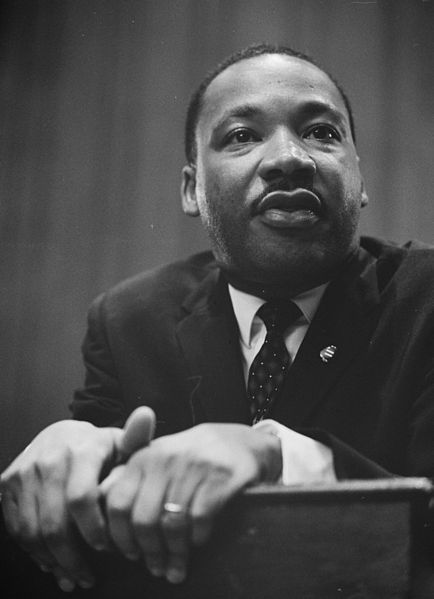
Obama included these references rightly in the context of other struggles. This is not about identity politics but human and civic equality that goes far beyond the gay experience. But sometimes you have to remember how far we have come, with this man pushed relentlessly forward by our pressure and by our conversations with each other. On the weekend we celebrate the memory of the assassinated Dr King, we also re-elect the country’s black president, who also happens to be finally embracing the civil rights cause of his time and ours’.
So forgive me genuflecting a little before this moment – but I didn’t think I’d ever live to see it. I didn’t just see it, but heard and felt it – and saw in this morning and early afternoon a tableau of democratic diversity that was indeed, to my mind, a city on a hill, deeply shifting, in its symbolism and multicultural dynamism, the “opinion of mankind” and our global future.
This has been a grueling few years of economic and military and psychological recovery for a nation still reeling from the new era that began on the 11th of September 2001 and plunged into more crisis in 2003 and 2008. But healing is possible and is happening. The crazies still dominate the airwaves, but the sane center showed up on election day. And the new patchwork that is always America is as vibrant as it has ever been – more different than ever before, including more lives and faiths and loves and genders. So I say this with a mixture of embarrassment (because it is a bit corny) but pride (because it is our duty as Americans and my first Inaugural knowing that I may soon become one):
Know Hope.
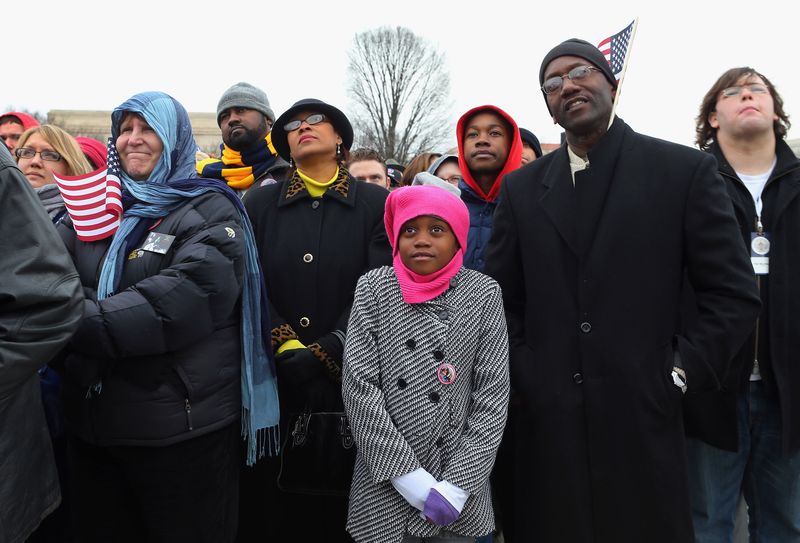
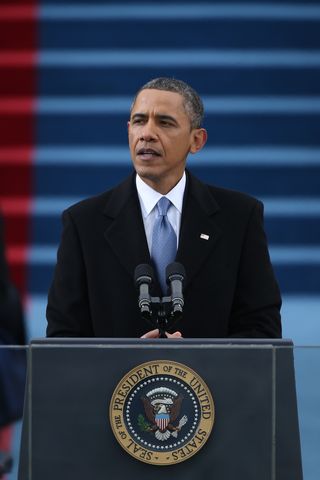
(Photos: People listen as U.S. President Barack Obama speaks during his public swearing in ceremony as they stand on the National Mall during the Inauguration ceremony on January 21, 2013 in Washington, DC. The President was sworn in for second term. By Joe Raedle/Getty Images; Martin Luther King leaning on a lectern on March 26, 1964, via Wiki.)
11.58 am. I’m going to let him give the entire address before jumping in. Here it is:
11.53 am. Well, they got it right this time: crisp, authoritative, clear. Sometimes I wonder if this entire period will be seen in part as a struggle between these two men – Roberts and Obama. He’s a shrewder, calmer, and more authentically conservative check on the president than the current deranged House of Representatives.
11.50 am. So we have a presiding Justice who grew up in her grandmother’s South Bronx apartment, practising insulin shots for her own diabetes on oranges, reciting the oath of office for vice-president, a good ol’ Irish-Catholic from Delaware. The best things about America are the things you don’t really need to say.
“Belittle”, “iffy”, “normalcy” and even “Founding Fathers” – all fall into the category of words invented by US presidents. Paul Dickson, author of Words From the White House, explains the root of the tradition:
Noah Webster early on says this is not the king’s English, this is not the language of the nobilities; it’s the language of the trapper and the farmer and the tradesman. So early on it was almost a patriotic thing. Thomas Jefferson to this day has 114 words credited to him in the Oxford English Dictionary. The most famous, and the one that drove the British nuts, and even up through Fowlers Modern English Usage, which came out in the middle of the 20th century, still bothered by it, was ‘belittle.’
It bothered the British deeply that an American could just come up with a word like this. They thought it was their language and we got to use it. We weren’t supposed to tinker with it.
Katy Steinmetz rounds up some choice bits from the compilation:
lunatic fringe (n.): a minority group of adherents to a political or other movement that is at odds with mainstream beliefs.
Teddy Roosevelt, whom Dickson calls the “Neologist in Chief,” coined this colorful phrase in 1913 when reviewing an art show. “In this recent art exhibition,” he wrote, “the lunatic fringe was fully in evidence, especially in the rooms devoted to the Cubists.” Hey, former Presidents have got to fill their days somehow. Why not take a few shots at Picasso?

 The Dish