Obama’s Speech Pre-Reax

pre-reax

Frum declares that, “however beautifully written, a speech can only be made great by the presidency that follows”:

A speech can fail all by itself. Its ideas can be weak, its language can be foggy. But even if the ideas are clear and the words crisp, an inaugural address can be deemed “great” only if it is followed by actions that make good on its lofty words. This is why we still remember the mighty words of Lincoln and FDR and why we forget almost all the others.

David Shipley wants a workmanlike speech:

I’ve come to believe that the most memorable inaugural address would be one that doesn’t sound like an inaugural address. … How much better to craft something granular, programmatic. Almost a State of the Union — but short. It certainly suits the moment — one when Americans are avidly hoping for detailed structural reform on specific issues. Bill Clinton famously declared that the era of big government was over. Can’t the era of big rhetoric be over, too?

Tomasky hopes for a “tough” speech:

He needs to send a signal in his address that he means business and that he’s figured out who’s boss. … That doesn’t mean an explicitly partisan speech about specific policies. That would be, in addition to inappropriate, crushingly dull. It does mean a speech in which he puts forward an idea about the country that is pointed and that can’t be expressed in the usual inoffensive platitudes.

First Read expects familiar themes:

Looking back at some of the most recent second inaugural addresses, they’ve typically been a continuation of that president’s first-term message (and re-election theme). For Bill Clinton, it was preparing the country for the 21st Century. For George W. Bush, it was security and freedom. And if that continuation theme is any guide, expect Obama to talk A LOT about rebuilding the middle class. After all, it was the central theme of his re-election campaign.

And Beinart thinks Obama needs to defend the role of government:

Obama will not win every skirmish with the Republican Congress in his second term. But to achieve his goal of being a transformational president, he must decisively win the overarching struggle over whether post-financial crisis America requires more government or less. His second inaugural will be judged on how well he defines the terms of that debate.

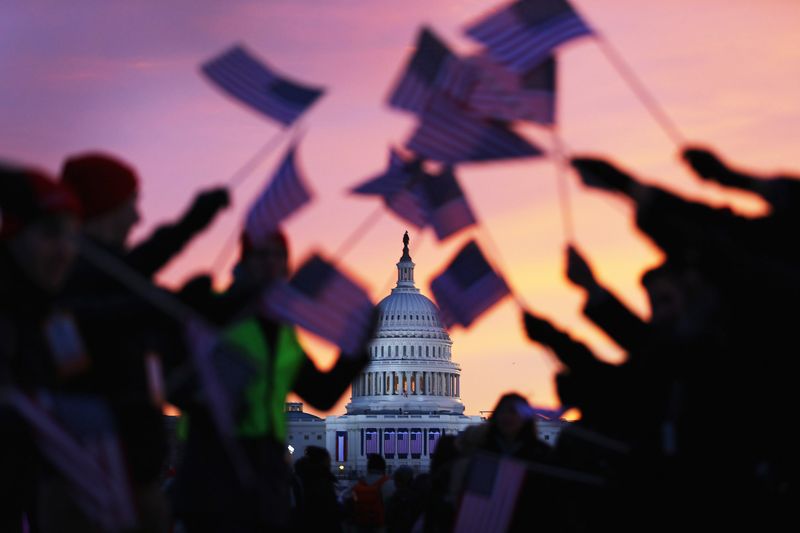
(Photo: People wave American flags as people gather near the U.S. Capitol building on the National Mall for the Inauguration ceremony on January 21, 2013 in Washington, DC. U.S. President Barack Obama, will be ceremonially sworn in for his second term today. By Joe Raedle/Getty Images)

Presidential Honeymoons Aren’t What They Used To Be

Silver notes that, in the past, “presidents enjoyed a ‘honeymoon period’ at the beginning of their second term, with a large number of Americans who had failed to vote for them nevertheless expressing their best wishes”:

Compare Truman in 1949, for example, to Mr. Obama today. Both won the popular vote by a similar margin, about four percentage points. They also got a similar share of the popular vote (51.0 percent for Mr. Obama, 49.6 percent for Truman). Both had experienced somewhat embattled first terms — Truman, whose approval ratings were as low as about 35 percent during parts of 1946 and 1948, probably even more so than Mr. Obama.

But Truman’s approval rating shot up to 69 percent at the start of his second term, while Mr. Obama’s is just 52 percent, just barely more than the share of the popular vote he received.

Chart Of The Day

Derek Thompson welcomes an adjustment in our beverage choices:

Ten years ago, Americans drank enough soda every year to fill a small aquarium. Fifty-three gallons of the stuff per person. That’s half a liter of Diet Coke on an average day. Compare that to our other favorite liquid-caffeine companion. For every cup of coffee we consumed in 2003, we drank two cups of soft drink. For $1 we spent on joe, we spent $4 on soda.

Now look where we are: Soda is in a free fall, with domestic revenue down 40%. Coffee culture is ascendant, up 50% in ten years. In another decade, the United States could easily spend more on coffee than soda — something utterly unthinkable at the turn of the century.

Booting Up An Organism

Adam Baer notes that slime mold “is surprisingly adept at making maps.” Above is an experiment by computer scientists Andy Adam­atzky and Selim Akl:

[T]hey took a map of Canada, dropped oat flakes (slime-mold food) on the nation’s major cities, and placed the mold on Toronto. It oozed forth to form the most efficient paths to the cities, creating networks of “roads” that almost perfectly mimicked the actual Canadian highway system.

Kevin Hartnett adds:

Compared to static circuit boards, living organisms make great computers because they’re good at learning as they go along (slime mold can find increasingly efficient routes between two points with each iteration of an experiment). They’re also a lot heartier than silicon chips which buckle at the idea of a drop of water, opening the possibility of installing computers in environments like the bottom of the ocean or inside the human body.

The Reminiscence Bump

That’s the term for our tendency to “remember more events from late adolescence and early adulthood than from any other stage of our lives.” Katy Waldman describes it further:

Autobiographical memories are not distributed equally across the lifespan. Instead, people tend to experience a period of childhood amnesia between birth and age 5, a reminiscence bump between age 10 and age 30 (with a particular concentration of memories in the early 20s), and at any age, a vivid period of recency from the present waning back to the end of the reminiscence bump.

She spoke with Joshua Foer, author of Moonwalking With Einstein: The Art and Science of Remembering Everything:

[Foer] describes a study in which researchers found that most movie adaptations and remakes occur exactly 20 years after the originals come out. Apparently, whatever touches people as young adults looms so large for the rest of their lives that when they reach the age at which their generation starts to create the culture—around 40—books and screens fill up with the arcana of 20 years ago. “So look out for a new Teenage Mutant Ninja Turtles film any day now,” Foer finished.

The Weekend Wrap

heart-string-attached

This weekend on the Dish we provided our usual eclectic mix of religious, books, and cultural coverage. In matters of faith, doubt, and philosophy, Simone Weilthought about suffering and joy, Giles Fraser channeled Augustine and Freud, a Christian pastor exemplified trends in evangelical political engagement, and Joan Acocella proiled St. Francis of Assissi. Charles Fried pondered Lincoln’s moral genius, Walter Kirn reinterpreted the Fall, a piano tuner found freedom in giving up his possessions, and Daniel Dennett provided a hypothetical question religious fanaticism. George Herbert’s religious poetry proved its ecumenical appeal, Mark Oppenheimer mused on non-celebrity Scientologists, and Kinsley was Kinsley as he reviewed Lawrence Wright’s new study of Scientology.

In literary and arts coverage, Mario Bustillos read Edmund Burke, George Saunders ruminated on technology and fiction, Ruth Padel found the poet behind the Sylvia Plath mythology, and Robert Fay reminded us that T.S. Eliot was good at his day job. Vladimir Nabokav classified Kafka, Stefany Anne Golberg learned about love from Waiting for Godot, and great writers emphasized the importance of revision. Linda Besner surveyed the education of George Orwell, James Franco riffed on heteronormative love stories, Joshua Lewis believed Scrabble needs an update, and Jimmy Stamp visited a scent museum. Read Saturday’s poem here and Sunday’s here.

In assorted news and views, Jeremy Schaap interviewed Manti Te’o, Robert Moorgot in cars with strangers, pot turned out to be popular in North Korea, and Ann Friedman considered the tradeoffs of being a female breadwinner. Michael Popp recounted the impact of his cancer diagnosis, Laura June uncovered this history of pinball’s ban in NYC, and Aaron Gilbreth explored the fate of L.A.’s last dive bar. Mac McClelland reported on families of PTSD patients, Tom Dibblee defended Bud Light Lime, Jill Filipovic savaged a NYT trend piece on millenial dating habits, and Claire L Evans confronted her digital shadow. MHBs here and here, FOTDs here and here, VFYWs here, and the latest window contest here.

– M.S.

(Photo: From the series “Album” by Jon Uriarte)

The Origin Of The Piggy Bank, Ctd

A reader adds to the surprisingly resilient thread:

May I offer another perspective on the “piggy bank” discussion: Proponents of the ‘pygg’ theory may need to explain why the German and Dutch words for piggy bank are ‘Sparschwein’ and ‘spaarvarken’; the first part being derived from the verb ‘to save’, and ‘Schwein’ and ‘varken’ meaning ‘pig’. The animal. The words have nothing to do with any type of clay. The meaning here is very clear, in German, Dutch and English: a pig is a store of wealth. Pigs, both when living and after they are slaughtered, act as a store of energy and proteins. The high fat content of pork means that bacon and ham, for example, keep very well, making it ideal to save for winter time, or when harvests fail.
For centuries, pork was used as a buffer to dampen the fluctuations of the food supply. Just as today you dip into the savings in your, yes, piggy bank, when money is tight.

I’ve always thought the ‘pygg’ theory is being promoted by overzealous vegetarians who have a hard time accepting that anything positive can be associated with the consumption of meat.

War Paint

Adam Mansbach criticizes NYC’s treatment of graffiti artists:

[The War on Graffiti] midwifed today’s era of epic incarceration, quality of life offenses, zero tolerance policies, prejudicial gang databases, and three-strike laws. The War on Graffiti turned misdemeanors into felonies, community service into jail time. It put German Shepherds to work patrolling the train yards; Mayor Koch once suggested an upgrade to wolves. Today, the city prosecutes hundreds of graffiti cases each year, and maintains a dedicated Citywide Vandals Task Force. Nationally, writers have been sentenced to prison terms as long as eight years, and ordered to pay six-figure restitutions. In other words, the war rages on.

In an interview about his new book Rage Is Back, Mansbach reveals the roots of his fascination with graffiti:

As a kid, during the time I was coming up in hip hop, you were expected to be conversant with all the art forms — the sonic, the kinetic, and the visual — and to be proficient in at least a couple in order to fully “be” hip hop. I was an MC and a DJ, but I also wrote graffiti. I wasn’t great, but the thrill of it was captivating, and I quickly discovered that graffiti writers were the mad geniuses and eccentrics of hip hop, the guys whose relationship to their craft was the most fraught and intense, the guys who labored in the dark, literally, whose lives were a discourse between fame and anonymity, who used “beautify” and “destroy” almost interchangeably when they talked about their work. And when I first got into hip hop around 1987, graffiti was already being forced off the New York subway trains, which had been its canvas since the beginning. So there was this sense of a death throe, and of guys outliving the form they’d created, which was weird and tragic, even though graffiti had already gone worldwide by then.

(Image from Banksy)

Quote For The Day III

“Only once in 430 pages filled with lurid anecdotes did my skeptical antennas start to twitch. [Lawrence] Wright asserts that someone was punished by being ‘made to run around a pole in the desert for 12 hours a day, until his teeth fell out.’ Really? That’s the first thing that happens when you run in circles in the desert all day? I need to know more. How many days are we talking about? Did they let him floss?” – Mike Kinsley, being Mike Kinsley.

Quote For The Day II

“To say that the world is not worth anything, that this life is of no value and to give evil as the proof is absurd, for if these things are worthless what does evil take from us?

Thus the better we are able to conceive of the fullness of joy, the purer and more intense will be our suffering in affliction and our compassion for others. What does suffering take from him who is without joy?

And if we conceive the fullness of joy, suffering is still to joy what hunger is to food.

It is necessary to have had a revelation of reality through joy in order to find reality through suffering. Otherwise life is nothing but a more or less evil dream,” – Simone Weil, Gravity and Grace.

(Video: Ann Hamilton’s The Event of a Thread, which draws together “readings, sound, and live events within a field of swings that together invite visitors to connect to the action of each other and the work itself, illuminating the experience of the singular and collective body, the relationship between the animal and the human.”)