T.S. Eliot Kept His Day Job, Ctd

The Dish previously noted Eliot’s work as a banker. Robert Fay reminds us “what is less appreciated is that he was really good at his day job”:

Huxley observed that Eliot was indeed “the most bank-clerky of all bank clerks.” And an officer of Lloyd’s, upon hearing of Eliot’s success with his “hobby,” remarked that Eliot had a bright future at Lloyd’s if he wanted it. “If he goes on as he has been doing, I don’t see why — in time, of course, in time — he mightn’t even become Branch Manager.”

Fay is disillusioned over writers’ day jobs:

When I learned that critic and famed literary blogger Maud Newton worked full-time as a legal writer, I was devastated. Maud Newton? The woman with 156,000 followers on Twitter, who knows every book person worth knowing, and has been on C-Span Book TV, she needs a day job? … It’s far more romantic to think of Jack Kerouac working as a railroad brakeman, zipping through the American landscape on the California Zephyr, than it is to ponder Eliot in the basement, Dr. William Carlos Williams treating a dying woman or the former U.S. Poet Laureate Ted Kooser (2004-2006) working as an executive at Lincoln Benefit Life Insurance Company in Nebraska. That’s why I’ll stick with denial, thank you very much.

Update from a reader:

Well, Eliot may have kept it, but I’m not so sure he liked it.

According to Virginia Woolf’s diary, there were various plots among his friends to obtain an annuity for Eliot or set him up as publisher of a small literary press similar to Hogarth, the Woolfs’ publishing entity, and she implies this was because he was unhappy at the bank. I suspect the reason Eliot turned down various offers of help was not so much because he liked being a banker or didn’t wish to support himself with a “literary” job, but because his wife was emotionally disturbed and he needed considerable financial security in case he was forced to place her in a sanitarium, which, eventually, he was.

Smelling Your Way Through A Museum

Smelly_Museums

Jimmy Stamp visits the first “major museum exhibition to recognize and celebrate scent as a true artistic medium rather than just a consumer product”:

While walking through the Museum of Art and Design’s exhibition “The Art of the Scent (1889-2012)” my mind was flooded with memories of a nearly forgotten childhood friend, an ex-girlfriend and my deceased grandmother. It was a surprisingly powerful and complex experience, particularly because it was evoked in a nearly empty gallery by an invisible art form—scent.

He marvels at the exhibit’s design:

The architects lined three walls of the nearly empty gallery space with a row of gently sloping, almost organic “dimples.” Each identical dimple is just large enough to accommodate a single visitor, who upon leaning his or her head into the recessed space is met with an automatic burst of fragrance released by a hidden diffusion machine. I was told the burst doesn’t represent the scents’ “top notes” as one might expect, but more closely resembles the lingering trail of each commercial fragrance—as if a woman had recently walked through the room wearing the perfume. The scent hovers in the air for a few seconds then disappears completely.

(Image from The Art of the Scent exhibition at the Museum of Art and Design in New York, by Brad Farwell, courtesy of the Museum.)

Classifying Kafka

Joe Hanson dug up a lecture from Vladimir Nabokov, author and entomologist, on the insect The Metamorphosis‘ Gregor Samsa awakes to find himself:

Commentators say cockroach, which of course does not make sense. A cockroach is an insect that is flat in shape with large legs, and Gregor is anything but flat: he is convex on both sides, belly and back, and his legs are small. He approaches a cockroach in only one respect: his coloration is brown. That is all. Apart from this he has a tremendous convex belly divided into segments and a hard rounded back suggestive of wing cases. In beetles these cases conceal flimsy little wings that can be expanded and then may carry the beetle for miles and miles in a blundering flight … He is merely a big beetle.

The View From Your Window Contest

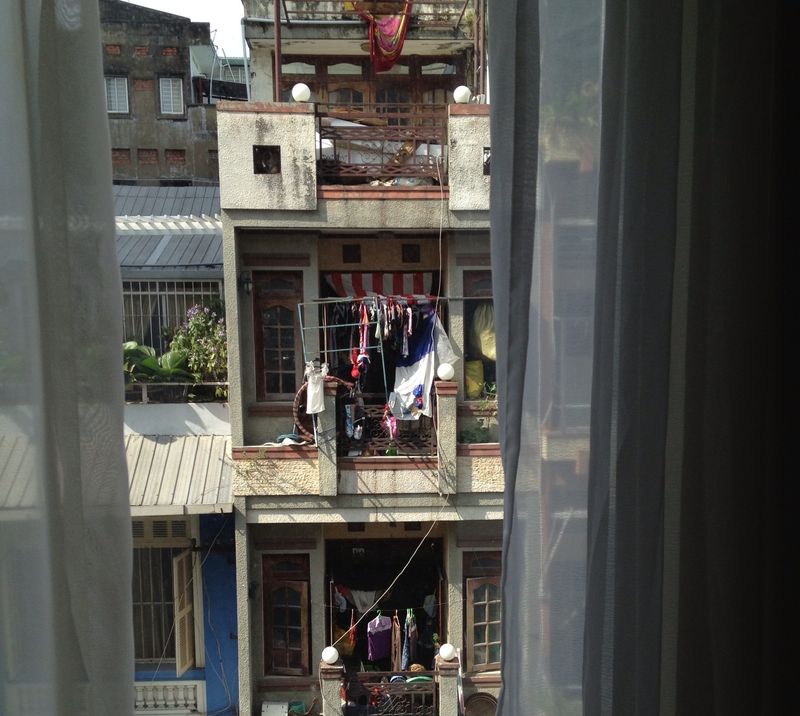
VFYW_Contest_119

You have until noon on Tuesday to guess it. City and/or state first, then country. Please put the location in the subject heading, along with any description within the email. If no one guesses the exact location, proximity counts.  Be sure to email entries to VFYWcontest@gmail.com. Winner gets a free The View From Your Window book. Have at it.

The Education Of George Orwell

From the age of 8 to 13, Orwell attended the boarding school St. Cyprian’s under his real name, Eric Blair. Thirty years later he wrote about his experience in the essay “Such, Such Were the Joys,” which was published after the school’s owner, and the essay’s primary target, passed away. Linda Besner surveys Orwell’s experience and the state of boarding schools in the UK today:

“[I]t is difficult for a child to realise,” Orwell wrote, “that a school is primarily a commercial venture.” The Blair family was not rich, and the Wilkeses accepted bright Eric at St. Cyprian’s on reduced fees with the understanding that he must win scholarships and national prizes, the better to boost the school’s reputation. In his account of what would happen when he did badly on tests or otherwise let his academic performance slip, he would be called into the headmaster’s office, where the Wilkeses (known as “Sambo” and “Flip” at the real St. Cyprian’s; “Sim” and “Bingo” at the lightly disguised “Crossgates” of Orwell’s essay), would sit him down and gently threaten him. “And do you think it’s quite fair to us, the way you’re behaving? After all we’ve done for you? You do know what we’ve done for you, don’t you?…We don’t want to send you away, you know, but we can’t keep a boy here just to eat up our food, term after term.”

The child’s fear and shame—the mask of paternalism strategically pulled askew to remind that the face underneath is not that of a father, but a stranger bound to him by money and power—fuels the cringing obedience and rebellious rage of 1984.

The Female Breadwinner

Ann Friedman considers how even financially independent women often sacrifice their own creative potential to support a spouse:

The partner who is more aggressive, assertive, and confident has a natural edge. Often, that partner is male. He’s the one who declares he’s ready to take the leap and try to make his unrealistic creative dreams come true. The woman, who is frequently but not always more self-effacing about her abilities, agrees to play a financially supportive role.

There are real privileges associated with going first. The creative world fetishizes young entrepreneurs and auteurs. As we age, most of us become more risk-averse. And then there’s the question of children. In almost every field, there’s a significant drop-off in women’s advancement after they have children. Men do not suffer the same fate. A2010 survey of U.K. workers in fields like film, design, and media found that 42 percent of the creative workforce is female, compared with 46 percent of the workforce in the wider economy. Older women were even more underrepresented.

For Friedman, “it seems like there’s no ideal”:

You either place a great deal of trust in your partner in the short-term and rely on his income while you invest in your long-term creative goals. Or you become the breadwinner and put your dreams on hold while you fill the joint bank account. But in either scenario, it’s clear that for creatively ambitious women, independence isn’t all it’s cracked up to be.

A Poem For Saturday

Saturday_Poem

“Categories of Understanding” by Catherine Barnett:

I’m studying the unspoken.
“What?” my son asks.
“What are you  looking at?”
But there is no explaining.
I can only speak the way light
falls, the way the cotton sheet
lays itself over his sleeping or resting
or dissolving body, touching him with
its ephemera, its oblivion.

(From The Game of Boxes by Catherine Barnett © 2012 by Catherine Barnett. Reprinted by permission of Graywolf Press. Photo by Flickr user quinn.anya)

“Trauma Is A Contagious Disease”

Mac McClelland reports that families of PTSD patients are starting to show the same symptoms:

Symptoms start at depression and alienation, including the “compassion fatigue” suffered by social workers and trauma counselors. But some spouses and loved ones suffer symptoms that are, as one medical journal puts it, “almost identical to PTSD except that indirect exposure to the traumatic event through close contact with the primary victim of trauma” is the catalyst. Basically your spouse’s behavior becomes the “T” in your own PTSD.

Among spouses:

Secondary traumatic stress has been documented in the spouses of veterans with PTSD from Vietnam. And the spouses of Israeli veterans with PTSD, and Dutch veterans with PTSD. In one study, the incidence of secondary trauma in wives of Croatian war vets with PTSD was 30 percent. In another study there, it was 39 percent.

“Trauma is really not something that happens to an individual,” says Robert Motta, a clinical psychologist and psychology professor at Hofstra University who wrote a few of the many medical-journal articles about secondary trauma in Vietnam vets’ families. “Trauma is a contagious disease; it affects everyone that has close contact with a traumatized person” in some form or another, to varying degrees and for different lengths of time. “Everyone” includes children.

The First Half Hour Of Cancer

Half-Hour-Of-Cancer

On his blog The Letting Go, Michael Popp recounts the initial moments in which he was curtly informed of his leukemia, “as if [I] was being asked if [I] wanted a receipt.”

The doctor scribbles down two numbers. Its 4:30 they tell me. You need to get to a sperm bank immediately. The chemotherapy will make you infertile and if you have any desire to have children, you need to call these numbers and bank. I had known, for nearly 4 minutes that I had cancer. It hadn’t even begin to phase me and now I would be infertile. I picked up the paper, still unsure of everything that was going on and began to beg a woman with a thick accent on the other line for an immediate appointment.

On his way to deposit the sperm, he called his girlfriend:

The phone rang and she answered. I explained, rather plainly, I had cancer.

My chances of survival were good and that everything would be okay. As I told her, it became real. My voice began to break up as I made it block by block towards the bank. I was having trouble holding it together as I said the words to her, trying to reassure her there wasn’t anything to worry about. I was losing it, I told her I’d call her back, I couldn’t bear showing her how upset I was, I needed her to believe what I had said, knowing that I myself was completely unsure of what to expect. I had only known I had cancer for 15 minutes. I knew nothing.

(Photo by Tom Hart)

Toking Up In North Korea

It’s rather common:

NK NEWS receives regular reports from visitors returning from North Korea, who tell us of marijuana plants growing freely along the roadsides, from the northern port town of Chongjin, right down to the streets of Pyongyang, where it is smoked freely and its sweet scent often catches your nostrils unannounced. Our sources are people we know who work inside North Korea and make regular trips in and out of the country.

There is no taboo around pot smoking in the country—many residents know the drug exists and have smoked it. In North Korea, the drug goes by the name of ip tambae, or “leaf tobacco.” It is reported to be especially popular amongst young soldiers in the North Korean military.