The GOP has agreed to raise the debt ceiling for three months. Chait celebrates:
The whole key to making Obama’s extortion-squelching plan, and saving American government from endless cycles of hostage drama that would eventually end in a default, was to credibly insist that he would not trade anything for a debt ceiling hike. After he moved his red line on tax cuts, I doubted that Obama could really make this stick. But he has.
As one senior House Republican aide explained it, putting the debt ceiling after the sequester (the series of automatic, across the board cuts that will kick in unless Congress acts to cut spending on its own) and insisting that the Senate produce a budget before April 15 or not be paid shifts the terms of the debate in a favorable way for Republicans.
Quin Hillyer wishes the GOP had gotten symbolic cuts:
I understand what the GOP leaders are doing in putting off the debt ceiling fight until after they bank the gains from the sequester. I understand them trying to put the onus on the Senate to pass a budget. I understand these things, and I don’t think they are awful idea — but I would do something just a bit different. I would not pass a clean debt ceiling hike for the equivalent of three months; I would tie it to a very nominal package of savings, even if only, say, $15 billion over ten years, if just to establish the principle that cuts belong with debt ceiling hikes.
And Kilgore wants to know what the Republicans’ demands are:
I guess this can-kicking does roughly align the debt limit expiration, the end of the “sequestration” delay, and the lapse in the continuing appropriations measure passed last year. So in theory it creates a Great Big Tripartite Crisis this spring. But Republicans still need to figure out what they are demanding from whom and when. A hostage-taker who’s not sure what ransom to ask isn’t usually real successful.
I’m having cancer treatment and am stuck in a hospital room for at least one month while my sister’s stem cells kick in for me. I love your blog. It’s the first thing I read every day. Anyway, if I’m going to be stuck somewhere, at least this place has a nice view.
Update from a reader:
The view posted today from Chicago is one I know very, very well. My wife and I spent much of our time together there. She battled breast cancer for over 9 years before passing away in 2011. It is a wonderful sight and the beauty of it still captivates me. I am madly in love with the great city of Chicago. While certainly it evokes a great sadness in me to see this view, there are also many warm feelings of remembrance. Despite the challenges, we had many good times together, even in hospital. Thanks to your reader for sharing this with me and providing an avenue to experience these feelings today.
Austin Considine contemplates research that “crunched B.O. data on 6,495 women and found that around two percent of subjects carried a specific genotype associated with a total lack of body odor”:
Researchers found that among women who possess the G allele—i.e., the smelly ones—around 5 percent didn’t regularly use deodorant. (Hippies.) Compare that with the 22 percent of those who possess the non-smelly AA allele who didn’t use deodorant. That’s a big difference, and indicates that non-odorous people have rightly figured out that they really don’t need it.
More fascinating, however, is the 78 percent of people who don’t genetically need deodorant but use it anyway. Why do they feel so compelled? Not only is it unnecessary, but it’s a waste of money.
If one needs more hope, one can find it in the history of the parallel fight against drunk driving. When that began, using alcohol and then driving was regarded as a trivial or a forgivable offense. Thanks to the efforts of MADD and the other groups, drunk driving became socially verboten, and then highly regulated, with some states now having strong “ignition interlock” laws that keep drunks from even turning the key. Drunk driving has diminished, we’re told, by as much as ten per cent per year in some recent years. Along with the necessary, and liberty-limiting, changes in seat-belt enforcement and the like, car culture altered.
The result? The number of roadway fatalities in 2011 was the lowest since 1949. If we can do with maniacs and guns what we have already done with drunks and cars, we’d be doing fine. These are hard fights, but they can be won.
The bloodshed in Syria hasn’t convinced Marc Lynch that American intervention was a better option:
[I]f political negotiation backers too easily assumed that levers could be found to push Assad from power, intervention advocates too easily assume that a military intervention would have made Syria today look substantially better. They refuse to consider the very plausible possibility that such a Syria would be just as violent and militarized, that al-Qaeda affiliated Islamists would be just as active, and that Assad would be just as entrenched and with far more robust domestic, regional and foreign backing. And they rarely consider one of the major risks identified by most of those opposed to limited intervention, that the United States would now be deeply enmeshed in an inescapable and escalating quagmire.
(Photo: Syrian rebels launch a missile near the Abu Baker brigade in Albab, 30 kilometres from the northeastern Syrian city of Aleppo, on January 16, 2013. By Elias Edouard/AFP/Getty Images)
Readers push back against the notion that Swartz is a millennial martyr:
As a security nerd, I’m inclined to be in favor of “information wants to be free” especially when it comes to academic papers, many of which were funded by NSF or other federal grants. But Orin Kerr has a good summary (and a followup here) of Aaron’s activity in detail here. He could’ve used Harvard’s network to scrape the papers, but tried to cover his tracks by going to MIT. When caught, he went back three times to evade blocks set up by JSTOR and MIT to try and keep him from continuing. Was it worth a 30-year sentence? I doubt it, and we may never know what sort of plea bargain the prosecutors offered him to begin with, or what went into his decision to turn it down. But it’s not reasonable to expect prosecutors to overlook activity this blatant, either.
Another:
You might argue that these institutions like JSTOR are simply middlemen, destined to be wiped out by the leveling force of the Internet as “pre-print” sites like ArXiv and SSRN allow researchers to share their results directly with the public. But they offer the community a valuable service, especially in an era of information-glut, by blindly filtering papers based on content alone, and then subjecting those qualified to a criticism from like researchers in the field. Without filtering predicated on quality, it will be even harder for little known researchers to get their results read and even easier for those that have made it to rest on their laurels. Peer review has been one of the most effective bars from keeping pseudoscience out of the mainstream and acquiring the respectability it craves; without it, everyone from creationists to vaccine-deniers will have their papers circulating, however dubious, and it will be impossible for the layperson to discriminate.
Another:
So despite the fact that JSTOR did not want to press charges, did not support the prosecution, is trying to begin opening access to files as much as they can as they are a non-profit working as an intermediary between publishers and libraries, you are supporting an attack against them because they exist. It is vandalism and it is immoral to go after an organization just because they have something others may want.
We are not dealing with government documents, something that is explicitly government funded. These are academic papers that are written by people who may or may not want their information released for copyright or whatever reason it may be. Let them make that chose, don’t give it to a mob.
And another:
First, let me say, as an attorney working in academia, I am familiar with the issues surrounding Swartz’s case, and I believe that restricting access to knowledge is antithetical to the spirit of universities. I also appreciate the zeal with which Aaron fought for his beliefs. However, I have a hard time understanding why Carmen Ortiz is responsible for this young man’s suicide or why anyone would feel compelled to sign a petition for her removal.
Aaron was an intelligent adult, his deliberate actions allegedly broke the law, and the US attorney pursued a legal prosecution of him for these acts. I keep reading these articles, particularly on tech sites, that say his treatment was unjust because this was a victimless crime and it was akin to not returning library books.
However, it doesn’t matter what the law is akin to; it matters what the law is, and apparently his actions triggered the possibility of greater sanctions. He may disagree or think that his actions do not violate the law and he was free to bring that issue before the courts. Or he could have fought the good fight in another matter, but considering the fact that he had run-ins with the law before, he knew that there could be serious consequence for what he did. Now with the case, he had the option of taking a plea or fighting this in court and under our system, the prosecutor threatens the worst possible sentence to try and induce a plea. If you have a problem with that, then your issue is with the system and placing the blame on Ortiz cheapens the real issue and speaks to navel gazing among the tech community and the chattering class.
The real structural problems in the American justice system disproportionately affect minorities and low-income persons. I’m not indicting you personally because you cover issues like this related to the drug war, but if the tech community really cares about the inequity in the justice system, then place to blame squarely where it belongs, the justice system and take up the fight to change it. I can’t imagine that anyone is truly foolish enough to believe that, even if Carmen resigns/is fired tomorrow, the incentives for prosecutors in our system will change. If anything, they will just figure out a way to provide themselves more cover.
One more:
I seem to be missing something here on the Aaron Swartz story. He was an activist, right? Activists sometimes get arrested. Sometimes they do things with the intention of getting arrested, in order to bring a story to light. Does anybody believe that Swartz was going to spend 30 years in prison? The TIME article you quote says that Rep. Lofgren is trying to amend the CFAA “which Massachusetts prosecutors used to charge Swartz with over 30 years in prison.” What does that even mean? How does a person get charged with 30 years in prison.
I don’t understand why this young man killed himself but I know who is responsible for his death. He is. He killed himself. He was not hounded to death. He was arrested for what seems to be a victimless crime, but he was not an anonymous innocent with no resources with which to fight the injustice being dealt him. He was out on bail. He had a legion of supporters. And he was fighting not only for his freedom, but for a cause he believed in. Overzealous as his prosecutors may have been, is it right to hold them responsible for his death.
Aren’t people being overzealous in their condemnation of the prosecution? If Ms. Ortiz is forced from her job because of this pressure, becomes distraught takes her own life, are all those who called for her dismissal to be held responsible for her death.
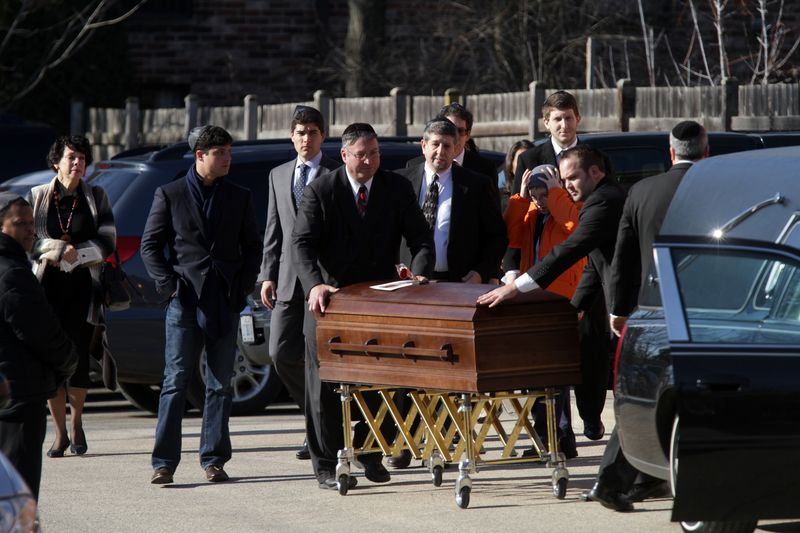
(Photo: The casket of Aaron Swartz, the Reddit co-founder and Internet activist, is moved to a waiting hearse during his funeral Tuesday, January 15, 2013, at North Suburban Lubavitch Chabad Central Avenue Synagogue in Chicago, Illinois. By Michael Tercha/Chicago Tribune/MCT via Getty Images)
Like many others, I was transfixed last night. The first thing to say is that Oprah Winfrey is one hell of an interviewer. As an exercize in journalism, in an extremely fraught interaction, she was focused, clear, calm and relentless. Not since Martha Raddatz …
As for Armstrong, I’m afraid I cannot muster much anger about the actual use of what he correctly calls “performance enhancers”. If everyone is cheating, in some ways, no one is. And the ubiquity of performance enhancers in the sport when he was at its helm means he was competing against chemically-enhanced equals. He still won. Those drugs take human performance to new levels, but they do not abolish core and real athletic prowess, focus, and psychological grit. I’ve long believed in ending prohibition in sports on performance enhancers – because they are everywhere and unstoppable. We should rather have tests that ensure equality of enhancement. We could also have drug-free football, for example, alongside the steroidal monstrosities of the NFL. Fans might even prefer to watch human beings play the game again, rather than herds of steroidal human cattle, slowly turning their brains to mush.
My point is that we are all pharmaceutically-compromised now. From SSRIs to Adderall, from Xanax to taurine and caffeine energy drinks, it’s harder and harder to draw very clear lines between what chemicals are illicit and what chemicals aren’t. We don’t begrudge injured athletes drugs that alleviate pain and speed recovery. And the distinctions between preventing pain and improving performance will become harder to maintain.
I can see a day when human growth hormone is almost universally used among male retirees, just as testosterone is now being prescribed routinely to those facing the decline of age. I have a bias here. Without pharmaceuticals of extreme sophistication, I’d be dead. Without testosterone replacement therapy, I’d probably be terminally depressed and sick. Without Xanax, insomnia would destroy my productivity. But I hope that bias does not negate the fact that the human mind has made the human body qualitatively different than it was only a couple of decades ago. We don’t just live longer because of drugs. We live immensely better lives. This is a fact that will affect every aspect of our lives, and sports, of course, will be part of that. The money involved, the sheer power of the drugs, the availability of them … we can continue to deny this and get outraged every time it emerges, or we can begin to have a calmer, saner conversation about it.
No, to my mind, what’s disgusting about Armstrong was not his drug-use; it was his unconscionably vicious assaults on the truth-tellers.
He went so aggressively on the offense against far weaker human beings who were simply telling the truth. He used his fortune to bully, abuse and destroy them. He trashed their reputations, while celebrating his own. He lied and betrayed others every single step of the way. What he called so many of them is simply beyond belief. He never had to do any of that. And Winfrey brilliantly exposed the monster he became. What she unpeeled is what living a lie will do to anyone’s integrity. It isn’t a one-off event. It is a slow-burning destruction of the human soul.
And, of course, even if performance enhancers didn’t give him an unfair advantage over his rivals, who were also pharmaceutical experiments on wheels, they were nonetheless clearly banned in his sport, he knew it, and the rules matter. Real sportsmen follow rules; they don’t find elaborate, conspiratorial means to foil them. And the use of cancer-survival as a device to keep the truth at bay is simply despicable.
Look: I’m a libertarian in most things and a Christian. I believe in forgiveness – which must start, of course, with Armstrong and those he wronged. But what I see in Armstrong is extraordinary intelligence, peerless will-power, and staggering athleticism – all destroyed by pride and deceit. He is living proof that greatness and evil are often intertwined in the self-destructive longings of the lost soul.
We know this already. And we are all human. Not many of us can say we have never lied. But I just want to say how impressed I was by how skillfully Oprah Winfrey laid that truth out in front of us, like a patient etherized upon a table. She is a broadcaster without equal.
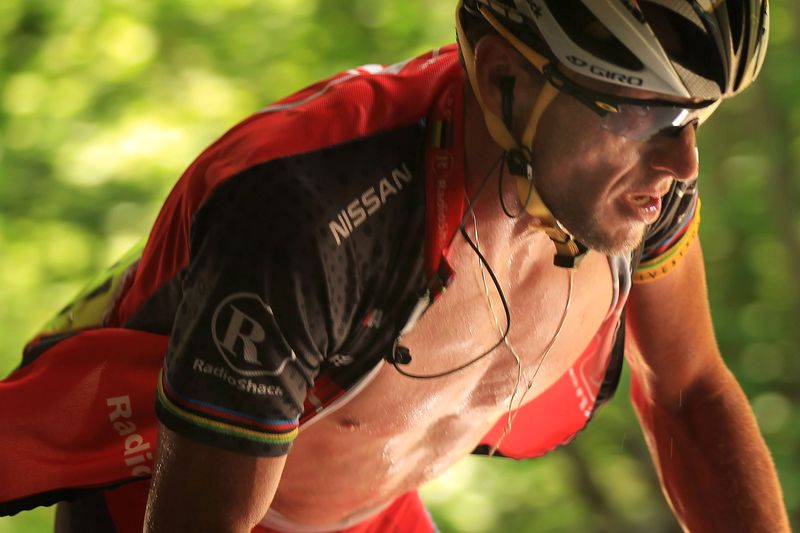
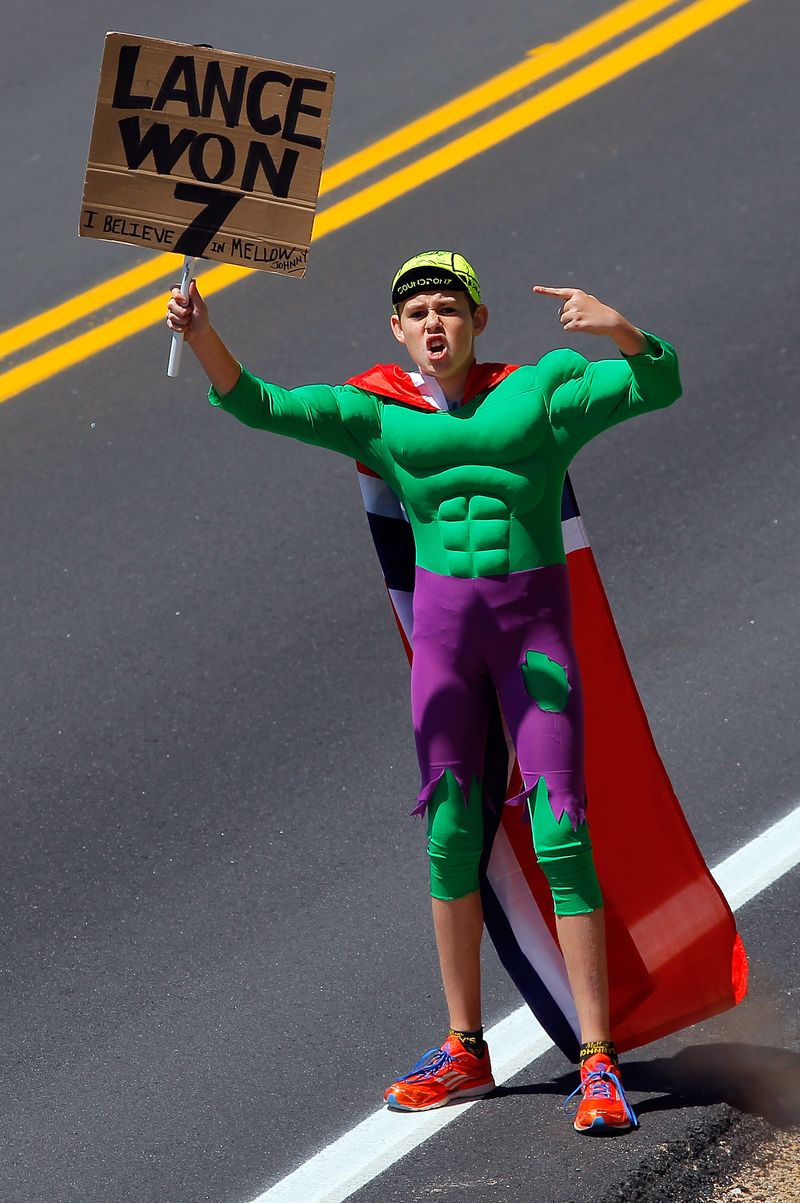
(Photos: American Lance Armstrong with team RadioShack rides in a breakaway during stage 16 of the Tour de France on July 20, 2010 in Pau, France. By Spencer Platt/Getty Images; a young fan holds a sign in support of Lance Armstrong as watches stage six of the USA Pro Challenge from Golden to Boulder on August 25, 2012 in Boulder County, Colorado. By Doug Pensinger/Getty Images.)
Rolling Stonemade a list of the most prominent pot legalization opponents. Mike Riggs suggests some additions:
If you’re going to make a list of legalization’s biggest enemies, and there’s only five slots, you should probably go with the people who are, you know, big. That’s why it was smart of Rolling Stone to include Kerlikowske and Leonhart in its writeup, and absolutely outrageous that the magazine omitted President Barack Obama, Attorney General Eric Holder, and Secretary of State Hillary Clinton, all of whom have exponentially more control over the execution of America’s drug war than a blogger and his friends, and all of whom are on the record as being opposed to legalization.
In another post, Riggs finds no evidence that Obama is tackling the drug war:
Even if Obama does do something with the drug war—say, expands the federal drug court pilot program from three jurisdications to nationwide, or allows convicted drug offenders to borrow federally guaranteed funds for college—that’s not the same as “tackling” the drug war. Not when you consider how complex Obamacare is, and the thousands of hours that went into crafting and debating and negotiating that legislation. Anything short of a major overhaul of the Controlled Substances Act, asset forfeiture policies, and our massive prison system simply doesn’t count as a tackle.
Fighting has erupted in Mali between the government and Islamist groups. Peter Chilson emphasizes al Qaeda’s role:
If Mali feels somewhat far away or less than important, consider this: Northern Mali is currently the largest al Qaeda-controlled space in the world, an area a little larger than France itself.U.N. Secretary General Ban Ki-moon has warned that Mali could become a “permanent haven for terrorists and organized criminal networks.” In December, Gen. Carter F. Ham, commander of the U.S. Africa Command, warned that al Qaeda was using northern Mali as a training center and base for recruiting across Africa, the Middle East, and Europe. Jihadists operating in northern Mali have been linked to Boko Haram, the violent Islamist group based in northern Nigeria, and to Ansar al-Sharia, a group in Libya which has been linked to the attack on the U.S. consulate at Benghazi that killed Ambassador Chris Stevens and three other Americans.
The ones who declared that northern Mali is now an independent state? They’re called the Movement for the Liberation of Azawad, or the MNLA, and they’re considered relatively secular. But not long after they announced their independence, extremists within their own movement started to emerge. Now the MNLA has been marginalized within its own rebellion, largely replaced by two breakaway Islamist groups: Ansar Dine and the dramatically named “Movement for Oneness and Jihad in West Africa,” also known as MOJWA. Ansar Dine, the better-known of the two, has recruited Arab fighters from a group that might sound familiar: al-Qaeda in the Islamic Maghreb.
The link between Ansar Dine and al-Qaeda in the Islamic Maghreb is not totally clear. Also unclear is their link to the “central” al-Qaeda organization better known to Americans. But they are all cruel, imposing extreme social restrictions and barbaric punishments on, for example, a woman who served a glass of water to a man.
Alexis Okeowo considers the role of France, which is fighting rebels on behalf of the Mali government:
France wants this to end with a stable government in Bamako and the eradication of terrorist groups in the north. But the French now concede that they underestimated the strength of their opponents, and the government, which initially said that it would only provide air support, has now announced that it would send ground troops and triple the size of its deployment, to twenty-five hundred personnel. Soon, the government may have to deal with a populace that’s unhappy with the idea of sending its soldiers to risk their lives fighting in an unfamiliar area that’s larger even than Afghanistan.
Simon Tisdall argues that America should stay out of the conflict:
[T]here is a clear danger that an expanding war in Mali could start a wave of new attacks on “soft” western targets similar to that in southern Algeria, and that increased western intervention in the region will transform extremist groups that had only local importance into potent trans-national threats.
[I]nitial reporting suggests that the U.S. is about to blunder into another far-flung overseas operation in no small part caused by prior U.S. f**k-ups with no end in sight and a hostile population on the ground. Right? Not so fast. Contrary to the claims of some militant anti-interventionists,the U.S. counter-terrorism policy didn’t cause the problems in Mali. And, indeed, based on this survey of Northern Mali villagers conducted by some kick-ass political scientists early last year, it would seem that the locals would welcome further U.S. involvement, particularly on the humanitarian side of the equation.
And as we pointed out earlier this week, much of the populace has welcomed the French. Walter Russell Mead weighs the risks:
France needs US help, and the US should give it. Just as France’s Libyan intervention failed because the country ran out of military supplies, France’s Malian adventure could collapse without our support. But the situation nevertheless raises alarms. The last time the US supported a major French military operation was the infamous Battle of Dien Bien Phu in Vietnam during the First Indochina War. The French were completely routed, and the US launched the Vietnam War soon after. We hope Mali doesn’t turn into another Dien Bien Phu.
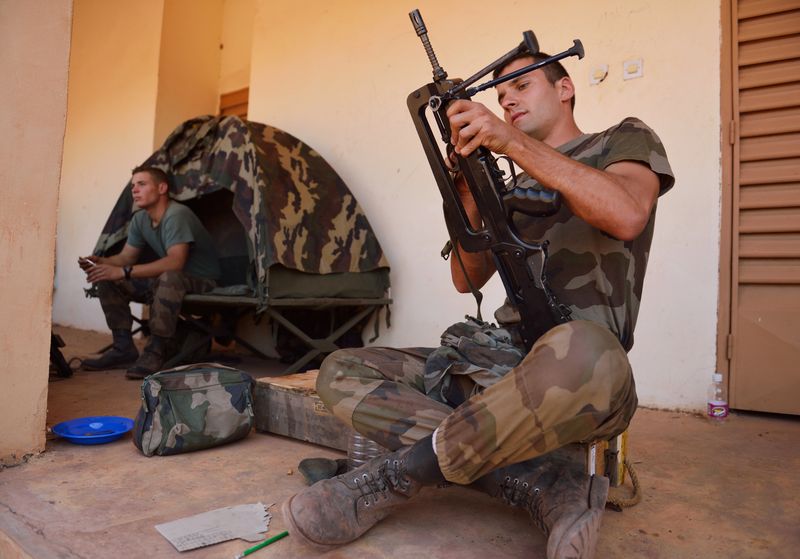
(Photo: A French soldier from the 21st Rima prepares a Famas machine gun, at the Malian army 101 airbase where French troops are stationed, on January 18, 2013, near Bamako. France now has 1,800 troops on the ground in Mali, inching closer to the goal of 2,500 it plans to deploy in its African former colony, Defence Minister Jean-Yves Le Drian said today. That was 400 more than a day earlier, said the minister as he met with French special forces in the western port of Lorient. The troops have been sent to help the Malian army regain control of the north from Islamist groups. By Eric Feferberg/AFP/Getty Images)

 The Dish