Angry Bird Watch

AngryBird

When life imitates art, spotted by a Dish reader. But it is a female bearded tit, after all. Of course, I realize that “female bearded tit” is probably the next thing Piers Morgan is going to call me. If I’m lucky.

(Photo: A female Bearded Tit perches on a reed amongst the reedbeds in Hyde Park on January 15, 2013 in London, England. The birds, a pair spotted for the first time last week, offer a rare opportunity to see them as this species has never before been seen in inner London. Since their arrival twitchers have flocked to the area for a rare glimpse of the birds. By Dan Kitwood/Getty Images)

“Because They Were The Right 900,000″

That quote by Roger McNamee refers to the number of heydey New Yorker subscribers, in the context of a brand isolating a core audience willing to pay for content rather than mass-market to everyone. But 900,000 also happens to be the rough number of Dish readers per month. McNamee gives that readership a shout-out starting at the 26-minute mark of this video, flagged by a reader:

Roger McNamee, the tech venture capitalist, was just on Charlie Rose.  One of his topics was paying for content that is valuable to you (one of his analogies was classical music – it doesn’t make it on its own so it gets subsized by a small group).  He said he supports about a dozen blogs directly and mentioned you specifically, saying $20 was nothing, and that he paid what it was worth to him – “10 times more than what [you] were charging.” Anyway, he’s pretty insightful, and entertaining. I suggest you watch the whole Rose interview and consider inviting McNamee on your “Ask Anything” series.

Stay tuned. And you can join Roger by pre-subscribing to the new Dish here.

Jon Stewart On Zero Dark Thirty, Ctd

This embed is invalid

Readers offer their impressions of the interview with Jessica Chastain:

I say this not as an excuse, but as a partial explanation. I think Jon Stewart has a bit of a blind spot for regarding terrorism in general and Osama Bin Laden in particular. This is one area where he tends to react first as a New Yorker who was attacked on 9/11 and not so much a liberal. I haven’t seen ZD30 and don’t particularly want to, but I don’t think you should assume that Stewart’s reaction is necessarily representative of liberals at large.

Another:

Chastain is an ACTRESS. She’s not the writer or the director or the producer. Should Stewart have attacked her for the role she played? Seriously? Chastain is the wrong target for the answers (and the fight) you’re looking for.

Another:

Stewart clearly relishes putting policy makers on the spot, but celebrities? Not so much. I suspect because he considers them “civilians” and has empathy for the situation they are in (folks called on to defend some project they are part of but had little role in creating).

Another adds that “if he had conducted a similar softball interview with Kathryn Bigelow, then there would be something to talk about.” Another:

When Stewart said that he had the feeling, “shouldn’t we be watching this 30 years from now?” I don’t see how you can read this as a statement that he believes in the suppression of information. I had the same thought in the film – that this is the sort of information we usually don’t learn about until many years after a fact. Stewart’s phrasing of “shouldn’t” (which he stumbled over, by the way), only tells us that verbal language is more imprecise than written language tends to be. And at the end of the interview, Stewart even uses waterboarding as the extreme example to counter “talking about waterboarding” in the punishment of a CIA agent (i.e., strange that talking about waterboarding could get you into more trouble than engaging in something so horrible).

In short, Andrew, you’re reading a great deal into this interview that strikes me as unfair to Jon Stewart. Please don’t turn him into the latest example of a “torture apologist”.

I think my readers are right – although I simply said his responses were confusing to me. On reflection, I think I made a mountain out of a molehill (as Aaron insisted as we watched and re-watched it that night). But I’m genuinely torn on this movie, which explains my sensitivity. I want to reiterate my profound admiration of what Stewart does every night. It’s often much much better journalism than anything on cable news. Another shifts gears somewhat (spoilers below):

As to your question regarding the movie.  I am a liberal.  I am, I hope obviously, against torture. This movie told me that sometimes – sometimes – torture can work and lead to important information.  However, I am capable of thinking about it outside the movie and came away thinking this does not make torture worth it.

It causes more problems, be they ethical moral, or practical, than it solves. The fact is torturing al-Kuwaiti may very well, and likely did, help find Usama Bin Laden.  But so what?  What about the countless others we tortured which garnered no such information?  That’s pretty fucking awful.  The fact is that the chances of getting a piece of information like the one received from al-Kuwaiti through torture, when we wouldn’t have been able to get it by less-horrible means, is extremely extremely small.

I feel, as a pragmatic person, the case against torture is that the moral and practical costs of obtaining information in such a way – which includes, but is not limited to, our a) standing in the world, b) receipt of misinformation, c) endangering our troops/civilians, d) emboldening terrorists, and e) corrupting legal cases – is much stronger than the case for torture … that maybe, just maybe there is a minute chance we will get a bit of info that may stop an attack.  The movie didn’t change my stance on torture; it just provided some nuance and told the story of one time torture was used.

Another:

My impression of the film is that it is essentially a Rorschach Test on celluloid.  If you came into the theater believing that “enhanced interrogation” is inhumane, illegal, and unhelpful to the manhunt, then you certainly wouldn’t have changed your mind after seeing the film.  The acts of torture portrayed in the film are vile, very difficult to watch, and they did not directly lead to useful information.  And the information gleaned from Ammar, the detainee tortured at the beginning of the film, was corroborated by other detainees anyway, so it would be reasonable to say that Bin Laden would have been caught and killed even without the use of torture.

On the other hand, if you came into the theater believing that “enhanced interrogation” was crucial to Bin Laden’s eventual capture, then ZD30 did not do much to dissuade you.  True, the agents were able to obtain information from Ammar only after they stopped torturing him and fed him a solid meal – and then, only by tricking him into believing he had already spilled the beans.  But it would be reasonable to conclude that Ammar’s fear of further torture was at least part of the reason why he gave up the info.  And that fear would not have been there if the agents hadn’t already tortured the guy.

So, I do think you were mistaken (I’d hesitate to say “naive”) to expect that the film would cause viewers to recognize and confront the fact that their government did evil, illegal things as part of this manhunt.  On the contrary, those who were predisposed to believe that torture is worthwhile will leave the movie with that belief intact, and perhaps even bolstered.

As for me, I came into the theater from roughly the same place as you – ashamed of what my government did, but pleased with the end result achieved in Abbottabad.  My shame has not receded after seeing ZD30, but it has been put into perspective.  That is because the torture scenes, though very difficult to watch, simply cannot compare to the abject horror of the opening scene, featuring voices of 9/11 victims. The bone-chilling opening scene set the stage for the entire rest of the film.  It is made entirely clear that whatever pain was suffered by Ammar – who is happily enjoying hummus and tabbouleh at last check – cannot even begin to compare with the suffering felt by those trapped in the towers or in the planes.

One more:

You and I agree on a lot of things so I was absolutely dumbfounded that you did not take away from it a direct connection between torture and the capture of bin Laden.  How did you not see the “bluff” scene as being directly related to the inmate being repeatedly tortured up to that point? Not to mention the other inmate telling Maya he will tell her everything because “I don’t want to be tortured again.”

The best review of the movie in my opinion is here. The concluding sentence is: “To me, that makes Zero Dark Thirty not an apology for torture so much as a powerful acknowledgement that we might never have found and killed Osama bin Laden without the willingness to enter the fog of war.” That is what people are going to take away from the film!  And this is evident in the Liz Cheney tweet you posted along with Hannity’s endorsement of it.

I thought showing torture on screen displayed honesty and would force us to own up to what our government did and hoped that viewers would be disgusted by it.  By connecting torture to OBL’s capture, Bigelow has completely leap-frogged that introspection to the inevitable thought that torture is needed to keep us safe. Even Jon Stewart is grappling with that, for god’s sake.  If he is, what hope is there for those who already believe torture is necessary?  This movie then becomes the ultimate defense for any past or future acts of torture.

Please see it again and let us know what you think.

Piers Morgan Quote For The Day

“I’ve tried to be very respectful about Larry [King]; he’s a legend, and I feel very proud to have followed him. But I think he just slightly needs to button it, because he’s talking nonsense. The reason we’re different is, I’m a journalist and he’s not. Larry isn’t a journalist, never has been,” – Piers Morgan.

He addresses the Leveson Inquiry’s belief that he was at best indifferent to criminal phone-hacking while running the Daily Mirror, and his own role in publishing fake photos and being fired for it, in a separate piece here. Believe it or not, he denies everything. The Leveson Inquiry’s conclusion about Morgan’s denials in the Guardian last November is worth a read. Money quote:

Lord Justice Leveson has described former Daily Mirror editor Piers Morgan’s assertion that he had no knowledge of alleged phone hacking as “utterly unpersuasive”, and said the practice may well have occurred at the title in the late 1990s.

Morgan was asked during his evidence to the Leveson inquiry about an interview he gave Press Gazette in 2007 when he said that phone hacking was an “investigative practice that everyone knows was going on at almost every paper in Fleet Street for years”.

In his testimony, Morgan … downplayed the comment as “passing on rumours that I’d heard” and said that there was no phone hacking at the Daily Mirror under his editorship from 1995 to 2004.

“Overall, Mr Morgan’s attempt to push back from his own bullish statement to the Press Gazette was utterly unpersuasive,” said Leveson in his report on the culture, practices and ethics of the press, published on Thursday. “This was not, in any sense at all, a convincing answer.”

Leveson was also critical of Morgan’s attitude to phone hacking.

“This evidence does not establish that Mr Morgan authorised the hacking of voicemails or that journalists employed by TMG [Trinity Mirror Group] were indulging in this practice,” said Leveson. “What it does, however, clearly prove is that he was aware that it was taking place in the press as a whole and that he was sufficiently unembarrassed by what was criminal behaviour that he was prepared to joke about it.”

But Larry King is not a journalist.

Israel’s Fundamentalist Temptation

“I would say that today Israeli democracy has one central mission, and that is to disappear. Israeli democracy has finished its historical role, and it must be dismantled and bow before Judaism,” – Benny Katzover, a leader in the settlement of Elon Moreh in Greater Israel, cited in a new must-read by David Remnick.

The entire report from Israel is as excellent as you’d expect from Remnick. Which is why it is also terrifying. As I argued in my post-9/11 essay, “This Is A Religious War,” and in my book The Conservative Soul, my own view is that the core dynamic in the world today is between fundamentalism and liberalism. By liberalism, I mean an acceptance of ideological and cultural diversity, a limited government, and a clear separation between church and state. This does not Israel_118mean an obliteration of religion; in fact, liberal democracy has, in America, helped religion flourish and evolve in constantly surprising ways, by no means all fundamentalist. By fundamentalism, I mean the attempt to enshrine certain scriptural or religious doctrines into literal reality for ever and to fuse them with politics and national identity.

Of course this is a grand simplification of a world beset by many other subcurrents. But the core battle between Western democracy and theo-political fundamentalism is as real as it is vital. In the US, thanks in large part to Obama and the younger generation, fundamentalism is losing the battle for hearts and minds for the time being, but remains dangerously irrational in its deep, panicked and bewildered hostility to modernity. In the Muslim world, it is waxing turbulently – from Pakistan to Egypt – and has killed thousands in its murderous wake. But it is also true that Greater Israel is, alas, an increasingly fundamentalist project, built on the most dangerous fusion there is: land and monotheism. All religions have the fundamentalist temptation, and Christianity has historically been one of the worst, but the point is not to single out any specific faith tradition, but to note this danger in all of them, and the distinction between a confident live-and-let-live faith and the neurotic need to enforce religious doctrine through civil law on others – a temptation that Jesus warned so often against.

Next week’s Israeli election will almost certainly mean the end of even the illusion of any two-state solution ever happening – and of a secular country able to make peace with its neighbors, let alone relent in its aggressive re-population of the occupied territories. It looks as if it will empower the fundamentalist, racist far right in ways we have not yet seen. Which is to say: If you fear a nuclear-armed theocracy emerging in the Middle East, Iran should not be your only worry. The slick and truly modern theo-fascism of a man like Naftali Bennett bears all the hallmarks of modern fundamentalism. Including its tendency toward violence when challenged.

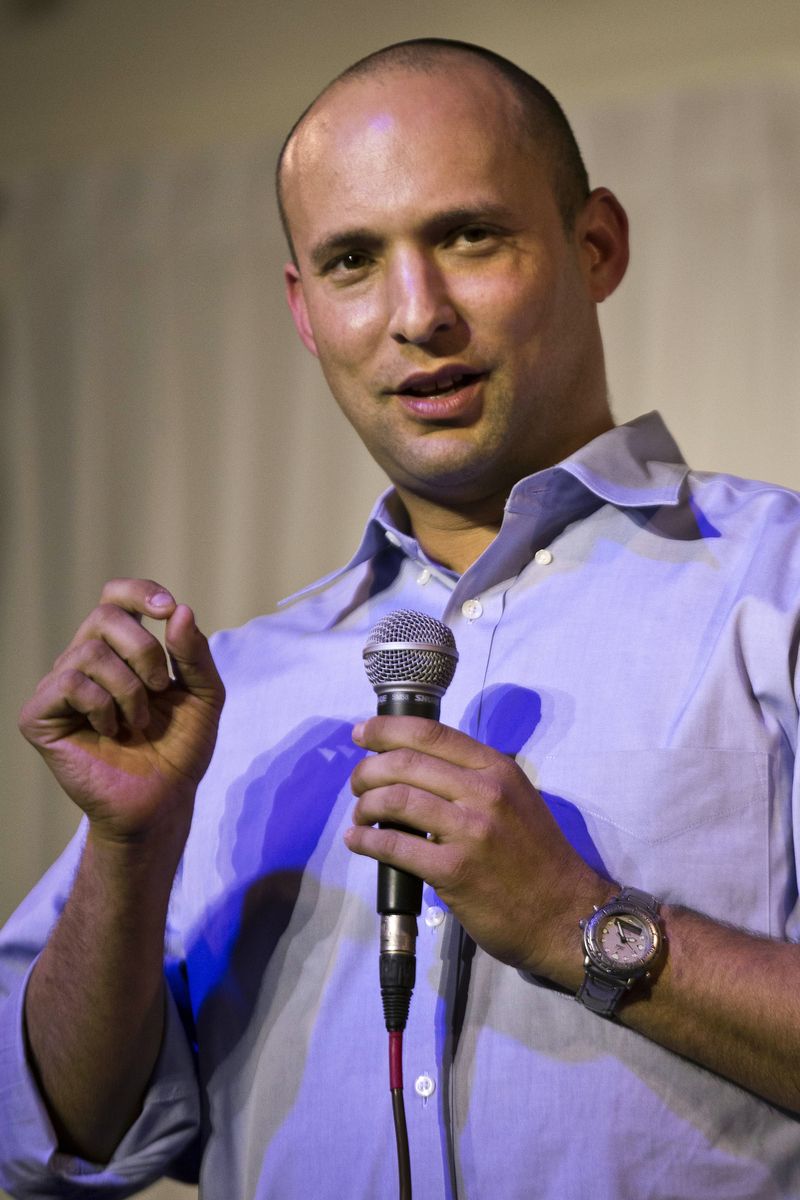
(Photo: Naftali Bennett, leader of the HaBayit HaYehudi (Jewish Home), delivers a speech during a meeting at the Tel Aviv International Salon on December 23, 2012. A former high-tech entrepreneur, the 40-year-old is a former protege of Prime Minister Benjamin Netanyahu and is expected to lead his party to one of their best results ever in the upcoming election. By Jack Guez/AFP/Getty Images.)

What Exactly Was The Government’s Role In ZD30?

A reader parses Jessica Chastain’s Daily Show comments on Zero Dark Thirty:

I actually know something about this topic both from years of covering the movie industry and from having done science and technical research for a studio movie that involved global terrorism and classified technology. I think you’re confusing two different ways the government cooperates with Hollywood.

In the Daily Show interview, Chastain says Bigelow and Boal decided “not to work in cooperation with the government.” She misspoke; she should have said that they decided not to work hand in hand with the Defense Department, which has a very active program of cooperation with Hollywood. Jerry Bruckheimer has used it many times. So did Michael Bay on Transformers. She is correct that under this program the DoD will provide helicopters and other authentic military hardware and locations. (I don’t know what financial arrangements they make with the production to cover costs.) However, they want to see the script first and will only provide that access to approved scripts.

Chastain implies they decided not to even try going that route. That was probably a wise decision. They probably wouldn’t have received that approval, and why fight that fight anyway? The lack of DoD cooperation probably cost them next to nothing. There are relatively few military locations or pieces of military gear in the movie. The big exception is the stealth helicopters used in the raid, and I think it’s safe to assume there was no way they were going to get access to them anyway, so those would have been created by the production one way or another.

That is not the same as Bigelow and Boal working closely with sources within the defense and intelligence community to research and write the script. I spoke to official DoD and CIA sources in doing my own research for that terrorism project. That was not contingent upon any script approval – and couldn’t have been, since the script wasn’t written yet. Good movie researchers, like good journalists, don’t rely entirely on those official sources, and after The Hurt Locker we can be sure Bigelow and Boal have a ton of contacts within the military and veterans who could help them contact sources such as current and former SEALs.

So I believe Chastain when she says the Zero Dark Thirty people didn’t work with the government go get military hardware and access, but that’s a separate issue from their having relied on government sources in writing the script.

Oh Dear

The GOP keeps tripping over itself:

Reporters quickly noted that a session for lawmakers called “Discussion on Successful Communication with Minorities and Women” will actually take place in the “Burwell Plantation” room at the resort where the retreat is being held. It turns out, according to NBC News, the room “is named after the Burwell Family, a wealthy family that owned many slaves in 18th century Southern Virginia.”

MSM SUPER FAIL, Ctd

A reader tries to wrap his head around this story:

Why is it that there is so little speculation that Manti Te’o may be in the closet? This seems like the perfect cover-up story. Te’o is Mormon, so obviously being gay is against his religion. Notre Dame is defending his story of being a victim of a hoax, but is it a surprise that the Catholic institution would want to keep his sexuality under cover?

It’s the perfect cover story (if it wasn’t completely fake). I mean … if the woman he loves died tragically, he has a long-term excuse for not being involved with any other women for years. It seems to me that many people close to him are complicit in advancing the story, to the point that it seemed much of his family had met “her” and were in communication with “her”. The Deadspin story links all of the various Twitter accounts, photos of “Lennay”, and much of the basis of the whole story to Te’o, his family, and friends or other acquaintances. He claimed to have met her (after a game at Stanford, visited her in Hawaii), but now says it was purely an online relationship? It all makes very little sense as described in most news stories I’ve read or watched so far.

To me, the only explanation for this seems to be that he is in the closet, and his friends and family went a bit overboard in perpetuating a cover-up story. Why is there no speculation about this possibility in the many news stories airing on every news and sports channel?

Another:

If it were true, the poor kid may be forced out of the closet. But he will also likely be drafted highly, and he could open the floodgates to all the major American male sports finally starting to accept openly gay players.

Update from another speculative reader:

I’ve been obsessed with the Manti Te’o story since it broke on Deadspin in a way that news stories don’t usually grab me. It’s a combination of being drawn to stories in which the truth turns out to be far more complicated than a simplistic story, a delight when hoaxes are unmasked, and a strong dislike of the human interest stories that seem to make up so much of popular sports coverage. So I’ve been reading everything I can about this story, and I have my own theory:

I don’t think Manti Te’o is gay. I think he greatly embellished his telling of his supposed relationship, but I think it’s completely consistent for a devout Mormon to be completely earnest, amazingly naive, and generally out of touch with the way in which normal relationships, gay or straight, usually proceed. But the general story of him being deceived, I think, is true.

If Te’o’a account is true, there is a hoaxer who was spending an enormous amount of time online and on the phone with him. Both the Deadspin article, and further reporting from TMZ.com make it clear that Ronaiah Tuiasosopo was involved in the hoax and probably the instigator. On a Utah sports talk radio show, Te’o’s uncle claimed that Ronaiah was trying to get close to Te’o in order to make money, using a fake leukemia foundation as cover.

Tuiasosopo comes from a big football family, and although he played high school football, his career never went beyond that. At present, he is a self-described actor, singer, dancer, and musician. He auditioned for The Voice, also telling a sob story involving a car accident.

I think Rohaiah Tuiasosopo is gay, and was living out his fantasy of a romantic relationship with a star football player through the online persona of Lennay Kekua. Te’o wasn’t the first football player that the Lennay Kekua persona interacted with. And other than a potential moneymaking scheme – and the elaborate detail of the hoax seems awfully inefficient if money was the only incentive -this is the only reason I can think of why a hoaxer would invest as much time as was reportedly spent courting Te’o.

The Cyclist You Didn’t Hear About This Week

Simon Hattenstone applauds the career of gold medalist Nicole Cooke, who retired from cycling this week at the age of 29:

[Cooke] has always said it as she has seen it, and never more so than in her retirement speech, in which she pulled what was left of the rug out from under her beloved sport. Slowly and methodically, she exposed every aspect of corruption in professional cycling, from doping to gross gender inequality. It took 20 minutes to deliver, and was greeted by journalists with stunned silence, then sustained applause. …

On her first Tour de France, she shared a house with other cyclists. When she opened the fridge she discovered it was full of medicines, which she promptly chucked out. Were the other women annoyed with her? She laughs, and says no they just pretended to be appalled and said they knew nothing about them. “A couple of weeks later, my team stopped paying the wages for me and my team mate, who had also said no. We were the only two riders who didn’t get our wages for the rest of the year.”

Her thoughts on Lance Armstrong:

He’s a criminal. He has stolen people’s livelihoods. There must be thousands of clean athletes scrabbling around on the bottom end of the employment structure because that’s all that’s possible, and he’s taken away their career… Of course, Lance Armstrong should go to jail. At the moment his punishment is not in line with the crimes he has committed. For the sport to genuinely clean itself up, the punishment has to be severe so not one would even think of doping.

Jane Martinson argues that Cooke deserves another medal “for turning the spotlight on the injustice and inequality” in cycling:

Like nearly all women’s sports in the UK, cycling suffers from a chicken-and-egg situation: a relative lack of prestige results in a lack of media coverage, sponsorship or support. The Commission on the Future of Women’s sport revealed that 0.5% of sponsorship in this country went to elite women’s sports in an 18-month period of 2010-11 compared with 61% for men.

But what Cooke has done is provide inside knowledge of how these overall figures hide deeper injustices in the way women are treated. Among the shocking things she discusses is that the sport’s governing body, the UCI Road Commission, has stated that a minimum wage is required for all male professionals, but not women. How on earth are they allowed to get away with such blatant discrimination?

By the way, a reader “boiled down the Armstrong interview” so you don’t have to watch it:

I did wrong.

But it was quite awhile ago.

And it’s not as much wrong as people think.

And I stopped on this particular date:  please note date in connection with the statute of limitations for perjury since even though I can afford to pay buckets of money as a consequence of civil suits, I’m far too pretty to go to prison.

And anyway, I wasn’t in charge.

And I have no excuse.  Except that I kinda do.  Did you know I had cancer and have only one ball?

And I’m truly, truly sorry.

Anyway, can’t we all just move on now?  Glad I got this off my chest.

Thank you for giving me this opportunity, Oprah.