Making Everyone A Criminal

Balko spells out how and why our justice system gives prosecutors so much power. He argues that we are increasingly “a nation ruled not by laws, but by politics”:

We need to move away from the idea that every act we find immoral, repugnant, or unsavory needs to be criminalized. Every new criminal law gives prosecutors more power. Once we have so many laws that it’s likely we’re all breaking at least one of them, the prosecutor’s job is no longer about enforcing the laws, but about choosing which laws to enforce. It’s then a short slide to the next step: Choosing what people need to be made into criminals, then simply picking the laws necessary to make that happen.

The Origin Of The Piggy Bank, Ctd

piggy bank

A reader writes:

As far as I can tell, there’s no evidence for the story that the piggy bank is named after a kind of clay called “pygg.” I’ve checked various dictionaries (including asking Merriam-Webster’s etymology editor) and looked into the origin of the “pygg” story, and as far as I can tell, the whole “pygg” thing is folklore (although extremely widely believed). Here’s a detailed writeup of my research so far.

Another writes:

I researched this subject recently for a post on my History Blog, and Megan Cohen’s summary of the origins of the piggy bank leaves out a key piece of the story. In so doing she inaccurately implies that the concept of a pig-shaped container for household moneys was a coincidence of English nomenclature that traveled across the world to 15th century Indonesia.

The “natural evolution of the English language” that transformed the pygg jar to the piggy bank was the Great Vowel Shift.

Between the 15th and 18th centuries, English long vowels gradually began to be formed higher in the mouth, changing the sound markedly. (This website has a nifty Java applet that allows you to hear the shift.) In 1400, “pygg” would have sounded like “pug.” It wasn’t until the Great Vowel Shift did its magic that it changed to “pig” and thus became a homonym of the animal. By 1700, then, even though pygg clay was no longer in widespread use, the term “pygg” had stuck and since it now sounded like “pig,” it gave craftsmen the undeniably adorable idea of turning out coin banks shaped like the animal.

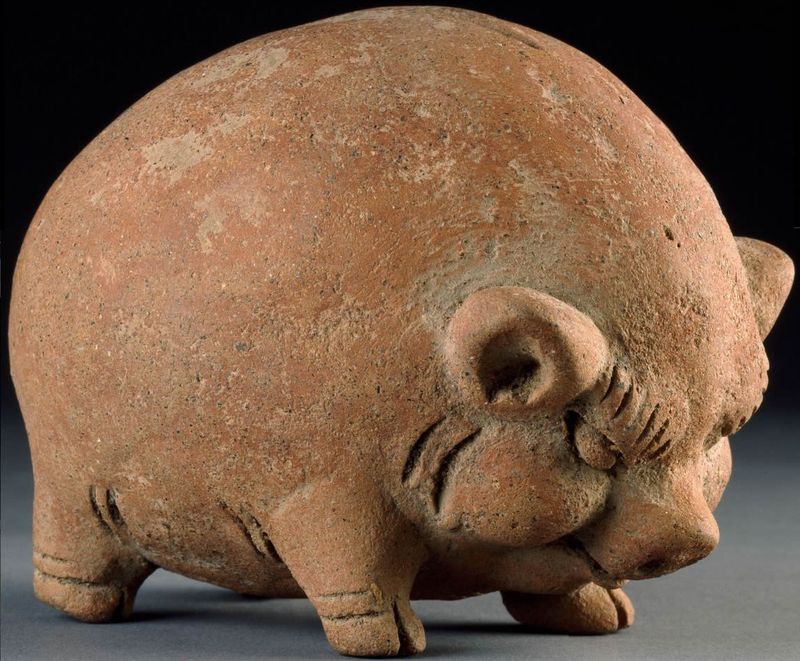
The piggy banks produced in the Majapahit Empire of Java obviously had nothing to do with the Great Vowel Shift of the English language. Majapahit piggy banks began to be made in the 14th century, when pygg jars in England were still pronounced “pug jars” and were just generic cheap vessels for home use with zero connection to the porcine world. Under the Majapahit Empire, increasingly widespread wealth and a massive importation of bronze coins from China led to a new money economy in which even the common people had cash on hand. Cash necessitates a place to put it, which gave rise to artisans creating closed terracotta containers with slots into which coins could be dropped. The celeng, a wild boar native to Java, was the favored shape because their endless appetites, rotund bellies and love of mud made them a symbol of good luck and prosperity connected to the spirits of the earth. How apposite to shape clay into a creature which wallows in mud and then to fill its well-fed round tummy with literal prosperity.

The concept of a pig-shaped home savings bank didn’t “[go] global early,” as Cohen put it. The Javanese got the idea from their own cultural imagery, and then centuries later the English got the idea from a fluke of their language. Even more centuries later, the Ashmolean bought the cutest Majapahit piggy bank ever.

Seen above.

A Genetic Flip Of The Coin

After her brother died of Huntington’s disease, Mona Gable confronted the fact that she might also have the disease:

One night I sat down at my computer and did a Google search. Huntington’s is all about the numbers; I learned I had a 50 percent chance of getting the disease. There is no cure. Then I saw the unthinkable: not only might I carry the lethal HD gene, but my children might too. … My choice was excruciating: Should I get tested? The disease can’t be treated, so what good would it do? But what about my children? At 18 and 20, they certainly had the right to know if they were confronting a fatal illness.

Fishy Studies

fishy_studies

Early studies suggested that fish oil has major health benefits, but later research found little effect. Keith Humphreys explains how this happens:

For a small study (such as Sacks’ and Leng’s early work in the top two rows of the table) to get published, it needs to show a big effect — no one is interested in a small study that found nothing. It is likely that many other small studies of fish oil pills were conducted at the same time of Sacks’ and Leng’s, found no benefit and were therefore not published. But by the play of chance, it was only a matter of time before a small study found what looked like a big enough effect to warrant publication in a journal editor’s eyes.

At that point in the scientific discovery process, people start to believe the finding, and null effects thus become publishable because they overturn “what we know”. And the new studies are larger, because now the area seems promising and big research grants become attainable for researchers. Much of the time, these larger and hence more reliable studies cut the “miracle cure” down to size.

(Chart from the JAMA modified by Drum)

The Next Public Health Crisis?

Nilofer Merchant thinks sitting is the new smoking:

As we work, we sit more than we do anything else. We’re averaging 9.3 hours a day, compared to 7.7 hours of sleeping Sitting is so prevalent and so pervasive that we don’t even question how much we’re doing it. And, everyone else is doing it also, so it doesn’t even occur to us that it’s not okay.

She’s made a small change to her daily routine to fight back:

I switched one meeting from a coffee meeting to a walking-meeting. I liked it so much it became a regular addition to my calendar; I now average four such meetings, and 20 to 30 miles each week. Today it’s life-changing, but it happened almost by accident.

The Daily Wrap

Dad's Flight Crew

Today on the Dish, Andrew tried to make sense of last night’s Daily Show segment on Zero Dark Thirtyexpressed his disgust with the double standards of the DOJ, and called out the MSM for not quizzing McChrystal on his alleged involvement in torture. Andrew kept pushing Dreher on the normalization of pot and stood by Goldblog as he faced slander from left and right. He also answered more reader emails about Jodie Foster’s speech, assured heterosexual readers that they understand more about gay love than they know, and nodded in approval at a sexy gallery of beards.

In political coverage, we gathered a stack of reader emails about the NRA’s latest ad and rounded up reax on Obama’s ideas for sensible gun reform. We then charted the recent rightward drift of the GOP, traced the decline of cap-and-trade, and looked ahead at the future of the abortion debate. Douthat issued a word of wisdom to both Democrats and Republicans comfortable with the ongoing brinkmanship, offered a two-part reality check on both Obama’s favorables and party alignment since the election, assessed the current gains and losses for labor in a world of runaway technology, and cringed at a WSJ cartoon feeling sorry for wealthy people paying a little bit more in taxes.

We also surveyed a horrifying week’s worth of grinding violence in Syria, poked a hole in the logic behind persecuting Bradley Manning, and Jonnie Freedland expertly analyzed the disconnect between American and European understanding of anti-Semitism.

In assorted coverage, we wondered how the media botched the Manti Te’o story and tried to size up Te’o’s own role in the mess. James Wolcott suited up with digital trackers during exercise, Alex Klein chronicled Scientology’s latest shameful scheme, and readers voiced strong thoughts regarding Jon Brodkin’s piece on the future of broadband. We aired the dispute over Amazon’s trickle-down partnerships, discovered a non-boozy use for the breathalyzer, and spotted heavy fracking activity from space. Later we fleshed out a reader’s story about his war hero father, got lost in a purple trance during the MHB, and spent a crisp moment in Burlington, Vermont for today’s VFYW. Finally, we continued our direct discussion with readers about the future pay-meter of the new Dish, which you can still become a part of here.

– B.J.

(Photo of Carmen Grasso’s Flight Crew V2. He’s on the far left, back row.)

“Kuwait On The Prairie”

drilling

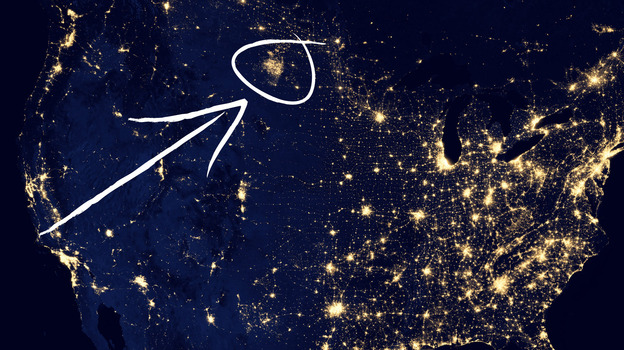
Robert Krulwich points out a new patch of light in the satellite photo seen above:

What we have here is an immense and startlingly new oil and gas field — nighttime evidence of an oil boom created by a technology called fracking. Those lights are rigs, hundreds of them, lit at night, or fiery flares of natural gas. … Altogether, they are now producing 660,000 barrels a day, double the output two years ago, so that in no time at all, North Dakota is now the second largest oil producing state in America. Only Texas produces more, and those lights are a sign that this region is now on fire … to a disturbing degree — literally.

Recent Dish on fracking here.

(Photo: NASA, with illustration by NPR)

MSM SUPER FAIL, Ctd

https://twitter.com/MattZeitlin/statuses/291910927882809344

Perhaps the most amazing part of the Manti Te’o story is the extent to which it went unchallenged for so long. Timothy Burke and Jack Dickey, who broke the story,point out the discrepancies that failed to raise red flags. Spencer Hall compiles a “short list of those who never checked to see if she actually existed.” Hampton Stevens summarizes:

Incredible, isn’t it? Not one of the highly-paid, well-respected journalists at SI or ESPN even bothered to check the most basic facts of their stories. Charlie Rose and CBS, with all that staff, with all that preaching about “original reporting,” yet nobody at the whole network even so much as bothered to pick up a phone to find out if the girl actually existed.

Reeves Wiedeman zooms out:

The reporters who traced Te’o’s story saw what they wanted to see and had little incentive to question it. In fairness to them, it was nearly impossible to imagine such a thing being made up. Regardless of how much he knew about his imaginary girlfriend, Te’o and his family repeatedly offered new layers of the story when talking with reporters. (He now says their relationship was only online and over the phone, though earlier there had been descriptions of in-person meeting.) It was a human-interest story of the kind that most major sports media outlets specialize in. There are ESPN’s endless segments with athletes doing good works. There was every story ever written about the greatness and infallibility of Joe Paterno. Creating figures whose aura expands beyond the field offers import to games that line up one after the other, the next not all that different from the last. Te’o’s story was fresh literary material for the reporters who covered him. If only they had taken the time to find out how eventful the real story was.

And Travis Waldron reflects on the implications for sports journalism more broadly:

Sports journalists — and I am not painting myself as an exception, since though I never wrote about Te’o, I can’t say definitively I would have verified every detail of his story had I chosen to — too often forget that we too are gatekeepers, that amid the games, the drama, and the hoopla, we too have an obligation to the truth not just on the field but off it as well. We too often forget that our heroes are still human and turn them instead into flawless role models worthy of admiration not just for their inhuman feats but for their stories, the odds they have overcome and the lives they lead. When our heroes fail as humans always do, when the heroic stories turn out to be lies, it becomes a mad scramble to demolish the images we helped build. The athletes failed you, we tell the world, excusing no one but ourselves.