Should Every Book Link To Amazon?

Over the weekend, Hairpin editors Nicole Cliffe and Edith Zimmerman debated the merits of the Amazon Affiliate program, where sites get a cut of the money spent at Amazon when a reader follows a link from their site. The Hairpin makes “between $140 (most recently) and $1,100 (May 2012) a month, but it usually hovers around $300.” Zimmerman defends the practice:

Although if authors get the same amount of money regardless, I prefer linking to a place that saves the reader money. Honestly — and maybe this is the potentially shadiest part? — we get most of our Amazon Affiliates money from stuff that people buy after they click past the link to the book. Because they don’t always buy the books — they’re searching for, finding, buying tights, computers, random DVDs, etc. — but as long as they got to Amazon from the Hairpin’s link, we get 7% (or so — it varies) of whatever they buy.

Dustin Kurtz joins the the discussion:

[The Hairpin] asked the reasonable question: why should we stop linking to Amazon when it is this lucrative for us? I would like very much to answer that question at extreme and shouty length. But the joy of The Hairpin is that it was answered, in the comments, by some fairly knowledgeable folks. Their answers weren’t always as strident as mine would have been, but they were enough. One even linked to our site calling us, accurately, “avowed Amazon haters.” They pointed Zimmerman and Cliffe to the Powell’s and Indiebound affiliate program, for instance, which in many ways are a better deal for vendors than Amazon’s, and a world better for independent publishers and booksellers.
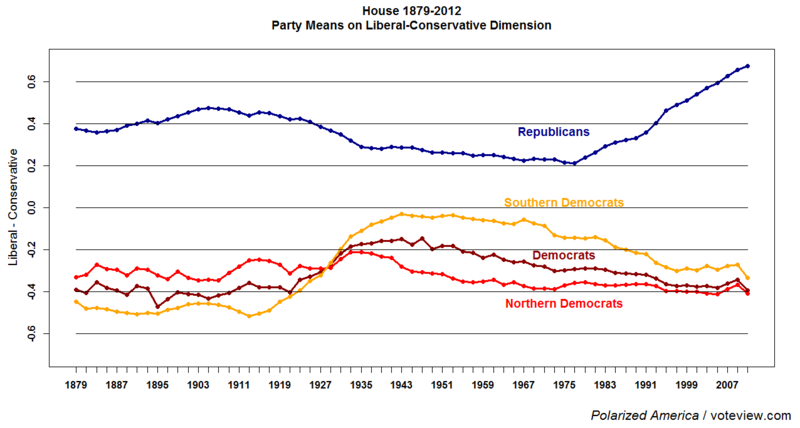
Chart Of The Day

Republican_House

Vote View tracks the Republican lurch to the right:

We have previously written about asymmetric polarization, arguing that the primary driver of contemporary partisan polarization has been the steady movement of congressional Republicans to the right. This trend appears to have continued through the 112th congress. House Republicans – despite a large majority earned in the 2010 midterm elections – have continued their rightward drift, adding more conservative members than moderate members. Senate Republicans also became a more conservative group in the 112th Congress, while Senate Democrats remained mostly ideologically static.

Broadband For All? Ctd

Readers take issue with the claim that “the only time latency becomes an issue is for a gamer.” A professor of computer networking who “co-authored one of the standards used in voice over Internet communications” writes:

The article you quoted by Jon Brodkin on satellite broadband is flat out wrong. It is not only gamers who suffer from half-second latency. 150 milliseconds is the maximum delay that you want for voice over Internet. Anything over that is definitely noticeable and anything over 400 milliseconds is flat-out unacceptable. With half-second delays, meaning 500 milliseconds, each speaker has to wait to be sure the other has heard, people talk over each other, it is a mess. There really is no debate on this in the scientific or telecommunications communities.

Another cites issues with latency and virtual private networks (VPNs):

Another gotcha on the latency issues affects telecommuters and other remote workers seeking to use a corporate VPN. Many corporate VPNs can’t tolerate the latency, so folks (like me) who work from (our) rural homes can’t use satellite services to connect to our offices.

Another gets pissed:

While I imagine most Dishheads would click through and give the Ars Technica article you linked to a close read, and would have thus seen some of the caveats raised in both the article itself and in the top comments on it, looking to satellite Internet as a panacea for our sluggish broadband penetration rate — as your post seemed to me to do, intentionally or not — is folly. The forums and user reviews at DSLReports for satellite ISPs are rife with complaints about punitive data caps and/or metering schemes, terrible customer service, outrageous pricing, and unreliable connectivity. See here for ViaSat, mentioned in the Ars post; here for HughesNet; and here for WildBlue.

I could rant on and on about the myriad disgraces of our nation’s telecommunications service providers, but I’m channeling my frustrations toward them into finding a job where I can help, in some way, to bring affordable, fast, uncapped broadband to everyone in the country. (As a recent college graduate [and “digital native”] living at home with a 1.5Mbps up/768Kbps DSL connection, you could say I’m triply motivated to find such a career.) It’s about time more of us started getting pissed off about our dismal standing in global broadband penetration and speed rankings – and letting our legislators know it.

In A Seeing World

Ayun Halliday spotlights a charming short film on master coffee roaster Gerry Leary, who happens to be blind:

On a related note, Joel Rice recently interviewed blind skateboarder Thomas “Tommy” Carroll:

The area I focus on is muscle memory. I’m always listening to the sound of my wheels—what surfaces they’re reflecting off of—because that helps me determine whether I am going off course or not. Like, this ramp puts you this way and puts you at this angle. Hearing I use as a reference. I can say, okay, I have this much room to 50-50.

Additionally, in this video, blind film critic Tommy Edison explains how he uses Instagram. You can follow him here.

The NRA’s Attack Ad Backfires, Ctd

A reader writes:

I am a graduate of Sidwell Friends, in the same class as Chelsea Clinton (1997), so I know what I’m talking about on the issue of Presidential protection on campus. To respond to your misinformed readers, a few points:

St. Albans and Sidwell have never had armed guards on campus. At Sidwell, this claim is particularly noxious, as it is a Quaker school. There was a great deal of uproar within the Sidwell community as to how to address the security needs of the President and his daughter against the school’s core value of nonviolence. An accommodation was made, but for the most part, Agents did not accompany Chelsea to classes, and were not visible on campus. A detail sat in an SUV in the parking lot, another monitored what happened in the building in an office with CCTV. While I am sure they were armed, it was not obvious, so the claim of “armed guards” is ridiculous.

Indeed, the greatest controversy arose in preparations for the final meeting for worship for graduating seniors and their families. President Clinton was in attendance, but the Secret Service agreed to keep all weapons outside the room in which the meeting was held.

Sidwell’s own “Special Police Officers” are simply security guards that you’d find at any school. They are not armed with guns, nor do they have access to guns (whether this is because of DC’s restrictive gun laws, the school’s Quaker values or a recognition that arming people increases the likelihood of negative outcomes, I’m unsure). There are eleven of them because they operate 24 hours a day, seven days a week. I’d expect that no more than four including supervisors would be on duty at any given time, and that’s to protect a campus of 5th through 12th graders, approximately 800 students.

This issue is so fraught with emotion, even moreso now that the NRA has brought the President’s young girls into the discussion. So please, please verify the claims of your readers when they’re adding fuel to the fire with claims that Sidwell runs a special ops unit.

Did Assad Use Chemical Weapons?

A video claiming to show a chemical weapons victim:

Raffi Khatchadourian pieces together conflicting information on the attack:

[W]as the gas used in Homs akin to sarin? No and yes, it seems. Sarin is odorless, and people in Homs reported smelling the chemical. Sarin is hyper-potent, and some people apparently inhaled a lot of this gas without dying. If these details are correct, then the compound surely differs from sarin in significant ways. And yet, there are similar chemicals out there that cause the same symptoms but are not nearly as potent and do have an odor. They are orgaonphosphate pesticides, which happen to be among the most common pesticides in the world and are also cholinesterase inhibitors. They can cause symptoms identical to their military counterparts, including death, and are treatable with atropine. If the chemical used in Homs was a commercial pesticide, then it appears that someone has manufactured a crude, poor-man’s chemical weapon out of a commonly available item.

Lead-On-Lead Crime?

Kevin Drum connects lead exposure to crime rate racial discrepancies:

Both gasoline lead and lead paint were most prevalent in the postwar era in the inner core of big cities, the former because that’s where cars were densest and the latter because slumlords had little incentive to clean up old buildings. Because African-Americans were disproportionately represented in inner-city populations during the high-lead era, they were disproportionately exposed to lead as children. The result was higher rates of violent crime when black kids grew up in the 70s and 80s.

More of the Drum-lead thread here.

The Age Of Big Data Is Here

A recent study [pdf] used automated content analysis to assess gender bias in the news media. Trevor Butterworth makes the case that the rise of “Big Data” will precipitate the decline of the anecdote:

[Before], you might have had pundits setting the air on fire with a mixture of anecdote and data; or a thoughtful article in The Atlantic or The Economist or Slate, reflecting a mixture of anecdote, academic observation and maybe a survey or two; or, if you were lucky, a content analysis of the media which looked for gender bias in several hundred or even several thousand news stories, and took a lot of time, effort, and money to undertake, and which—providing its methodology is good and its sample representative—might be able to give us a best possible answer within the bounds of human effort and timeliness.

The Bristol-Cardiff team, on the other hand, looked at 2,490,429 stories from 498 English language publications over 10 months in 2010. Not literally looked at—that would have taken them, cumulatively, 9.47 years… instead, after ten months assembling the database, answering this question took about two hours. And yes, the media is testosterone fueled, with men dominating as subjects and sources in practically every topic analyzed from sports to science, politics to even reports about the weather. The closest women get to an equal narrative footing with men is—surprise—fashion.

Speaking of gender bias in the media, Tessa Simonds surveys the male-dominated landscape:

White men own most broadcast TV and radio outlets. The FCC’s own data show that women own less than 7 percent of all broadcast licenses. And people of color own just 7 percent of radio stations and just 3 percent of TV stations. To make matters worse, the percentage of minorities in newsrooms has declined every year since 2006… Men wrote 72.1 percent of the print articles in major publications during the time of the study. Men were seven times more likely to be quoted in major newspapers and TV news programs. (Yes, even for stories on “women’s issues” like abortion, birth control, Planned Parenthood and women’s rights. No, really.) And as my colleague Amy Kroin pointed out, this trend held true for both conservative and liberal media outlets.

(Video: An analytics company breaks down the coming data deluge)

The South Won’t Rise Again? Ctd

Packer thinks Dixie’s political power is in decline. Bouie isn’t so sure:

Yes, whites in the South are implacably opposed to Democrats, and President Obama in particular. The lack of exit polls for November’s election makes deeper analysis more difficult, but judging from pre-election public opinion polls—particularly those right before the election‚ Obama’s support among white southerners was close to twenty points lower than his support among whites as a whole.

Even still, if the coastal South remains on its current path, it will—at the very least—become a contested political space in national elections. And it’s hard to imagine that this won’t spill over into the actual culture of the South, which is often more fluid and open than it seems from the outside.