How Hyperlocal Was Overhyped

Tim De Chant urges newspapers "to concentrate on a particular topic instead of a geographic region":

I was flipping through the Houston Chronicle when I noticed the paper had branded their energy coverage, FuelFix. Not the best name, but it’s a sound idea. Houston is a major hub for the oil and gas industry, and Chronicle reporters have spent years, even decades reporting on it. Who else would be so positioned to cover the industry?

The Chronicle isn’t the first paper to experiment with trade-specific coverage. The New York Times has done the same thing with financial firms and DealBook, to much success. By providing consistent, nearly obsessive coverage of an industry, both papers attract new readers and new advertisers interested in reaching a targeted audience.

Relatedly, after three years editing the hyperlocal news site Center Square Journal (covering neighborhoods on the north side in Chicago), Mike Fourcher reflects on the lessons learned.

The Daily Wrap

6a00d83451c45669e2017c35b77c33970b-800wi

Today on the Dish, Andrew denounced the undue viciousness of Aaron Swartz’s prosecutor at DOJ, and wondered whether academic literature could be made a public good. He applauded Matt Stone and Trey Parker breaking free of Hollywood studios and called out Jodie Foster on her narcissistic coming-out speech at the Golden Globes. He chided Dreher and Frum on their arguments to shield the poor from pot, continued to ruminate on the legacy of Richard Nixon and sang the praises of DC bear culture. Elsewhere he urged popular opposition to the GOP’s ongoing economic terrorism, which will likely earn them the scorn­ of the public.

In political coverage, we questioned whether or not guns are a safeguard against Big Brother and circled back to Drum’s original evidence connecting lead and crime. We juxtaposed two quotes in which a former member of the Knesset sighed at Israel’s swing to the right while an American senator called Israel our hands-down greatest ally. Seth Masket joked about Obama’s vulnerability on intergalactic defense, readers sounded off on Anne Lowrey’s unkind portrait of the nation’s capital, and we revisited the data about movies and violence in light of Tarantino’s recent outburst on the subject.

In assorted coverage, we compared the hazards of driving drunk to driving stoned, got a taste of the power of tea in Pakistan, and revealed the one word that will burn Brits’ grits. We remained diligent about flu vaccination, and kept up with the debate over the benefits of bare feet while running. Jane Shilling argued that power of the Internet would make Socrates glow, while Geoffrey Nunberg saw Amazon users’ book annotations as a window into their collective consciousness.

Meanwhile, we rounded up some more insightful reader reax to impending Dish independence, followed a famed photographer duo as they scouted locations via Twitter, all as the great showdown between mutant ducks and tiny horses raged on. An old MHB received an update from a talented music class, while we gazed over the red rooftops of Malacca, Malaysia in the VFYW and watched the doors of a health clinic close on the Face of the Day.

– B.J.
The Examined Life

Jane Shilling contemplates it:

The writer and philosopher Julian Baggini has argued that the Socratic maxim about the examined life is profoundly elitist. "The bulk of humankind, today and in history,” he writes, "has been far too busy struggling for survival to engage in lengthy philosophical analyses. So if an examined life is one in which more than just a little investigation takes place, by implication, huge swaths of humanity are ignorant beasts."

How that has changed:

[A]nyone with access to the internet (and that is a vast number of even the otherwise most severely impoverished members of the world’s population) can indulge in public acts of self-examination, whether blogging clandestinely from a country in the grip of a tyrannical political regime, or soliciting sympathy on Facebook for what might once have been an anxiety or grief too intimate to mention to any but the closest of friends, or tweeting updates on one’s changing frame of mind. Self-examination has become one of the most democratic of all activities.

The Most Underlined Passages

Geoffrey Nunberg considers how technology tracks them:

Think of the tens of thousands of used copies of Pride and Prejudice still in circulation with "It is a truth universally acknowledged …" highlighted or underlined and "IRONY" written in the margin, as readers affirm that they're in on the game. … The opening sentence of Pride and Prejudice comes in second place [on Amazon's list of the most highlighted passages ever], just behind one from The Hunger Games, whose selections occupy 13 of the top 15 slots. As Ann Blair has said, the annotations made by ordinary readers have always been useful windows on shared patterns of thought, and those of us anxious about the fate of literary culture can take some comfort in knowing that Austen can still claim so high a place in Amazon's collective florilegium. Still, you might wonder if it's possible to grasp the irony of her sentence without undermining one's faith in the wisdom of crowds.

When Lightning Strikes A Million Times

Kevin Kelly ruminates on YouTube's love of improbable events:

Superlatives were once rare — by definition — but now we see multiple videos of superlatives all day long, and they seem normal. Humans have always treasured drawings and photos of the weird extremes of humanity (early National Geographics), but there is an intimacy about watching these extremities on video on our phones while we wait at the dentist. They are now much realer, and they fill our heads.

His fear:

What happens if we spend all day exposed to the extremes of life, to a steady stream of the most improbable events, and try to run ordinary lives in a background hum of superlatives? What happens when the extraordinary becomes ordinary?

Running Pains, Ctd

Katherine Harmon highlights new research contradicting the conventional wisdom about "habitually barefoot runners," those who "grew up running sans footwear":

"The Daasanach people grow up without shoes and continue to spend most of their lives barefoot," Kevin Hatala, a graduate research in Hominid Paleobiology at George Washington University and co-author on the new paper, said in a prepared statement. Nevertheless, these people, it seems, land farther back on the foot when they run. "We were surprised to see that the majority of Daasanach people ran by landing on their heels first," Hatala noted. "This contradicts the hypothesis that a forefoot strike characterizes the ‘typical’ running gait of habitually barefoot people."

Not everyone is jumping on the barefoot bandwagon. After a recently diagnosed stress fracture in his foot, The Running Moron is giving up minimalist shoes:

It goes against the hype I know, but I've come to the belief there is just a certain type of foot and/or body that should not forego the protection of a well cushioned shoe and I'm wondering if my feet and/or body belongs in that group. Maybe it's our natural disposition to walk around barefoot like our caveman ancestors, but back then not only did a caveman die from simple viruses that are rendered relatively harmless now with antibiotics, but there was no way to correct any problems cavemen experienced with age. 

Previous Dish on barefoot running here, here and here.

Face Of The Day

159501174

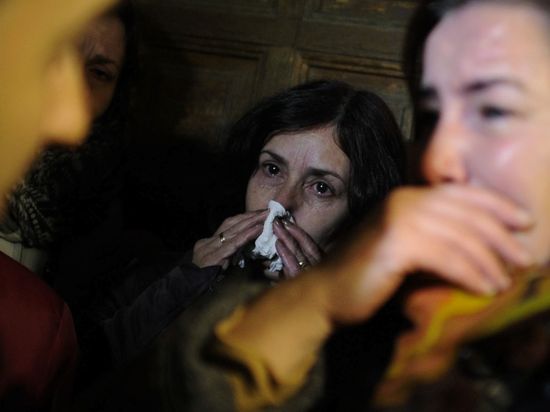
People react in front of the local healthcare centre that closed at 8pm tonight its emergency hours along with 21 other centres in the region of Castilla-La Mancha, following budget cuts and privatisations in Spanish health services, in Tembleque, near Toledo on January 14, 2013. By Pedro Armestre/AFP/Getty Images.

Can Guns Really Protect Us From Tyranny?

Joshua Keating gathers evidence that widespread gun ownership doesn't translate into successful uprisings against oppressive government:

[T]he country ranked last on the [Small Arms Survey] — with only 0.1 guns per 100 people — is Tunisia, which as you'll recall was still able to overthrow a longtime dictator in 2011. With only 3.5 guns per 100 people, the Egyptian population that overthrew Hosni Mubarak was hardly well armed either. On the other hand, Bahrain, where a popular revolution failed to unseat the country's monarchy, has 24.8 guns per 100 people, putting it in the top 20 worldwide. A relatively high rate of 10.7 guns per 100 people in Venezuela hasn't stopped the deterioration of democracy under Hugo Chávez.

Michael Moynihan recently dismantled the myth pushed by gun activists that Hitler's rise was aided by gun control laws.

The Best Way To Fight The Flu

Flu_Vaccine

Michael Specter urges everyone to get a flu shot:

Even if you think you are invincible, your elderly neighbors and infant children are not. People with weakened immune systems—those undergoing cancer treatments, for example—are not. Your parents and grandparents are not. The flu vaccine is not perfect, but it’s what we have. It’s available at drug-store chains and malls, big-box superstores and, naturally, at your doctor’s office. Get one today.

Lisa Beyer worries about shortages:

Should a severe flu push demand for vaccines higher than the planned supply, manufacturers would be unable to respond. That's because flu vaccine production — an antiquated system using chicken eggs that has remained basically unchanged since the 1940s — is a six-month long process. That's why it's best to get the vaccine as soon as it's available, in September usually, when supplies are plentiful, before flu season begins.

And Sarah Kliff explains why flu vaccination rates are relatively low:

Lori Uscher-Pines, a policy researcher at the RAND Corp., estimates that part of the issue has to do with no consequences for not getting vaccinated (well, except for coming down with the flu). Unlike childhood vaccines, which are generally required to start a school year, employers don’t stop their workers’ from coming to work if they cannot prove flu immunization.

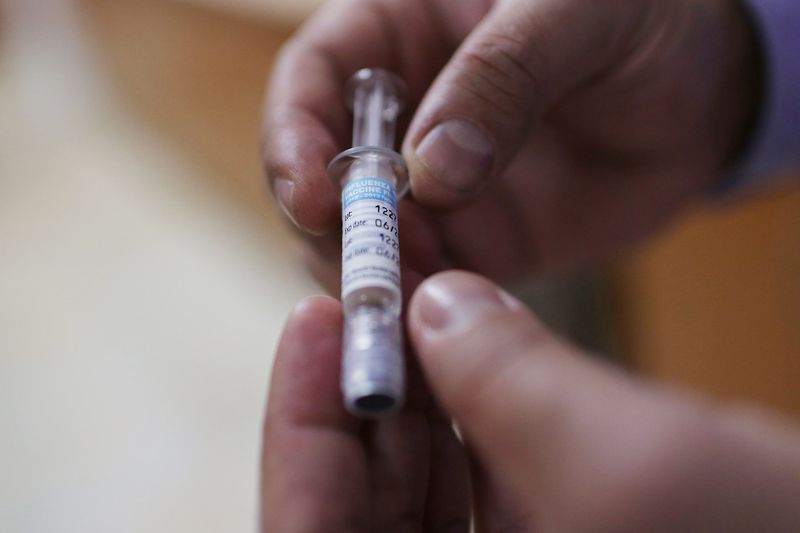
(Photo: Dr. Sassan Naderi holds a vile of flu vacination at the Premier Care walk-in health clinic which administers flu shots on January 10, 2013 in New York City. By Spencer Platt/Getty Images)

Will Voters Punish House Republicans?

Maybe:

The particular problem for House Republicans is this: when Congress is unpopular, voters don’t punish all House incumbents. Instead, they direct their dissatisfaction primarily at majority-party House incumbents. So argue political scientists David Jones and Monika McDermott in their book (see also this article). In the article, Jones finds that a 10-point decrease in approval costs majority-party House incumbents 4 points at the poll.  This effect is larger in swing districts and has been getting larger over time, as the parties have polarized.