The Question Obama Ducked, Ctd

Screen shot 2013-01-11 at 9.51.16 PM

A reader reframes the question:

Would you rather fight 100 hoarse ducks or a horse that ducks?

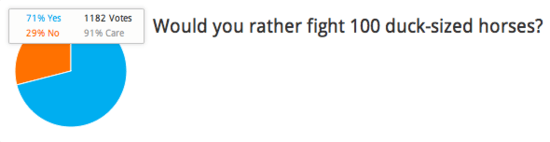
Another disagrees with 71% of readers who participated in our Urtak poll (snapshot seen above):

From a physics standpoint, pick the horse-sized duck. The square-cube law would certainly render it incapable of flight and more than likely incapable of much locomotion. There is a reason why most birds aren’t the size of horses: they quickly become too heavy to fly. A duck is already at, or very close to, its optimal size.

Horses reduced in size don’t fare much better, losing much of their strength with their reduced size. But they will still have agility, locomotion and numbers to aid them in the fight.

Another would take on the tiny horses:

As having raised/butchered ducks for a few years, I feel uniquely qualified to chime in on this one. I have a favorite story I tell my friends when they ask me about Motherduckerbutchering ducks, and the first full-sized male I attempted beat the shit out of me with its wings and claws (yes, some duck breeds have nails). It is 10x more difficult than a chicken and seems to have a strong instinct to survive when it’s time for the dinner plate. When my wife came out to check on me after being gone so long to prep the duck, she found me covered in blood, sweating, exhausted, and my clothes ripped. I fought this damn duck for 20 minutes and was only able to finally put him down with a tire iron, smashing it to death in a fit of rage. I wish I could have given it a more humane death, but I learned to never underestimate a duck’s unusual strength and will to live.

Another reader with first-hand experience agrees:

Let me just say that anyone who chooses a horse-sized duck is fooling themselves.

Fowl may seem calm and pretty, but they can be mean, nasty, and aggressive. I have much experience fighting fowl from my days doing research on Guinea Fowl, basically small chicken-like birds (long story).  Let me tell you, even the tiny Guinea Fowl were nasty fighters.  They are smart, assessing you and watching for a moment of weakness. They use their wings to burst and lunge, and fight with their beaks, feet, and wings. The Guinea Fowl had a favorite move which I can only describe as a two-foot flying dropkick with a simultaneous bite.  If you want to get an idea, take a look at this video.

A horse-sized duck simply won’t be defeated.  It will not back down.  And how do you think you can get to it?  Birds are fast and agile and as soon as you try to get to the body or head it will use its wings to keep you at bay or dodge.  They have quick and powerful necks which can make the beak a deadly weapon, and the feet and wings would be nasty secondary weapons.

On the flip side, a hundred duck-sized horses is a daunting task.  However, horses are not nearly as multi-faceted as birds, generally relying on backwards kicks or rearing that has a limit of a second or so or else they lose their balance.  They are not able to turn as quickly and even though they are good jumpers, a jumping horse is not the same as a bird with wings.  If you fought a hundred duck-sized horses you may be able to defeat them one by one as long as you are able to keep your balance and stay on your feet.  It would end up being an endurance task as long as you stay upright.  A horse-sized duck?  You would go down in a minute, is my guess.  And if you were able to dodge and weave, you will never outlast a bird’s endurance.

In fact, I would say with strong conviction that I would rather fight a hundred duck-sized horses than a hundred normal ducks.  Fowl are not to be messed with.

Another considers the spoils:

I discussed the duck/horse question with my wife, who is French, and our kids, who are half-French.  They unanimously favor fighting the horse-sized duck, pointing out that the White House staff and your commentators (so far) appear to be ignoring the all-important culinary considerations.  Fighting a horse-sized duck may be more difficult than a hundred duck-sized horses, but the rewards for success are much greater.  Yes, you can eat horsemeat, but duck is much tastier and works with a wider variety of preparations.

For best results, try to fight a horse-sized duck with an artifically enlarged liver.  (But not in California.)

Driving While Stoned, Ctd

A reader writes:

Just reading your response to Frum's scaremongering on legalized weed.  When it comes to driving while high, I completely agree that there needs to be legal enforcement in place similar to drunk driving.  I don't want anyone on the road to be inebriated in any way.  But I'm willing to bet that the threat of hordes of stoned drivers as a result of legalization is misplaced.  People drive drunk because they're out for drinks and need to get home.  The majority of those who get caught DUI likely aren't plastered.  Sometimes they probably just don't want to pay for a cab and don't want the hassle of coming back to get their car the next day or whatever, so they decide to run the gauntlet and get caught. And good, because I don't want drunk drivers on the road.  

But as we all know, booze and pot aren't the same.  When people smoke pot, they're usually doing it at home.  They're not out at bars or out at live sports or wherever.  They are, like me, sitting in their own living room or back yard, enjoying a joint, listening to some music, then watching some Breaking Bad and going to bed. They're far less likely to be in a position to make the poor choice to get behind the wheel because in many cases they're probably already home.

Frum writes as someone who has clearly never gotten high once in his life.  And it's sad that these people are driving public policy on drug use.  It's no different from old white men deciding what women get to do with their bodies.

Previous Dish on stoned driving here and here.

Remove The Hounder Of Aaron Swartz

If you are furious at the Justice Department's hounding of a brilliant young activist, and don't know quite what to do, how about signing the petition to remove the prosecutor. Money quote:

A prosecutor who does not understand proportionality and who regularly uses the threat of unjust and overreaching charges to extort plea bargains from defendants regardless of their guilt is a danger to the life and liberty of anyone who might cross her path.

Fight back here against a DOJ run amok. Update from a reader:

Be careful about this. I'm a (state) prosecutor, and it's perilous business to say who's responsible for the management of any one case.

In some, it may well be that the lead prosecutor (here, US Attorney Ortiz) directed assistants to treat Swartz as they did. Certainly she bears ultimate responsibility for her office's actions. But you can't be sure that an overzealous deputy, or even line assistant isn't the one to blame. All you can say for sure is the office messed up, and it would be disappointing to react against the wrong individual. 

Similarly, for a view at the various incentives and strings pulling at any one US Attorney, and a lesson on how easy it is to misassign "blame," consider the (true) case of "Fast & Furious," per Forbes.

Pot Paternalism

116486193

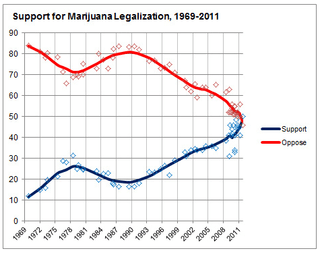
Dreher and Frum argue that poorer Americans need to be protected from legalized marijuana. Kleiman intervenes:

Legalizing marijuana would make it easier for people to smoke pot. Some of those people would benefit from having that option; others would make choices they would come to regret. On average, the more socially advantaged will make better choices, and be better positioned to recover from their bad choices, than the less socially advantaged. To that extent, legalization favors the privileged over the less-privileged. Screen shot 2013-01-14 at 12.36.41 PMBut keeping marijuana illegal creates a different sort of temptation, by expanding the range of illegal money-making options. Compared to theft, commercial sex work, or hard-drug dealing, pot-dealing is less edgy and less risky.

Some of the people who take it up (not very many, in my view) may be better off than they would have been doing legal work; others will be better off than they would have been doing alternative illegal work. But, inevitably, some people will yield to the temptation for a quick buck and wreck their lives in doing so. And like those who yield to the temptation to smoke too much pot, they’re likely to come from the bottom half of the income/status distribution, not the top half. Just how damaging your youthful pot-dealing arrest will turn out to be could depend very strongly on how good a lawyer your parents can find for you.

On balance, are poor neighborhoods made better off by maintaining cannabis prohibition? Maybe so. But opponents of legalization haven’t made that case in anything like adequate detail.

For my part, I simply cannot understand how the alleged harm of pot can possibly outweigh the harm of being labeled a felon for the rest of your life, denied job opportunities, stigmatized and marginalized from mainstream society forever because of a mistake made early in your teens. And what exactly is the harm in marijuana? It can harm the development of the young brain – which is why I favor legalization because it enables us better to keep it away from kids. If you smoke it, it can be bad for your lungs – but pales in comparison with tobacco, which is usually smoked far more often than a joint. But vaporizers – which convert the THC into vapor – can largely mitigate any lung damage.

So a question to my friends Rod and David: why not make far more dangerous cigarettes illegal? They're more addictive and more harmful. Their response to the double standards charge is to accept it, but to argue that legalizing any more substances that might provide pleasure and relief is ipso facto a bad thing. This is simple Puritan paternalism. And like marriage equality, with each generation, it is collapsing under the weight of its own illogic.

(Photo: Getty. Chart: Nate Silver.)

Drum, Lead And Crime, Ctd

Drum defends his thesis, that lead exposure is a major cause of crime, against Manzi’s criticisms:

Far from being an exotic, hard-to-believe explanation for the rise and fall of violent crime, the truth is that lead is actually an explanation that makes perfect sense. After all, we have multiple prospective studies that associate lead with arrest rates for violent crime in individuals. We have MRI studies showing that lead affects the brain in ways likely to increase aggression levels. We have copious historical evidence of the effect of high doses of lead on workers: for years people said it made them “dumb and mean.” We have medical studies showing that prisoners convicted of violent crimes have higher lead levels in their teeth than similar populations. We have studies linking lead exposure to juvenile delinquency. Dose-response effects litter the literature. And much, much more.

In retrospect, if I were writing my article over again I’d begin with this evidence. I chose to begin with the population studies mainly for narrative purposes, but I think that was a mistake because it led a fair number of readers, like Manzi, to believe that the Reyes paper was the linchpin of my argument. But it’s not. It’s just one confirming piece in an ocean of evidence.

Quentin Tarantino Is Not A Slave

The director's refusal to talk about the effects of violent media consumption is making the rounds:

Frum is taken aback by Tarantino's word choice:

"Don't ask me a question like that …. I am not your slave and you are not my master." You'd think a man who'd spent the past year and a bit immersed in a movie about the antebellum South might see the difference between this one unwelcome moment in his ultra-luxury movie promotion tour and the real experience of slavery: a lifetime in bondage, exploitation, and degredation, but … no. Slavery – like the suffering of the Jews in Nazi-occupied Jews – seems interesting to Tarantino mostly as a prophylactic against those who accuse him of delighting in sadism for its own sake.

Meanwhile, Waldman finds no link between violent media consumption and violence:

[I]f exposure to violent media was a significant determinant of real-world violence, then since media culture is now global, every country would have about the same level of violence, and of course they don't. Japan would be the most violent society on earth.

Have you seen the crazy stuff the Japanese watch and play? (Two words: tentacle porn. Don't ask.) But in fact, Japan is at or near the bottom among industrialized countries in every category of violent crime, from murder to rape to robbery. There are many reasons, some of them cultural, some of them practical (like the fact that it's basically illegal for a private citizen to own a gun there), but the point is that even if all that violent media is having an effect on Japanese psyches, the effect is so small that it doesn't make much of a difference on a societal level.

Christopher Ferguson has more:

Youth violence has declined to 40-year lows during the video-game epoch, and countries that consume as much violent media as we do, such as Canada, the Netherlands, and South Korea, have much less violent crime, even if you factor out gun violence.

Academic Articles For All?

The death of Aaron Swartz, who potentially faced significant jail-time for downloading JSTOR files, has sparked debate about public access to academic research. Freddie DeBoer’s view:

Here’s the point I want to make about journal archive access: I have never talked to anyone– arts, professional schools, humanities, social sciences, or STEM– who was opposed in theory to the idea of free access. You’ve got to do something to rebuild the revenue streams of the academic journals, many of which operate at a loss already. But as a principle, giving people free access to journal articles is as close to a universal stance as I can think of among academics. Why wouldn’t it be? Researchers believe that their research has value, that it matters, and they want it to be read.

Caleb Crain is conflicted:

I come by my ambivalence about JSTOR honestly. On the one hand, I’ve written a handful of the articles in it, none of which I ever have been or ever will be paid for, and all of which I wish could circulate freely. And on the other hand, I tap the database almost every working day and find it invaluable, and I know that few worthy things happen in our society unless they can be monetized. If Aaron’s goal was to protest the commercialization of scholarship, I’m not sure he picked the best target. JSTOR is a non-profit, probably better understood as one of the damaged offspring of American higher education than as an active villain.

I would think that colleges and universities with massive endowments would be able to afford to lose some of the revenues they get from keeping their research papers sealed off from the public. If only in the general interest of liberal learning. Online courses have made lectures effectively free for milions, but the feds get to force a young and brave genius into suicide for wanting to spread scholarship around the world. The whole thing, in my view, is obscene and the more I think about it, the angrier I become and the more ashamed I am that I did not cover this case earlier.

Ending Republican Nihilism, Ctd

Ross contemplates the fallout of a GOP-induced credit crisis for the US:

Note that it’s perfectly sensible for Republicans to negotiate over how the debt ceiling is to be raised — to haggle over the extension period and the combination of Democratic and Republican votes, for instance, and to look for a small-ball deal on spending to give cover to the legislators who cast those votes. But there simply isn’t a way for the G.O.P. to win anything big here, given the correlation of political forces in Washington D.C. and the country as a whole. And the fantasy of leveraging the debt ceiling to “force” the White House to dramatically cut entitlements, if actually pursued rather than just entertained, would quickly put the Republican Party on the path to losing the more modest leverage that it currently enjoys.

Contempt Dripping From Every Sentence, Ctd

Bus-stop

A reader writes:

Annie Lowrey's ending to that DC piece dripped with just as much condescension as the beginning: 

On the final spot on our tour, Abdo took me to his newest, biggest project. We drove north on North Capitol Street, as if we were driving out of the District, to a shabby and decidedly unhip neighborhood called Brookland. It is a mostly older, mostly lower-middle-class neighborhood, underserved by grocery stores and restaurants and overlooked by many of the young professionals farther south in Bloomingdale or Shaw or Capitol Hill.

Really? Brookland may not be Bloomingdale (where Lowrey lives), but to describe it "as though we were driving out of the District" is ludicrous. You've lived here for five years and you think Catholic University is out of the District? It's less than two miles from her own neighborhood and just three from the Capitol, closer than Georgetown, Woodley Park, or Cleveland Park. And "mostly lower-middle-class" sounded off to me as well. A quick search of Census data: the neighborhood's median household income is $72k and 38 percent of the households make more than $100k. Those numbers may be low for the area but it's still a neighborhood full of great old houses that regularly sell for more than $500,000.

Another:

It was such a lazy, wrong-headed piece, I don't even know where to start.  How about the fact that her basic premise (exploding federal workforce leads to an economic boom in DC) is completely backwards: DC the city has boomed precisely while the federal workforce stagnated or fell through the '90s and 2000s (see chart here).

DC actually was collapsing in population and wealth through the previous four decades, when federal employment WAS growing tremendously. The real story of DC's revival is much more complex, but you could start with our series of pragmatic yet idealistic city leaders. Mayor Anthony Williams's crucial, far-reaching downtown redevelopment plans kicked things off, and his work was continued ably by Adrian Fenty and Vincent Gray. Many, many folks have worked their asses off to make DC a better, more livable city, which I feel privileged to have witnessed in the last several years living here. One person who has advocated tirelessly for smart growth policies, from a blog and local activist network, is Dave Alpert of Greater Greater Washington. Lowrie dismissively refers to his work as a "yuppie blog." What the fuck?

If you thought she treated Logan Circle roughly, get a load of her visit to my home, or "a shabby and decidedly unhip neighborhood called Brookland." Did Jim Abdo take her by Menomale, the best-rated pizza place in DC, opened in Brookland in 2012, making RIDICULOUSLY good Neapolitan pizzas (with excellent gluten-free options)? Or the awesome new Cuban place, Little Ricky's? Or the blocks upon blocks of beautiful, varied bungalows with lovely gardens east of 12th St. NE? If not, would it have killed Lowrie to do five minutes of basic research herself on the neighborhoods she was visiting?

Ugh. Thanks for being there to give some voice to DC's frustration at the NYC condescension.

Another:

Annie Lowrey is a pompous ass, but as a long-time DC resident I plead guilty to the charge that we're fashion victims.  One of my favorite blogs of all time is DC Style Sheikh; the writer catalogued the horrors in men's fashion around him (sadly, he stopped last year). But it's good enough for government work!

(Photo by DC Style Sheikh)