"Now, if you ask an Israeli taxi driver, he will say, 'I want peace, but there's no chance of it in this or the next generation.' That is now the opinion of 90% of the public. And when people feel there's no chance of peace, the rightwing is more creditable than the left. Today the competition is between the right wing, the extreme right wing and the fascist right wing. They have a solid majority," – former MK Uri Avnery, on Israel's descent into militarism and far-right extremism.
Year: 2013
A Millennial Martyr
Greenwald rightly seethes over the suicide of Aaron Swartz, who faced charges from federal prosecutors threatening several decades in prison and $1 million in fines – all for illegally downloading a bunch of academic files:
To say that the DOJ’s treatment of Swartz was excessive and vindictive is an extreme understatement. When I wrote about Swartz’s plight last August, I wrote that he was “being prosecuted by the DOJ with obscene over-zealousness”. Timothy Lee wrote the definitive article in 2011 explaining why, even if all the allegations in the indictment are true, the only real crime committed by Swartz was basic trespassing, for which people are punished, at most, with 30 days in jail and a $100 fine, about which Lee wrote: “That seems about right: if he’s going to serve prison time, it should be measured in days rather than years.”
My feelings entirely. The feds were almost deranged in prosecuting someone so ferociously because he dared to make more data – with no national security implications whatsoever – more accessible to more people. At some point, these federal cops need to understand that the world has passed them by. Glenn’s take on why the feds pursued Swartz so fiercely:
I believe it has more to do with what I told the New York Times’ Noam Cohen for an article he wrote on Swartz’s case. Swartz’s activism, I argued, was waged as part of one of the most vigorously contested battles – namely, the war over how the internet is used and who controls the information that flows on it – and that was his real crime in the eyes of the US government: challenging its authority and those of corporate factions to maintain a stranglehold on that information. In that above-referenced speech on SOPA, Swartz discussed the grave dangers to internet freedom and free expression and assembly posed by the government’s efforts to control the internet with expansive interpretations of copyright law and other weapons to limit access to information.
Andrea Peterson points out that “JSTOR made its peace with Swartz in June 2011 and just last week expanded its online Register & Read program, making more information available for free.” She concludes:
In death, Swartz can be a vehicle to transform the pain felt by the community into the kind of change he would have wanted. It’s unfair to diminish a life into a figurehead for an issue, and it is likely that other factors—not just the court case—contributed to Swartz’s decision to end his life. But there might be no better way to honor Aaron Swartz’s memory than continuing the dialogue about the future of freedom of access to information.
Previous coverage of the Swartz suicide, including remembrances by Lessig and Doctorow, here.
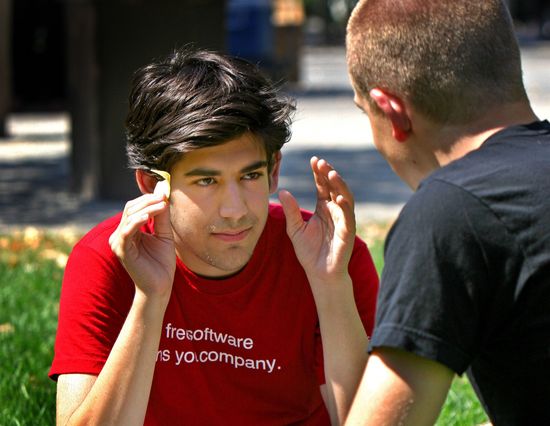
(Photo: Business partners Aaron Swartz, left, and Simon Carstensen, right, have a working lunch outside in Cambridge, Friday, August 31, 2007. By Wendy Maeda/The Boston Globe via Getty Images.)
Tea Time In Karachi
Saba Imtiaz examines Pakistan's passion for tea:
In a country polarized in every possible way – from disparities in wealth and education to differing views on politics and extremism – tea is the great social equalizer. Everyone drinks tea: government officials have an army of ‘tea boys’ at their disposal, investigators work through crime scenes with cups in hand, and journalists substitute tea for a proper meal. There are entire rituals built around it: arranged marriages, traditionally, feature prospective brides serving families cups of tea lain out on a trolley, and cops would never be so tactless as to ask for a straight-out bribe: they instead coyly ask for ‘chai paani’ (tea and water).
It's also "an increasingly pricey habit, given that a kilogram of loose tea costs Rs540 ($5.50)":
According to a 2011 government survey, 2% of Pakistani households’ average monthly expenses are tea, and another 24% is for milk products. Seven percent goes to sugar. That’s a whopping one-third of the total, but no one is pulling the plug on the kettle. Even in flood-ravaged parts of the Punjab province where thousands had lost their houses and possessions, survivors offered cups of tea to visiting reporters.
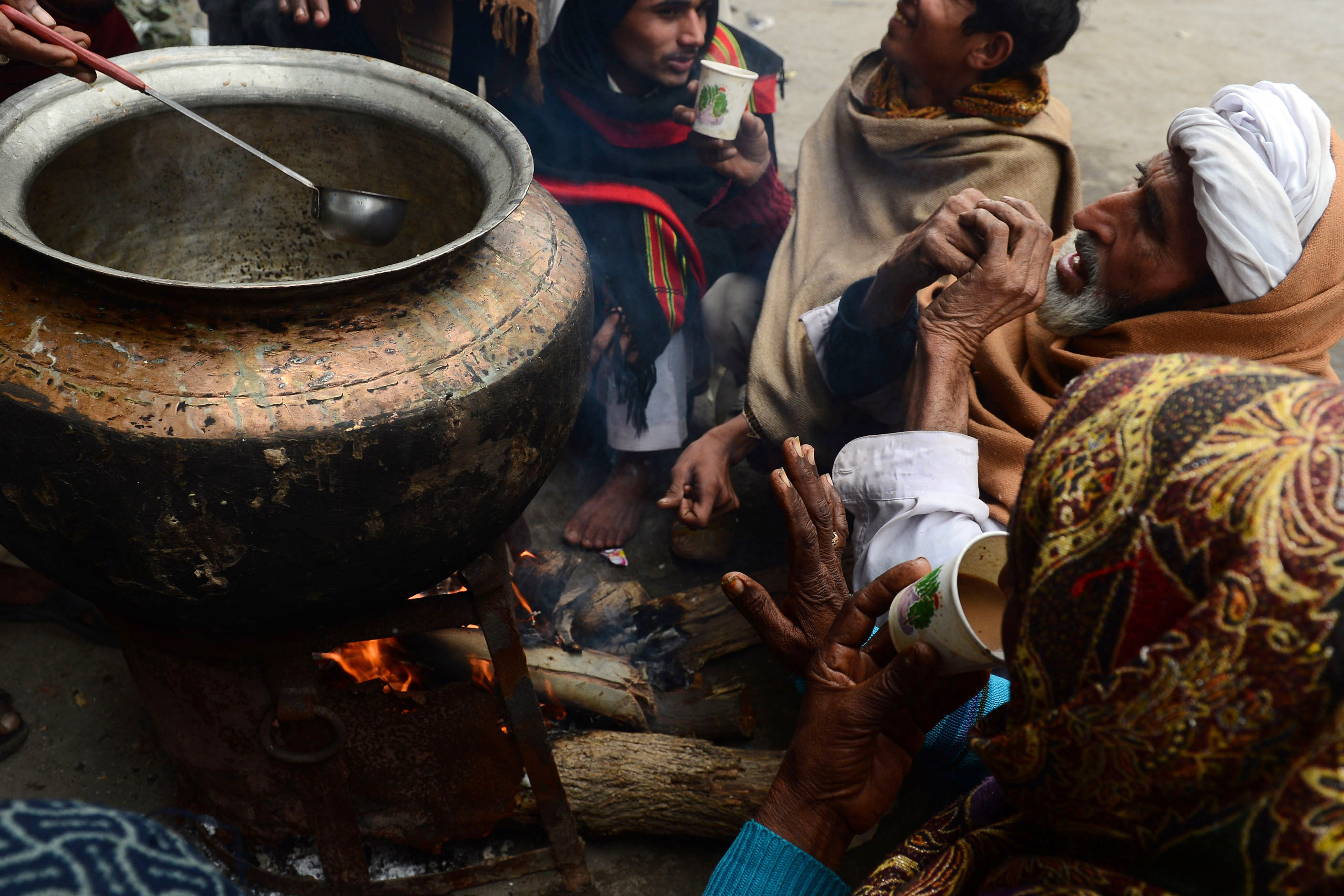
(Photo: Pakistanis drink tea at a roadside stand during a cold and foggy morning in Lahore on December 31, 2012. By Arif Ali/AFP/Getty Images. Hat tip: The Morning News)
A Picture Is Worth 140 Characters

Andy Cush highlights a fascinating project called Geolocation:
Photographers Nate Larson and Marni Shindelman use Twitter as a location scout for their haunting, beautiful images. The two artists scan the social network for tweets with location information embedded but no picture, head to those locations to shoot, then caption each photograph with the tweet’s original text. If the photographs weren’t so good, the concept might come off as gimmicky. But in the hands of Larson and Shindelman, it is anything but–their images, always free of people, capture the loneliness and dread that underscores much of our online communication.
Jakob Schiller zooms out:
Last fall, Twitter reported that the service now handles half a billion messages a day. Facebook has more than a billion active users each month and in August, Instagram reported that it had 7.3 million daily active mobile users (surpassing Twitter). Instead of being overwhelmed, Larson and Shindelman see this vast expanse as a gold mine of sorts. For them it’s an under-tapped sociological resource that they’ve been mining for years to see what it can tell us about ourselves and our habits.
The Weekend Wrap
This weekend on the Dish, Andrew castigated Piers Morgan's "dumb, disgusting desperation" and defended Washington, DC, from its condescending critics. We also provided our customary coverage of religion, books, and culture, high, low, and in-between.
In matters of faith, doubt, and philosophy, David Bryant elaborated on faith in an unknowable God, Mark Galli meditated on grace and parenting, and Casey Cep remembered the idiosyncratic Christianity of Reynolds Price. John Jeremiah Sullivan considered his secular appreciation of gospel music, Lorin Stein praised the understanding God of Psalm 139, and Justin Erik Haldór Smith ruminated on the unlikely places he finds God. Jim Shepard thought about Flannery O'Connor and epiphanies, Richard Feynman riffed on the beauty of a flower, and Daniel Baird wondered just what justice requires.
In literary and arts coverage, David Mikics uncovered how Emerson and Freud compete for Harold Bloom's soul, Greg Olear argued that Nick Carraway of The Great Gatsby was gay, and Anthony Paletta detailed Oscar Wilde's trip to America. Rebecca Lemon showed how Shakespeare deployed alcohol in his plays, James Hall traced the difficulties the artist Raphael poses for biographers, Emily Elert highlighted the experiences for which English has no word, and Marcy Campbell plumbed her book club for insight into today's literary market. Megan Garber found a novel in your outbox, Michael Thomsen was disappointed by drug writing's inability to capture the psychadelic experience, readers continued our thread on fonts, and Stephen Marche believed the art bubble might be ready to pop. Read Saturday's poem here and Sunday's here.
In assorted news and views, a Dish reader honored the activist and polymath Aaron Swartz, Joshua Coen appreciated the public beauty of Central Park, and Dave Bry earned an Yglesias nomination for his thoughts on Chief Keef's latest album. The White House dashed the hopes of Star Wars fans, Daven Hiskey let down drinkers who think booze can keep them warm, and Devendra Banhart narrated the story of a great and crazy soul singer. Julian Baggini theorized why Nespresso won a taste-test, Gregory Ferenstein offered a cautionary tale about Wikipedia, Jon Brodkin reported on satellite companies providing broadband Internet access, and Derek Workman mused on the vagaries of foosball in a flat world.
We asked the Leveretts anything here and here. MHBs here and here, FOTDs here and here, VFYWs here and here, and the latest windown contest here.
– M.S.
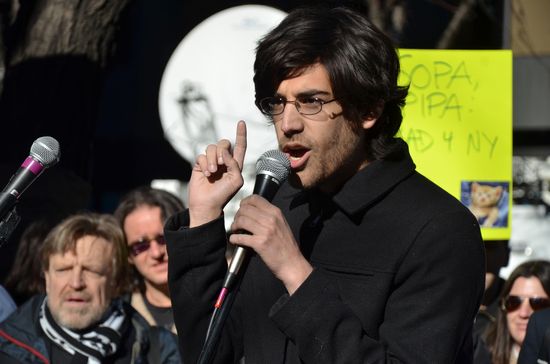
(Photo of Aaron Swartz, who committed suicide this weekend, by Daniel J. Sieradski)
Dressing Your Mum
Author, photographer and ossuary expert Paul Koudounaris recently recounted the strange culture surrounding mummies in Italy's Palermo Catacombs:
For centuries people would pay to have their relatives mummified and put on display. And every November 2 you would dress your mummies in a new set of clothing. It was just a traditional family obligation. Eventually this stopped. Those catacombs are basically the finest fashion history museum in the world — what they’re wearing now is whatever they had on when their relatives stopped bringing them new clothes.
Generally this happened [around] the Enlightenment. It shows how drastically our conception of dealing with the dead changed at that point. If you consider Psycho, the one thing that makes Norman Bates absolutely unfit to be a member of human society is that he has his mother mummified and dresses her in clothes. That what marked him as a lunatic. But back in 1700 in Sicily that would have marked him as the paradigm of a loving son.
The Starbucks Pseudonym

Language blogger S.A.P. over at The Economist confesses his morning ritual:
S.A.P. doesn't order a nonfat latte (easy on the foam) every morning. "Sam" usually does, though. I have a relatively popular male name: not ubiquitous, but familiar enough—in India. Stateside, Sam sounds vaguely related, so I've taken it on as my Starbucks name. Sam orders my coffees and makes restaurant reservations for me. He introduces me in short-lived conversations. His name is quick and perfectly dull, and unfailingly spelled correctly by the barista on my cup. I envy Sam sometimes.
(A cup belonging to Ann-Louise, posted on the tumblr Starbucks Spelling)
“The Paradox Of Self-Help” Ctd
Kathryn Schulz considers the "beautiful fact that the underlying theory of the self-help industry is contradicted by the self-help industry’s existence" – that is, we don't really know what a "self" is:
The self-help movement seeks to account for and overcome the difficulties we experience when we are trying to make a desired change—but doing so by invoking an immortal soul and a mortal sinner (or an ego and an id, a homunculus and its minion) is not much different from saying that we "are of two minds," or "feel torn," or for that matter that we have a devil on one shoulder and an angel on the other. These are not explanations for the self. They are metaphors for the self. And metaphors, while evocative and illuminating, do not provide concrete causal explanations. Accordingly, they are not terribly likely to generate concrete solutions.
True, self-help literature is full of good advice, but good advice is not the issue; most of it has been around for centuries. The issue is how to implement it. In the words of the emphasis-happy Robbins, "Lots of people know what to do, but few people actually do what they know."
Previous Dish on the subject here.
Quote For The Day

"Faith is not the progressive unearthing of God's nature but a recognition that he/she is fundamentally unknowable. The signpost points not to growing certainty but towards increasing non-knowing. This is not as outrageous as it seems. An apophatic thread, a belief that the only way to conceive of God is through conceding that he is ineffable, runs throughout Christian history. Jan Van Ruysbroeck, the 14th century Augustinian and man of prayer, maintained that 'God is immeasurable and incomprehensible, unattainable and unfathomable'. St John of the Cross, one of the pillars of western mysticism, put it even more succinctly: 'If a man wishes to be sure of the road he travels on, he must close his eyes and walk in the dark,'" – David Bryant
("Nimbus D’Aspremont 2012" by Berndnaut Smilde. Photo by Cassander Eeftinck Schattenkerk. Courtesy the artist and Ronchini Gallery.)
Contempt Dripping From Every Sentence
This NYT paragraph took my breath away:
One damp morning this winter, Jim Abdo was looking through architectural renderings at his office in Logan Circle, one of the many leafy Washington neighborhoods anchored by a statue of a long-dead guy riding a horse. Abdo got his start as a property developer by buying decrepit buildings and modernizing them, and his headquarters shows off the trick. The adjoining storefronts had been stripped bare and rebuilt, all warm wood and cold glass with exposed brick and beams. It looked like a Brooklyn design studio or a Silicon Valley start-up, or at least how those offices might look in a Nancy Meyers movie. But Abdo has built his business in the unstylish land of think tanks and tepid salmon lunches and boxy women’s suits.
Seriously, could you get any more contemptuous of the nation’s capital, one of the most pleasant, modern and livable cities in America. Unless you’re such a fucking snob you write paragraphs like that one. Makes me want to go back – just to stick it to Annie Lowrey, and her insufferable condescension.
 The Dish