Richard Feynman's famous riff on the beauty of a flower, wonderfully animated:
(Hat tip: Joe Hanson)
Richard Feynman's famous riff on the beauty of a flower, wonderfully animated:
(Hat tip: Joe Hanson)
Greg Olear makes the case that Nick Carraway, the protagonist of The Great Gatsby, is gay and in love with the novel's eponymous character. The biographical details that provide the initial impetus for Olear's suspicions:
Here’s what we know about Nick Carraway, from what he tells us in the first few pages of the book: he was born in 1896, so is about the same age as Fitzgerald; he went to Yale, as his father did before him; he fought in the First World War; he resembles his “hard-boiled” great uncle; his aunts and uncles are worried about him; he is, at age 25-26—his birthday is the summer solstice, and occurs during the action of the book—still single. Reading between the lines, we deduce that there is something unusual about him, something that concerns his family. So far, Nick’s is exactly the profile of a (closeted) gay young man in a prominent Middle Western family in 1922.

Michael Zhang spotlights the portrait series, “Holy Men,” of religious ascetics from around the world, by photographer Joey L:
Joey traveled to India (for the third time) in March 2011 and spent a month creating more photos of wandering monks in Varanasi, the holiest of the seven sacred cities in Hinduism and one of the oldest cities in the world.
Joey explained the project to Zhang:
I began the Holy Men collection with a photo series from the North of Ethiopia focusing on Coptic Christianity. In this new series, Sadhus and religious students are the featured subjects. Although Coptic Christian monks and Sadhus live in different corners of the world, the connection all these subjects have to each other is profound. Almost every major religion breeds ascetics; wandering monks who have renounced all earthly possessions, dedicating their lives to the pursuit of spiritual liberation. Their reality is dictated only by the mind, not material objects. Even death is not a fearsome concept, but a passing from the world of illusion.
Follow Joey's work on his blog, Twitter and Facebook or watch a documentary on his series, here.
(Vijay Nund performing morning rituals in the Ganges River, the most sacred river in Hinduism.)
In a two-part remembrance (one, two) of the late novelist, poet, and translator Reynolds Price, Casey N. Cep focuses on the writer's persistent, idiosyncratic Christian faith. Cep ends her essay with a meditation on Price's fraught relationship with the organized church:
It pains me to know that Price considered himself “a literal outlaw” of Christian churches because of his homosexuality. In one of his final books, A Serious Way of Wondering: The Ethics of Jesus Imagined (2003), Price confessed “though I’m not a churchgoer, for more than sixty years I’ve read widely in the life and teachings of Jesus; and since at least the age of nine, I’ve thought of myself as a Christian.”
Like the mystic Simone Weil, who resigned herself to “the conclusion that my vocation is to be a Christian outside the Church,” Price found his community with Christ beyond the sanctuary.
In his 1991 Paris Review interview, Price talked about his religious life this way:
I don’t see my work as proselytizing, certainly not in any sectarian way. I grew up in a particular American religious tradition, which was Southern Christianity, and in my own immensely unorthodox way, I’ve remained in that tradition with no great problems to my intellect because it reached me so early and deeply. I still have very intense relations with what I can only rather spookily call “the unknown,” which definitely doesn’t mean Ouija boards or table tilting, though it does mean constant meditation and attempts at least to communicate hopes and various other forms of requests to a creator, the Creator, since I assume there’s only one. I think that all my work and its overreaching conviction of the comedy of history comes directly out of an unshaken knowledge that’s been inside me all my life. Again though, I won’t be passing out cards and asking you to step forward and give your life to the Lord here now. That’s your lookout.

New York City, New York 9.30 am
In a searching essay on his Christian faith, Justin Erik Haldór Smith ruminates on the unlikely places he finds God – and his affinity for the doubters among us:
Those who know me or have read me will probably know that I have often claimed that I am an atheist. I would like to stop doing this, but if I had to justify myself, I would say that it is for fear of being confused with that blowhard with the 'John 3:16' banner that I am unforthcoming about what I actually believe. I am infinitely closer, in the condition of my soul, to the people who feel God's absence — the reasons for this feeling are a profound theological problem, and one might say that it is only smugness that enables people, atheists and dogmatists alike, to avoid grappling with this problem. I am with the people who detect God's hand, perhaps without even realizing it, where the smug banner-holder sees only sin: in jungle music, dirty jokes, seduction, and swearing. I am with the preacher who puts out a gospel album, then goes to prison on fraud and drug charges for a while, then puts out a hip-grinding soul album, and then another gospel album. I am with the animals, who can't even read, but can still talk to the saints of divine things. I am sooner an atheist, if what we understand by Christianity is a sort of supernatural monarchism; if we understand by it that God is love, though, then, I say, I am a Christian.
brightcove.createExperiences();
During the Iranian uprising of 2009, the Dish continuously clashed with Flynt and Hillary Mann Leverett, the most well-known skeptics of the Green Movement. The husband and wife team continue to blog at Going to Tehran. Watch their previous videos here, here, here, here, here and here. In an excerpt from their new book, they touched on Western conceptions of the Islamic Republic:
In the more than thirty years since the Iranian Revolution, Western analysts have routinely depicted the Islamic Republic as an ideologically driven, illegitimate, and deeply unstable state. From their perspective, Iran displayed its fanatical character early on, first in the hostage crisis of 1979-81, and shortly afterward with the deployment of teenage soldiers in ‘human wave’ attacks against Iraqi forces during the 1980s. Supposedly the same Shi’a ‘cult of martyrdom’ and indifference of casualties persist in a deep attachment to suicide terrorism that would, if Iran acquired nuclear weapons, end in catastrophe. Allegations of the Iranian government’s ‘irrationality’ are inevitably linked to assertions that it is out to export its revolution across the Middle East by force, is hell-bent on the destruction of Israel, and is too dependent for its domestic legitimacy on anti-Americanism to contemplate improving relations with the United States.
Update from an Iranian reader:
This is providing a platform for blatant lies, unbalanced by reality. I want you to talk to these guys with a straight face when they say that Iran is not a theocracy, or that women have great rights in Iran. My cousins are Bahaii’s and their kids are not allowed to go to school. They’re not allowed to have regular jobs. If this isn’t a theocracy then what is it? Some haven for women when they rape underage girls before they execute them! I’m really pissed at you guys right now. Shameful! Some idiots might watch these videos and believe it’s true.
Lorin Stein praises Psalm 139:
Psalm 139 gets my vote for being the most beautiful of the psalms in the King James version. The other day I happened to read it in French and it left me cold—it conjured up surveillance—whereas the high-low diction of the King James translators sings and is intimate, because you would only sing this way to a God you loved: "If I ascend up into heaven, thou art there: if I make my bed in hell, behold, thou art there. If I take the wings of the morning, and dwell in the uttermost parts of the sea, even there thy hand shall lead me." It’s like an advertisement for the English language.
An old boss of mine used to claim that the most seductive words are not "I love you," but "I understand you." Surely a deep need is expressed by the line, "Thou knowest my downsitting and my uprising, thou understandest my thought afar off."
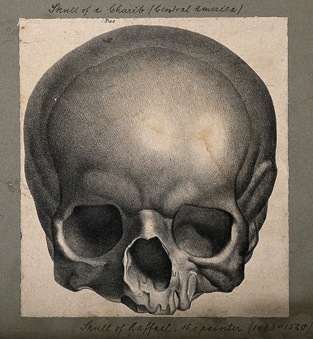
James Hall traces the difficulties the much valorized Raphael poses for biographers:
The Raphael cult was helped by the fact that very little is known about his opinions or “inner life”: he was an unsullied blank canvas. Unlike Leonardo and Michelangelo, he
didn’t write many letters or poems or theorize or jot down ideas and shopping lists next to his sketches. What admirers had instead, from the beginning of the eighteenth century, was his skull, exhibited in the Accademia di San Luca in Rome. As part of their initiation, each new student had to place his pencil on it. Goethe, as a kind of climax to his Italian Journey of 1786–8, visited the Academy to marvel at the “brain-pan of beautiful proportions” (he had a cast sent home to Germany, to meditate daily on it). This skull worship only stopped in 1833, when Raphael’s tomb in the Pantheon was opened in the presence of the Pope and other dignitaries, and the skeleton was found to be intact; somewhat disappointingly, the large larynx, still intact and pliable, suggested he had a loud voice.
Read more about the skull of Raphael here.
(Lithograph of the skull of Raphael via the Wellcome Collection)
Joe Fassler interviews the author Jim Shepard about what Flannery O'Connor's brilliant short story, "A Good Man Is Hard To Find," taught him about the nature of epiphanies:
O'Connor really believes that we can flood, momentarily, with the kind of grace that epiphany is supposed to represent. But I think she also believes that we're essentially sinners. She's saying: Don't think for a moment that because you've had a brief instant of illumination, and you suddenly see yourself with clarity, that you're not going to transgress two days down the road.
I find this idea enormously useful in my own work. My characters are all about gaining an understanding of the right thing to do—and avoiding it anyway. That sense that we can be in some ways geniuses of our own self-destruction runs, in some ways, counter to the more traditional notion of the epiphany—which tells us that stories are all about providing information to characters who badly need it. Epiphanies are, in some ways, staged and underimportant.
 The Dish