When English Words Fail

Emily Elert explains using a linguistic graph:

Few of us use all–or even most–of the 3,000 English-language words available to us for describing our emotions, but even if we did, most of us would still experience feelings for which there are, apparently, no words. In some cases, though, words do exist to describe those nameless emotions–they're just not English words. Which is a shame, because–as today's infographic by design student Pei-Ying Lin demonstrates, they often define a feeling entirely familiar to us.

Megan Garber highlights some favorites:

You know that sorry state of affairs that is actually looking worse after a haircut? Or the urge to squeeze something that is unbearably cute? Or the euphoria you feel when you're first falling in love?

These are common things — so common that they're among the wonderfully delightful and excruciatingly banal experiences that bind us together as humans. And yet they are not so common, apparently, that the English language has found words to express them. The second-most-spoken language in the world, as a communications system, sometimes drops the ball when it comes to de-idiomizing experience — a fact that we are reminded of anew in the image above.

Go here for a similar Dish thread on words without an English equivalent.
America Gone Wilde

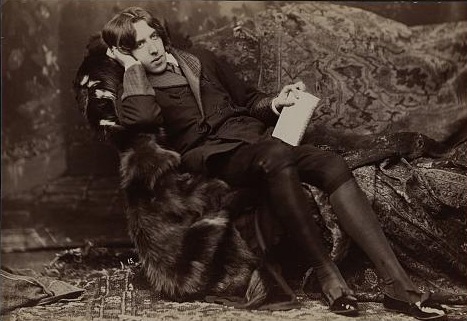
Oscar_Wilde_(1854-1900)_in_New_York,_1882._Picture_by_Napoleon_Sarony_(1821-1896)_8a

Upon arrival in the States, Oscar Wilde reportedly quipped, "I have nothing to declare except my genius." The US tour proved excellent fodder for Wilde's wit:

Wilde ranged all about the country subsequently—west along the Great Lakes and on to California, back through the prairies and into Atlantic Canada, and then to the American South. He scattered mordant criticism but also genuine praise, often about the same things. Wilde declared, of Niagra Falls, "Every American Bride is taken there, and the sight of that tremendous waterfall must be one of the earliest, if not the keenest, disappointments in American married life" but also that the "majestic splendour and strength of the physical forces of nature” were "far beyond what I had seen in Europe." On Cincinnati: "I wonder that no criminal has ever pleaded the ugliness of your city as an excuse for his crimes." He found California "a very Italy without its art," though later he admired that "nature had exhausted her resources on the West and left nothing for the prairies."

(Portrait of Oscar Wilde in New York, 1882 by Napoleon Sarony via Wikimedia)

The Burdens Of A Book Club

As the only writer in her book club, Marcy Campbell plumbs the group for insight into today's literary market, including the many reasons members will reject a book:

I’m in the heads of these ladies, imagining the silent demerits they will offer to words like "heartbreaking," (too sad), "epic" (too long), "thought-provoking" (meh, could go either way). Any book that features the loss of a child is out, no debate. Spousal abuse, cruelty to animals, anything hinting at a conservative world-view (unless it’s written by someone who abandoned that world-view), nope, nope, and nope.

She fears that the group, mostly made up of tired young mothers, don't have the energy at the end of the day to tackle a serious book:

Is that a lame excuse? Have I, and our other club members, become lazy? Complacent? Has motherhood made us incapable of putting literary tragedy in its proper perspective? Or are we just…tired? Are we victims of the mentality that says we must do it all or die trying? (Books on this topic will almost always get the nod.)

Is The Art Bubble About To Pop?

154266866

Possibly, according to Stephen Marche – at least if Damien Hirst's market value is any indicator:

He has produced some dreadful still lifes and a magnificently grotesque sculpture [above] that is both ugly and pointless and, much less forgivable, not particularly interesting. But diminishing quality doesn't explain the ferocity of the collapse. The value of works that have been much feted, and which have made him among the richest artists in the world, with a fortune somewhere in the vicinity of 400 million dollars, has been declining steadily. If you own a Hirst, sell now. The value of Hirst paintings sold between 2005 and 2008 have taken nearly a 30 percent bath in the meantime. Since 2009, a third of his works have failed to sell at auction.

He continues:

It's no coincidence that Hirst's peak was in 2008, just before the economic crash. Hirst's paintings and scultpures are the aesthetic equivalent of bad collateralized debt obligations. They are worth what people believe they are worth. And when people stop believing? They are worth nothing.

(Photo: The morning sun illuminates detail in Damien Hirst's bronze sculpture of a pregnant woman on October 17, 2012 in Ilfracombe, England. The bronze-clad, sword-wielding 65ft (20m) statue, named Verity, has been controversially given to the seaside town by the artist, on a 20-year loan and was erected yesterday by crane onto the harbour pier. By Matt Cardy/Getty Images)

The View From Your Window Contest

Vfyw_1-12

You have until noon on Tuesday to guess it. City and/or state first, then country. Please put the location in the subject heading, along with any description within the email. If no one guesses the exact location, proximity counts.  Be sure to email entries to VFYWcontest@gmail.com. Winner gets a free The View From Your Window book. Have at it.

History Is Written By The Tricksters

Gregory Ferenstein offers another cautionary tale about Wikipedia:

Wikipedia editors unearthed a clever hoax perpetrated on the web’s gullible netizens, sending the mighty "Bicholim Conflict" back to where it originated: non-existence. For five years, the imaginary year-long battle, from 1640 to 1641, between Portugal and the mighty Indian Marath Empire, reigned as truth in the user-generated halls of Wikipedia’s archive. Despite the fact that the cited sources were as real as the conflict, it even achieved "Good Article" status for its thorough 4,500 word recounting of the major historical event. It is said that history was once written by the victors; now, history is also written by the bored.

Ask The Leveretts Anything: A Rift Between Ahmadi And The Ayatollah?

During the Iranian uprising of 2009, the Dish continuously clashed with Flynt and Hillary Mann Leverett, the most well-known skeptics of the Green Movement. The husband and wife team continue to blog at Going to Tehran, in addition to Flynt’s role as Penn State Professor of International Affairs and Hillary’s role as Professorial Lecturer at American University and CEO of the political risk consultancy, Stratega. In the spring of last year, they addressed what they consider the misguided media approach to stories about Iran:

One all-too-typical example is The New York Times’ main “analytic” piece about the parliamentary elections, see here; the article, entitled “Elections in Iran Favors Ayatollah’s Allies, Dealing Blow to President and his Office,” was filed by Neil Macfarquhar from Beirut.  This specimen of bad journalism cites a former reformist parliamentary now living in the United States, an editor for the opposition Rooz online, and the Washington commentator Karim Sadjadpour (who favors the Islamic Republic’s overthrow), to assert that the elections were carefully stage managed (by Ayatollah Khamenei’s son, Mojtaba, working on behalf of his father) as part of an ever increasing dictatorship to abolish the presidency and turn the Islamic Republic into a parliamentary-based, prime ministerial system.  One can find these themes in many other Western media stories about the elections.

Watch their previous videos hereherehere, here and (with reader pushback) here.

The Precision Of The Perfect Cup

At some of the best restaurants in the UK, Julian Baggini was horrified to discover they're serving Nespresso, coffee made "by the waiter popping a capsule into a machine and pressing a button." After a blind taste-test with some experts, however, Nespresso scored the highest. Baggini theorizes why:

Coffee-making lends itself to automation, since all the key variables are strictly controllable. Technically, it’s relatively easy to get hold of the best coffee beans, roast them at the right temperature for the right time, grind them to the right fineness, and then vacuum-seal the right quantity for one shot. From that point on, the coffee will not degrade, effectively being as fresh once the machine pierces the capsule as it was when it went in. Then it’s a matter of hiring leading coffee experts, throwing millions of pounds of R&D at a crack team of engineers, and building a machine that will force the right amount of water through the coffee at the right temperature and pressure.

In theory, that is bound to result in a better brew than the traditional process, which, for all its romance, is full of opportunities for degradation and mishap. A bag of beans, once opened, will start to lose its flavour very rapidly once it is ground. Calibrating temperature and pressure is also difficult and subject to human error. While the capsule always contains exactly the same amount of coffee, the amount the traditional barista places in the portafiltro, and the degree to which is it compacted with the tamper, will always differ slightly. Most cafés do not get every step right, and they only get away with it because most people drown their espressos in steamed milk.

A Taxonomy Of Type, Ctd

-qkslvr deli rug2 (1)

A reader sends the above photo:

Yesterday I walked across my typeface design on a rug in a midtown deli. It's an old design called "Quicksilver" I did in 1976 in high school and sold to Letraset. I collect samples of it on a Flickr page.  I am the one bridging the punk, hip hop, Aussie pop, Michael Jackson, and porn. 

Another writes:

Sadly the photo you used (Lenox Lounge) is part of what is dying in NYC.  Lenox Lounge closed at the end of December to make room for a Harlem Nobu.  There is less and less of this kind of gorgeous signage in New York.  It is completely dying.

Another:

Along the lines of this thread, you guys should check out font.ly, a web project designed to map font examples from the wild. Fun to explore.