The greatest ping-pong plays ever:
Year: 2013
The Freedom To Smoke Pot
Dreher agrees with Frum about marijuana:
We Americans love to think idealistically about the virtues of expanding freedom, but we are poor at thinking about what happens to people who can’t handle freedom. Every parent understands that older kids can be afforded a degree of freedom that younger kids cannot, and that younger kids need a firm, "No, you can’t do that, because I said so." Frum’s point is that while we ought to reduce the criminal penalties for marijuana possession and use, decriminalization goes too far because of the added burden it would place people who are most vulnerable to the deleterious aspects of the drug. He has a good point, and not just about drug laws.
So all American adults are basically children that we have to protect from their own choices? You can't get a clearer voice of condescending paternalism than that. Conor is as aghast at it – and its completely counter-productive effects – as I am:
One final point about the "unsophisticated" people the paternalists are out to protect.
So long as prohibition persists, a subset of them will be risking their futures and perhaps their lives by deciding to sell drugs on the black market. And another subset of the "unsophisticated" will trust the wrong people to supply their drugs and wind up with a product more dangerous than it would otherwise be. I wish David Frum's family all the best, but catering drug policy to the needs of upper middle class kids in homes with parents who actively talk to them about drug abuse doesn't make much sense, even from a paternalist perspective – especially given the awful track record of "it's illegal" in preventing American youth from experimenting with marijuana.
I have to say that David's arguments on this remind me of the early arguments I had about marriage equality.
David hasn't thought much about this question and his arguments simply miss the core case of the other side: that Prohibition is making pot more available to kids, not less; that countless people not in the upper middle class are swept up into a criminal records simply because they want to enjoy a pleasure less dangerous than alcohol; that the racial disparities are simply unconscionable. The thing is, as with marriage equality, the opponents of Prohibition have thought a great deal about this, while the supporters truly haven't. They need to up their game – or they will lose this argument as soundly as they lost the marriage one. (Recall that not so long ago, David urged re-enforcement of sodomy laws as revenge against the push for marriage equality. You can look it up now in the e-Book version of my anthology, "Same-Sex Marriage: Pro and Con".)
The Dish Meter’s Mechanics
Jonathan Glick wonders about them:
I suspect the longer pieces that trigger the pay-us reminder will need to be original just because writers being aggregated will get pissed if they use long quotes from their stuff to drive subscription sales.
We've been contemplating the best way to use "read-ons" going forward, since the read-on clicks are what will trigger the meter and the please-pay message. We could set the meter lower and only have read-ons on longer original commentary and on reader threads. Or we could set the meter higher and use read-ons essentially as we do now. Or we could just play it by ear, experiment a bit and see what works best. What do you think?
Twice Looks Like Carelessness
So the second Inaugural benediction for Obama turns out to be another clusterfuck. First, they had the fatuous Rick Warren, whose campaign against marriage equality was deemed irrelevant to the cause of uniting the country. Now we have Louie Giglio, a preacher who has done sterling work in preventing human trafficking – an extraordinarily important and admirable thing – but who, like most evangelicals, still believes that gay relationships, let alone marriages, are anathema.
The sermon in question, which I listened to, is not full of hatred. It has all the caveats about not hating gay people, not promoting intolerance. But it is quite clear that Giglio has never  stopped believing that what he calls “the gay lifestyle” is a terrible crime against God. He also calls it one of the most important issues of the time. He proposes the horrifying abuse of “ex-gay therapy.” He cites Leviticus, which mandates the death penalty for gays, and says it is the lynchpin of the teaching against homosexuality. In fact, he doesn’t just cite Leviticus; he goes on for ever about it. He describes gay people as living a “lie,” a term my born-again uncle accused me of doing when he found out I was gay. He calls us engaged in “depraved, lustful behavior” and being haters of God. He calls for his congregation to “firmly respond to the aggressive agenda” of gay equality.
Now, people evolve. And we should be happy to welcome those who have evolved and no longer find homosexual relationships sinful or poisonous. But Giglio shows no sign of having changed. His defense is that “clearly, speaking on this issue has not been in the range of my priorities in the past fifteen years.” But in that sermon, he described it as possibly the most important moral battle of the time. And get a load of this: “Those who practice such things are worthy of death.” And this:
Homosexuality is not an alternate lifestyle. Homosexuality is not just a sexual preference. Homosexuality is not gay. But homosexuality is sin.
He does not seem to me to be a hateful person. He makes a distinction between homosexual behavior and homosexuals. Read his statement if you doubt me. Or listen to his full sermon here. He takes pains not to demonize gay individuals in fire and brimstone terms. But he is adamant that gay relationships are an attack on God. That’s his religious prerogative. But what clueless administration official did not do due diligence on this figure? After the Rick Warren mess, could no one in the White House do the same research as Think Progress? The sermon is sitting online, for Pete’s sake. I’m tempted to paraphrase Lady Bracknell’s line in Oscar Wilde’s “The Importance of Being Earnest”:
To bollix up one Inaugural Benediction, President Obama, may be regarded as a misfortune. To bollix up both looks like carelessness.
There’s only way forward on this and that is to choose as his replacement a minister who endorses gay unions and full gay inclusion in the Christian community. Why would Obama object to that? He has “evolved” now, hasn’t he?
The View From Your Window

Ushuaia, Argentina, 12 pm
Is Hagel “Out Of The Mainstream”?
It's a bizarre formulation in the first place. Who would want to be in the mainstream in Washington in the first decade of the 21st century? Shouldn't all of them be running away from their previous disastrous judgments – I mean McCain and Butters and Lieberman and Cornyn et al. I was for a bit and then realized the true scale of my misjudgment. How could you not as tens of thousands of Iraqis died under US control? As the US squandered a core element of its soft power by copying the torture techniques of totalitarian regimes? As the end-result was an Iraq on the edge of sectarian collapse and a strengthened Iran? As we now realize that the longest war in American history in Afghanistan will have, at best, a compromised conclusion. So it seems to me a plus if Hagel is out of that particular mainstream. It's a feature, not a bug.
Greg Djerejian goes further, in a splendid bloggy rant. Money quote:
I believe skepticism about a military adventure in Iran is eminently “mainstream”. Indeed, I would go further, and would think that fuller consideration of a “containment” doctrine vis-à-vis Iran should be “mainstream” too—if ultimately diplomacy and sanctions were to run aground, only leaving potentially less desirable military options, and as done with arch-foes in the past of far greater geopolitical strength than Iran (even if the President has ostensibly removed this policy option from the table). I believe skepticism about unilateral Iran sanctions—as compared to the multilateral variety that Hagel more typically has supported—is “mainstream” and indeed, far more intelligent, as unilateral sanctions can be avoided with ease and so have materially less bite. I believe looking to aggressively haircut the, yes, “bloated” Pentagon budget is “mainstream”, especially in this era of mammoth deficits and looming austerity.
Drum, Lead And Crime
Jim Manzi offers the most thorough critique yet. It gets nerdy at times, but no nerdier than necessary. Money quote:
Reyes seems like a diligent and thorough analyst, and she has an admirably clear prose style. But this regression model is reading tea leaves. The problem is not with her, but with the econometric method she is using to try to tease out causality. It is like using a child’s magnifying glass to try to investigate the structure of a skin cell.
Richard Nixon: It’s Complicated
This week marked what would have been the 100th birthday of America’s 37th President, Richard Milhous Nixon. In an essay summarizing the breadth of Nixon’s remarkable life and career, John Aloysius Farrell points to the man’s frequently neglected virtues:
Americans, at their best, are romantics. As was Nixon. He dreamed of noble triumphs in international affairs; asked to use Woodrow Wilson’s desk in the Oval Office. He was sworn in as vice president on a Quaker Bible opened to the beatitude: Blessed are the Peacemakers. “We are asking you to join us in a great venture,” he told congressional leaders in 1972, after his second historic trip that year, to sign a nuclear arms treaty with the leaders of the Soviet Union. “We may change the world for a while.”
He embodied, too, another great American virtue: pragmatism. His was the last progressive Republican presidency, his White House manned by bright young men (and women) who devised forward-thinking reforms for health care, poverty, civil rights and affirmative action, the treatment of American Indians, the advancement of women and protection of the environment.
He could be achingly, clumsily kind. In 2012, his alma mater, Whittier College, settled a decades-long dispute with the National Archives and opened more than 300 oral histories it had conducted among Nixon’s friends and family to historians. In one of them, a classmate at Duke Law School recalls how a fellow student, a victim of polio, needed to be carried up the stone steps of a building to class, and how it was Dick Nixon who assigned himself the task.
Which simply shows how we are all complicated. I remember when he died being in a hotel room in New York City, about to go out on the town (those were the days). I switched on the television and they were broadcasting the Frost-Nixon tapes. You would think that hour after hour of interviewing a highly unattractive, defensive politician would be mind-numbing. Instead, I couldn’t pull my eyes off him. I was still sitting there in the early hours, riveted by this simmering human volcano of rage, hate, self-hate, resentment, some remnants of conscience, and kindness.
This was a criminal who betrayed the core of American democracy, lied to the people, persecuted those dedicated to free speech, ordered robberies and cover-ups, and laid the ground work for some of the best innovations of the time – like the EPA – and the worst – price controls. For one generation he will always be evil. For the next he may be more complicated. Still a crook and an enemy of the Constitution. But complicated.
The Platinum Coin Option, Ctd
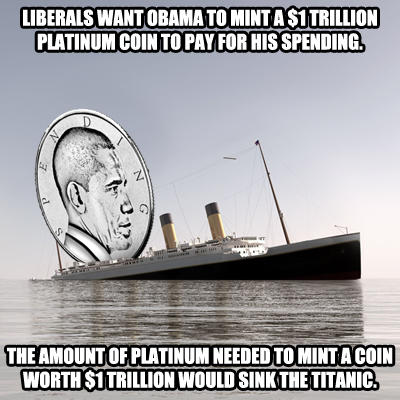
Steve Benen objects to the NRCC tweeting the above image:
[T]he problem with the image and initial argument is that the NRCC appears to have forgotten how money works. A $20 bill does not have $20 worth of paper. Indeed, the paper and fibers that go into a $50 bill do not have five times the value of a $10 bill. And as such, a $1 trillion coin would not need $1 trillion worth of platinum.
Kevin Drum isn't so sure:
[A]s a lawyer friend emailed to me this morning, "bullion coins are generally understood by other statutes within the US Code to be coins with a value effectively equal to the market value of the precious metal bullion in them. The trillion dollar coin is not that."
Former US Mint director Philip Diehl argues otherwise. Meanwhile, David Silbey fact-checks whether a trillion dollars of platinum could sink the Titanic and concludes that the NRSCC "did manage to come up with a historically-plausible way to snark about the platinum coin":
[T]he Titanic could carry about 14,300 tons. The weight of the platinum for the coin is substantially larger than that, but would it sink theTitanic? Well, it would certainly drive it beyond its regular displacement, but it might not cause it to go under. Ships can carry a lot of weight beyond their design capacities. Still, it’s not the kind of thing that I’d be really eager to try.
Can There Be “Nixon In Pyongyang”?
As former UN ambassador and New Mexico governor Bill Richardson visits North Korea in an attempt to free an American hostage, Armin Rosen explores the perils of any engagement with the prison state:
[The] trip calls to mind William J. Dobson's concept of "the dictator's learning curve" — the idea that successful autocracies (and North Korea certainly qualifies) can adapt to prevailing realities and challenges in order to further entrench the existing system.
He cites humanitarian aid like the UN's World Food Program as an example:
WFP aid can even be thought of as a kind of unearned subsidy — or as a subsidy that the North Korean government was able to extract through its continued bad behavior. After all, the estimated $3 billion to $4 billion North Korea has spent on its missile program over the past two years could easily have resolved the country's food security problems. Pyongyang's arrangement with the WFP gives the North Korean government leverage over an international community eager to alleviate large-scale human suffering, while freeing its resources for projects that arguably prop up the regime and destabilize the southeast Asian security environment. The less North Korea cares about solving a chronic and man-made food security crisis, the more the international community feels compelled to disconnect political and humanitarian concerns in dealing with the Hermit Kingdom.
 The Dish