The Question Obama Ducked

During his Reddit "Ask Me Anything":

There was one question everyone on the team wished Obama had answered. [Teddy Goff, head of Obama’s digital team,] probably would have selected it, according to his colleagues, but he didn’t see it at the time.

Would you rather fight 100 duck-sized horses or one horse-sized duck?

In the days following, staffers debated the answer. Most immediately chose the 100 duck-sized horses— they would be easy to stomp on and were, generally, a reflection of the usual day-to-day conflicts in life. A danger to the shins, but possibly manageable. "Ducks are not exactly teeny-tiny—so 100 duck-sized horses (as opposed to duckling-sized horses), while smaller than a miniature pony, are still probably clocking in somewhere around ten pounds each," one Obama official argued. "That’s a lot to kick/throw/battle."

Who would choose to fight a duck the size of a horse? The beak. The wingspan. The ability to defend and attack in the air, on land, and in the water. "Also, lacking a weapon of some kind, how exactly do you defeat it? Wrestling it to the ground seems unlikely. Can you break its legs? Snap a wing?" the official continued. "Yet, it’s just one opponent—you can focus all your energy, attention, and strength on outsmarting it. Maybe it tires easily. Hard to know."

Face Of The Day

159184973

Guatemala's National Civil Police drug squad graduates stand in formation during their graduation ceremony at Guatemala's Police Academy on January 9, 2013 in Guatemala City. Guatemala keeps a constant struggle against drug trafficking as 90 per cent of the drug going to the United States, main world market, travels through the region. By Johan Ordonez/AFP/Getty Images.

An Alternative To Default

Keith Hennessey proposes a moderate debt-limit strategy for Republicans. Either Obama agrees to spending cuts or the debt ceiling gets passed with mostly Democratic party votes:

The President wants a debt limit increase, but his Democratic colleagues (especially in the House) expect they won’t have to vote for it. By turning this assumption on its head, this strategy would tell the President, “Hey, if you want your terrible policy, you’re going to have to deliver House Democratic votes for it. Good luck with that.” Either the President accepts and Republicans pound on the “Democratic debt limit increase” message every three months, or he agrees to cut spending. Either way, default risk is eliminated. Republicans will look responsible because they will be acting responsibly, and the markets couldn’t care less about which Members take political heat for casting these unpopular votes.

But the Members care. A lot.

Battling Assad And The Elements

Syrian_Refugee_Mud

Mike Giglio covers the Syrian refugee crisis:

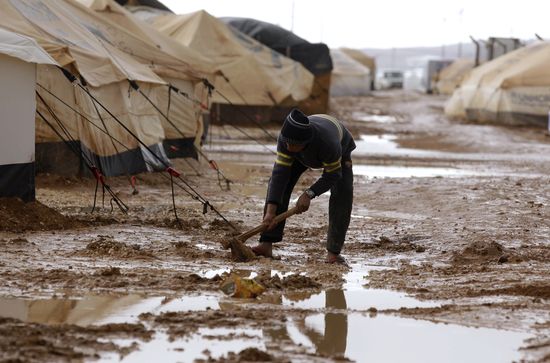
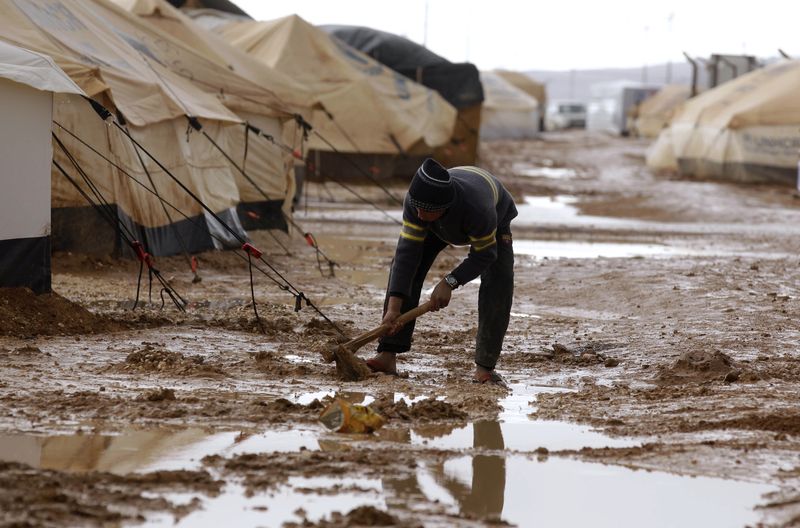
In the midst of a bitter winter season, the conflict in Syria continues to rage, and the number of refugees continues to climb. Exhausted from the harrowing ordeal that drove them from their homes, and often lacking the most basic of resources, the refugees’ lives are marathons of endurance, even during the warm summer months. Now, in deepest January, their existence is all the more precarious. At a Lebanese camp this week, for example, a storm blew away most of the families’ tents, while at another camp in Jordan, a winter deluge collapsed and flooded tents during the night, leading frustrated residents to stage a riot yesterday in which several international aid workers were injured as they distributed bread.

Meanwhile, this week, the United Nations’ World Food Programme announced that it would be unable to feed a million hungry residents in combat zones inside Syria, while the U.N. increased its estimate of the number of Syrian refugees upward to more than 600,000.

(Photo: A Syrian refugee removes water and mud around his tent at the Zaatari refugee camp, near the Syrian border with Jordan in Mafraq on January 9, 2013. Thousands of Syrian refugees are appealing for help after three days of rain and winter storm left them battling mud, water, freezing temperatures and increasing misery. By Khalil Mazraawi/AFP/Getty Images)

A Few Extra Pounds Are Good For You? Ctd

Lindsay Abrams urges caution when interpreting the finding that higher BMIs are associated with decreased mortality rates:

Aside from the obvious limitations — people who pass away after a lengthy period of disease, for example, will likely be thinner than they might have been had they died unexpectedly — the study fails to take into account any of the various other measures used to assess health. It ignores blood pressure, blood sugar, and cholesterol — high levels of all are directly associated with a variety of chronic conditions and diseases — not to mention mental health and life satisfaction scores. As another large-scale study recently pointed out, longevity isn't everything. The population as a whole is living longer than it was twenty years ago, but the number of those years spent in poor health are increasing as well.

That BMI is an imperfect measure of body size is emphasized here as well. The simple calculation of height and weight ignores gender, age, and muscle mass … A BMI in the "overweight" range, from 25 to just below 30, encompasses a broad sweep of body diversity: A frequently cited argument is that Michael Jordan, at his prime, would have been classified as overweight. By almost any other measure but BMI, we would almost certainly put him in the range of ideal health.

The Fundamentals Won It?

Fundamentals_Chart

John Sides questions whether Obama's campaign deserves the credit for his victory:

As I understand the "formidable campaign" narrative, it’s that Obama campaign simply did a lot of things much better than the Romney campaign.  If so, then one possible implication is this:

Obama should have done better where the two campaigns went head-to-head, relative to places where neither side was campaigning.  That is, even though Obama was expected to lose votes in most states relative to a more favorable year like 2008, he should have done better in the battleground states, relative to non-battleground states, because the battleground states were where his campaign’s hypothesized prowess—in fundraising, messaging, GOTV, etc.—was manifest.  So did that happen?

No.

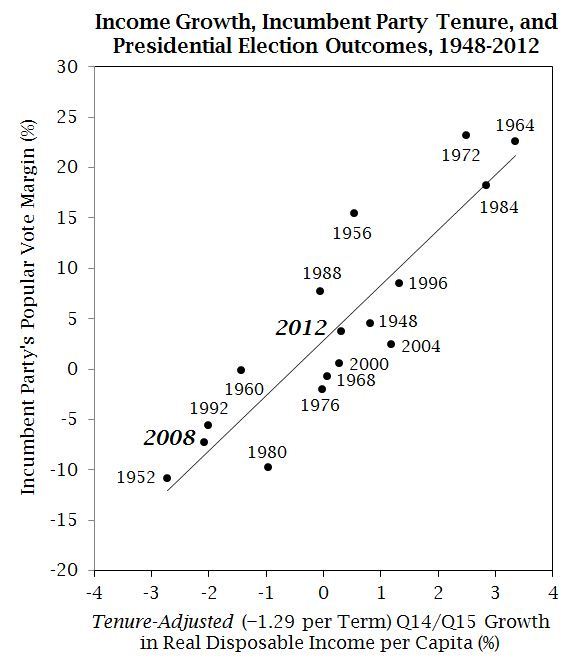
Larry Bartels agrees that in "2012, as in 2008, Obama’s electoral performance was quite consistent with what might have been expected on the basis of political fundamentals." He provides the above chart:

We have lots of distinct but broadly consistent statistical analyses of presidential election outcomes. My own favorite is based on just two factors: the income growth rate in the second and third quarters of the election year and the incumbent party’s tenure in office. The [chart] combines these two factors by relating election outcomes to tenure-adjusted income growth, which simply subtracts 1.29 from the actual income growth rate for each consecutive term (beyond the first) that the incumbent party has held the White House.

Quote For The Day II

"[I]nsofar as centrism is a political force that matters, it ends up inciting rather than restraining extremists. If centrists can be relied upon to embrace the middle position between two extremes, the partisans of each extreme have every incentive to make their positions more extreme, not less, before the centrists calibrate and then endorse the half-a-loaf resolution. For all their hopes and exertions, moderates not only do not moderate the political process and policy outcomes, but actually intensify and polarize fights over the nation's future course," – William Voegeli.

Which Law Will Obama Break?

Jonathan Bernstein mulls Obama's debt ceiling options:

At some point, Barack Obama will, if Congress does not act, be faced with an impossible choice. He will have clear, conflicting imperatives. Congress will have obligated him to spend money; not spending money that Congress has appropriated is an impeachable offense. The government will also be obligated to make good payments on current debts; he's clearly required to do that, as well. However he also will will be without money to do those things, not have the authority to borrow any more, thanks to the debt limit. So he will have to choose to have the government violate one of those legally binding commitments.

In response to the platinum coin debate, Kleiman asks:

[I]f we imagine a situation where the Congress doesn’t lift the debt limit, and the President has to choose between the Coin and default, would default really be the better option? If default is preferred, on what principle should the President choose which bills to pay and which to refuse to pay? And by what authority would he make that choice? If you’re sworn to execute the laws, and your choice is between the Coin and not executing some of the laws, aren’t you pretty much stuck with the Coin?

Josh Barro continues to insist that the coin is the least bad option.

Pot, Booze, Cars And Guns: Frum’s Response

116486193

David Frum tackles Mark Kleiman's 13 theses on marijuana and my approach to cannabis. The heart of Frum's argument (with my responses):

First, as Kleiman notes, it's an illusion to imagine that marijuana and alcohol users form two separate and distinct camps. It's already true that many of those who drink too much also smoke marijuana, and ditto for many heavy marijuana users. I'll defer to Kleiman's warning about avoiding under-researched overstatements about these interactions, but they exist and could well become much more severe in a legalized world.

This has to be the weakest point I've yet heard. Why should we not on these grounds ban many prescription drugs – whose interaction with alcohol is profoundly more dangerous than pot. 20,000 Americans died last year by abusing prescription drugs. No one died of smoking marijuana. It's a physical impossibility. As Sanjay Gupta notes, "Distribution of morphine, the main ingredient in popular painkillers, increased 600% from 1997-2007, according to the U.S. Drug Enforcement Administration." And yet David focuses on pot as the truly deadly mixture that must be curtailed. It's the one pain-killer that will never kill you. Bizarre.

Second, as former Obama drug-control official Kevin Sabet pointed out in his bravura appearance on MSNBC's "Up with Chris," it's not as if alcohol law enforcement does not exist. In fact, as he notes, some 2 million arrests occurred last year for alcohol offenses (e.g. public drunkenness, drunk driving, and violation of liquor laws) – not counting actual crimes, such as assault, committed under the influence of alcohol.

And your point is … what exactly? Those against Prohibition favor laws to punish driving while stoned. And I'm happy to lay a bet with David right now that in those states with legal pot, drunk driving arrests will far outpace stoned-driving arrests. But that is the right balance: it's if your use of an intoxicant presents a threat to others. Right now, alcohol is exponentially more dangerous than pot in this respect.

Third, as with guns and cars, the trend lines on marijuana and alcohol are sloping in different directions. Alcohol abuse is becoming less of a problem for American society in the 2010s, marijuana use, by contrast, is increasing – and increasing particularly among the very youngest users, who should not be using it at all because of the harms to brain development.

Again: what's the point here? The argument for legalization begins with it being a better way to protect kids from easy pot use. David doesn't address this crucial issue. It's Prohibition that drives up teen pot-smoking. And yet David wants more of it. He continues:

Fourth, as with guns, so with marijuana, proponents misstate what critics think public policy should look like. The goal is neither gun elimination nor the arrest of every marijuana user. Guns are constitutionally protected, subject to reasonable restrictions. Occasional in-home marijuana use by adults is not something that any police department in America will bother with.

Fifth, in both cases, proponents and critics agree on a strategy of risk reduction. What proponents refuse to acknowledge, however, is that a legal regulatory regime is essential to risk reduction. It's because police could arrest a young man smoking marijuana in a park that they can effectively divert him to treatment instead – as more and more police departments do. Everybody understands that neither guns nor cars, neither alcohol nor marijuana, will vanish from our society. The key thing is not to make existing problems even worse. 

Does David really think we cannot have a reduction in pot use under a rational legalization scheme? Didn't he just note that alcohol use – far more dangerous to society and the individual body – has declined thanks to social pressure and government information programs? As have drunk driving incidents? Did we have to make alcohol illegal to achieve these gains? Of course not. Kleiman responds:

If legalizing cannabis (under some specified set of taxes and regulations, including, for example, a ban on lacing beer with cannabinoids) turned out to decrease heavy drinking by 10%, then any "public health case against cannabis legalization" would vanish in – pardon me – a puff of smoke.

Since the benefit-cost analysis of cannabis legalization turns crucially on its effect on heavy drinking, and since that effect is unknown, dogmatic assertions about whether legalization would, on balance, be beneficial or harmful are not justified by the current state of knowledge. (Principled support for legalization on libertarian grounds, or principled opposition to it on cultural-conservative grounds, remain logical possibilities.)

I think David is really opposed on cultural-conservative grounds. But he gins up all these non-arguments to avoid sounding like a Puritan. But he is one on this subject. Which is unlike him.

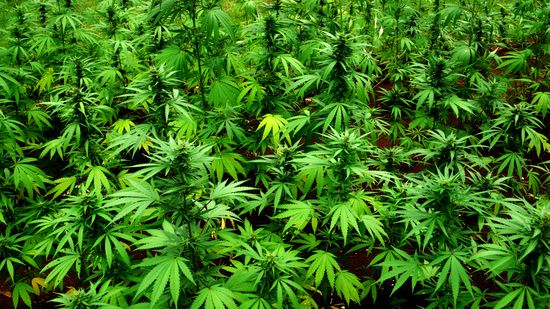
(Photo: Marijuana plants at the mausoleum for reggae musician Peter Tosh (1944 – 1987) in the grounds of his former house in Belmont, Jamaica, 3rd June 2011. By Kevin Cummins/Getty Images.)