Why Online Advertising Need Not Die (And Could Just Get Better)

While explaining why, as of February 1st, the Dish won't be taking advertising, I wrote how "distracting and intrusive" online ads can be and "how online ads have created incentives for pageviews over quality content." Mike Masnick pushes back:

[I]t's absolutely true that an awful lot of advertising sucks in exactly the manner described above. But that doesn't mean it needs to be that way. There's a growing recognition in the industry that intrusive and annoying advertising is not the way to go for exactly the reasons that Sullivan explains above. But as we've discussed, when you do advertising right, it's simply good content itself that people want. That's why a month from now, the most popular thing on Superbowl Sunday won't be the football game, but the commercials. There are times that peopleseek out advertising and are happy to see it. And compelling ad/sponsorship campaigns need to be about that. 

Now, it's reasonable to admit that many marketers haven't full grasped this concept, and dragging them, kicking and screaming, into this new era is not something that Sullivan and his team wants to take on. And that's a reasonable argument (and, as someone who's spent way too much time trying to convince marketers of this thing, only to see them default back to silly, pointless, misleading ad metrics, I can completely respect such a decision). But, it seems wrong to slam "all advertising" into a single bucket, just because some (or even a lot of) advertising is done really poorly. 

Agreed. And we have emphatically not ruled out advertizing for ever. It's just that, right now, it's more trouble for a site like ours than it's worth. But if the industry begins to smarten up and find a way to bring creative advertizing that does not impede but enriches the reader experience, we have no philosophical objections to it. Just not yet. In the same vein, Derek Thompson assesses Buzzfeed's business model:

It's probable that the Dish can live a year on subs alone. It's plausible that the Dish can live for two years on subs alone, or three, or 30. But practically everything else — the vast majority of journalism, from the New York Times to the pop culture blogs that specialize in bikini shots — cannot survive on the good will and generosity of their readership, and there is no expectation that they will. Advertising is what makes news and entertainment — first in 19th-century newspapers, then on early 20th-century radio, then on late-20th-century television, and now on early-21st-century Web and mobile — affordable at a mass scale. The news needs successful advertising to breathe.

That's why BuzzFeed's story matters. It's commonly understood that Web advertising stinks, quarantined as it is in miserable banners and squares around article pages. BuzzFeed's approach is different: It designs ads for companies that aim to be as funny and sharable as their other stories. Jonah Peretti, the CEO of BuzzFeed, told the Guardian's Heidi Moore that he attributed nearly all the company's revenues to this sort of "social" advertising. "We work with brands to help them speak the language of the web," Peretti said. "I think there's an opportunity to create a golden age of advertising, like another Mad Men age of advertising, where people are really creative and take it seriously."
The Highs And Lows Of 2012

First, a low of sorts:

But more to the point, Christopher Burt reviews the extreme temperatures recorded last year:

The Weather Underground climate extremes database follows 298 significant city sites in the U.S. which represent all climate divisions and major population centers. More importantly, they all have long periods of record (POR’s) dating back to the 19th century in most cases. This past summer some 22 of these 298 sites beat or tied their all-time absolute maximum temperature on record. This was the most since the infamous summer of 1936. No site recorded their coldest such.

Evan Lehmann notes that 2012 was "one of the most expensive weather damage years on record." And the effects were not evenly distributed:

Nearly all the world's economic damage from storms, drought, fire and earthquakes was centered in the United States as it experienced the highest temperatures ever recorded, according to Munich Re, a global reinsurance company. More than 90 percent of insured losses worldwide occurred in the United States, well above the 30-year average of 65 percent.

Despite these extreme conditions, Douglas Fischer reports that news coverage of climate change was down in 2012, "with worldwide coverage continuing its three-year slide."

Assad Digs In

On Saturday, in his first public speech in months, the Syrian dictator rejected any political compromise with the opposition. The world is not amused:

The West, including the U.S. and Britain, denounced Assad’s speech, which came amid stepped-up international efforts for a peaceful settlement to the Syrian conflict. On Monday, Turkish Prime Minister Recep Tayyip Erdogan also criticized the Syrian leader’s initiative. He accused Assad of "state terrorism" and called on him to relinquish power.

Dan Murphy argues the speech is proof that both the regime and the rebels now view the conflict as a "zero sum struggle":

To be sure, anyone going into a negotiation would want to do so from a position of strength. It's possible that Assad is striking a maximalist, defiant tone in public while entertaining compromises behind the scenes. But there were no indications of even a moderation of tone towards his opponents, routinely described as "terrorists" or agents of foreign powers, which would usually be taken as a signal that some sort of overture was being made.

And the deeply troubling news about chemical weapons does not reassure either. I have few doubts that Assad would use them. The crime family running Syria lost any semblance of humanity decades ago. Richard Spencer hears an echo of Gaddafi in Assad's speech:

Even the slogans were the same as the slain Libyan dictator: "God, Syria, Bashar, enough". Reminiscent too was the rambling delivery, leaping incoherently back and forth between vague peace proposals and unremitting imprecations against the opposition: "al-Qaeda", "armed criminals", "foreign terrorists" were also prominent in Col Muammar Gaddafi's vocabulary.

Al-Jazeera rounds up reactions from the Syrian opposition and Western statesmen.

The Long Game, Revisited

Screen shot 2013-01-08 at 12.55.05 PM

More and more, the second term is coming into focus. The nominations of Kerry, Hagel and Brennan in the national security tent confirms that Obama intends to make his mark more emphatically in his second term than his first (which primarily meant cleaning up the mess from Bush-Cheney). All three are skeptical of resorting to military force; Kerry is a veteran diplomat and decorated veteran; Hagel has two Purple Hearts and is ideally positioned to defend cuts in Pentagon spending. Brennan has the confidence of the CIA, even as he appears to be intent on bringing its often unaccountable actions more firmly into the nexus of law, and checks and balances. Of course, they should all be grilled by the Senate – on Iran, Greater Israel, torture, secrecy and Asia. But they seem like sterling and solid picks to me.

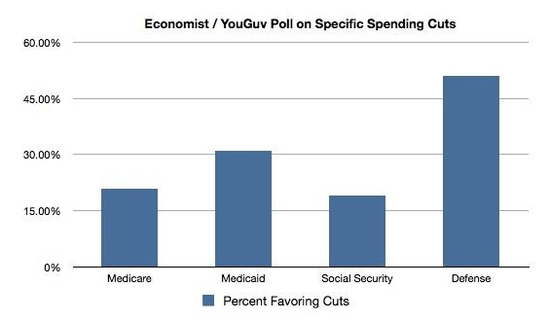
But it's Hagel's potential for cutting the Pentagon – and the credibility he has a Nebraska Republican vet – that really hits home. When you look at the slo-mo fiscal pile-up, you can see Obama's logic. He has essentially dispensed with Item Number One: raising taxes on the very rich. Next up comes the fight to cut spending or increase revenues by roughly the sequester amount. On the table for cuts, we have Medicare, Medicaid, Social Security, and the Pentagon, now spending almost twice what it did ten years ago. I defer to David's core judgment:

As the federal government becomes a health care state, there will have to be a generation of defense cuts that overwhelm anything in recent history. Keep in mind how brutal the budget pressure is going to be. According to the Government Accountability Office, if we act on entitlements today, we will still have to cut federal spending by 32 percent and raise taxes by 46 percent over the next 75 years to meet current obligations. If we postpone action for another decade, then we have to cut all non-interest federal spending by 37 percent and raise all taxes by 54 percent. As this sort of crunch gradually tightens, Medicare will be the last to go.

The polls agree (see above). If the cuts are not so much to the troops but to the massive defense contracting industry, then we could be in a whole new world. My sense is that Americans will want tax loopholes cut as a first resort (though nowhere near as much as would represent real tax reform), defense cut as a second resort and Medicare dead-last. (This isn't my preference. I'd rather see more serious cuts in Medicare, along with Simpson-Bowles radical tax reform and a radically reduced global footprint. But I'm just a blogger.)

Now that Obama has taken the tax rate issue off the table, all we know about US public opinion and the popularity of entitlements suggests that Obama has strategized to make the US government structurally more progressive, with defense being cut hard. Yglesias, who produced the above graph, notes:

I recently read David Karol's Party Position Change in American Politics which reveals that the politics of the defense budget is one of the most frequently flip-flopped non-procedural issues in modern politics. It's one where party leaders seem relatively unconstrained by constituency group commitments or ideology, and fairly free to engage in freelance gambits of various kinds. So given the gap between current polling and current elite positioning, it's a place where we might expect to see some surprisingly rapid changes.

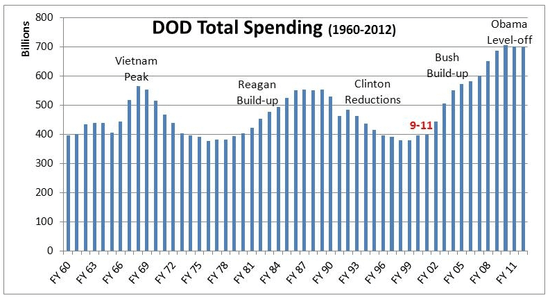
How about back to the levels of Reagan in 1984 at the height of the Cold War, for example?

6a00d83451c45669e2017d3f5ae05e970c-550wi

That would require a cut from around $700 billion to around $500 billion. Could we do that in four years? It seems to me that if we could almost double "defense" spending in the last decade, we should be able to cut it around 30 percent in four years. Leaving not a soldier behind in Afghanistan by 2014 would help.

(Graphs from Yglesias and simple serf)

The View From Your Window Contest: Winner #135

Vfyw_1-4

A reader writes:

The picture screams Seoul, South Korea.  The mountains in the background, the drab institutional architecture combined with the modern looking high-rise and the exhaust from the heating systems on a cold day – it all reminds me of the three winters I spent in Seoul.  I think the picture was taken on the north side of the Han River, in the neighborhood of either Angukdong; Insadong, Itaewon or Hannam – but I can't be sure.  The best I can guess is that the picture was taken on the North side of Seoul on a January afternoon.

Another:

I don’t have time to narrow it down, I’ve only been there once (and submitted a pic of my own from there that never made the cut), but that visage screams Mendoza, Argentina to me, as the sun sets over the Andes.

Another:

Asheville, North Carolina? I'm pretty sure that this was taken from downtown on Wall Street, most likely from the parking deck or a building near the parking deck, which is at 45 Wall Street. There is a great vegan restaurant just up the street from called the Laughing Seed. They have some of the best food in town, which is saying a lot.  I think it was the mountains that gave it away.  I know of no other view like that (not that I've been that many places).  I love that city. 

Another:

Hello dear, Compliment of the season! I'm Jennifer by name, female by sex, American(from New York City) by nationality and never married by marital status. I'm looking for friends all over the world to share ideals and visions with. I believe friendship makes the world go round; and distance, race, color, religion or culture ought not to be barriers to friendship but instead ought to be the solidifying points of relationship since life itself isn't static but dynamic. I'm a post-grad student and a staff of Great Hope Agency New York City. I will tell you more about myself when i hear from you. Please no tricks or mind-games because I'm tired of such in Facebook, and that's why i decided to go the archaic way of searching for friends by searching though mail contacts. I hope you gonna reply ASAP.

No hope, spam bot. A reader writes:

CONGRATULATIONS on your new adventure! Next paycheck and I'll join the new Dish enthusiastically. I love being an armchair traveler with these contests. My guess this week is Belo Horizonte, Brazil.

I tried to make it Venezuela in honor of Hugo Chavez but there was a 1/16" distance to the mountains. So I landed on Belo Horizonte. My deductions began with a southern hemisphere country with mountains. All southern continents have mountains. For amateur reasons, I ended up with South America. B.H. is near a mountain range.  The mountain type in the photo kinda sorta looks like the experts' description of mountains in Brazil.  After jumping around Wiki,  it seemed B.H. mostly fits the view from the window. Belo Horizone is in serious discussions about radiation from cell phone towers. I've never hiked the Espinhaco. In fact, I've never hiked anywhere, unless you count vehicle rest stops in the Smokey Mountains. This is my first time entry. Do 60 year olds recieve any type of dispensations?

All ages created equal on the Dish. Another gets the right region:

Based on the concrete construction and preponderance of air conditioners on the roofs, I'm going with the Middle East. The mountains limit it to a few countries, so I'll go with Oman and its most populous city, Muscat (which is beautiful, by the way).

Another:

The photo reminded me of the view from a hotel in Kayseri, Turkey.  If correct, the volcano in the distance would be Mt. Erciyes 25 km south of the city.

Another:

That just HAS to be Incirlik, Turkey!  At least it’s some place in Turkey, I’m sure of it.  Or at least some place close.  Or in the general region.  I’m pretty sure.

Not Turkey, but close; it's Iran:

Tehran VFYW Overhead Marked - Copy

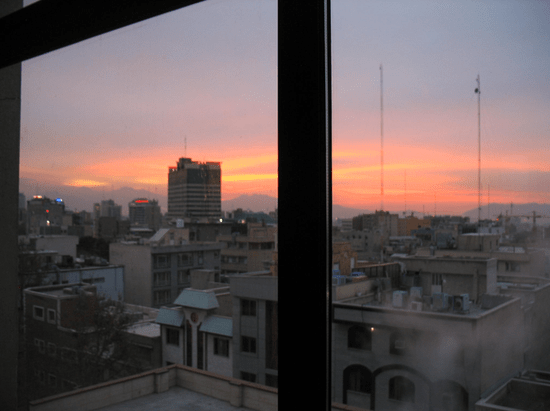
It takes an afternoon spent searching through pictures of Tehran to realize how damn big that city actually is. Finding your viewer's location was brutal, and I wouldn't be surprised if the city has more high rises than Sao Paolo or Hong Kong. In any case, this week's view looks southeast from roughly the 6th floor of the Espinas International Hotel located at 126 Keshavarz Boulevard. The Alborz mountains form the view's backdrop. The large tower at the left center of the picture is adjacent to the Noor Commercial Center, and the dark glass towards the tower's top is actually a metallic green when seen in daylight.

A remarkably accurate answer, and from only one of two readers to submit a Tehran entry. But since the above reader has won a contest already, the prize this week goes to the following reader:

This looks like Tehran to me. Big dense city with heavy air pollution, surrounded by mountains. Architecture reminds of "Tehran-like" vernacular, plus all those construction sites … antenna poles extend high too! At first I guessed that the window gazed westward (sunset) but then I noticed lack of incandescent lighting from the neighboring apartments. Early morning's more likely. East view would seem more apt then. Also, far left portion of the view reveals taller buildings. No major landmarks in sight, but hey, they could be deliberately omitted (either cropped out or hidden behind that window beam thing). So, long shot, I'll say Shirazi street.

Details from the photo's submitter:

Espinas Hotel on Keshavarz Boulevard, looking SE from room 617. Available through the hotel's wifi: HuffPo, no. Slate, no. NYT? Please. The Dish: Except for links and embedded videos, yes.

Believe it or not, there's also a Christmas tree with a little St. Nick in the lobby. Happy Christmas, Happy New Year!

(Archive)

How The Right “Bilks Its Activists”

In the wake of Dick Armey's frosty divorce from FreedomWorks, Pareene checks in on the lucrative scams on the right and how ordinary conservatives' donations fund a feedback loop between hacks and think tanks:

As Armey admitted to Media Matters, FreedomWorks at this point essentially raises money for the sake of raising money. It exists to bilk "activists." … 102210freedomworks

[W]hat are people who donate to this grass-roots conservative organization funded mostly by a few very rich people getting for their hard-earned money? In addition to paying Dick Armey $400,000 a year for 20 years to stay away, FreedomWorks also apparently spent more than a million dollars paying Glenn Beck and Rush Limbaugh to say nice things about FreedomWorks, in order to convince listeners to send FreedomWorks money that FreedomWorks would then give to Limbaugh and Beck. It’s a pretty simple con.

The larger problem:

The problem this presents for the movement, beyond the threat of eventually bankrupting the people who give it power, is that the business of money-making, for consultants and media personalities and Herman Cains, is at this point getting in the way of the business of advancing conservative causes. The groups exert massive influence, and they only ever push the Republican Party to get more extreme. Apocalyptic hysteria is much more effective at getting people to open their wallets than reasonable commentary.

Richard Socarides’ Glass House

Every now and again, you get whiplash. Here is Bill Clinton’s former chief liaison with the gay community demanding that Chuck Hagel account more fully for his past statements and actions on gay people. Let me repeat: Bill Clinton‘s “principal adviser to Clinton on gay and lesbian civil rights issues” from 1993 to 1999. Think about that for a minute.

Socarides was paid to defend the Defense of Marriage Act in public and certainly didn’t quit over its passage, as any gay person with true commitment to gay equality would have. In this respect, I think of him as the opposite of Bob Hattoy, an old dead friend who, like Socarides, worked for the Clinton machine, but, unlike Socarides, didn’t put his gay soul on eBay to do so. Dee-Dee Myers said of Bob:

He wasn’t wrong, but he wasn’t necessarily helpful to the administration cause…. He had one foot inside and one foot outside.

Which brings me to Socarides. He had both feet firmly inside the administration’s cause and did all he could to back the Clintons against the real lives of gay people.

Recall: he was paid to spin the Don’t Ask Don’t Tell policy, even as it doubled the discharges of gay 158238220servicemembers in the military under Clinton’s term. He was paid by an administration that made every effort to kill the marriage movement (believe me, I was there and saw it up-close), a movement in which Socarides was AWOL until the political tide safely turned. With Socarides as chief adviser, Bill Clinton also signed the law that made me and countless other non-Americans with HIV forbidden to enter the US and live under a brutal legal surveillance system which Clinton did nothing to change. Clinton even broke a clear campaign promise not to codify and sign the measure into law. How does a gay person work for someone who signs such a bill, stigmatizing countless people with HIV and putting the US on the same level as Saudi Arabia? And when will Socarides apologize to me and countless others for being there and not stopping it and not resigning?

In fact, I recall no moment in his career in which Socarides apologized for selling out the gay community in every single possible way in order to stay comfortably ensconced in the Clinton White House. And notice the gay issues Socarides focuses on:

[Hagel’s] record earned him a zero-per-cent rating (three times) from the Human Rights Campaign, the leading gay-rights lobby. Among other things, Hagel voted against extending basic employment nondiscrimination protections and the federal hate-crimes law to cover gay Americans.

If you read Virtually Normal, you will find that I too opposed such initiatives because they ducked the core issue of how government treats its gay citizens, which, in my view, should come before the same government regulates the actions of its own citizens. And because hate crimes are a bullshit legal category. Would I be deemed by a Clinton-hack as insufficiently in favor of gay rights – back when Socarides was advising a president who was eviscerating them? The truth is: I would have been and was at the time. Because I was a limited government conservative – not because I was anti-gay at all.

Socarides summarizes with this statement:

Hagel will have to show not only some genuine regret for his past actions and statements about gay Americans but also a real command of the civil-rights issues facing the military in order to convince people of that.

Here’s a better idea: let’s have Richard Socarides not only show some genuine regret for his working for a president who signed more anti-gay laws than any other in American history – but also offer proof that he has evolved from enabling attacks on gay Americans to backing their rights. Let’s get that apology now, so that he and Hagel are on equal ground.

(Photo: Richard Socarides attends The 2012 Emery Awards at Altman Building on December 11, 2012 in New York City. By Ilya S. Savenok/Getty Images.)

The Neocons Rally Against Hagel, Ctd

Peter Feaver argues that that "battle over Hagel is a battle over the meaning of Iraq":

The debate over the historical meaning of Iraq matters because it has such obvious implications for the analogous challenge with Iran. Many of the pro-Hagel supporters openly acknowledge that they hope Hagel's pick signals that the President is willing to abandon the military option in dealing with Iran, for much the same reasons that they argue the option was disastrous in Iraq. President Obama has not publicly connected those dots, but I expect he will be challenged to explain whether that interpretation makes sense in the days to come.

And I expect him to keep his options open. Reihan explains why he remains a neocon who wants more of a neo-imperial presence across the globe:

I object to Hagel primarily because I see him as a faithful adherent to President Obama’s approach to foreign and defense policy and I disagree with what I take to be the president’s approach. Like Frederick Kagan and Kimberly Kagan, for example, I believe that the U.S. should have made more of an effort to retain a sizable military presence in Iraq. And though I support cuts to some defense expenditures, e.g., I favor an overhaul of personnel policies to more effectively deploy human capital and resources across the military … I also support the recapitalization of the armed forces, and I believe that defense expenditures should have been a central part of fiscal stimulus efforts.

"Recapitalization of the armed forces". And where will that money come from? Frum fears – yes, fears – that Hagel would prevent another Middle East war:

[H]e would have substantial control over the information, advice, and policy options available to the person who does determine foreign policy. Suppose a president were to request an assessment of a hypothetical strike on Iran. Suppose the secretary of defense delivers to him a plan requiring the insertion of US ground forces into Iranian cities to be sure of destroying relevant facilities. That "plan" is as much a veto of a strike as any decision. Donald Rumsfeld enabled the Iraq war by producing estimates it could be won with as few as 135,000 troops. Had he instead on 300,000, the war would not have occurred: it would have seemed too heavy a lift. (As indeed it proved.) A Secretary Hagel could similarly thwart policies he disapproved of by magnifying their cost and difficulty. That's why his views matter, and that's why it's so disingenuous to claim they do not.

I take the point that the defense secretary is an important voice at the table. But I've seen no feasible plan that could accurately target Iran's nuclear sites without boots on the ground, and all that entails. And is David actually using Rummy's utopian over-ruling of Shinseki as a reason to oppose someone who will precisely not engage in such wishful thinking? Does David really want a defense secretary who will always lean in favor of intervention – even after the catastrophes of Iraq and Afghanistan?

It's as if the Iraq war never happened, isn't it? Which is why the three most powerful attributes of the neocons are amnesia, ignorance and denial.

Ask The Leveretts Anything: The Treatment Of Women In Iran

brightcove.createExperiences();

During the Iranian uprising of 2009, the Dish continuously clashed with Flynt and Hillary Mann Leverett, the most well-known skeptics of the Green Movement. The husband and wife team continue to blog at The Race for Iran, in addition to Flynt’s role as Penn State Professor of International Affairs and Hillary’s role as Professorial Lecturer at American University and CEO of the political risk consultancy, Stratega. In a 2010 post, the Leveretts addressed the status of women in Iran:

The political views of Iranian women seem to cut across the Islamic Republic’s political spectrum. Certainly that was our impression of the political views of the educated, professionally-oriented young women we met at the University of Tehran. In this regard, Western polling data suggest that President Mahmoud Ahmadinejad carried the women’s vote in the June 12, 2009 presidential election. While Western media exhibited a strong proclivity for posting pictures of Green Movement rallies in which women were prominently featured, a review of any reasonable sample of photos of “pro-government” demonstrations would suggest that at least as high a percentage of women were involved in those gatherings. (Perhaps the women captured in photos of pro-government rallies are somewhat more conservatively dressed than those in the Green Movement gatherings, but they were present in large numbers.)

A reader pushes back on yesterday’s video:

In watching the Leveretts account of Ahmadinejad’s Iran, I learned a great deal about the Islamic Republic’s fiscal policy and constitutional arrangements but, hoping to find at least one mention of the mass immiseration constantly forced on its citizenry, I was out of luck. Iran is a country where torture is commonplace to the point of banality, where dissidents are routinely imprisoned, where protesters are shot and beaten, where the Internet is heavily monitored, where corruption runs rampant, and where the regime espouses the kind of antisemitic rhetoric we normally associate with the 15th century.

Despite what the Leveretts may think, Iran is also developing a nuclear bomb. You wouldn’t learn any of those things from the their answer to the question of “what is your view of the Ahmadinejad regime”. Somehow, the only think the Leveretts thought of Ahmadinejad was “economic reformer”. They’re masquerading as maverick truth-tellers but, in reality, they’re just playing the role of knee-jerk contrarians . There’s nothing novel about it. They’re not the first American intellectuals to sell apologia as insight and they won’t be the last. You want to push back against the simplistic garbage peddled by some news media, fine. But I’d rather they fought agitprop with truth rather than more agitprop.