Chart Of The Day

Screen shot 2013-01-01 at 7.46.46 PM

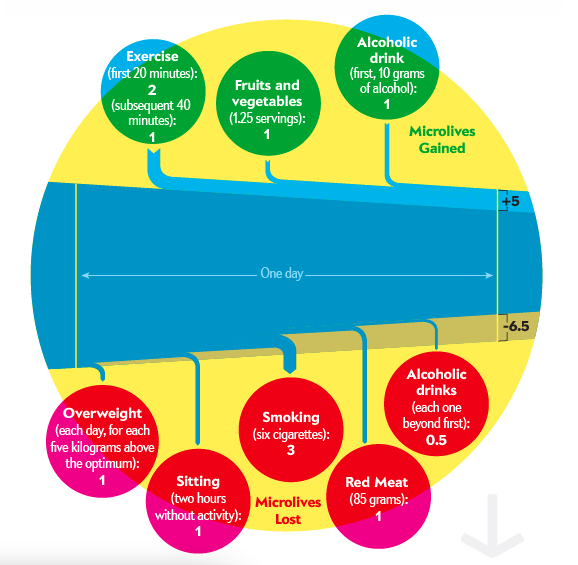
Mark Fischetti offers this chart to those struggling with kicking a bad habit:

"I hate when someone tells me that something is risky," says David Spiegelhalter, a professor of risk assessment at the University of Cambridge. "Well, compared to what?" To answer his own question, Spiegelhalter converted reams of statistical risk tables into a simple metric: a microlife—30 minutes.

(Chart by Jen Christiansen)

The Decline Of Tinkering, Ctd

A reader writes:

Tinkering is not actually declining. While it may not take the form of a Jobs & Wozniak, there are plenty of tinkerers taking old objects and trying to improve them or create something new out of them. A whole new culture has formed around that very idea to the point where there are magazines dedicated to the craft (Make Magazine among others), Internet programs (Revision 3) and even fairs. Make Magazine has Makerfaire with San Francisco, NY, UK and Detroit as the main sites with smaller versions around the world. These events are heavily attended by a diverse audience that includes everyone form science geeks to families. Tinkering has taken different forms where people build their own 3d printers, robotics and other electronics. It isn’t gone, it’s just moved into a more modern age thanks to tinkerers like Jobs & Wozniak.

Another:

I think that you are missing the tinkering that is going on now days. Consider the Raspberry Pi computer selling for just $35.

This is a modern tinkerer's dream box and an entire ecosystem has sprung up around it with projects, daughter cards – all sorts of stuff. For example, the latest post on a projects website is "How to build a virtual analogue synthesizer using Raspberry Pi." You can't get more tinkerer than that! And that is only one of the new small, cheap -dare I say disposable – micro PCs out there.

Another:

If, as Foege writes, "tinkering is making something genuinely new out of the things that already surround us," I'd say that the number of tinkerers is many times that of the golden era of the '70s. It's just that people are tinkering with code rather than hardware. All those apps for the iPhone and Android? Thousands represent the product of tinkering, in which developers take existing resources like an operating system and a widget set and produce something new enough that people are willing to spend time on it or even spend money for it.

“It Makes Me Cry Only When I See My Friends Go Before Me” Ctd

A reader writes:

I could go on for pages about why I willingly and eagerly subscribed to the Dish yesterday (and paid more than the asking price).  But only your blog brings me things like the 5-minute animation of Terri Gross's interview with Maurice Sendak, which just now rendered me weeping over my lunch as I heard him describe his love for the world and for his friends who have died.  I had to go over to lock my front door, turn off the overhead lights to get some semblance of privacy, and only in writing you this email am I finally composing myself.

Another:

When he told Ms. Gross that he "hopes he goes first so he doesn't have to miss her" – you could hear Ms. Gross get taken aback, and I was too.  I simply cannot think of a nicer thing to say to another human being.  Leave it to Mr. Sendak to find the single nicest sentiment ever.

Another reader moved by the interview:

I also took your reader-centric survey a while ago and need to change a response. Until this article, I was an under-35 who had never cried as a result of a story on The Dish … no more.

Another:

Because I hadn't known much about Mr. Sendak's personality or personal history before listening to that show, the earlier interview (and the earlier part of the clipped interview) provided the remarkable context for his aging observations and attitude, from a person who doesn't seem disposed toward sentimentality.  I have seldom heard someone so intelligent be so open and apparently honest about their thoughts about life's many difficult troubles, god, and growing old, and in such concise fashion.  Some of the very aspects I so cherish about The Dish, actually, and also one of the things that Terri Gross is so often able to nudge her guests toward.

Mr. Sendak says he only cries when his friends go first.  I generally only cry when I encounter fundamentally poignant stories that make me deeply happy – if I had to force myself to cry as an actor, I would think of someone who is severely disabled who works for years, with the help of friends and family, to get to the point where they can complete a given task – to be dramatic, let's say a marathon.  I envision that person's friends and family waiting at the finish line in the cold and dark, at 4:30 in the morning (19 hours after the race started), long after everyone else had gone home, jumping up and down and cheering as their loved one completes the last block.

I was all but bawling as I sat in the Comcast parking lot last May when I heard Mr. Sendak ever so momentarily render Terri Gross speechless as he communicated how meaningful their relationship was to him.

When I composed myself, I called my wife and told her it was a must must listen (and then returned the modem).  I am not sure she ever listened to the broadcast, so I am glad you reminded me and that the NY Times and you shared this with a wider audience.

Another:

The animation of the Gross/Sendak bit is nice, but one reason Sendak opens up to her is that they had been talking for over twenty years. One of last year's great "long listens" was the replay of all their interviews, as you find here. Fresh Air rebroadcasted segments upon Sendak's death. You can hear his voice age and change after his stroke, and you can hear his concerns darken and deepen. Give yourself the time for it and you won't be sorry.

Another sends the above video:

If you haven't seen the Spike Jonze documentary about Sendak, it is wonderful.
The Return Of The Repressed

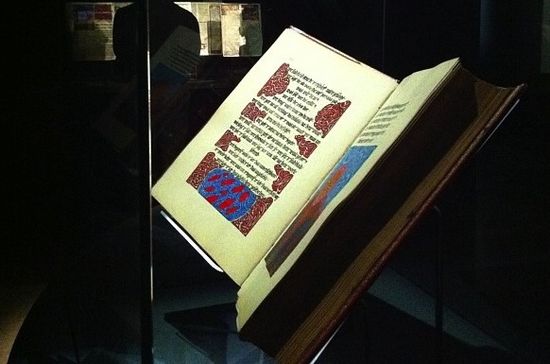
Red_Book

In a long, highly critical review of Carl Jung's posthumously published Red Book, which he describes as "a secret visionary tome, written in the master’s own hand, containing the mystic key to all his thought," David Bentley Hart drop these lines about the spiritual condition of our age:

Every historical period has its own presiding powers and principalities on high. Ours, for what it is worth, seem to want to make us happy, even if only in an inert sort of way. Every age passes away in time, moreover, and late modernity is only an epoch. This being so, one should never doubt the uncanny force of what Freud called die Wiederkehr des Verdrängten—“the return of the repressed.” Dominant ideologies wither away, metaphysical myths exhaust their power to hold sway over cultural imaginations, material and spiritual conditions change inexorably and irreversibly. The human longing for God, however, persists from age to age. A particular cultural dispensation may succeed for a time in lulling the soul into a forgetful sleep, but the soul will still continue to hear that timeless call that comes at once from within and from beyond all things, even if for now it seems like only a voice heard in a dream. And, sooner or later, the sleeper will awaken.

(Photo of Jung's Red Book by Flickr user olivierthereaux)

Sounds Familiar, Jeeves

Reviewing a new collection of P.G. Wodehouse's letters, Ed Park locates the source of the novelist's enduring popularity – consistency:

A friend mentions that any random Wodehouse is his go-to subway reading—perfect for dipping into, no emotional commitment, it doesn’t matter if you don’t finish it. Indeed, you might have already finished it: The remarkable consistency and volume of his output means you can be pretty far into something before it dawns on you that you’ve read it before. Even his titles are designed to blur the lines. I couldn’t be trusted to tell you the difference between Mulliner Nights and Mr. Mulliner Speaking, Heavy Weather and Summer Lightning, Carry On, Jeeves and Very Good, Jeeves, though I’ve read them all. (I think.) This is in fact a virtue of Wodehouse’s work, although as we learn in a new collection of his letters, the author was sensitive to accusations that he was continually raking over the same fictional ground. In 1932, Wodehouse grumbled about a review by J. B. Priestley, who “called attention to the thing I try to hush up,—viz., that I have only got one plot and produce it once a year with variations.”

GPS Time

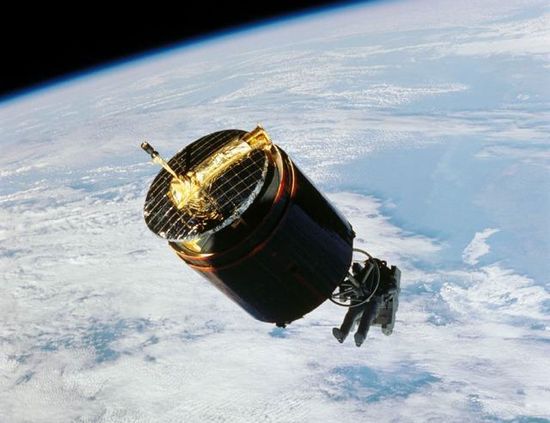
Westarcapture_sts51a_960

Jesse McDougall explains the science of time and space:

There are a few dozen GPS satellites floating high above the Earth. Each satellite carries an atomic clock that, when on Earth, is perfectly precise and in sync with Earth time. However, when lifted to the less dense gravity of the upper atmosphere, the satellites’ atomic clocks speed up. Were an observer to fly up to one of these satellites and watch the on-board atomic clock, he would see no difference in the length of a second. It would still be that familiar tick, tick, tick of Earth seconds. At that level of gravity, he, too, would be moving faster through time and would therefore see one second to be one plain old second. But, from here on the Earth’s surface and from within our denser gravitational field, we can see that the seconds pass a little more quickly on the satellites.

Time is slowed by heavy gravity. Just as it's easier to swim through outer space, than it is through the atmosphere, than it is through water, than it is through rock, time moves more quickly through less dense gravity. Time passes more slowly on Jupiter than it does here on Earth. And, as the impatient clocks on the Mars rover prove, time passes more quickly on Mars due to its lighter gravitational pull.

(Above from NASA's APOD: "In 1984, high above the Earth's surface, an astronaut captured a satellite … Communications satellite Westar 6 had suffered a rocket malfunction that left it unable to reach its intended high geosynchronous orbit.")

A Philharmonic Panacea

Norman Lebrecht eviscerates the "Mozart industry," which is replete with radio stations dedicated to his oeuvre, pseudo-scientific claims about the effects of playing his music to infants, and massive anniversary celebrations remembering his birth. Lebrecht's peroration:

Once we invest music with supernal qualities, once we maintain (there are learned papers to this effect) that Mozart can ease childbirth pains and stimulate brain cells in laboratory rats, it ceases to be music at all and becomes a part of humdrum mundanity, along with unemployment statistics and the football results. Sooner or later, you will read that Mozart can cure cancer.

The challenge for my working life is to rescue music from such tedious misconceptions and restore its gift to elevate us above the irksomeness of everyday life. We have just under three decades left to reclaim Mozart from mass media and market economies before the next anniversary reduces his music to a pinball on the political-industrial table. There’s no time to lose. Save Mozart Now.

Without A Paper Trail

Detroit

James Panero puts the digital age in the context of other information revolutions, arguing that lamenting the rise of the Internet "mimics the complaints of those Renaissance elites who favored manuscripts and turned their noses up at middle-class print culture." His biggest hesitation? Reliable archives:

[A] great challenge still exists in the way the Internet records and stores information. A published book is a fixed and polished record of a moment in time. The Internet always operates in the present. Aside from web portals like the “Wayback Machine,” which can provide historical snapshots of webpages, the Internet has no past. With “time stamps” and footnoted “corrections,” web culture has attempted to import the rules of fixed publication, but the Internet still treats all information the same. Any information on the Internet can be updated, changed, or erased at any moment. On the plus side, the mutable quality of Internet-based information has permitted the rise of great user-maintained databases such as Wikipedia. In this way the Internet mimics scribal culture more than print culture: New readers add new insights, and the information the Internet contains is forever evolving.

On the downside, Internet-based information is infinitely more fugitive than printed matter. In order to eliminate the information in a book, each copy must be rounded up and destroyed. For Internet-based information to go down, only the data hosts need be eliminated. Unlike letters sent in the mail, emails are often poorly archived, challenging our ability to preserve important correspondence. As more and more data enters what is known as the Internet cloud and no longer sits on personal storage devices, a centralized loss could be catastrophic.

(Photo by Flickr user joguldi)

In An Epic Poem Far, Far Away

Katy Waldman hails John Milton as a progenitor of science fiction, "arguably a forefather to Asimov, Bradbury, Delaney, and the rest," and holds that his Paradise Lost is "saturated in science":

Book I compares Satan’s shield to the moon seen through a telescope. And the poem is studded with scientific details—“luminous inferior orbs” churning through outer space, descriptions of sunspots and seasons, creatures that evolve (according to divine plan, but still). Through it all, Milton, a storyteller, comes off as entranced by the laws governing the universe. (His mouthpiece in this regard is Adam, who cannot get enough of the angel Raphael’s disquisition on celestial motions in Book VIII.) There’s something very sci-fi about anyone who, while taking care to present his era’s astronomical theories as speculative, still likes to spin that speculation out into long descriptions of cosmic phenomena. Arthur C. Clarke would surely be proud.

Also, Milton kinda sorta thought that extraterrestrial life might be possible. In Book III of Paradise Lost, Satan flies down from Heaven to Earth, passing distant stars that, on closer inspection, turn out to be “other Worlds.” Other worlds with aliens on them? Could be! “Who dwelt happy there,” Milton explains, the archangel “stayd not to enquire.”