An Ephemeral Poet

Rilke_Drawing

John Banville ruminates on Rainer Maria Rilke's Letters to a Young Poet, claiming that "one cannot but be impressed by the passionate dedication with which Rilke addressed the task of living—living as a poet, that is":

Above all, these letters give the lie to the idea of Rilke as hopelessly self-regarding and cut off from authentic, “ordinary” life. His tone may be elevated and his manner at times that of a dandy—he was elevated, he was a dandy—but the advice purveyed in these letters, and the observations and aperçus that they throw off, contain true wisdom, and are anything but platitudinous. Franz Kappus was a fortunate young man to have found such a correspondent, and we are fortunate in his good fortune. Despite all the moaning and complaining; despite the lists of illnesses, mental and physical; despite his constant urge toward transcendence, Rilke was thoroughly of our world. In the ninth and perhaps greatest of the Duino Elegies he asks why we should persist in our humanness, and offers this beautiful answer:

…because truly being here is so much; because everything here
apparently needs us, this fleeting world, which in some strange way
keeps calling to us. Us, the most fleeting of all.

(Image: Sketch of Rilke by Leonid Pasternak via Wikimedia Commons)
The Appearance Of Profundity

Victoria Beale lambasts recent books from Alain de Botton's  "School of Life" imprint, which, in Beale's phrase, bring "literature together with peppy self-actualization":

There have been six books published in the series so far, one written by de Botton, the rest adopting his authorial technique. How to Stay Sane by Philippa Perry, epitomizes the worst tendencies of this formula: it amounts to little more than philosopher name-dropping with poorly written exegesis. “Socrates stated that ‘The unexamined life is not worth living,’” she writes. “This is an extreme stance, but I do believe that the continuing development of a non-judgemental, self-observing part of ourselves is crucial for our wisdom and sanity.” The whole book is composed of this kind of grinding obviousness, bizarrely sprinkled with a King Lear line, a Martin Buber quote, or a Wagner reference.

Hallucinating God

Paille1-600x480

In a review of Oliver Sacks' recent book, Hallucinations, T. M. Luhrmann emphasizes the spiritual dimension of altered states:

Hallucinations teach us that these odd moments of sensation are an extreme point of a continuum along which what we imagine becomes more real, more possible than the mundane, and that the continuum has power. The terror of horrible imaginings can nearly destroy us, but good moments can change us for the better.

At the end of his book, Sacks turns to the sense of presence. This is a specific phenomenological experience detectable in a brain scanner: a clear awareness that someone is sitting there, right there, even though you cannot see him or her. Perhaps this uncanny awareness, Sacks suggests, evolved over time from a constant watchfulness for predators and potential threats. But see what it makes possible, he suggests. For those willing to trust in the benevolence of the unseen, the presence becomes God. It is the point on which he ends his book.

Previous Dish on Sacks' book here.

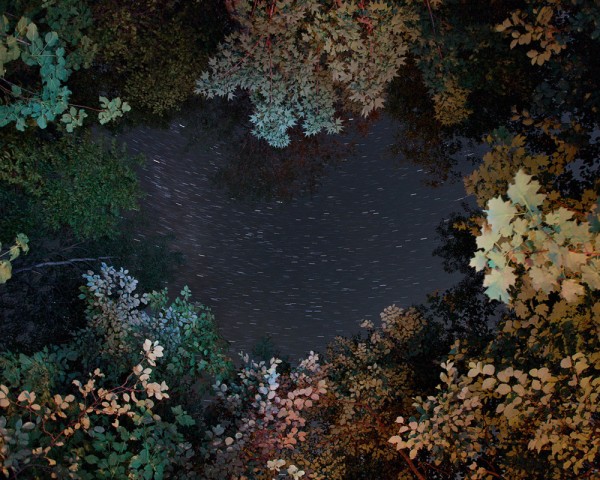
(Image: From photographer Benoit Paillé’s LSD series, which he shot after he "dropped acid and headed into the woods, where he lit a candle and took these four-minute-exposure photos," via Judy Berman.)

Gaming The Price Is Right

With the advice of repeat contestants and a bunch of spreadsheets, Ben Robinson reveals some of the secrets to success on the show:

You show up early (though not as early as you had to in the Bob Barker days), you sit around, and you get interviewed in a group of about 15 or 20. That interview is the lone means producers have of selecting the nine contestants who’ll be called out of the audience of 300. The goal is to toe the line between enthusiasm and transparent, annoying fakeness. Nobody knew if I should shave my beard or not.

The hot-tub showcase winner, the last one I consult, has the most compelling advice. She offers hugely valuable trip-pricing info—domestic or Caribbean trips run $6-7K, Euro ones more like $11K—and she wildly contradicts the others on the question of enthusiasm. Go completely bonkers, she tells us, and as long as we’re as young and good-looking as I’ve claimed, one person from our group of four will get on.

Or you could take shrooms before the show, like the bearded dude seen above did. Just don’t take forever to make a bid like Mary did.

A Victimless Bloodsport

Justin Amirkhani goes behind the scenes at Medieval Times, interviewing his friend, the knight Max Shkvorets:

When I asked if he ever got too invested in the imagination of the show, Max told me, "It’s a little bit of an unhealthy way to think about things, but I remember the very first time I won a fight as the red knight and I got to kill a guy. For a split second after I killed him, I felt in it—completely in it—I had just killed a man for someone’s amusement and felt the glory of the Earth."

Amirkhani nods:

Although I had only seen the show once before meeting the cast, I completely understood their sentiments. As Max explained it to me, "Combat is literally the purest form of drama." It’s the reason you get a thrill when watching a clip of a lion taking down a zebra and the reason folks gather around to gawk at people brawling in the streets. [… Medieval Times] lets the audience bask in their natural desire for carnage without any of the first world guilt that comes from watching people permanently destroy themselves for someone's entertainment.

Liquid Gold

Christian DeBenedetti tracks the rise of a black market for craft beer:

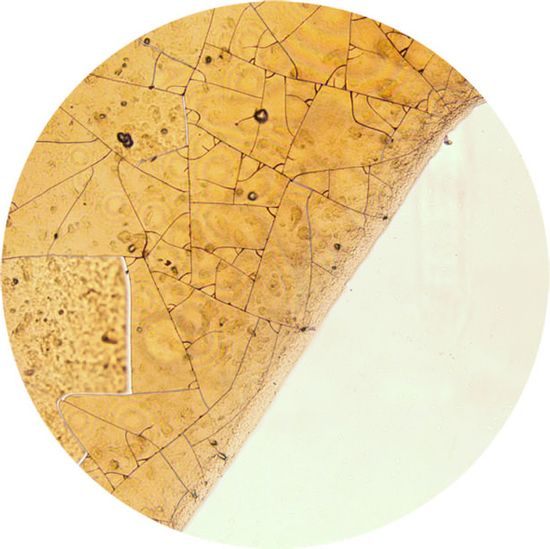
It’s illegal to sell beer for consumption without a license, but thousands of beer auctions on eBay have successfully closed. Their vendors have managed this by listing Beer their wares as "collectible containers" lacking any valuable contents, an obvious dodge that infuriates many brewers. The deals have seemed to flout both U.S. law and the site's own guidelines, and have often resulted in eye-popping prices—like this $1,300 sale of a single 12-ounce bottle. In one of the most galling recent examples, a seller in Vermont resold a magnum of sour beer blended by Belgian Lambic master Armand Debelder for Debelder’s wedding (starting bid, $90; winning 20th bid, $1,322). …

Are some brewers merely aping the outrageous price hikes and marketing-motivated affectations of wine? Perhaps. But many beers are worthy of the cellar; as [Kirk Kelewae, service director of New York’s Eleven Madison Park] says, "Aged beers can be a remarkable experience." What’s more, a move toward extravagance isn’t so much a modern fad as a return to beer’s high-society past. (Catherine the Great of Russia, for instance, commissioned age-worthy, English-brewed imperial stout for her court.)

(Image: Beer under a microscope, from the series Fingerprints of Drinkable Culture, by photographer William LeGoullon, via Petapixel)

Literature As Harsh Mirror

In a wide-ranging interview, Zadie Smith offers insight into how we view ourselves, both inside and outside of books:

You’re so used to this kind of smoothness in writing, this feeling that you, the reader, or you, the writer, are this great empathic, wondrous soul. I would love to be that, but of course when we see the way we behave in the world really to other people, we’re confronted with a different version of who we are. Not just this wonderful, tolerant, broad person who sees humanity and everything, but someone a little more narrow, self-defended, sometimes cruel, sometimes selfish. I wanted to try and show that. And also, someone who—people who live in a city, who are able to switch off these famous values of empathy and tolerance and love quite suddenly when you need to. Or if you need to. I wanted to be honest about that experience, but it’s not something you want reflected back at you perhaps, it’s not a pleasure. But reading can be many things: sometimes it can be a pleasure, sometimes it’s a bit tougher. It’s a broad church that way.

A Poem For Saturday

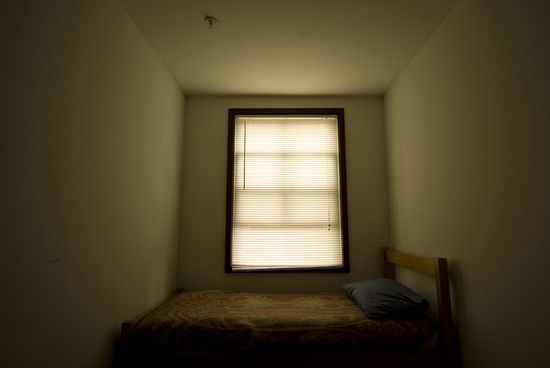
Bedforsafe2

"Safe" by Aaron Smith:

We weren’t supposed to touch
              the guns lined up
under our parents’ bed, rifles
              for hunting, pistols for protecting
our home. The carpet was burning
              lava, we’d dangle our feet,
the barrels mysterious beneath us.
              Headstands on the floor,
inches from accident, from sadness,
              and always we knew not to tell.
Nobody home, I lay my body the length
              of the bed, all the barrels
facing out. I pressed my back against
              their silent ends, metal tips
poking neck and spine—a firing squad!
              a stickup! Sometimes I’d face
them, a microphone, or love
              their tiny lips—tongue-deep
between my teeth—practicing the first kiss
              the way my sister used her fist.

(From Appetite by Aaron Smith © 2012. Used by permission of the University of Pittsburgh Press. Photo by Flickr user JD_WMWM)