Amanda Marcotte summarizes a Steubenville, Ohio rape story from August that has steadily spread online. Now that the hacktivist group Anonymous has gotten involved, Marcotte ponders the implications of Internet vigilantism:
Anonymous has been vital in getting out at least some of the evidence of the assault to the media. As the group shows no signs of slowing down the hacking, this is a story that could very well develop further. But the role Anonymous now plays in this case is certainly hard to reconcile, morally.
As some initial gleeful Twitter responses from students to the alleged rape demonstrate, one reason rape continues is that communities not only don't hold perpetrators responsible, but close ranks to defend or even celebrate them. By stepping in and holding people accountable, Anonymous stands a very good chance of taking action that actually does something to stop rape.
But: This type of online vigilante justice is potentially invading the privacy of or defaming innocent Steubenville residents, and even if everything published is true, there are very serious legal limits to the Anonymous strategy. Not all of the leaked allegations are attached to Twitter or YouTube accounts—many of the most serious cover-up claims, which we won't reprint here, are at this point only rumor. The allegations will infuriate you, but they don't rise to the level of real evidence that can be used to truly hold responsible those who participate in sex crimes.
A local crime blogger, Alexandria Goddard, became a crucial player in drawing attention to the case, highlighting how multiple people witnessed the alleged assault and did nothing to stop it. They even documented what transpired in social media postings and videos, which have been deleted but were preserved by Goddard.
New research in the US supports the case for nature's cognitive benefits:
David Strayer, a professor of cognition and neural science at the University of Utah, noticed that his brain felt more limber, his thoughts more fluid, on backcountry trips in the Southwest than they did in the lab. His undergraduates reported a similar mental boost, as did his colleagues. The peripatetic life seemed ideal for thinking about thinking.
Strayer began to organize yearly camping trips for his fellow neuroscientists. In 2010, Ruth Ann and Paul Atchley, a wife-and-husband team of psychologists from the University of Kansas, joined him on a weeklong trek through Utah’s Grand Gulch. Ruth Ann asked the group to complete the [wordplay "remote associates test," or RAT] before hitting the trail, and again a few days into the 32-mile hike. "It worked really, really well," Strayer says. "We had about a 45 percent improvement. So we said, ‘This seems to be perfect. It’s cheap, and it produces a nice big effect.'"
(Photo of Freya and Ralph Bodenner in Forest Park, Portland)
NASA is considering lassoing a nearby asteroid and bringing it into the moon's orbit:
Why is NASA so keen to give our moon a moon? Well, the Obama administration has said it wants to send astronauts to a near-Earth asteroid. Currently, the best target for a trip—a space rock called 1999 AO10—would require a dangerous six-month trip by the astronauts in question. Bringing an asteroid into the orbit of the moon is a safer—if complex—option.
[Keck Institute for Space Studies] researchers envision a slow, steady spacecraft powered by solar ions — a sort of spacefaring tugboat that would rendezvous with a small asteroid, probably about 7 meters wide.
This week the Dish declared independence and you can read Andrew’s announcement and all our other coverage and explanation of the move here. We also hope you’ll consider joining us as a founding member. Friday on the Dish, Andrew rounded up more reaction to our new business model and how it might evolve, got interviewed by David Carr, asked readers to weigh in on whether or not we should round our subscription rate up to $20, and answered PM Carpenter’s concerns over the possible editorial consequences of directly relying on readers’ support. In other independence coverage, Ann Friedman evaluated the importance of building a relationship with readers and we addressed the mystery of our mega-donor, as well as acknowledged the Dishheads of Arizona. Andrew also marveled at an animated Maurice Sendak interview, responded to President Reagan’s love of Reader’s Digest,hoped Iran would again turn Green during this year’s election, and pointed out how similar Obama’s presidency has thus far been to both Reagan and Eisenhower’s (and later the WSJ agreed about Barack being the new Ronald). In political coverage, Ambers and Ezra tried to guess what the GOP’s post-fiscal cliff strategy would be, Joe Biden worked the chamber as readers gauged his influence, Brian Resnick taught us about the Presidential Autopen, and Sam Harris pleaded for some common sense to untangle America’s political deadlock. We also went through how the fiscal cliff deal will affect the wealthy, analyzed the state and sustainability of the US welfare system, examined the polarizing effects of Congressional-district gerrymandering, and charted the number of abortions state governments have been restricting. Looking overseas, Frank Dikötter looked at China’s resource trade policies with the developing world, Evan Osnos wanted the US government to better back up American journalists in China, and Derek Thompson surveyed the economic disaster of Latvian austerity. In assorted coverage, Alyssa suggested ways to de-glorify violence in pop culture, Jack Shafer considered the ethics of publicizing gun-ownership data, Richard Gunderman appreciated the transcendence of music, Keith Humphreys shone a light on America’s gradually-declining prison population, and Maria Konnikova tried to experience the benefits of Sherlock Holmesian mindfulness. Also, Douglas McCollam shared what Brando said to Capote, Dean Karlan advised us how to best make our charitable contributions count, Walter Russell Mead believed in the greenness of telecommuting, Alec Foege wanted us to start tinkering with our stuff again, and Henry Wiencek panned Jon Meacham’s Jefferson biography for going too easy on the president’s slaveholding. We looked into whether or not dating sites were making us less monogamous, viewed Facebook’s efforts to capture some of the self-deleting photo market, watched backwards fireworks in our MHB, admired Bali through the VFYW, and noted how the Internet had accidentally shaved Andrew’s beard in our FOTD. The rest of the week is after the jump:
Thursday on The Dish, Andrew explained what our soon-to-be-independent business model was, as well as made clear how transparent the Dish would be (and why) before then releasing the overwhelmingly-positive data from our first 24 hours signing up members. Andrew also went through more reader responses to our announcement and appreciated Jay Rosen’s appraisal of the “mutualized journalism” the Dish is trying to do. In other IndieDish coverage, Dean Starkman questioned the likelihood that others could follow our lead, Jeff Bercovici passed alongThe Atlantic’s new thoughts regarding a pay-meter of their own, and @MelloMcGee mashed up MGM with the Dish’s independence in our Tweet Of The Day.
Andrew also responded at length to the pending investigation of the CIA’s involvement in Zero Dark Thirty, tried to unpack the polarized vitriol between conservatives and liberals, and called out the Obama administration for its “indefensible secrecy” regarding the assassination of US citizens who wage war on the US.
In political coverage, David Brooks noted the GOP’s fiscal rock-and-a-hard-place, Tim Huelskamp pushed back on the idea the the full House GOP really supported Speaker Boehner, hunter Ari LeVaux took on the NRA, and David Gutting claimed that Obama rolled the GOP with the fiscal cliff deal. We also explored Al Jazeera’s purchased-entry into the US television market, about which Pamela Geller made a deranged statement to earn herself a Malkin Award nomination. Looking overseas, Ackerman tried to make sense of the newest death toll out of Syria, Jacob Newberry was troubled by reverse exploitation of the Israeli-Palestinian conflict, Keith Humphreys questioned pot’s profitability for drug cartels, Max Paris surveyed the sad state of the Kyoto climate change treaty, and we learned about China’s democratic near-miss of a hundred years ago.
In assorted coverage, Drum highlighted the link between lead exposure and crime rates, Eric Moll detailed what we could do to combat fossil fuels, Ian Frazier lamented modernity’s lack of mystery, Adam Green introduced us to the world’s greatest pickpocket, and Tom Jacobs examined the psychological power of a woman in high heels. Also, Evgeny Morozov dispelled the environmental friendliness of telecommuting, a reader further explained the dangers of eating fructose, Jelani Cobb pointed out that Django Unchained was “a riff on the mythology we’ve mistaken for history”, and Willoughby Cooke stood up for the typically over-worked and under-paid line cook. We then wondered if being a little overweight might actually be good for us, again contemplated the universe’s possible opinion of humanity, considered the interactions generated by provocative-book reading in public, saw a Brooklyn substation through the VFYW, literally took a second look at 2012 in today’s MHB, and an owl was inventoried in our FOTD.
– C.D.
Wednesday on the Dish, Andrew declared our independence, announcing that on February 1 the Dish would leave The Daily Beast to become a fully independent blog which depends on nothing but our readers for support (via a freemium-based meter). Andrew then answered reader questions about the move here and here. Also we rounded up blog reax, as well as checked in on the Twitter response here and here. We watched in amazement as an avalanche of memberships began, published many reader reactions from the inbox, reposted last year’s fascinating reader survey, charted the inequality of the web advertising business, got called mavericky in a tweet, and handed John Nolte a Malkin nomination for calling the Dish’s independence part of some left-wing media conspiracy.
In political coverage, we rounded up blogosphere response to the now-passed fiscal cliff deal, Michael Hirsh wondered if Joe Biden was the most influential VP in history, Conor Friedersdorf rejected the notion that the 2nd Amendment was some safeguard against tyranny, Paul Ryan earned the year’s first Yglesias nomination for supporting the fiscal cliff deal, and Richard Socarides anticipated marriage equality for Illinois.
In assorted coverage, Maria Popova explained her donation-over-advertising strategy, Boris Muñoz imagined a Venezuela without Hugo Chavez, Ada Calhoun looked at the increasing practice of at-home abortions, Wayne Curtis surveyed America’s walking stats, and Terry Teachout advocated for more accurate depictions of small-town life in the arts. Also, Edward McPherson told us the story behind Dallas’ essential airport, Alex Knapp questioned the management skills of robots, Kevin Kelly called in about the developing world’s prioritizing of cell phones over toilets, and a reader (who is an actuary) set the record straight about car insurance rates based on how much someone drives. Readers also pushed back on the idea that teenagers shouldn’t smoke weed, while other readers weighed in on why women seem to smoke less of it than men. Then we went over the news that Avis was buying Zipcar, examined the possible late-career solipsism of Judd Apatow, discovered a new use for washing machines in our MHB, met a Chinese camel herder in our FOTD, and saw Colorado mountains through the VFYW.
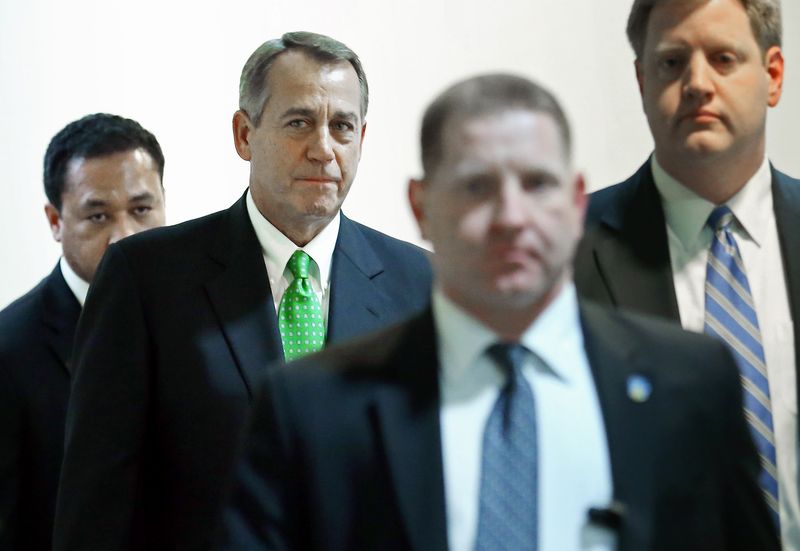
By Chip Somodevilla/Getty Images
Tuesday on the Dish, Andrew offered his extended thoughts on last night’s fiscal cliff deal, raised an eyebrow at Barney Frank’s recent change of heart about Chuck Hagel, and announced 2012’s Dish Award winners, later adding some important context to our Face Of The Year.
In political coverage, we rounded up blogosphere reactions to the fiscal cliff deal, while Bruce Bartlett and Daniel Gross examined why a Grand Bargain didn’t happen and Drum cautioned that deal or not, the fiscal cliff was still out there. Also, readers responded to the conversation over Hillary Clinton’s blood clot, Ann Friedman checked in on the still-limited progress of America’s female politicians, and a traveler aboard the National Review’s “conservative cruise of a lifetime” shared her Hewitt-ian fears. Looking overseas, Marc Lynch hoped Egypt would be able to “muddle through” its current morass.
In assorted coverage, Oliver Burkeman offered a reality check regarding New Year’s resolutions, readers proved themselves quite knowledgable about Hobbit names, Eric Jaffe suggested pay-per-mile car insurance as a way to reduce driving, Rober Walker pondered the shrinking authority of magazine covers, and Gary Marcus argued that an automated workforce could lead to greater inequality. Also, Nathan Harden previewed the idea of a la carte college classes from multiple universities, Gaia Vince appreciated the many benefits of urban density, David Haglund teared up while watching a trailer for Landfill Harmonic, a reader gave their perspective on why women don’t often buy weed, and somewhat relatedly, Justin Shanes avoided a hangover in our Tweet Of The Day. Readers shared their views from abroad on America’s vacation-light work ethic, Charles Simic noted the ease with which present-day idiots can make themselves known, Jeff Jordan anticipated the death of shopping malls, and Atossa Araxia Abrahamian explained the (libertarian) paleolithic diet, while Robert Lustig detailed the dangers of fructose. John Herrman surveyed Instagram’s growing international footprint, a reader passed along a great Don Becker joke referring to his mental illness, and Rand Simberg explored the fascinating implications of property rights in space.
We also watched the new trailer for To The Wonder, learned about the use of canine labor throughout history, saw a Puerto de la Cruz paraglider through the VFYW, and enjoyed a four minute reduction of 2012 in our MHB. Meanwhile readers struggled with this week’s difficult (and Danish) VFYW contest and Nancy Pelosi walked the media gauntlet in our FOTD.
This Holiday Season on the Dish, Andrew wished readers a Merry Christmas and Happy New Year and urged readers to support the Poetry Society of America with a rumination on verse. He also dissected the Pope’s incoherence on gay marriage, provided further thoughts on the Zero Dark Thirty debate, relayed a personal anecdote about the “mutts of war,” sounded off on marijuana prohibition, watched Bibi become even crazier, and charted Krauthammer’s continued descent into Fox News absurdity. In a somber year-end meditation, he declared the American polity “broken.”
The fiscal cliff loomed large, and you can read Andrew’s evolving thoughts on it here, here, here, here and here.
Andrew also closely tracked opposition to Chuck Hagel possible nomination as Secretary of Defense. He told the President to grow a pair and face down the former senator’s AIPAC-led critics, lamented the purity of neocon McCarthyism, evaluated the reasons for the anti-semitic slurs against the man, defended Hagel against Barney Frank, and followed the ridiculous Log Cabin Republican resistance to Hagel, including questions about who paid for the NYT ad they deployed against him, here, here and here.
Like Mac Davis, I believe in music. When I listen to music, or at least certain kinds of music, I feel transported to another place, my mood is elevated, I feel a new sense of harmony, and I am able to focus more clearly on what seems to matter most. A physicist might come along and say that what I call music is merely the scraping of horse's hairs across cat gut, a mechanical vibration in a particular frequency range. A neurologist might come along and explain that I am merely experiencing the transduction of kinetic energy into electrical energy as processed by neurons in the auditory and higher associative cortices of the brain. And yet, there is something about the music that is hard to reckon in such terms. It would be like saying that a passionate embrace is merely the pressing of flesh on flesh.
Walter Russell Mead finds Morozov's take too pessimistic:
Some of the benefits of telecommuting will take some time to work themselves out. As IT improves and new generations become more accustomed to interacting virtually, we’ll be able to solve some of the current kinks Morozov points out. But he is also too pessimistic about the state of telecommuting technology today. Even if telecommuters still buzz around in their cars from time to time, the widespread adoption of telecommuting will distribute travel away from the peak times, making it more energy efficient—and reducing costs for infrastructure.
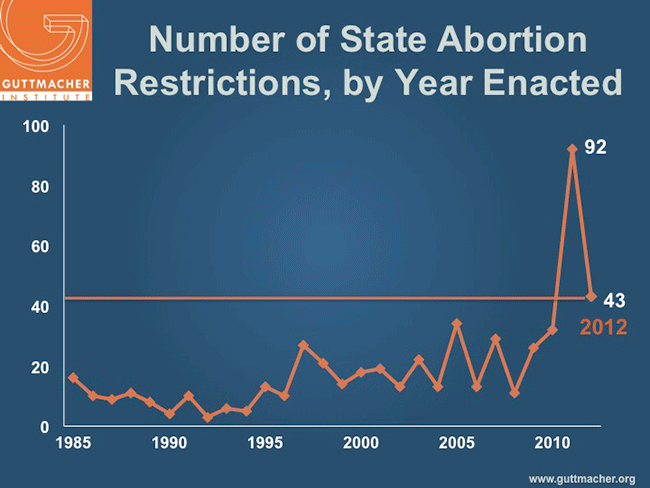
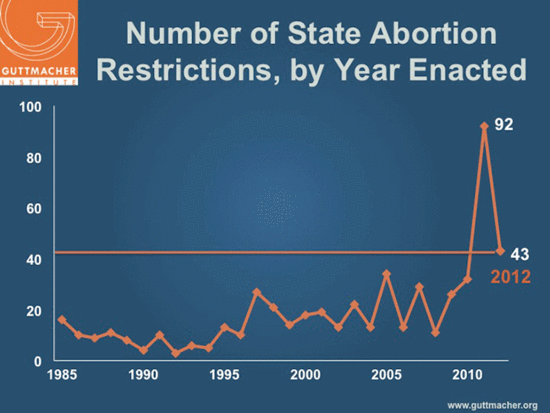
The Guttmacher Institute charts abortion restrictions by year:
Twenty-four of the 43 new abortion restrictions were enacted in just six states. Arizona led the way, enacting seven restrictions; Kansas, Louisiana, Oklahoma, South Dakota and Wisconsin each enacted at least three. Although some of the most high-profile debates occurred around legislation requiring that women seeking an abortion be required to first undergo an ultrasound or imposing strict regulations on abortion providers, most of the new restrictions enacted in 2012 concerned limits on later abortion, coverage in health exchanges or medication abortion.
There is one type of law that seems to be moving in the opposite direction: Barring abortion providers like Planned Parenthood from receiving state family planning dollars. Seven states passed laws like that in 2011, a number that dropped to two states in 2012.
Dan Slater claims that dating websites are threatening monogamy:
The positive aspects of online dating are clear: the Internet makes it easier for single people to meet other single people with whom they might be compatible, raising the bar for what they consider a good relationship. But what if online dating makes it too easy to meet someone new? What if it raises the bar for a good relationship too high? What if the prospect of finding an ever-more-compatible mate with the click of a mouse means a future of relationship instability, in which we keep chasing the elusive rabbit around the dating track?
Alexis Madrigal rebuts the piece. His biggest problem with the article: blaming technology for our own choices:
[I]t's not wrong to say that Facebook wants us to do things. But if you stop talking to your cousins because it's easier to update Facebook than give them a call, it's not right to say that Facebook made you do that. If you stop reading novels because you find Twitter more compelling, it's not correct to say that Twitter made you do that. Maybe you like real-time news more than the Bronte sisters, no matter what your better conception of yourself might say.
Maybe Jacob doesn't want to get married. Maybe he wants to get drunk, have sex, watch basketball, and never deal with the depths of a real relationship. OK, Jacob, good luck! But that doesn't make online dating an ineluctable force crushing the romantic landscape. It's just the means to Jacob's ends and his convenient scapegoat for behavior that might otherwise lead to self-loathing.
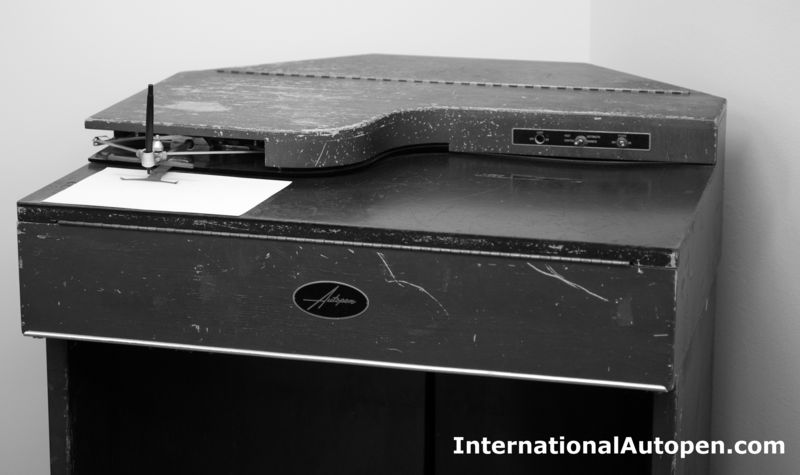
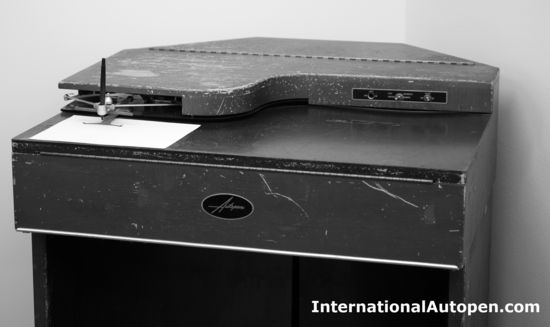
Obama signed the fiscal cliff bill using an autopen because he was vacationing in Hawaii. Brian Resnick notes that handwriting-copying devices date back to Thomas Jefferson's era and reports that, understandably, the technology behind reproducing the signature of the commander-in-chief is locked up:
The White House treats the presidential autopen's security with the secrecy you might expect for the most powerful signature in the world. "I always heard the autopen was the second-most guarded thing in the White House after the president," Jack Shock, Bill Clinton's director of presidential letters and messages told the Associated Press in 2011. When the AP pressed the matter to the executive branch, the White House "declined to provide any further details about how many autopens the administration uses, what they look like, where they're kept, or who makes the machine."
(Photo: The Autopen Model 50 from the International Autopen Company. According to Wikipedia, the device "was used extensively by John F. Kennedy's White House to duplicate his signature." By Benjamin Olding, International Autopen Company, via Wikimedia Commons.)


 The Dish