Obama: Like Eisenhower And Reagan

Screen shot 2013-01-04 at 11.52.59 AM

With respect to two things:

Obama is the first president to achieve the 51 percent mark in two elections since Republican Dwight D. Eisenhower, who did it in 1952 and 1956.

Then there's the golf and the fact that Obama really has restored the cultural Waspiness of the presidency. And:

Obama is the second president since World War II to win re-election with a jobless rate above 6 percent. The other was Republican President Ronald Reagan in 1984.

And that makes Sean Hannity's head explode.

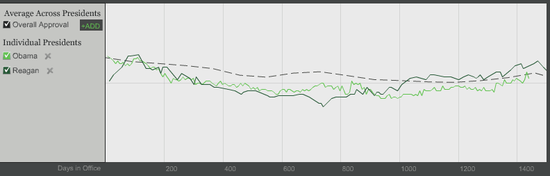
(Chart: Obama's approval ratings across his first term compared with Reagan's, from Gallup's fascinating presidential approval center.)

“It Makes Me Cry Only When I See My Friends Go Before Me”

Maurice Sendak on growing old (truly a must-must-listen):

Mike Springer loves Christoph Niemann’s animation:

In late September of 2011, Maurice Sendak spoke one last time with Terry Gross for the NPR program Fresh Air. Ostensibly the interview was to promote Sendak’s final book, Bumble-Ardy, but as the conversation progressed it was clear they just wanted to talk. The beloved children’s writer and illustrator was 83 years old and in declining health. He was feeling the loss of people close to him who had died in recent years. Inevitably, the discussion turned to issues of mortality. As the conversation built to an emotional crescendo, Sendak laid bare the qualities that made him such a great author: sincerity, depth of feeling, and an insuperable need to connect with people in some elemental way.

It’s the voice that takes my breath away. And Terri Gross’s brilliance. And the simple statement: “I’m in love with the world.” Why is that so hard for so many of us to feel?

The Mystery Mega-Donor

A reader notices:

Someone paid $9999.99!? And here I thought I was a loyal reader.

Another:

I'm sure most of your readers are curious who that one donor of $9,999 is, but I assume you can't divulge that! 

Correct. What I'm wondering is what we would have gotten if we'd added another digit to the price box. By the way, we're closing in on $400,000. You can help put us over the line here.

Shades Of Rich

Fiscal_Cliff_Winners

Looking back at the fiscal cliff negotiations, Jamelle Bouie is disappointed by the narrow focus of the debate:

I’ve said this before, but it makes no sense to include all income above a given limit in the same tax bracket. In 1960, there were 17 brackets above $35,000—roughly $250,000 in today’s dollars—going up to $400,000 in annual income, or $3 million, adjusted for inflation. Now, there’s a single one.

This presents an obvious problem for liberals—by placing every high income person in one bracket, it binds the interests of the sorta-rich, the rich, and the super-rich. Instead of a small number of truly wealthy people pushing for lower tax rates, you have a broader coalition of the well-off. Which is to say that if tax reform is on the table this year, then there needs to be a push for more brackets at higher incomes.

Only if tax reform means further complicating the code for more progressivity. My priority is simplicity and transparency. Drum, meanwhile, posts the above helpful chart:

Who were the biggest winners from the fiscal cliff deal? The invaluable Tax Policy Center has a preliminary analysis up, and it shows how much various income groups will save as a result of the deal. (These are savings compared to going over the cliff and letting the Bush tax cuts expire completely.)

Is The Welfare State Sustainable?

A few days ago, Douthat argued that the lesson of the fiscal cliff "negotiations seems to be that Democrats are still skittish about anything that ever-so-remotely resembles a middle class tax increase, let alone the much larger tax increases (which would eventually have to hit people making well below $100,000 as well) that their philosophy of government ultimately demands." Millman sees things differently:

There is clearly substantial opposition within both the Democratic and Republican parties to raising income tax rates on anyone but the wealthy. Within the Democratic coalition there’s debate about who constitutes the wealthy; within the Republican coalition, a majority opposes raises tax rates on anybody. But we’re still talking about income tax rates. If we now move to tax reform, that leaves open the possibility of loophole-closing tax reform that raises revenue without raising rates. And it leaves open the possibility of new consumption taxes (a VAT, or a carbon tax, or a series of smaller Pigovian taxes). For that matter, the expiration of the payroll tax holiday was a tax hike on the middle class that just passed with bipartisan support. These kinds of taxes aren’t going to be popular. But they are not the same as raising income tax rates. The real question remains whether Republicans would be willing to consider additional revenue as part of a tax reform package.

Yglesias' perspective:

[E]ven with a Democratic President in the White House who's eager to cut spending on retirement programs they still don't get cut. That's how robust the welfare state is. Recall that the last time we had a Republican President in the White House what he did was make Medicare benefits significantly more generous. Recall also that Mitt Romney ran on a pledge to increase Medicare benefits for ten years and then offset that by cutting benefits for younger people in the future. That's how robust the welfare state is. Concern trolling about Democratic senators' willingness to blink on taxes is neat, but all we're seeing again and again is confirmation of Paul Pierson's thesis from Dismantling the Welfare State?, namely that dismantling the welfare state is incredibly difficult.

Not Just Seeing, Observing

After spending time researching the infamous attention to detail that allowed Sherlock Holmes to recall minutiae, like the number of steps leading up to 221B Baker Street, Maria Konnikova tried to develop her ability to be "mindful":

It was hard. But it was worth it, if only for my enhanced perceptiveness, for the quickly growing pile of material that I wouldn’t have even noticed before, for the tangible improvements in thought and clarity that came with every deferred impulse. It’s not for nothing that study after study has shown the benefits of nature on our thinking: Being surrounded by the natural world makes us more reflective, more creative, sharper in our cognition. But if we’re too busy talking on the phone or sending a text, we won’t even notice that we’ve walked by a tree. …

Even brief exercises in mindfulness, for as little as five minutes a day, have been shown to shift brain activity in the frontal lobes toward a pattern associated with positive and approach-oriented emotional states. And the mind-wandering, multitasking alternative? It may do more than make us less attentive. It may also make us less happy.

The Right And Wrong Ways To Give, Ctd

Dean Karlan provides charitable giving tips. Among them:

Organizations usually have transaction costs for processing each donation, and also spend time and money communicating with their donors – you might have noticed all those mailings piling up this time of year. So giving a large number of small donations is actually less effective than a few larger ones. Plus, if there is one that is doing the most good for the cause you care the most about, then every dollar you give to the one doing the 2nd best work is a dollar not given to the one doing the best work!

Earlier advice on charity here.

A House Divided

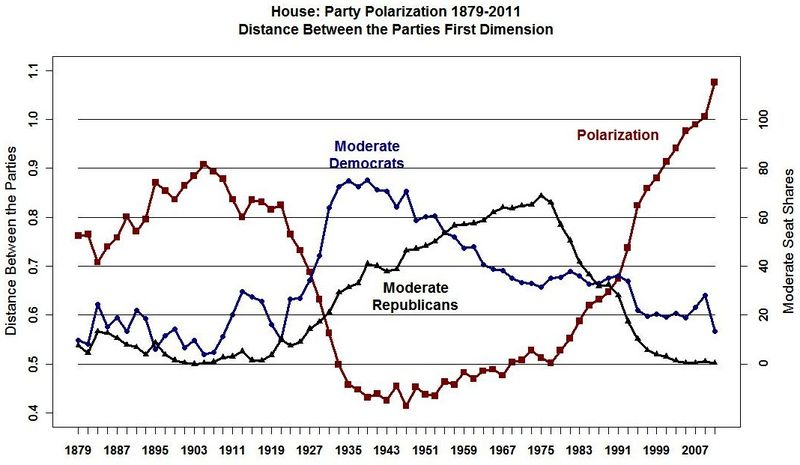
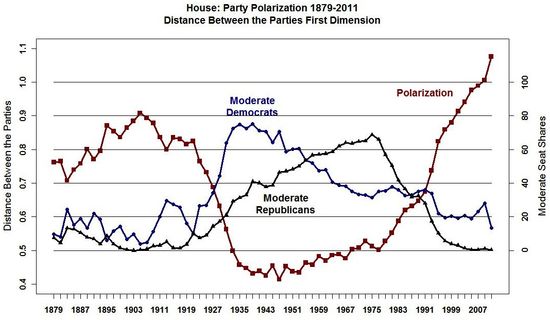
Polarization_House

Ambers largely blames political polarization in the House on redistricting:

[U]ltimately, both the Democratic and Republican parties are responsible for the strategy that has so polarized this chamber of Congress in the first place. Redistricting is controlled by state legislatures, and the same Republicans who are now grumbling that the House GOP is throwing away the baby with the bath water were the ones who encouraged conservative donors to focus on state legislative chambers and on electing politicians who were keen to redraw districts in ways that corralled conservative constituencies. 

He later notes that "the idea that partisan redistricting alone is responsible for the make-up of the House Republican conference is ridiculous." Ideology matters. The combination of greater ideological coherence and  redistricting is a very nasty combo. It can also feed on itself, as Harry Enten argues and new research shows:

Anyway you put it, Democrats and Republican legislators have greater ideological differences than ever. Gerrymandering probably doesn't help, yet it's not the major cause of the problem. Natural geographic divisions on the state and local level between Democrats and Republicans are a big cause in this growing polarization. Both of these, though, fail to account for the fact that even when controlling for district partisanship, there are increasing ideological differences between Democrats and Republicans in Congress.

Sam Wang models the effect of gerrymandering in the last election, focusing on disenfranchised voters:

[T]he disenfranchisement due to partisan-controlled redistricting was a total of 4.4 million voters from both parties. Democrats were disenfranchised more than Republicans, at a ratio of 10:1.

(Chart on political polarization in the House from Voteview.com)
The Glorification Of Violence

Alyssa contemplates pop culture's relationship with violence:

If there’s one thing that marks our current era of popular culture, it’s an obsession with cool of the kind exemplified by Quentin Tarantino’s movies, or with transgressive badassery, of the sort that’s characterized so many anti-hero dramas. And the way most people achieve that cool or badassness? The deployment of violence. This has become a clear problem for shows like Breaking Bad, where some fans, schooled in the lesson that transgression and violence are admirable, are failing to read the clear signs from Vince Gilligan that it’s time Walter White faced his comeuppance, whether in the form of cancer, violent death, or imprisonment and shame. It’s time to retrain viewers in how to interpret violence, so we can tell the difference between its deployment for gleefully sadistic ends, and when it’s a sign that a character has become depraved—and maybe that we need more products that are sure of which argument they’re making.

The Importance Of Biden, Ctd

A reader writes:

I have two teenage boys who love Joe Biden.  They call him "Joe Fucking Biden" with sincere respect and admiration! And by far the best and funniest piece we have ever read about him was when The Awl liveblogged the vice presidential debate with the sound turned off.  So funny.

Another reader questions Hirsh's take:

Biden the most influential VP?  Not until he starts two wars, shreds a few contsitutional amendments, leads cheers for torture, and gets away with shooting a hunting pal in the face.