Small Towns On The Big Screen

Good depictions of small-town life are underrepresented in the arts, according to Terry Teachout:

"Every great man nowadays has his disciples, and it is usually Judas who writes the biography," said Oscar Wilde. I've noticed something similar when it comes to fictional treatments of small-town life in America, most of which are the work of bright, embittered émigrés who couldn't wait to grow up, move to the big city, and write novels, most of them bad, about how much they hated their childhoods. …

For the most part, you have to look to films, not novels, to get a clear sense of small-town life, and it's surprising–or maybe not–how few of the ostensibly serious ones hit the mark at all squarely. By far the most convincing cinematic portrayal of a small town that I know is Kenneth Lonergan's You Can Count on Me, a modest little masterpiece that gets absolutely everything right. Peter Bogdanovich's The Last Picture Show comes close, but it's too harsh to be entirely persuasive, at least to me.

Saving Money By Not Driving, Ctd

A reader writes:

Eric Jaffe's description of the pricing of automobile insurers is decidedly incorrect.  As a pricing actuary for a top 10 U.S. insurer, I can assure you that most, if not all of the top 20 companies, already factor into the price of auto insurance the amount of miles driving. In our company's parlance, this variable is called "annual mileage." All other rating variables being equal, somebody who drives, say, 12,000 miles a year already pays considerably more (more than twice as much) than somebody who drives only 3,000 miles annual miles. 

What is emerging in the field of auto insurance pricing is what's referred to as "usage-based insurance". A small device installed in the car measures "how you drive."  It measures abrupt lane changes, accelerations, heavy breaking, etc.  Ideally, the "usage-based" data will allow insurers to more accurately predict risk and therefore differentiate premiums more appropriately.

America’s Hub

3033152813_fe84870062_o

Edward McPherson pens a sprawling homage to Dallas:

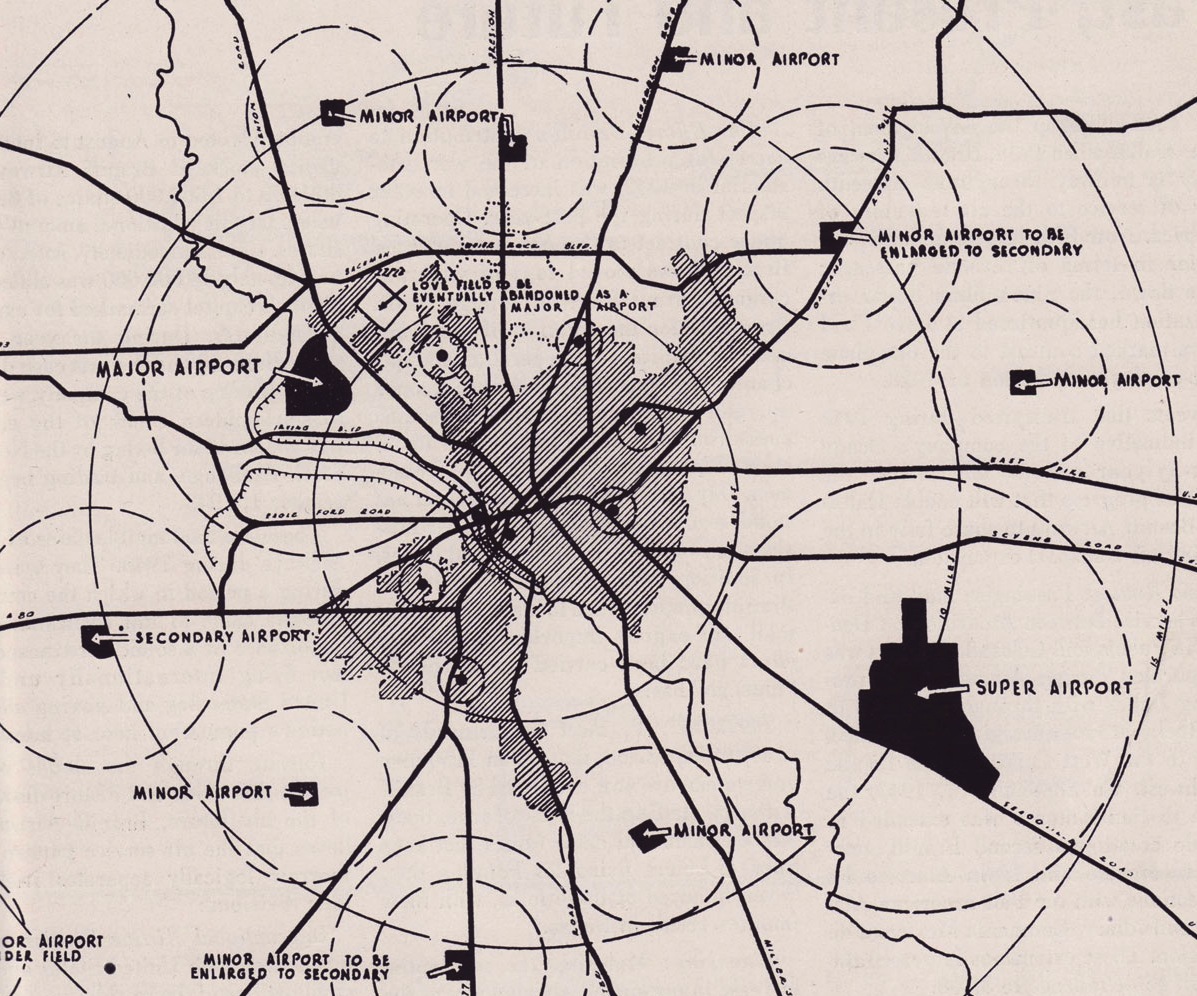
Dallas is an underdog. Landlocked, not blessed by a navigable waterway, Dallas made itself into a transportation hub by sheer will. Charles Lindbergh, at a banquet in Dallas in September of 1927, told the city, "Keep your airport—it will place you among the commercial leaders of the world." A midcentury scene: an aviation company is considering moving to Dallas. The president of the company is heard saying the runways at Love Field aren’t long enough by 2,000 feet. Three hours and forty minutes pass. The phone rings; it’s the city council. Thanks to an emergency bond measure, crews will begin lengthening the runways on Monday.

But Dallas eventually outgrew Love Field and built itself a bigger airport, Dallas-Fort Worth International, which opened in 1974 and now sprawls some twenty-seven square miles, making the airport the third largest (in terms of size) and fourth busiest (in terms of takeoffs and landings) in the world. You could fit JFK, LAX, and O’Hare within its boundaries and still have room to park. Thanks to DFW, the people of Dallas are within four hours of every major U.S. city in the lower forty-eight.

("Dallas' 1946 urban plan (somewhat comically) assumed that most people, by the year 1980, would be commuting to work by air. … The super airport would eventually become D/FW Airport," by Justin Cozart)

Robots In Middle Management, Ctd

Unlike Scott Adams, Alex Knapp believes that robots would make terrible managers:

In theory, it sounds awesome. Finally – an objective manager, without any human quirks or foibles. Your performance is measured objectively, so you know exactly where you stand, and there can’t be any favoritism. Everyone is kept on track, following the exact steps of the project that are known to everyone.

In practice, I’d expect what you’d see a lot more of is the same thing that happens when schools start getting judged solely by their students’ performance on certain standardized tests. Pretty soon, all the incentives for the schools become geared towards teaching to those tests, and everything else falls by the wayside. Similarly, when your manager is judging you solely on your performance of its project management tasks, everything else will fall by the wayside, too.

A reader calls Adams' proposal "absurb":

Management exists to remove obstacles to doing work for a company's employees, and as humans, many of these problems are motivational. Adams suggests that having callous robot managers would simply prevent people from bringing up emotional, interpersonal problems in the workplace (and therefore these problems wouldn't be an obstacle to doing work?). I suspect Scott himself is a bit robotic and would love such an arrangement.

The Long Game, Revisited

Image1

[Re-posted from earlier today]

It's been interesting to see how the final mini-cliff-deal on taxes has been greeted on left and right. The left is pissed that Obama did not go fully over the cliff, using the post-re-election sunsetting of the Bush tax cuts to get all the revenues he campaigned on. The right is eager to get on with the debt ceiling fight, keen to forget the implosion of Plan B and their votes for one of the biggest tax increases in recent times (see the above chart from Zachary Goldfarb ranking the tax hikes in terms of their percentage of GDP). Obama yesterday basically said that he regarded the tax increases as simply the premise on which any future Grand Bargain needs to be agreed upon. And he is insisting that the next deal – on entitlements and tax reform – be equally balanced between revenue increases and spending cuts.

Well he can insist, but why would the GOP not talk right past him? The answer to that is that Obama has not lost all his leverage. The sequester remains – and is suspended only for two months 158838193(a reasonable compromise, although I'd have preferred it going into force already as a way to pressure these politicians into grander ambitions). The threat to the Pentagon therefore endures, which frightens those Republicans (and many Democrats) still wedded to a Cold War defense strategy a couple of decades after the Cold War ended. And the threat to Medicare hasn't gone away for the Democrats. Both sides will want to mitigate these crude cuts – and closing loopholes is one way to do it. Another Small Bargain with more revenues – and fewer loopholes – is therefore not necessarily a pipe dream.
And so you see that Obama's re-election has meant the biggest increase in revenues to the federal government since 1968. That would not have happened under Romney. And if the tax deal is not as big as the polls suggest Obama could have gotten away with, it is in part because of the contextual reasons Bruce Bartlett lays out here, in part because Obama genuinely believes in exercizing responsibility as president, but also in part because the president wants to avoid too much austerity too soon as we inch out of the worst recession since the 1930s.

It seems to me this latter point is under-rated. The left often talked of the fiscal cliff as if it were only win-win for Obama. It wasn't, in my view. He faced two dangers: of seeming unable to come up with a compromise (which is integral to his appeal) and of seeing the US economy sink under the weight of an imprudent and drastic reduction in demand. As Josh Marshall has noted, Obama always wanted a deal. No president wants to kick off his second term with a double-dip recession. He got half of a deal that will not have as drastic an effect as the full cliff-divers wanted.

Does the promised debt-ceiling hostage-taking by the GOP render all this strategy moot? Maybe. But it seems to me that the GOP has hurt itself so far since the election on fiscal matters – appearing, especially last week, as a herd of feral, foam-flecked cats. I don't see their threatening to ruin America's credit unless they get to cut Medicare by $500 billion over a decade as a particularly strong political hand. Any party triggering a self-imposed credit crisis as the economy recovers will not be rewarded politically. On that, especially after 2011, the president has the upper hand. Americans do not like monkeying around with the national credit rating as a way to cut medical care for grandma.

More to the point, the GOP has yet to even lay out the details of its proposed entitlement cuts (and campaigned in part against them). One way out would be for both parties to focus on cutting the Pentagon bloat – but that's not going to happen any time soon. And so I can see revenue-raising tax reform returning as a way to alleviate some of the political pain on both sides.

In other words, I can see Obama's logic here. What he's getting – which is a gradual shift toward more fiscal responsibility, with key protections for the working poor and the unemployed in place – is all he really wants right now. Like many of Obama's incremental achievements, you can sometimes miss the forest for the trees. We have the biggest tax hike in decades – without a sudden recession. And we have huge, painful spending cuts looming unless new revenue is found through tax reform. The end result – for all its unseemly messiness right now – may still be a sane, graduated fiscal readjustment as the economy recovers. The sequester can be back-loaded a little to find that elusive sweet spot between structural fiscal rebalancing and economic growth. And we could even clean up the tax code a little.

It's not great, but it will do. Sometimes, the little advances are preferable under certain circumstances to big breakthroughs. And Obama has to face a rabid Republican House probably for his next four years. They self-destructed on Plan B. They will almost certainly have to swallow hard and vote for big tax increases in the next day or so [and, in fact, now have]. And a campaign to slash Medicare is their next major goal. A phrase springs to mind.

Meep meep.

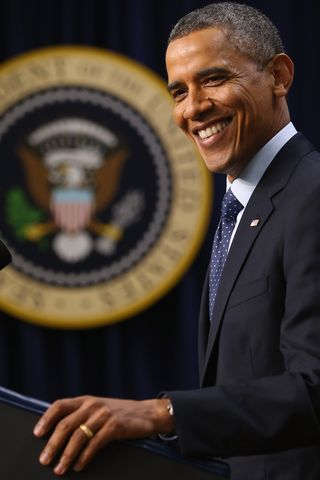
(Photo: U.S. President Barack Obama delivers remarks about the fiscal cliff negotiations in the Eisenhower Executive Office Building next to the White House December 31, 2012 in Washington, DC. By Chip Somodevilla/Getty Images.)
The Daily Wrap

158859021

Today on the Dish, Andrew offered his extended thoughts on last night's fiscal cliff deal, raised an eyebrow at Barney Frank's recent change of heart about Chuck Hagel, and announced 2012's Dish Award winners, later adding some important context to our Face Of The Year.

In political coverage, we rounded up blogosphere reactions to the fiscal cliff deal, while Bruce Bartlett and Daniel Gross examined why a Grand Bargain didn't happen and Drum cautioned that deal or not, the fiscal cliff was still out there. Also, readers responded to the conversation over Hillary Clinton's blood clot, Ann Friedman checked in on the still-limited progress of America's female politicians, and a traveler aboard the National Review's "conservative cruise of a lifetime" shared her Hewitt-ian fears. Looking overseas, Marc Lynch hoped Egypt would be able to "muddle through" its current morass.

In assorted coverage, Oliver Burkeman offered a reality check regarding New Year's resolutions, readers proved themselves quite knowledgable about Hobbit names, Eric Jaffe suggested pay-per-mile car insurance as a way to reduce driving, Rober Walker pondered the shrinking authority of magazine covers, and Gary Marcus argued that an automated workforce could lead to greater inequality. Also, Nathan Harden previewed the idea of a la carte college classes from multiple universities, Gaia Vince appreciated the many benefits of urban density, David Haglund teared up while watching a trailer for Landfill Harmonic, a reader gave their perspective on why women don't often buy weed, and somewhat relatedly, Justin Shanes avoided a hangover in our Tweet Of The Day. Readers shared their views from abroad on America's vacation-light work ethic, Charles Simic noted the ease with which present-day idiots can make themselves known, Jeff Jordan anticipated the death of shopping malls, and Atossa Araxia Abrahamian explained the (libertarian) paleolithic diet, while Robert Lustig detailed the dangers of fructose. John Herrman surveyed Instagram's growing international footprint, a reader passed along a great Don Becker joke referring to his mental illness, and Rand Simberg explored the fascinating implications of property rights in space.

We also watched the new trailer for To The Wonder, learned about the use of canine labor throughout history, saw a Puerto de la Cruz paraglider through the VFYW, and enjoyed a four minute reduction of 2012 in our MHB. Meanwhile readers struggled with this week's difficult (and Danish) VFYW contest and Nancy Pelosi walked the media gauntlet in our FOTD.

Lastly, don't forget to help us decide what to ask Flynt and Hillary Mann Leverett here. And the Holiday Wrap is here.

– C.D.

(Photo by Chip Somodevilla/Getty Images)

Who Owns Space?

PhillipSchumacher2

Rand Simberg wonders:

Despite the progress in technology, and the appeal of valuable resources, space settlement has been hampered by the lack of a clearly defined legal regime for recognizing property rights in space under current U.S. and international law.

There is in fact some slight internationally recognized legal precedent for retaining ownership of resources mined in space, as lunar samples returned to Earth on both U.S. and Soviet missions (the latter robotically) have been exchanged for other tokens of value. But actually owning the portion of the celestial body from which the resources are harvested — as in a traditional mining claim — is more problematic. Without legally recognized rights to buy, own, and sell titled property, it is difficult if not impossible to raise capital to develop land or extract the resources it holds. Property rights have long been considered one of the pillars of prosperity in the modern world, and their absence in space — due to the contingencies of the history of international law during the early space age — partly explains why we have not yet developed that final frontier.

(By Phillip Schumacher via My Modern Met)

Aphorisms At Year’s End

The poet Charles Simic pieces together impressionistic fragments from 2012. Among them: 

"Are there more idiots in the world today percentagewise than in some earlier ages?" asks Teofil Pancic, a columnist for Belgrade’s weekly Vreme. His answer is that it only seems so, because today they are more visible, more audible, and, of course, connected by the Internet. In the past, he wittily observes, everyone was his own idiot, isolated not only from the rest of mankind, but also from his fellow idiots, so that when something stupid occurred to him, there was no chance of it instantly becoming known to idiots in Tasmania and Uzbekistan.