A Hobbit By Any Other Name, Ctd

A reader writes:

You quote Michael Adams: "But still others appear to be well and truly invented by Tolkien, such as Bilbo, Bungo, and Frodo." Tolkien might have come up with the name "Bilbo" by himself, but there was a Theodore G. Bilbo (1877-1947), who served as US Senator and Governor from Mississippi. According to Wikipedia he "believed that black people were inferior, defended segregation, and was a member of the Ku Klux Klan." Fantasy writer Andy Duncan took advantage of this coincidence of names in his story, "Senator Bilbo," which imagined a racist politician in Tolkien's Shire.

Another writes:

"Bilbo" is an example of the sort of old-fashioned Scots-Irish or Anglo-Saxon surnames that persisted in the Bible Belt and Appalachia after becoming rare in the U.K., or at least, in urbanized England. (As they say, if you want to know what Shakespeare sounded like, go to West Virginia.) Plenty of Hobbit names are to be found in U.S. phone directories – Baggins itself, as well as Bracegirdle; Brockhouse – I had a friend in law school with the fine old North Carolina surname of "Brock"; Goodbody; Goodenough or Goodenow; Burrows; Chubb (a major U.S. insurance agency); Hogg – another historical, southern-U.S. name; Proudfoot, etc.

Tolkien was known to chat up his occasional American student in search of these wonderful old names. I remember from somewhere (the Letters?) that he was delighted to find Baggins had hung on as a surname in the U.S.  (Supposedly, it's also north-England slang for a workman's bagged lunch.) I would bet that if Tolkien's American informants had happened to mention some of my favorite names – Puryear, Boger, Law, Thigpen, Gasaway, Pickett – they might have found a place in the Hobbitton genaeology.

Another:

Please allow me to geek out a bit over Tolkien's strange and fascinating translation practices.

Even more than just the weird provenance of the hobbits' names as they appear in the book is how they interact with Tolkien's translation convention – the idea that Tolkien was merely translating the Red Book of Westmarch from the original Westron and Elvish tongues into English for modern readers. Tolkien had a complicated way of translating even Westron names into English. For instance, Meriadoc Brandybuck's name in Westron was Kalimac Brandagamba. "Kali" in Westron was a close pun (something the hobbits in particular were fond of) of a word meaning "happy," so Tolkien, in communicating that meaning, transposed Kalimac into Meriadoc.

As another example, the Brandywine River in the Shire was originally known as the Baranduin in Sindarin (an Elvish language), which then corrupted to Branda-nin ("border water" in Westron, since it was originally the eastern border of the Shire) in hobbit-speak, which further turned into Bralda-him ("heady ale," for the color of its water). Tolkien "chooses" to take the English translation from the alcoholic pun, while still keeping it phonetically similar enough to the Elvish Baranduin that we can see its descent – though it does lose the intermediate step until we are informed of it in an appendix.

Even further, he alters some colloquialisms of the Rohirrim and Gondorin to show their languages' relationship to Westron. Hobbits in Rohan are known as "hobylta," demonstrating that hobbits had more exposure to Rohan of old than they did to Gondor or other Edain (Elvish-speaking) humans. Gondor, relying still on the much more foreign Sindarin, calls the hobbits "perrinaith." (And even the names for hobbit is a stand-in word, with Tolkien borrowing Old and Middle English words and word-parts to construct them – in Westron, "hobbit" was in fact "kuduk," and "hobylta" was "kud-dukan.")

All of this illustrates not just how important the names were to Tolkien, but also how important it was that even his English "translations" capture the spirit, character, and descent of the languages. This is just one stance in a long and involved debate among translators on how to participate in translation – particularly as to whether and how to translate "sense for sense," as opposed to word for word. For Tolkien, this is especially important because, while he held an apparently quite extensive internal knowledge of the function and purpose of his languages, he never wrote the "original" Westron version of the Lord of the Rings, and so we have no way of gleaning any contextual meaning past what Tolkien includes in the English translation.

Modern scholars can debate for weeks over what passages in the Bible would've meant to a contemporary reader in the original Greek, and whether the King James or NIV gets the meaning right, but we can't do that for the Red Book. Tolkien instead does all the contextual assignment for us. Reading with this in mind makes a lot of the otherwise strange discussions on language and meaning in LOTR far more fascinating.

Update from another:

My nerd alarm just went off, an though the point is minor, I had to chime in. The reader says: "Hobbits in Rohan are known as "hobylta," demonstrating that hobbits had more exposure to Rohan of old than they did to Gondor or other Edain (Elvish-speaking) humans." In the internal history, the Rohirrim, who would use that word (actually "Holbytlan"), came out of the north of Middle Earth before settling in Rohan. The ancestors of the hobbits of the Shire came from roughly the same area. It was in the north that the Rohirrim had contact with hobbits, not in "Rohan of old."
Face Of The Day

158855076

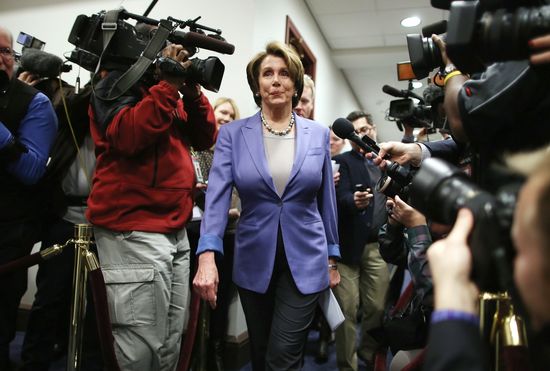
House Minority Leader Nancy Pelosi (D-CA) arrives for a House Democratic Caucus meeting to discuss the legislation that will blunt the effects of the 'fiscal cliff' before a rare New Year's Day session in Washington, DC on January 1, 2013. Vice President Joe Biden and Senate Minority Leader Mitch McConnell (R-KY) negotiated the deal that produced The American Taxpayer Relief Act of 2012, which passed the Senate after midnight on New Year's Day. By Chip Somodevilla/Getty Images.

The Progress Of Female Politicians

Ann Friedman assesses how far they've come lately:

The female narrative had a resurgence in November, when America’s election results prompted descriptions of 2012 as another "year of the woman" — a reference to the 1992 election in which four women were elected to the Senate and 24 to the House. Following a campaign season in which female voters were alternately courted and alienated (R.I.P. Republican "rape caucus"), America’s 113th Congress will theoretically be the most representative of American women in history, with twenty serving in the Senate and 81 in the House. While this progress is exciting, it’s worth noting that women are still 30 Senators and more than 130 Representatives away from parity. Moreover, just because more women are serving doesn’t mean they have political clout: Not a single House committee will be chaired by a woman in 2013. (Down from a single female chair in 2012.)

Powered By Fido

Turnspit_Dog_Working-460

After noticing a dog treadmill for sale in a gift guide for pet owners, Rachel Laudan discovers it's not an entirely new development:

Early in the twentieth century the Sears catalog advertised dog treadmills for $15, very roughly about $300 in present day terms. These were all business, though.  The treadmills designed so that a dog (or a sheep or a goat) could do the hard work of churning butter.

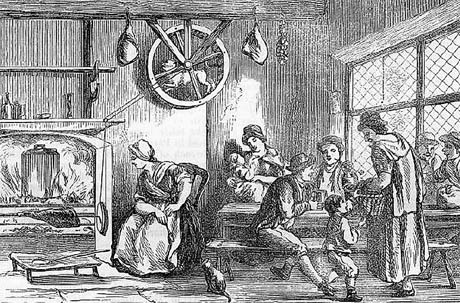
Dogs were also employed for turning meat in front of the fire. Nicola Twilley has more:

The existence of a special dog bred for kitchen service was mentioned as early as 1576, in an English book on dogs. According to the BBC, the turnspit was recognised by taxonomist Carolus Linnaeus as a separate breed in 1756. Based on contemporary references, it was a terrier of some sort, developed from badger-hunting dogs. Turnspits were long in the body, like a sausage dog, with droopy ears and short, strong legs that Darwin remarked upon as an example of a desirable genetic trait nurtured through selective breeding.

Abergavenny Museum claims to have “the last surviving specimen of a turnspit dog, albeit stuffed,” in its collection. However, Wilson reports that “dog wheels were still being used in American restaurant kitchens well into the nineteenth century,” when, in the face of early animal rights lobbying, they were often replaced with young black children.

(Image c. 1800 of a turnspit dog from Wikipedia)

Machine-Made Jobs, Ctd

Gary Marcus deflates Kevin Kelly's argument:

Personal workbots could, some day, be like cars or cell phones, ubiquitous tools that almost everyone could afford, but they could also be like factories, affording new wealth for the owners, while others are stuck with shovels and seeds. For centuries, it has always been the case that some new jobs are eliminated by technology, while others are created. It’s hard to parse out exactly the role that technology has played, but as Erik Brynjolfsson and Andrew McAfee note in their superb recent book, “Race Against the Machine,” over the last decade throughout the economy, there has been a drop in the employment-to-population ratio and a drop in median wages, and many of the people who lost jobs couldn’t find new ones that paid as well as the ones that they lost.

In Praise Of Urban Density

Street_art_january_2011_21-evol-farringdon-london-england-1

Gaia Vince runs through the reasons:

The denser the city, the more productive, efficient and powerful it becomes. The theoretical physicists, Luis Bettencourt and Geoffrey West calculated that if the population of a city is doubled, average wages go up by 15%, as do other measures of productivity, like patents per capita. Economic output of a city of 10 million people will be 15-20% higher than that of two cities of 5 million people. Incomes are on average five times higher in urbanised countries with a largely rural population. And at the same time, resource use and carbon emissions plummet by 15% for every doubling in density, because of more efficient use of infrastructure and better use of public transportation.

(By Evol in Farringdon, London, England via Street Art Utopia)

The Fiscal Cliff Hasn’t Been Averted

Drum points out that, even if the Senate bill becomes law, "the fiscal cliff is far from over":

[N]egotiators punted over the debt ceiling and the sequestration cuts. That's the $1.2 trillion in automatic spending cuts that emerged from the 2011 debt deiling debacle, split evenly between domestic programs and defense programs. Congress now has two months to hammer out a deal on that front, and Obama held a press conference yesterday warning Republicans that he wouldn't accept a deal that was all spending cuts and no revenue increases. If this sounds like the exact same thing they've been fighting over for the past year, give yourself an A.

So as soon as Part 1 of the fiscal cliff deal is safely signed and in the history books, we're going to have the same, dreary argument all over again. Call it Fiscal Cliff 2: The Dogfight in the District Continues.

Meanwhile, it looks possible that the House will derail the Senate's agreement.

The Weed Gender Gap, Ctd

A reader writes:

As a daily pot user, I'd like to offer my own theory on this. During college and afterwards, I've known plenty of women who smoke pot and plenty who have given money towards the purchase of weed, but I've known very few who actually conduct the business transaction of getting said weed. I think on some level, buying weed is still "drug dealing" to a lot of people, and is still a criminal act where one may have to deal with a "dangerous criminal" (though almost all pot dealers I've ever known are entirely too high to be considered remotely dangerous).  And so, not to sound sexist, but I think that "dealing with criminal elements" is still considered "men's work" by a lot of men and women. Is it antiquated? Yes. But ask a 20-year-old female Penn student if she'd rather have her boyfriend go into West Philly to buy weed from one of the bodegas, and I guarantee she'll say yes too.

Egypt’s Best-Case Scenario

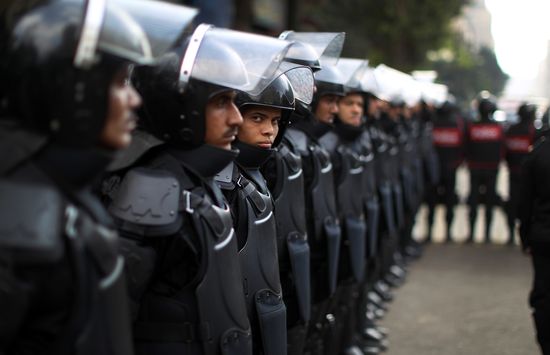
158793349

Marc Lynch outlines it:

An Islamist sweep two months from now could allow for some truly alarming legislative encroachments on personal freedoms and civil rights. But a strong electoral performance by the opposition could also – finally – create meaningful checks on Presidential authority for the first time in modern Egyptian history. The best case here would be that the opposition can build on the energy of its protests, its newfound unity and the strongly felt antipathy towards the Muslim Brotherhood, to compete effectively two months from now in Parliamentary elections. That would position it to legislate more liberal interpretations of the Constitution, and to block any Presidential efforts to impose a more autocratic or more Islamist agenda.

His disclaimer:

I realize that this is a perhaps overly optimistic reading of Egyptian politics. I recognize the intensity of the political passions unleashed during this crisis, the legitimate doubts over the intentions of the Brotherhood and the military, and the many possible ways in which things could go horribly wrong. But I also think it's important to visualize a pathway towards a more successful transition. What Egypt needs now is a roadmap towards completing the Egyptian transition to an instituionalized democratic system, and to head off the polarization and alienation rather than fan the flames. Let's hope that Egypt can once again muddle through and get there.

(Photo: Egyptian riot police stand guard outside the Shura Council, the upper house of parliament where the Constituent Assembly drafted the country's new constitution, as protesters against Egypt's President Mohamed Morsi demonstrate as Morsi gives a speech before a newly empowered senate in Cairo on December 29, 2012. Morsi said in the address, a disputed new constitution guaranteed equality for all Egyptians, and downplayed the country's economic woes. By Mahmud Hams/AFP/Getty Images)