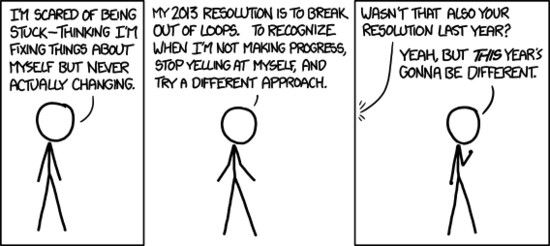
Oliver Burkeman, whose book on the power of negative thinking we've covered before, offers a word of caution about resolutions:
Spoiler alert: most of them will fail. It’s a curious truth about the happiness industry that, unlike most other industries, it doesn’t have much to gain from selling a product that actually works. If you bought, say, a smartphone that performed much worse than advertised, you might avoid that manufacturer in the future. But the doctrine of positive thinking that underpins modern self-help rests on circular logic: when a given technique fails, the implication goes, it’s because you weren’t thinking positively enough—and so you need positive thinking even more.
In reality, psychological research increasingly suggests that repeating “affirmations” makes people with low self-esteem feel worse; that visualizing your ambitions can make you less motivated to achieve them; that goal setting can backfire; and that emotions can’t be controlled through sheer force of will. But the temptation to just try even harder can be hard to resist.
But, "if you must make resolutions," he says, "it’s preferable to make tiny individual ones, repeatedly throughout the year, rather than multiple, ambitious ones at the start of it."
(Cartoon from XKCD)
 The Dish
